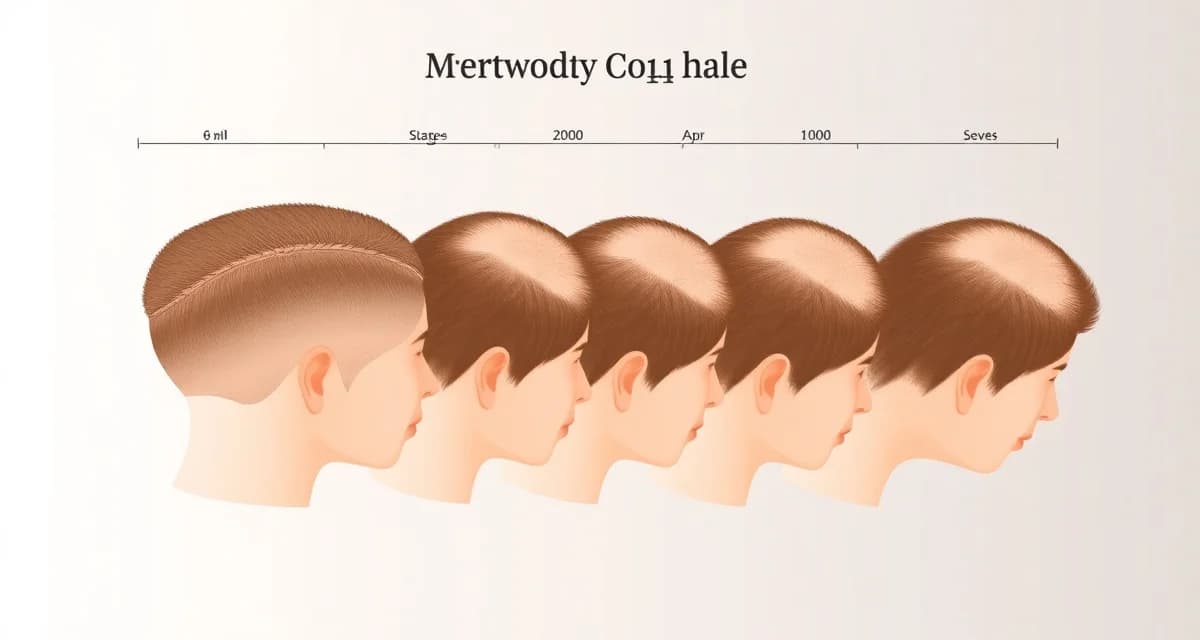
The Norwood Scale Explained: Stages of Male Pattern Baldness
A clear explanation of the Norwood-Hamilton scale for classifying male pattern hair loss, with what each stage means for treatment options.
What Is the Norwood Scale?
The Norwood-Hamilton scale is the standard classification system for male pattern baldness (androgenetic alopecia). Developed by Dr. O'Tar Norwood in 1975 as a refinement of Dr. James Hamilton's earlier work, it divides male hair loss into seven stages based on the pattern and severity of recession and thinning.
Stage 1: No Significant Hair Loss
Minimal or no recession of the hairline. This is the baseline - the mature adult hairline. Some men stay at Stage 1 their entire lives. If you have a family history of hair loss, this is when preventive treatments like finasteride can be most effective.
Stage 2: Slight Recession
Mild recession at the temples, forming a slight M-shape. This is often called a "mature hairline" and is common in men over 25, even those who won't experience further loss. The distinction between a maturing hairline and early pattern baldness can be subtle. Monitoring over 6-12 months helps clarify.
Stage 3: First Significant Stage
Deeper recession at the temples, and the M-shape becomes more pronounced. Stage 3 is the earliest stage typically considered clinically significant. There's also a "Stage 3 Vertex" variant where thinning begins at the crown while the hairline shows less change. This is usually when men start seeking treatment.
Stage 4: Moderate Hair Loss
Further hairline recession with significant thinning or baldness at the crown. A bridge of hair may still connect the front and crown areas. Hair transplant candidates at this stage typically need 2,000-3,000 grafts for meaningful coverage, depending on their goals and donor supply.
Stage 5: Extensive Loss
The bridge between the front and crown becomes thinner and may break through. The bald areas are larger. Donor supply needs to be carefully evaluated, as the area to cover is substantial. Treatment planning at Stage 5 often involves managing expectations about achievable density.
Stage 6: Large Bald Area
The remaining hair on the sides and back forms a horseshoe pattern. Only a narrow band of hair connects the temporal and occipital regions. Hair transplant candidates need careful planning to distribute limited donor grafts strategically. Full coverage at natural density is typically not achievable with one session.
Stage 7: Most Advanced
Only a narrow band of hair remains around the sides and back of the head. The donor area itself may be thinned. Hair transplant surgery at this stage requires very conservative graft use to avoid an unnatural result. Some men at Stage 7 find that embracing the look or considering scalp micropigmentation produces a better cosmetic outcome than a transplant.
Using the Scale for Treatment Decisions
The Norwood stage helps you and your surgeon plan a long-term strategy. Younger patients at Stage 2-3 need to account for future progression. A 25-year-old at Stage 3 who gets a transplant should also start medical therapy to slow further loss. Transplanting without addressing ongoing loss often leads to unnatural patterns as native hair continues to thin behind the transplanted zone.