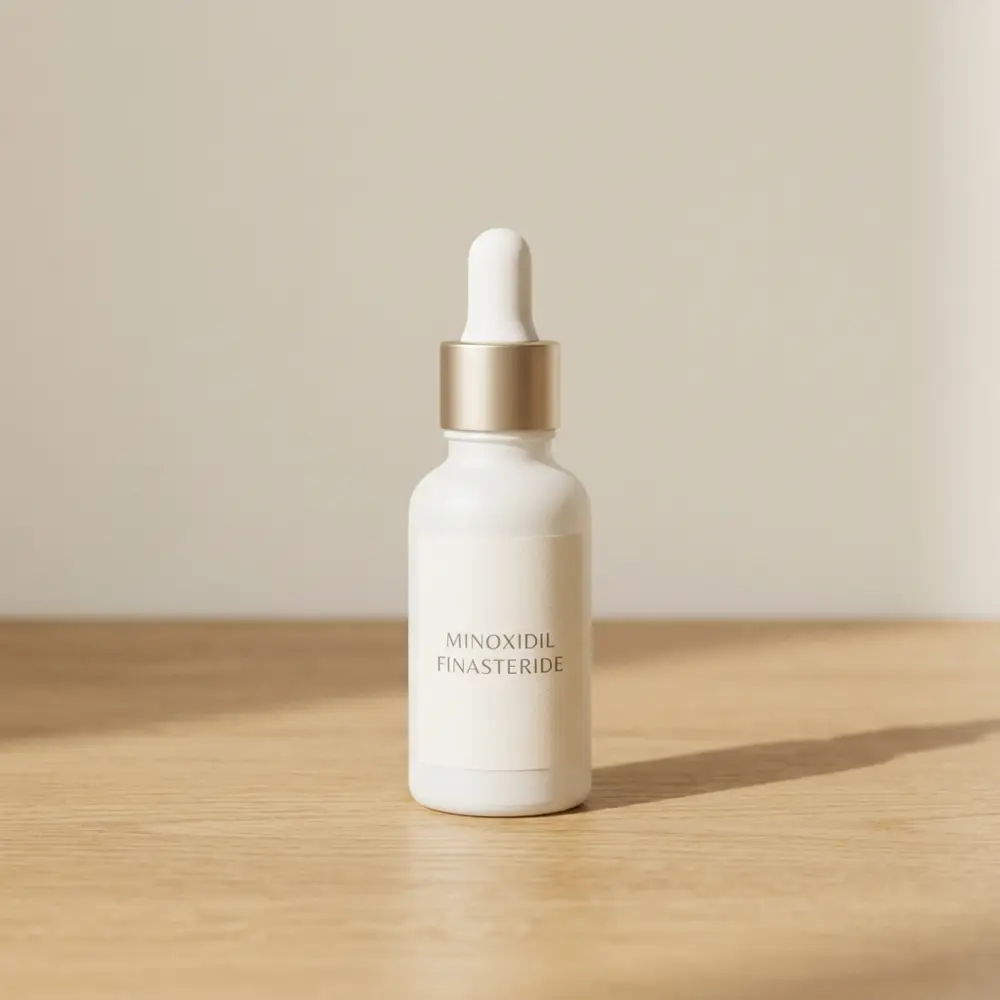
Topical Finasteride Tracking: Monitor Scalp-Applied DHT Blocker Results
Topical Finasteride at 0.25% achieves comparable scalp DHT reduction to 1mg oral with significantly lower systemic exposure. This makes it an attractive option for users concerned about systemic side effects, but it also introduces a new tracking challenge: measuring whether the results are concentrated at application sites or distributed across the scalp.
Why Topical Finasteride Requires Different Tracking
Oral finasteride reduces serum DHT levels by approximately 70%, producing a systemic effect across every follicle on your scalp. Topical finasteride works differently. Applied directly to the scalp, it achieves high local DHT reduction while keeping blood serum levels of the drug lower.
This means your tracking approach needs to account for zone-specific responses.
| Factor | Oral Finasteride | Topical Finasteride |
|---|---|---|
| DHT reduction location | Systemic (whole body) | Primarily local (scalp) |
| Serum DHT reduction | ~70% | ~30% (lower systemic exposure) |
| Application area | N/A (pill) | Specific scalp zones |
| Tracking approach | Whole-scalp density | Zone-specific density mapping |
| Expected timeline | 3-6 months for visible results | 3-6 months for visible results |
| Efficacy | 80-90% halt loss, 65% regrowth | Comparable to oral at adequate dose |
How to Track Topical Finasteride: Step by Step
Step 1: Map Your Application Zones
Before your first application, define exactly where you will apply the topical solution. Common zones include:
- Frontal/hairline area: Where recession is most visible
- Crown/vertex: Where thinning often begins
- Mid-scalp: The bridge between frontal and vertex areas
Photograph each zone separately at your baseline session. This zone-specific approach lets you compare density changes in treated areas versus untreated areas over time.
Step 2: Establish Your Baseline
Take density readings in at least 4 zones:
| Zone | Location | Purpose |
|---|---|---|
| Zone 1 | Primary application area | Measures direct treatment response |
| Zone 2 | Secondary application area | Measures treatment spread |
| Zone 3 | Non-application area | Controls for systemic effect |
| Zone 4 | Donor area (back/sides) | Stable reference baseline |
Record your current density score for each zone. The donor area serves as your control since those follicles are DHT-resistant and should remain stable regardless of treatment.
Step 3: Log Your Application Protocol
Consistency in application is critical for meaningful tracking data. Document:
- Concentration: Most compounded topical finasteride comes in 0.1% or 0.25%
- Volume per application: Typically 1 mL per session
- Frequency: Once daily or as prescribed
- Application method: Dropper, spray, or foam
- Application time: Morning or evening (evening is common to allow overnight absorption)
If you miss applications, log those gaps. Inconsistent use will show up in your density data and needs to be accounted for in your analysis.
Step 4: Track Monthly With Zone-Specific Photos
Every 4 weeks, photograph each zone with consistent lighting and distance. Upload each zone as a separate reading.
Look for these patterns over time:
| Month | Expected Observation |
|---|---|
| Month 1 | Baseline established, possible initial shedding |
| Month 2-3 | Shedding may continue (this is normal) |
| Month 3-4 | Shedding stabilizes, miniaturized hairs may appear |
| Month 4-6 | First visible density improvements in application zones |
| Month 6-9 | Clearer density gains, trend becomes visible |
| Month 9-12 | Near-maximum response for most users |
Remember: oral finasteride produces results in 80-90% of users (halting loss) with 65% experiencing regrowth. Topical finasteride at adequate concentrations should produce comparable outcomes. Side effects occur in only 2-4% of oral users, and topical formulations aim to reduce this further.
Step 5: Compare Application Zones vs. Control Zones
This is where topical finasteride tracking gets uniquely valuable. At each monthly session, compare:
- Zone 1 (primary application) vs. Zone 3 (non-application): Shows whether the effect is localized
- Zone 1 vs. Zone 4 (donor area): Measures absolute density change against a stable reference
- Zone 2 vs. Zone 3: Shows whether the solution migrates beyond the primary application area
If Zone 3 (non-application) shows improvement similar to Zone 1, it suggests the topical formulation is producing some systemic absorption. This data helps you and your dermatologist assess whether the topical route is delivering the desired local-only effect.
Combining Topical Finasteride With Other Treatments
Many users combine topical finasteride with minoxidil (40-60% of users see moderate regrowth from minoxidil alone). Tracking becomes essential when using combination therapy because you need to attribute results to the right treatment.
Isolation strategy: For the first 3-6 months, consider applying finasteride and minoxidil to different zones. This lets your tracking data isolate each treatment's contribution before combining them everywhere.
| Combination | Application Approach | Tracking Benefit |
|---|---|---|
| Topical fin + minoxidil | Separate zones initially | Isolates each drug's effect |
| Topical fin + PRP | PRP to specific areas | Compares PRP zones vs. fin-only zones |
| Topical fin + microneedling | Microneedle specific zones | Measures absorption enhancement |
For users already tracking oral finasteride and considering a switch, our finasteride progress tracking guide covers how to maintain data continuity during the transition.
When to Discuss Results With Your Doctor
Schedule a review with your prescriber at these milestones:
- 3 months: If shedding has not stabilized
- 6 months: First meaningful efficacy assessment
- 12 months: Full treatment evaluation
Bring your zone-specific tracking data to these appointments. The comparison between application zones and control zones gives your doctor objective evidence to decide whether to continue, adjust concentration, or switch approaches.
For users on compounded formulations with unique concentrations, see our compounded finasteride tracking guide.
Start Tracking Your Topical Finasteride Response
Zone-specific tracking turns topical finasteride from a guessing game into a data-driven protocol. Every month of data makes your next dermatologist appointment more productive.
Upload your zone-specific baseline photos at myhairline.ai/analyze and start mapping your response to topical DHT blocking.
Medical disclaimer: This article is for informational purposes only and does not constitute medical advice. Topical finasteride requires a prescription. Consult your dermatologist before starting or modifying any finasteride protocol.