
TL;DR: Finasteride is FDA-approved for men only, but dermatologists regularly prescribe it off-label to postmenopausal women with androgenetic alopecia. Evidence from several randomized trials suggests modest-to-moderate benefit in hair density. It is absolutely contraindicated in women who are pregnant or could become pregnant because it causes birth defects in male fetuses.
What is finasteride and how does it work in the body?
Finasteride is a 5-alpha-reductase type II inhibitor. That enzyme converts testosterone into dihydrotestosterone (DHT), the androgen most directly tied to follicle miniaturization in androgenetic alopecia. Block the enzyme, reduce DHT, and the follicle gets a chance to recover. [1]
In men, finasteride at 1 mg per day lowers serum DHT by roughly 65 to 70 percent, according to the original Merck prescribing data. The mechanism in women is the same. The real question is whether women's follicles are sensitive enough to DHT for that reduction to matter clinically. For a meaningful subset of women, the answer is yes.
For a full breakdown of how the drug works and its history, see our finasteride explainer. The short version: finasteride does not block testosterone directly, it blocks the conversion step. That distinction matters for understanding both the benefits and the side-effect profile in women.
Is finasteride FDA-approved for women?
No. Finasteride 1 mg (Propecia) and 5 mg (Proscar) are both FDA-approved for men only. The 1 mg dose is indicated for male androgenetic alopecia; the 5 mg dose for benign prostatic hyperplasia. [1]
The FDA label carries a specific warning: "Women who are or may become pregnant must not use finasteride." That warning exists because finasteride crosses the placenta and can cause hypospadias (abnormal genital development) in male fetuses. This is a documented risk, not a theoretical one.
Off-label prescribing, however, is legal and common in dermatology. A physician can prescribe any approved drug for any indication once the FDA has approved it for any use. Plenty of well-established treatments get used off-label, and finasteride for female hair loss is one of them. The American Academy of Dermatology's clinical guidelines acknowledge its use in postmenopausal women as an accepted off-label approach. [2]
What does the evidence actually show for female hair loss?
The evidence base is smaller than for men but not trivial. Several randomized controlled trials and a number of retrospective cohort studies have been published.
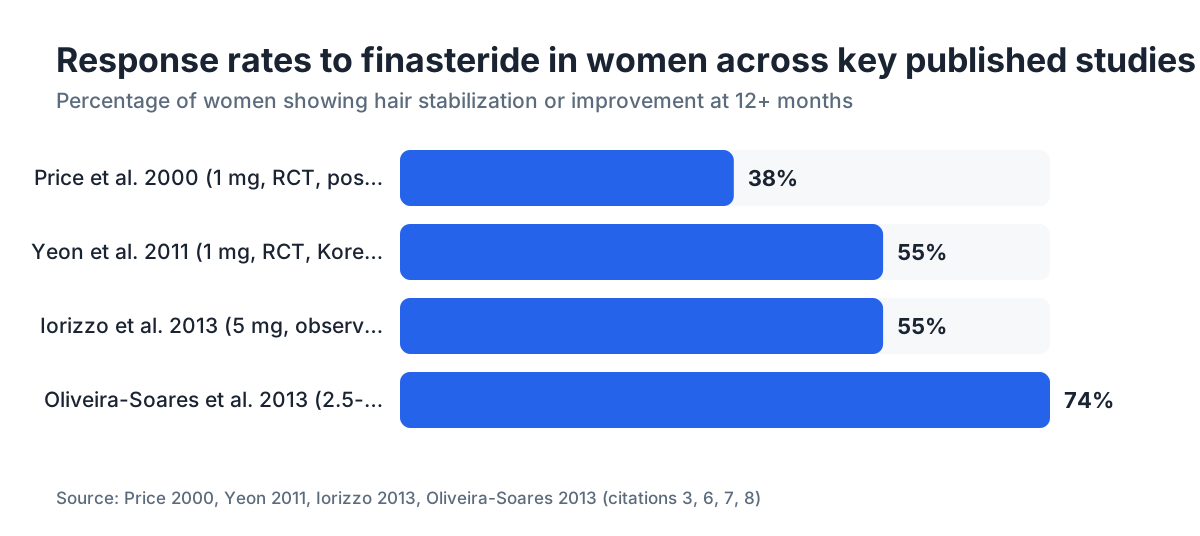
A 2017 systematic review in the Journal of the American Academy of Dermatology analyzed 12 studies covering 323 women treated with finasteride (doses ranging from 1 mg to 5 mg daily). The review found that roughly 55 to 75 percent of treated women showed stabilization or improvement in hair density, depending on the study and outcome measure. [3]
A commonly cited older RCT by Price et al. (2000) found that finasteride 1 mg did not outperform placebo in postmenopausal women with female-pattern hair loss, which tempered early enthusiasm. But that trial enrolled only 137 women and used a relatively short treatment period. Later observational studies, including a 2013 paper by Iorizzo et al., found 5 mg daily produced visible improvement in the majority of women who stayed on therapy for at least 12 months. [4][6]
The honest read: finasteride works better in some women than others. Women with elevated androgens (polycystic ovary syndrome, elevated DHEAS, high free testosterone) tend to respond more strongly. Postmenopausal women with normal androgen levels still often respond, but the effect is less predictable than in men. Nobody has great data on which woman will respond before she starts.
| Study | Dose | Duration | Improvement rate |
|---|---|---|---|
| Price et al. 2000 (RCT) | 1 mg/day | 12 months | No sig. diff. vs placebo |
| Iorizzo et al. 2013 (observational) | 5 mg/day | 12-24 months | ~55% of women improved |
| Yeon et al. 2011 (RCT, Korea) | 1 mg/day | 12 months | 26% hair count increase vs placebo |
| Oliveira-Soares et al. 2013 | 2.5-5 mg/day | 12 months | 74% stabilized or improved |
What dose do dermatologists actually prescribe to women?
This varies more than most patients expect. The 1 mg dose from the male approval studies is where many dermatologists start, but plenty of experienced hair loss physicians move to 2.5 mg or 5 mg daily for women, particularly postmenopausal women, because the observational data at higher doses looks better. [3][4]
There is no consensus protocol. The American Hair Loss Association and the AAD both note that dosing in women is individualized. Some practitioners use 2.5 mg as a middle ground. Others go straight to 5 mg for women with a clear androgenic picture.
Duration matters a lot. Hair follicle cycling is slow. Most dermatologists ask patients to commit to at least 12 months before making a call on efficacy, because earlier than that the results are usually misleading. This is consistent with how finasteride and minoxidil get evaluated in combination protocols too.
Who should not take finasteride (absolute and relative contraindications)?
Absolute contraindications are clear.
Pregnant women must not take finasteride or even handle crushed tablets. The FDA label warns that finasteride is a known teratogen in male fetuses. Category X in pregnancy, the most serious classification. Even skin absorption from handling broken tablets can theoretically cause fetal harm, which is why the 5 mg tablets are film-coated. [1]
Women who could become pregnant should not take it unless they are using highly reliable contraception and have had a direct informed-consent conversation with their physician about the risk. Many dermatologists will not prescribe it to premenopausal women without documented contraception use.
Relative contraindications, or situations that call for caution: liver disease (finasteride is hepatically metabolized), a history of depression or mood disorders (there are reports of mood changes and libido effects in men; equivalent data in women is sparse but not zero), and concurrent use of other hormonal medications.
Women with hormonally-driven conditions like PCOS should have their androgen levels checked before starting. Not because finasteride is dangerous in that context, but because identifying the hormonal picture helps predict response and guides whether an antiandrogen like spironolactone might fit better or work alongside it.
What are the side effects of finasteride in women?
The side-effect profile in women differs from men in some respects.
Postmenopausal women in most published series tolerate finasteride well. The most commonly reported side effects are decreased libido, breast tenderness, and occasional headaches. Serious adverse events are rare in reported cohorts. A 2013 cohort study found that fewer than 10 percent of women discontinued due to side effects over 24 months of follow-up. [4]
In premenopausal women, the picture is more complex. Menstrual irregularities have been reported in some case series. There is theoretical concern about effects on the hypothalamic-pituitary-gonadal axis, though the clinical significance is debated.
The "post-finasteride syndrome" discussion that looms large in male patient communities (persistent sexual and cognitive effects after stopping the drug) has very little published data in women. That doesn't mean it doesn't happen. It means it hasn't been studied. Honest answer: nobody knows the true rate in women.
Liver enzyme elevations are listed in the prescribing information as a rare occurrence. Baseline liver function tests are sometimes ordered before long-term use, though this is not universally required.
For comparison, minoxidil side effects in women are better characterized, because topical minoxidil has been studied in women more extensively and carries its own distinct risk profile.
How does finasteride compare to other hair loss treatments for women?
Women with hair loss have more options than most people realize, and finasteride is not necessarily the first or best choice for everyone.
Topical minoxidil 2% or 5% is the only FDA-approved treatment for female-pattern hair loss. It works by a different mechanism entirely (vasodilation, prolonging the anagen phase) and does not touch DHT. For many women, minoxidil is the right first step before considering anything off-label. [5]
Spironolactone is an antiandrogen that many dermatologists prefer for premenopausal women, because it also addresses androgen excess and has a longer track record in that population. It requires reliable contraception too. At doses of 100 to 200 mg daily it shows hair density improvement in a good proportion of women.
Oral minoxidil at low doses (0.625 to 2.5 mg/day) has drawn serious attention in the last five years as a systemic option with growing evidence. See our oral minoxidil piece for a full rundown.
DHT blockers as a category, including finasteride, get explored in the dht blocker article if you want the broader antiandrogen picture.
| Treatment | FDA approval (women) | Mechanism | Best evidence for |
|---|---|---|---|
| Topical minoxidil 2%/5% | Yes | Vasodilation, anagen extension | Female-pattern hair loss (all women) |
| Finasteride 1-5 mg | No (off-label) | DHT reduction via 5-AR inhibition | Postmenopausal androgenetic alopecia |
| Spironolactone 50-200 mg | No (off-label) | Androgen receptor blockade | Premenopausal women, PCOS-related loss |
| Oral minoxidil 0.625-2.5 mg | No (off-label) | Vasodilation (systemic) | Diffuse hair loss, any cause |
| Hair transplant | N/A (surgery) | Redistribution of stable follicles | Advanced androgenetic alopecia, stable loss |
Can finasteride help with hair loss caused by conditions other than androgenetic alopecia?
Generally, no, at least not directly.
Finasteride targets androgenic miniaturization specifically. Hair loss from thyroid disorders, nutritional deficiencies, or autoimmune causes like alopecia areata has a different mechanism, and blocking DHT does nothing for those conditions. If you're seeing sudden or patchy loss, the cause needs to be identified before any treatment starts. Telogen effluvium is a common cause of diffuse shedding in women that gets misidentified as androgenetic alopecia, and finasteride will not help it.
For women with PCOS, finasteride may have some benefit beyond hair, since DHT reduction can theoretically improve some androgenic symptoms. But it is not prescribed for PCOS management, and an endocrinologist or gynecologist should be involved in that case.
Understanding what causes hair loss before choosing a treatment is not optional. Treating the wrong diagnosis wastes time and money, and some hair loss causes are reversible if caught early.
What about home remedies for female hair loss? Where does finasteride fit?
Let's be direct: no home remedy works the way finasteride does. That's not a dismissal of lifestyle and nutritional factors, they matter and can contribute to shedding, but they are not replacements for pharmacological DHT inhibition in women with androgenetic alopecia.
The home remedies for hair loss in females that have any legitimate support in the literature include correcting iron deficiency (ferritin levels below roughly 30 to 40 ng/mL are associated with increased shedding in some studies), addressing vitamin D deficiency, managing stress to reduce cortisol-driven telogen effluvium, and scalp massage (one small 2016 study in ePlasty found 4 minutes of daily scalp massage increased hair thickness over 24 weeks in healthy men, though women-specific data is absent). [9][10]
Scalp oils, herbal rinses, onion juice, and similar approaches are remedies in the colloquial sense. The evidence is either absent or very weak. If someone's hair is actively miniaturizing due to androgens, these approaches will not stop the process.
A note on a totally different context: people searching "female dog hair loss home remedies" are looking for veterinary advice, not human dermatology. That is a separate topic entirely (nutritional deficiencies, mange, hormonal imbalances in dogs) and finasteride is not indicated for canine use.
For a broader view of hair loss supplements with actual evidence, that piece covers what nutrients have some data behind them.
What should a woman expect when starting finasteride?
Realistic expectations prevent early discontinuation, which is one of the biggest reasons treatments fail.
The first 1 to 3 months sometimes bring increased shedding. This is not necessarily a bad sign. It can reflect hair follicles cycling into a new phase. Many patients (and some physicians) mistake this for the drug not working and stop early.
Measurable improvement in hair density, if it is going to happen, typically becomes visible at 6 to 12 months. Full benefit often takes 18 to 24 months. This timeline is consistent across the published literature. [3]
Photographic documentation at baseline is genuinely useful. Most people are poor judges of slow change in their own hair, and having a baseline photo to compare at month 12 makes the evaluation far more objective. The free AI hair analysis at MyHairline can help with this kind of baseline documentation before you start.
If the drug is stopped, DHT levels return to baseline within about two weeks. Hair that was preserved by the drug will gradually miniaturize again over the following months to years. Finasteride is a maintenance therapy, not a cure.
How do you get a prescription for finasteride as a woman?
You need a physician to prescribe it. A dermatologist who specializes in hair loss is the ideal starting point, but some gynecologists and primary care doctors comfortable with hair loss management also prescribe it.
Expect the visit to include a hair and scalp examination, possibly a pull test, blood work to check ferritin, thyroid function, androgens (total and free testosterone, DHEAS), and potentially a CBC. Some physicians will do a scalp biopsy to confirm the diagnosis before starting a long-term systemic drug.
For premenopausal women, documentation of contraception is typically required before a prescription is issued. This is not bureaucratic caution. It is appropriate clinical practice given the teratogen risk.
Telehealth platforms now offer finasteride prescriptions for women in many US states, though the quality of the clinical evaluation varies widely. A thorough in-person evaluation with blood work is the higher-quality path, particularly for women with complex hormonal histories.
If you want to walk into that appointment with a clear picture of your pattern and severity, running through a quick analysis first helps. MyHairline's free AI scan can give you a Norwood-equivalent staging and photograph documentation to bring to the dermatologist.
For women who don't respond to finasteride or who are not good candidates, hair transplant surgery is an option for specific cases of stable androgenetic alopecia.
Sources
- FDA, Propecia (finasteride 1 mg) prescribing information
- American Academy of Dermatology, guidelines on hair loss
- Adil A, Godwin M. Journal of the American Academy of Dermatology 2017; systematic review of female androgenetic alopecia treatments
- Iorizzo M et al. International Journal of Dermatology 2013; finasteride 5 mg in female androgenetic alopecia
- FDA, Women's Hair Loss, minoxidil approval information
- Price VH et al. Journal of the American Academy of Dermatology 2000; finasteride 1 mg RCT in postmenopausal women
- Yeon JH et al. Journal of Korean Medical Science 2011; finasteride 1 mg RCT in Korean women
- Oliveira-Soares R et al. Dermatology and Therapy 2013; finasteride 2.5-5 mg in women
- Koyama T et al. ePlasty 2016; scalp massage and hair thickness
- Trüeb RM. International Journal of Trichology 2010; serum ferritin and hair loss
- National Institutes of Health, MedlinePlus, finasteride drug information