TL;DR: Finasteride has a 5-8 hour half-life but suppresses DHT for roughly 24 hours after a single dose, so the clock on your pill matters far less than taking it at the same time every day. Morning or evening both work. Consistency is what drives results. No meal is required, but food can ease nausea in sensitive stomachs.
Does the time of day you take finasteride actually change how well it works?
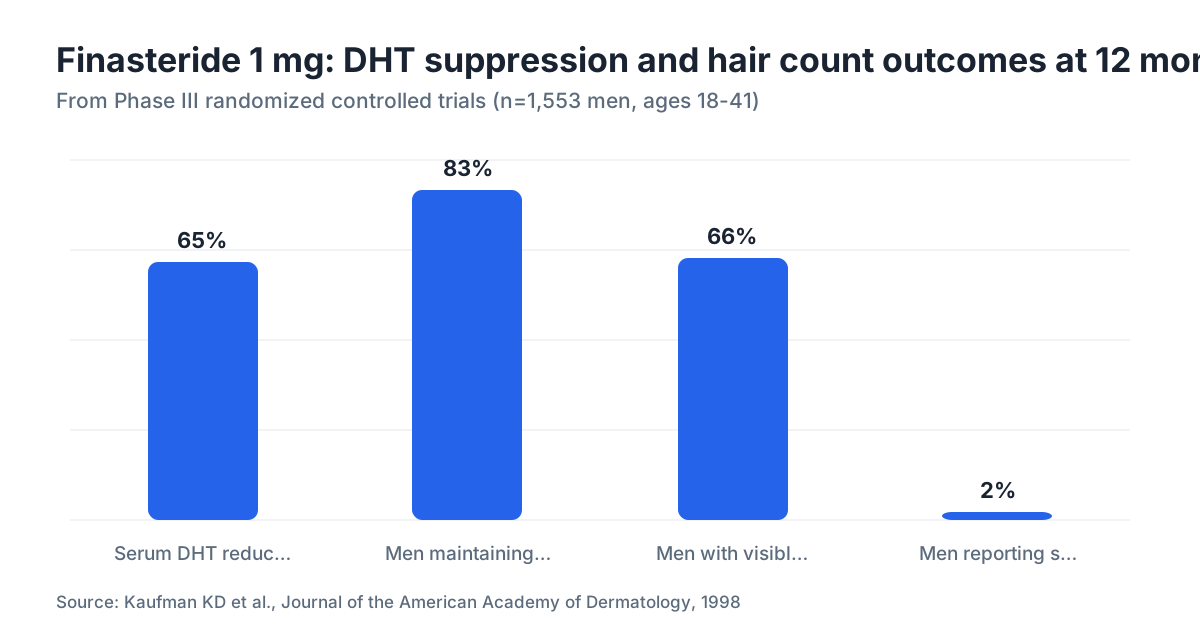
Short answer: no, not meaningfully. Finasteride's pharmacology is the reason. The drug has a plasma half-life of roughly 5-6 hours in younger men and up to 8 hours in men over 70, but that short half-life is misleading [1]. A single 1 mg dose suppresses scalp and serum DHT by around 60-70% within 24 hours, and that suppression persists well beyond the time the drug clears your bloodstream [2]. The enzyme finasteride targets, 5-alpha reductase type II, recovers slowly even after plasma levels fall. So the idea that you need to time your dose around a specific part of the day to maximize DHT suppression doesn't hold up.
What matters is that you take it every day. Miss doses often enough and DHT creeps back, hair follicles that were stabilizing start miniaturizing again, and you lose the ground you gained. The clinical trials that showed finasteride halting hair loss or producing regrowth were built on daily dosing, full stop [2]. Timing within that day was not a variable they tested because there was no mechanistic reason to think it mattered.
There's a practical case for picking a specific time and sticking to it. Attaching the pill to a routine you already do (morning coffee, brushing teeth at night, a daily alarm) cuts the chance you forget. That habit-stacking effect is the real reason any time-of-day recommendation exists.
Is it better to take finasteride in the morning or at night?
There is no clinical trial comparing morning versus evening finasteride dosing for hair loss outcomes. Neither the FDA label nor the American Academy of Dermatology guidelines specify a preferred time [3]. Both work equally well if you're consistent.
The choice comes down to your lifestyle and, for some men, side effects. A small percentage of men experience mild dizziness or fatigue early in treatment. If that sounds like you, taking it at night means you sleep through the window when plasma levels are highest, which can make those early weeks more comfortable. Men who take other medications in the morning sometimes prefer to keep finasteride separate at night to avoid any confusion about whether they've taken everything.
Morning dosers often find it easier to remember because the morning routine is more structured. If you already take a multivitamin or blood pressure medication at breakfast, adding finasteride to that moment is simple.
Pick the time that fits your life. Then protect it like it's non-negotiable, because for hair loss purposes, it basically is.
For context on how finasteride works alongside other treatments, see our full guide on finasteride and the combination approach covered in finasteride and minoxidil.
Should you take finasteride with food or on an empty stomach?
Finasteride can be taken with or without food. The FDA-approved label for Propecia (1 mg finasteride) states it can be taken with or without meals [1]. Bioavailability is not significantly affected by food: the original pharmacokinetic data showed that a high-fat meal slightly slowed absorption but did not change overall exposure (AUC) in a clinically meaningful way [7].
The practical exception is nausea. Some men, particularly in the first few weeks, feel mildly queasy after swallowing the tablet. Taking it with a small amount of food (a piece of toast, a handful of nuts) usually settles that. It's not a drug interaction concern, just a comfort adjustment.
Do not crush or split finasteride tablets without checking with a pharmacist. Women who are pregnant or may become pregnant should not handle crushed or broken tablets because finasteride is absorbed through the skin and causes fetal harm in male fetuses [1]. That safety note is on every label and worth taking seriously.
How long does finasteride take to work, and does timing affect that?
Timing your dose does not shorten the time to results. What controls how fast you see a response is biology, specifically how far your follicles have miniaturized and how sensitive your scalp androgen receptors are.
The clinical picture from the Phase III trials: at 12 months of daily 1 mg dosing, 83% of men maintained or increased hair count, and about 66% showed visible improvement by a standardized photographic assessment [2]. Regrowth, when it happens, peaks around 12-24 months [9]. You won't see a change in the mirror for at least three to four months. That timeline does not shift based on whether you take your pill at 7 AM or 11 PM.
One thing that does delay results: inconsistent dosing. If you're taking finasteride four or five days a week instead of seven, you're giving DHT more recovery time each week. The cumulative effect over months is slower suppression and slower follicle recovery. A forgotten occasional dose won't ruin anything, but making it a habit will.
For men also dealing with active shedding that might confuse the picture, understanding telogen effluvium is worth your time, since finasteride can trigger an initial shed in the first few months as follicles reset.
What happens if you miss a dose of finasteride?
Take it as soon as you remember that same day. If it's already the next day, skip the missed dose and go back to your normal schedule. Do not double up [5].
One missed dose will not cause noticeable hair loss. DHT suppression from a single dose persists for roughly 24 hours, so a one-day gap barely moves scalp DHT levels [7]. The concern is pattern: missing doses regularly over weeks or months is what undoes progress.
If you find yourself forgetting often, the fix is a system change, not willpower. Set a phone alarm. Put the pill bottle next to your toothbrush. Use a weekly pill organizer. These are low-tech but they work, and they work better than trying to remember by calendar alone.
Can you take finasteride at different times each day?
Technically, yes. The pharmacology allows it. Because the DHT-suppression effect lasts the full 24-hour dosing window, taking your pill at 8 AM one day and 10 PM the next doesn't create a dangerous gap in coverage the way irregular timing might with a blood pressure drug or antibiotic [7].
Practically though, variable timing makes it easier to lose track of whether you've taken the day's dose. That's the real risk. If you're swapping times by a couple of hours because your schedule shifted, fine. If you're unpredictably dosing across a 14-hour window every day with no anchor point, you'll eventually miss doses more often.
Pick a window, even a loose one. Within two hours of your target time is plenty close.
Does taking finasteride at night reduce sexual side effects?
This is a common question, and the honest answer is: nobody has good data on it. The claim circulating in hair loss forums is that taking finasteride at night means plasma DHT is lowest while you sleep, and highest again by the time you're awake and sexually active. The logic sounds plausible, but there are no published randomized trials comparing morning versus evening dosing on sexual side effect rates.
What we know from the existing trial data: about 1-2% of men in the Phase III trials reported decreased libido, erectile dysfunction, or reduced ejaculate volume at the 1 mg dose [2]. These effects reversed in men who discontinued. The FDA label lists these as known adverse effects [1].
For men genuinely troubled by sexual side effects, the timing experiment is low-risk to try. Switch your dose to night for two months and see if anything changes. If side effects persist, that's a conversation for your prescribing doctor, who can weigh alternatives or dose adjustments. The American Academy of Dermatology guidelines recommend discussing sexual side effects openly because they are real and documented, even if relatively uncommon [3].
For a full look at the mechanism behind finasteride and what it blocks, the DHT blocker guide covers the biology in detail.
How does finasteride dosing compare to other hair loss treatments?
A quick reference table helps here, because the answer depends a lot on which treatment you're comparing.
| Treatment | Typical dose | Timing flexibility | Food requirement | Time to visible results |
|---|---|---|---|---|
| Finasteride 1 mg (oral) | Once daily | High (any time) | None | 3-6 months min |
| Minoxidil 2%/5% topical | Once or twice daily | Moderate (apply to dry scalp) | N/A | 3-6 months min |
| Oral minoxidil 2.5-5 mg | Once daily | High (any time) | Can help with dizziness | 3-6 months min |
| Dutasteride 0.5 mg (off-label) | Once daily | High (any time) | None | Similar to finasteride |
Finasteride is among the most forgiving oral hair loss drugs on timing. Topical minoxidil has one real constraint: don't apply it to wet or sweaty hair, because that dilutes the solution and reduces absorption. Oral minoxidil (covered in more depth in the oral minoxidil guide) has the same timing flexibility as finasteride.
For men using both finasteride and topical minoxidil, there's no interaction concern between the two. Take finasteride whenever it fits your routine, and apply minoxidil to a dry scalp separately.
Are there any drugs or supplements that interact with finasteride and affect when you should take it?
Finasteride has a relatively clean interaction profile. It's metabolized primarily through CYP3A4 in the liver. Drugs that strongly inhibit or induce this enzyme can theoretically alter finasteride levels, but formal interaction studies found no significant pharmacokinetic interactions with common medications including antipyrine, digoxin, propranolol, theophylline, or warfarin [8].
For men taking ketoconazole (an antifungal used systemically, not the shampoo) or other strong CYP3A4 inhibitors, a pharmacist review is reasonable, but it's not a timing issue so much as a potential dose-level conversation with your prescriber.
Supplements are a different story because the evidence base is thin. Saw palmetto also inhibits 5-alpha reductase, so men stacking it with finasteride could theoretically get additive DHT suppression. There's no solid trial data on this combination. It's not a timing issue specifically, but worth knowing. The hair loss supplements article covers the supplement evidence base if you want to sort the signal from the noise.
What's the single best habit for taking finasteride correctly?
Attach it to something you already do every single day without exception. That's it. That's the whole recommendation.
Morning brushers: put the bottle next to your toothbrush. Coffee drinkers: take it the moment you press the coffee maker button. Night-routine people: leave it on your nightstand next to your phone charger. Weekly travelers: carry a pill organizer and refill it every Sunday.
The habit loop (trigger, routine, reward) is the system that actually holds up long-term for daily medication. The trigger is the anchor activity. The routine is swallowing the pill. The reward is knowing you're protecting your hair. Over time it becomes automatic.
If you're starting finasteride and want to track whether it's actually working, photographing your hairline under the same lighting every month is genuinely useful. Changes at 12 weeks are usually subtle. You need a baseline to see them. MyHairline's free AI hair analysis at myhairline.ai/scan can give you a structured baseline and track change over time, which beats trying to judge in a mirror.
For men who haven't yet identified where they are on the hair loss spectrum, understanding what causes hair loss and your receding hairline pattern is a useful starting point before optimizing a treatment schedule.
Is finasteride the right long-term approach, or should you also consider transplants?
Finasteride is a maintenance drug, not a cure. It slows or halts miniaturization and can recover some follicles that are thinning but not yet dead. It does not regenerate follicles that have been gone for years. That's why the men who get the best results from finasteride start early in the hair loss process.
For men at more advanced Norwood stages with significant bald patches, a hair transplant enters the conversation, but virtually every transplant surgeon will tell you the same thing: start finasteride before surgery and keep taking it after, because a transplant moves donor follicles but doesn't stop continued loss from native follicles in areas that weren't transplanted. Finasteride protects your investment.
The combination of finasteride plus minoxidil is the most evidence-backed non-surgical approach. A 2021 study in the Journal of the American Academy of Dermatology found the combination produced statistically significant greater improvement than either drug alone in men with androgenetic alopecia [4]. That combined effect doesn't change the timing rules, but it does reinforce that daily consistency across both drugs is what produces results.
If you want to understand the full treatment picture, the minoxidil for men guide is a practical companion to this one. And if you're weighing whether side effects from minoxidil are a concern, minoxidil side effects runs through the data honestly.
A quick summary: the finasteride timing rules that actually matter
Here's the short version of everything above, so you can bookmark it and stop overthinking this.
The time you take finasteride does not change its effectiveness. Morning, evening, afternoon, pick one and keep it. Food is optional, though it helps if your stomach is sensitive. Consistency over months and years is the only variable that matters clinically. Missing one dose occasionally is fine; missing doses regularly defeats the purpose. Sexual side effects are real but affect a small minority, and there's no proven timing trick to avoid them (though taking it at night is low-risk to try). Drug interactions are minimal for most men, but tell your doctor everything you're taking.
And if you haven't started yet: the earlier in the hair loss process you begin, the more finasteride can do. It can't bring back follicles that closed years ago. It can protect the ones still working.
MyHairline's AI scan at myhairline.ai/scan can help you assess where you stand before you decide anything.
Sources
- FDA, Propecia (finasteride 1 mg) prescribing information
- Kaufman KD et al., Journal of the American Academy of Dermatology, 1998, Phase III finasteride trials
- American Academy of Dermatology Association, Hair Loss guidelines
- Hu R et al., Journal of the American Academy of Dermatology, 2021, finasteride plus minoxidil combination trial
- MedlinePlus, National Library of Medicine, finasteride drug information
- Gupta AK et al., Skin Appendage Disorders, 2021, alternate day finasteride dosing review
- Merck & Co., Propecia pharmacokinetics, original NDA clinical pharmacology data, via FDA label
- DailyMed, National Library of Medicine, finasteride 1 mg label
- Olsen EA et al., Journal of the American Academy of Dermatology, 2002, long-term finasteride efficacy
- Price VH et al., Journal of the American Academy of Dermatology, 2000, finasteride in postmenopausal women