TL;DR: Finasteride blocks type II 5-alpha reductase, the enzyme that converts testosterone into dihydrotestosterone (DHT). Scalp DHT is the primary driver of androgenetic alopecia. At the standard 1 mg daily dose, finasteride reduces scalp DHT by roughly 60-70%, slowing or stopping follicle miniaturization in most men. It does not regrow hair that is already gone.
What is finasteride actually doing inside your body?
Finasteride is a competitive, selective inhibitor of 5-alpha reductase (5AR), the enzyme responsible for converting testosterone into dihydrotestosterone (DHT). That single action is the whole mechanism. Everything else, the slower recession, the stabilized crown, the modest regrowth some men get, flows downstream from that one biochemical block. [1]
The drug works by binding to the 5AR enzyme and forming a stable complex with it, essentially occupying the active site so testosterone can't get in. Because the binding is competitive and the complex is slow to dissociate, a daily dose keeps enzyme activity suppressed around the clock. Miss a few days and DHT levels start creeping back up, which is why consistent use matters.
To be clear about what finasteride is not doing: it is not blocking the androgen receptor, it is not lowering testosterone (it typically raises serum testosterone modestly), and it is not a hormone in itself. It is an enzyme inhibitor. That distinction matters when you start thinking about side effects and how they compare to something like a direct androgen blocker.
What is DHT and why does it shrink hair follicles?
DHT (dihydrotestosterone) is an androgen, about five times more potent than testosterone at binding to the androgen receptor. It exists throughout your body, but in the scalp it has a specific and destructive effect on hair follicles that are genetically sensitive to it. [2]
Here is the sequence. DHT binds to androgen receptors inside the dermal papilla cells at the base of a hair follicle. That binding triggers a cascade that progressively shortens the anagen (growth) phase of the hair cycle and causes the follicle to produce thinner, shorter, less pigmented hairs with each successive cycle. The clinical term for this process is follicle miniaturization. Over years, the follicle produces hairs so fine they are essentially invisible, and eventually it may stop producing hair altogether.
Not every follicle is equally sensitive. Follicles at the temples and crown express more androgen receptors and are therefore more vulnerable, which is why androgenetic alopecia follows the predictable patterns described by the Norwood scale. Back and side follicles have far fewer receptors, which is why donor hair taken from there for transplantation is DHT-resistant. [3]
Understanding this follicle sensitivity is also why finasteride is not a universal cure. If a follicle has already miniaturized completely and lost its dermal papilla structure, lowering DHT cannot rebuild it. The drug preserves what you have. It does not restore what you have already lost. For a broader picture of what else triggers follicle damage, see our guide on what causes hair loss.
What are the two types of 5-alpha reductase and which one does finasteride target?
There are three isoforms of 5-alpha reductase, but two are clinically relevant: type I and type II. [1]
Type II is the dominant isoform in the scalp, specifically in the outer root sheath of hair follicles and the dermal papilla. It is responsible for most of the local DHT production that drives androgenetic alopecia. Finasteride at 1 mg is a selective type II inhibitor. That selectivity is intentional and is what makes the 1 mg hair loss dose different from the 5 mg prostate dose (Proscar), which also inhibits type II but simply at a higher systemic exposure.
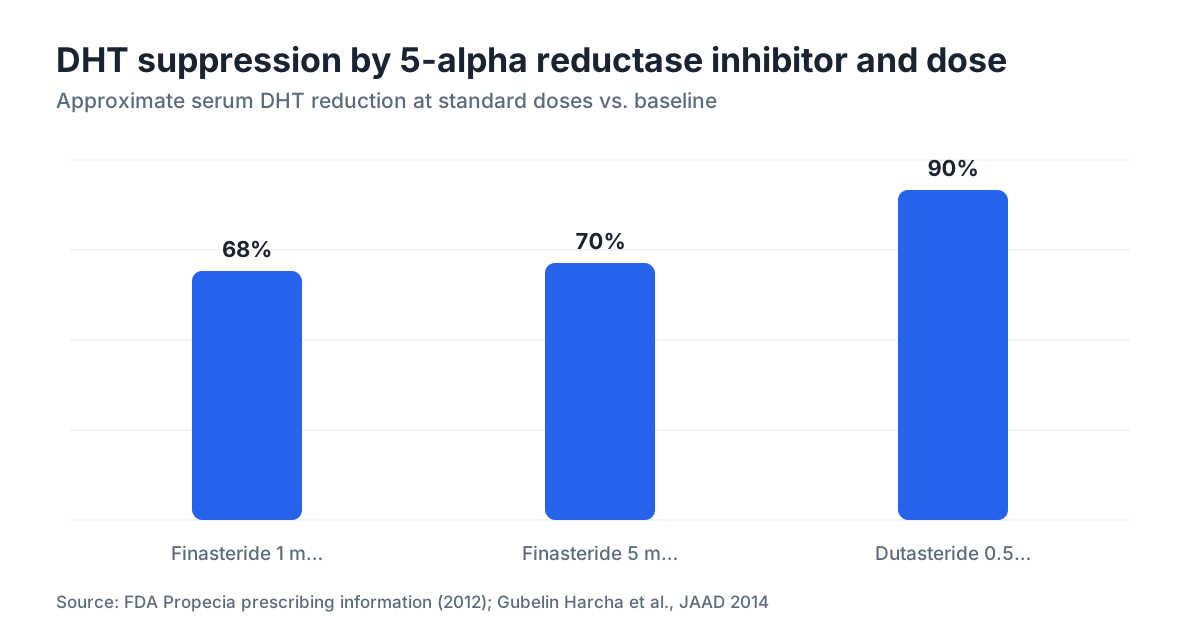
Type I is expressed in sebaceous glands, the liver, and skin. It contributes to total body DHT but is a smaller player in scalp follicle miniaturization specifically. Dutasteride, the other 5AR inhibitor used in hair loss, blocks both type I and type II, which is why it suppresses DHT more completely (by around 90% vs. 60-70% for finasteride). The tradeoff is a longer half-life and a less selective mechanism.
For practical purposes: finasteride at 1 mg hits the right target for androgenetic alopecia without needing to carpet-bomb the entire 5AR system. Whether the extra DHT suppression from dutasteride produces meaningfully better hair outcomes is an active clinical question, and the honest answer is that the data are limited. See our full overview of dht blocker options for a side-by-side comparison.
How much does finasteride actually reduce DHT levels?
The numbers here are real and fairly consistent across trials. At 1 mg per day, finasteride reduces serum DHT by approximately 65-70% and scalp DHT by approximately 60-70% within two weeks of starting. [4]
A 1999 paper by Whiting et al. in the Journal of the American Academy of Dermatology measured scalp tissue DHT in men taking 1 mg finasteride and found a reduction of about 64% compared to placebo. The original Merck trials that supported FDA approval showed serum DHT reductions averaging 65% at the 1 mg dose. [4]
One thing worth knowing: serum DHT and scalp DHT do not move in lockstep. Scalp tissue has its own local 5AR activity, so serum measurements slightly underestimate what is happening at the follicle level. That said, serum DHT is what most blood tests measure, and a reading in the 65-70% reduction range from baseline is generally considered a therapeutic response.
Testosterone, as noted, typically rises modestly (around 9-15%) because some of it is no longer being converted to DHT. This does not translate to any obvious clinical effect for most men, though it is a physiological reality worth noting.
| Measure | Approximate change at 1 mg/day finasteride |
|---|---|
| Serum DHT | -65 to -70% |
| Scalp tissue DHT | -60 to -70% |
| Serum testosterone | +9 to +15% |
| Serum LH/FSH | Minimal to no change |
How long does it take for finasteride to stop hair loss?
DHT suppression is fast, measurable within days of starting. Visible hair effects are slow. These two timelines confuse a lot of people who expect quick results.
Hair follicles operate on a cycle that runs roughly two to six years for anagen (growth), a few weeks for catagen (transition), and two to four months for telogen (shedding). Finasteride works by extending the anagen phase and reversing the miniaturization trend, but follicles already in telogen when you start the drug will still shed. Some men actually notice increased shedding in the first one to three months, which is alarming but generally a sign the cycle is resetting rather than a sign the drug is failing. This phenomenon is discussed more thoroughly in our piece on telogen effluvium.
The clinical trials set realistic expectations. In the original two-year Merck trials, men on 1 mg finasteride showed statistically significant improvement in hair count and scalp coverage compared to placebo at 12 months, with further improvement at 24 months. [5] The five-year extension study showed maintained benefits through year five in men who continued treatment.
Most dermatologists say to give finasteride at least 12 months before evaluating effectiveness. Calling it a failure at three months is premature. Calling it a success at six months may also be premature since the full benefit accumulates slowly. The honest timeline: some stabilization by months four to six, meaningful improvement assessment at 12 months, peak effect somewhere in years two to three.
What do clinical trials actually show about finasteride's effectiveness?
The core evidence base comes from two randomized, double-blind, placebo-controlled trials conducted by Merck before FDA approval in 1997, plus subsequent long-term extension data. These are among the better-designed trials in hair loss research, which is not a high bar but still meaningful. [5]
In those trials, men aged 18-41 with mild to moderate vertex and frontal hairline loss took 1 mg finasteride or placebo daily for two years. Hair counts in a defined scalp area increased by about 9% in the finasteride group and decreased by about 10% in the placebo group, a 19-percentage-point difference in hair count. Physician and patient global assessments both favored finasteride significantly. At five years (in men who continued), 90% of finasteride users maintained or improved their hair count versus about 25% of placebo users.
A 2010 systematic review in the Journal of the American Academy of Dermatology concluded that finasteride at 1 mg daily increases hair count and improves patient and physician assessments compared with placebo, with the evidence graded as high quality for androgenetic alopecia in men. [6]
For women, the picture is different. Finasteride is not FDA-approved for hair loss in women, evidence is much thinner, and use is contraindicated in pregnancy due to risk of male fetal genital development abnormalities. Some dermatologists prescribe it off-label for postmenopausal women, but this is a different clinical conversation entirely.
If you want to understand finasteride alongside the other major treatment option, our overview of finasteride and minoxidil covers combination therapy and what the evidence shows when you use both.
What are the side effects and how does the mechanism explain them?
Side effects matter and the mechanism explains most of them directly. DHT has functions beyond the scalp: it contributes to libido, erectile function, ejaculatory volume, and prostate size. Suppress it systemically and you risk affecting those functions. [7]
The FDA label for 1 mg finasteride (Propecia) reports the following sexual adverse events in clinical trials, occurring in greater frequency than placebo: decreased libido (1.8% vs. 1.3% placebo), erectile dysfunction (1.3% vs. 0.7% placebo), and decreased ejaculatory volume (1.2% vs. 0.4% placebo). The label also notes that in most men these resolved after discontinuation. [7]
Post-marketing reports raised a more serious concern: a syndrome called Post-Finasteride Syndrome (PFS), characterized by persistent sexual, neurological, and psychological symptoms after stopping the drug. The FDA added a label update in 2012 noting that libido disorders, ejaculation disorders, and orgasm disorders continued after discontinuation in some men. The causal mechanism for PFS remains debated and not fully understood; the FDA has not concluded that a definitive causal link exists for the full syndrome, but the label change reflects real reports. [7]
Other reported side effects include breast tenderness or gynecomastia (rare, under 1% in trials), and altered mood in some men. The neurological angle relates to neuroactive steroids: DHT and its metabolites (like 3-alpha-diol) have activity in the brain, particularly at GABA receptors, and reducing them may affect mood and cognition in susceptible individuals. The research on this is preliminary and contested.
The practical framing: serious persistent side effects affect a minority of users, but they are real and not trivial. Anyone starting finasteride should have a clear-eyed conversation with a prescribing physician about these risks. See the broader finasteride article for a complete side-effect breakdown.
Does finasteride work the same way for a receding hairline as it does for the crown?
This is one of the most practically important questions and the answer is: mostly yes, but with meaningful nuance.
The mechanism is identical regardless of location, finasteride reduces scalp DHT everywhere. But follicle density and the clinical response rate differ by region. In the Merck trials, the strongest evidence came from vertex (crown) loss. The frontal hairline showed benefit too, but the magnitude of hair count improvement was somewhat smaller. [5]
The reason likely comes down to follicle sensitivity gradients. Crown follicles are generally more androgen-sensitive, so DHT suppression has a more dramatic rescue effect there. Hairline follicles are also sensitive but may have been miniaturizing for longer by the time treatment starts, leaving fewer viable follicles to rescue.
Practical implication: if you have a receding hairline, finasteride can slow or stop further recession in many cases, but the odds of meaningful regrowth at the hairline are lower than at the crown. This is why some men who do well on finasteride still choose a hair transplant to address the frontal zone that the drug stabilized but did not restore. Our piece on receding hairline covers this decision in more detail.
What happens when you stop taking finasteride?
The mechanism reverses. DHT suppression ends, DHT levels return to baseline within roughly two weeks of stopping, and the follicle miniaturization process resumes. [4]
This is not a hypothetical. The five-year Merck extension study showed that men who stopped finasteride returned to their pre-treatment hair loss baseline within 12 months of discontinuation. Whatever hair had been preserved or regained was lost again as DHT climbed back.
The implication is that finasteride is a maintenance drug, not a one-time fix. You take it indefinitely or you lose the benefit. This is a commitment many men underestimate when they start. It also means the cost calculation is essentially a monthly subscription for as long as you want the protection.
This permanent dependency element is also why some men combine finasteride with procedures like hair transplants: the transplant moves DHT-resistant donor follicles to the thinning zone, while finasteride protects the native follicles that would otherwise keep miniaturizing around the transplanted hairs. Stopping finasteride after a transplant does not threaten the transplanted hairs, but it does allow the surrounding native hair to continue thinning.
How does finasteride compare to minoxidil mechanistically?
They work through completely different mechanisms, which is actually why combining them makes sense.
Finasteride attacks the cause: it reduces DHT, the androgen that drives follicle miniaturization in androgenetic alopecia. Minoxidil addresses a consequence: it prolongs the anagen phase and may improve follicle blood supply, counteracting the shortened growth cycle that DHT creates. Minoxidil does not lower DHT. Finasteride does not directly affect the hair cycle length or blood flow the way minoxidil does. [8]
Minoxidil's mechanism is still not fully understood, which is a little embarrassing given it has been in use since the 1980s. The leading hypothesis is that it acts as a potassium channel opener in vascular smooth muscle, improving perifollicular blood flow. It may also have direct effects on follicle cells including stimulating prostaglandin production. None of this touches DHT. Our overview of minoxidil for men explains what this means for dosing and expectations.
The combination of finasteride plus minoxidil is the most evidence-supported medical regimen for androgenetic alopecia in men. A 2015 study in Dermatology and Therapy found that combination therapy produced significantly greater hair count increases than either drug alone. The mechanistic complementarity is the likely explanation: finasteride removes the cause, minoxidil compensates for the cycle disruption. [9]
One other difference worth naming: minoxidil's side effects come from a different biological system (cardiovascular, fluid retention, unwanted body hair growth from systemic absorption), while finasteride's side effects come from androgen suppression. For a full side-effect comparison on the minoxidil side, see minoxidil side effects.
If you are trying to decide where to start with your own pattern, an objective baseline from the free AI hair analysis at MyHairline can help you see exactly which zones are thinning before committing to a regimen.
Can finasteride prevent hair loss before it starts?
Possibly, and this is an interesting mechanistic question. If DHT drives miniaturization, suppressing DHT before miniaturization becomes visible could theoretically preserve follicle health longer.
There is no large prospective trial specifically designed to test finasteride as prophylaxis in men with a strong family history who have not yet shown clinical loss. What does exist is indirect evidence: the five-year trial data shows consistent benefit in men with early-stage loss, and the mechanism does not suggest a threshold of hair loss severity below which DHT suppression stops working.
The practical barrier is that physicians typically do not prescribe a drug with real side-effect risk to a person who does not yet have the condition it treats. That said, a young man who is a Norwood 1 with a strongly affected father might have a legitimate conversation with a dermatologist about early intervention. This is a judgment call that belongs with a physician who knows the patient, not a general recommendation. Nobody has good trial data on prophylactic use specifically.
Is finasteride the only drug that works through this mechanism?
No. Dutasteride works through the same 5AR-inhibition pathway but with broader isoform coverage, blocking both type I and type II 5-alpha reductase rather than type II alone. This produces DHT suppression of roughly 90% versus 60-70% for finasteride. [1]
Dutasteride is FDA-approved for benign prostatic hyperplasia but not approved specifically for hair loss in the United States (it is approved for androgenetic alopecia in Japan and South Korea). Some dermatologists prescribe it off-label for hair loss when finasteride has proven inadequate or when patients want stronger DHT suppression.
Whether greater DHT suppression translates to meaningfully better hair outcomes is genuinely uncertain. A few small head-to-head trials have found dutasteride superior to finasteride for hair count, but the trial sizes are small and the differences modest. Dutasteride also has a longer half-life (around five weeks), meaning side effects persist longer after stopping than they do with finasteride (half-life around six to eight hours for the drug, though active metabolites extend this somewhat).
Beyond 5AR inhibitors, there are no other drugs approved through this specific mechanism for hair loss. Saw palmetto extract is sometimes marketed as a natural 5AR inhibitor. It does have some 5AR-inhibiting activity in laboratory settings, but there are no rigorous randomized controlled trials establishing clinical efficacy for hair loss at the level finasteride has. Our guide to hair loss supplements covers this territory honestly. The evidence gap between finasteride and saw palmetto is large.
For men exploring every evidence-based option, including procedures, our hair transplant article explains how surgery complements rather than replaces pharmacological DHT suppression.
Sources
- American Academy of Dermatology, Androgenetic Alopecia clinical guideline
- National Library of Medicine, StatPearls: Androgenetic Alopecia
- Whiting DA et al., Journal of the American Academy of Dermatology, 1999
- Kaufman KD et al., Journal of the American Academy of Dermatology 1998 (Merck pivotal trial)
- Mella JM et al., Journal of the American Academy of Dermatology 2010 systematic review
- Suchonwanit P et al., Drug Design Development and Therapy, 2019
- Hu R et al., Dermatology and Therapy, 2015
- van Zuuren EJ et al., Cochrane Database of Systematic Reviews, 2016
- Traish AM, Sexual Medicine Reviews, 2020 (Post-Finasteride Syndrome review)
- Gubelin Harcha W et al., Journal of the American Academy of Dermatology, 2014 (dutasteride vs finasteride trial)