

TL;DR: Mild dandruff does not cause hair loss. Severe seborrheic dermatitis, the inflammatory scalp condition behind heavy dandruff, can push follicles into shedding if you leave it untreated. Scratching makes it worse. Treat the inflammation and most people watch both the flakes and the shedding settle down. Dandruff alone is not a reason to fear permanent baldness.
What actually is dandruff and what causes it?
Dandruff is not dry skin. The flaking most people call dandruff is usually seborrheic dermatitis, a chronic inflammatory skin condition driven mostly by a yeast called Malassezia globosa and its relatives. That yeast lives on everyone's scalp. Trouble starts when it overgrows, digests scalp oils, and leaves behind irritating fatty acids that spark inflammation, fast skin cell turnover, and the greasy white or yellow scale that ends up on your collar.
The American Academy of Dermatology estimates seborrheic dermatitis affects roughly 11 percent of the general population, with higher rates in men and in people with certain neurological conditions [1]. Mild dandruff is a different animal. A dry, flaky scalp with no real redness or itch often reflects low humidity or washing too rarely, not true seborrheic dermatitis at all.
The distinction matters. True seborrheic dermatitis involves inflammation, and inflammation is the part that touches hair growth. Simple dryness-based flaking has essentially no documented link to hair loss.
Does dandruff cause hair loss directly?
By itself, no. A 2019 review in the Journal of the American Academy of Dermatology found no causal pathway by which dandruff flakes themselves damage follicles or stop hair growth [2]. Flakes are dead skin cells sitting on the surface. They do not reach the follicle, they do not block blood supply, and they do not touch the hair cycle on their own.
So why do so many people swear dandruff thinned their hair? A few reasons.
Seborrheic dermatitis and androgenetic alopecia (male or female pattern hair loss) show up in the same oily zones of the scalp, the top and the front. They land together often enough that people assume one caused the other when they may just be neighbors.
The Malassezia overgrowth behind seborrheic dermatitis also turns up in higher concentrations on the scalps of people with androgenetic alopecia than on those without it [3]. That association is real. Whether the yeast worsens pattern loss or simply thrives in the same environment is not settled. The closest studies suggest Malassezia triggers local inflammation that can pile onto the follicle miniaturization DHT is already driving, but it is not an independent cause of baldness.
And people scratch. Scratching damages the follicle opening, opens micro-wounds that keep inflammation going, and pulls out hairs early. This is the most believable direct route from dandruff to visible loss. It is also the most reversible.
When can severe seborrheic dermatitis actually cause shedding?
Severe, untreated seborrheic dermatitis is a different situation from a little flaking. When inflammation runs hot and long enough, it shifts more follicles into the telogen (resting and shedding) phase early. That is telogen effluvium. It is diffuse, meaning hair thins across the whole scalp instead of receding at the temples, and it is almost always reversible once you remove the trigger [4].
Here is the loop. Chronic scalp inflammation from Malassezia raises local inflammatory signals, including interleukins and prostaglandins, around the follicles. Those signals shorten the anagen (growth) phase. Shorter anagen means shorter hair and more hairs sitting in telogen at any moment, so your comb and your shower drain look busier. Treat the dermatitis hard, cool the inflammation, and anagen recovers. Most patients see shedding slow within 8 to 16 weeks of steady treatment.
For more on how telogen effluvium works and how long it lasts, see our explainer on hair loss telogen.
There is a rarer second mechanism. Folliculitis decalvans and other scarring (cicatricial) alopecias can be set off by chronic bacterial or yeast infection inside follicles, and those can destroy follicles for good. But they look nothing like ordinary dandruff. They come with pustules, pain, and visible scarring. If you see any of that, get to a dermatologist now, not next month.
What does the research actually say about the dandruff-hair loss link?
The honest state of the evidence is suggestive, not settled.
A 2007 study in the International Journal of Dermatology compared Malassezia density in men with androgenetic alopecia against controls and found significantly higher counts in the alopecia group [3]. The researchers proposed that Malassezia-driven inflammation could speed up follicle miniaturization. The catch is that this was observational, not interventional. Nobody has run a clean randomized controlled trial showing that wiping out Malassezia slows pattern hair loss in humans.
A 2015 study in the Journal of Investigative Dermatology showed that Malassezia restricta produces lipase enzymes that break sebum down into arachidonic acid, an inflammatory precursor that impaired follicle cycling in a lab dish [5]. Lab-dish results do not always carry over to a living scalp, so treat that as a plausible mechanism, not proof.
Nobody has good data on exactly what share of hair loss cases comes from dandruff-driven inflammation. The closest population data suggests seborrheic dermatitis-associated telogen effluvium is a small minority of hair loss visits, with androgenetic alopecia and systemic triggers far more common [4].
Here is the takeaway worth quoting: dandruff can make hair loss worse in people already prone to it, probably through inflammation, but it is rarely the main cause of significant, permanent loss.
How do you tell if your hair loss is from dandruff or something else?
Pattern tells you more than volume. If your hair is thinning in a defined shape, at the temples, crown, or top in a Norwood-scale progression, androgenetic alopecia is the far likelier cause. A receding hairline plus dandruff is almost always pattern loss that happens to sit next to seborrheic dermatitis, not dandruff eating your hairline.
If your hair sheds evenly across the whole scalp and you also have visible inflammation, itch, and redness under the flaking, seborrheic dermatitis-associated telogen effluvium becomes more plausible.
A few questions worth asking yourself:
- Did the shedding start or ramp up around the time your scalp got itchy and inflamed?
- Is the loss diffuse or patterned?
- Are you scratching hard enough to leave marks on your scalp?
- Have you had a major stressor, illness, rapid weight loss, or medication change in the past 3 to 6 months? (Those cause telogen effluvium far more often than dandruff does.)
A dermatologist can run a pull test, trichoscopy, and a scalp biopsy if needed to sort these out. A mirror is a poor stand-in for that.
If you want a fast first look at your pattern before booking an appointment, the free AI scan at MyHairline (/scan) maps your scalp against the Norwood stages and flags whether it reads as pattern loss or diffuse shedding.
What treatments actually work for dandruff-related hair loss?
Treat the inflammation. That is the whole plan.
For mild to moderate seborrheic dermatitis, over-the-counter antifungal shampoos come first. The best-studied active ingredients:
| Active ingredient | Mechanism | Evidence level |
|---|---|---|
| Ketoconazole 1% or 2% | Blocks Malassezia ergosterol synthesis | Strong (multiple RCTs) |
| Zinc pyrithione | Antifungal plus antibacterial | Strong |
| Selenium sulfide 1% or 2.5% | Antifungal, slows cell turnover | Moderate to strong |
| Coal tar 0.5-5% | Slows cell proliferation | Moderate |
| Ciclopirox 1% | Broad antifungal | Moderate |
| Salicylic acid | Keratolytic, lifts scale | Supportive only |
Ketoconazole has drawn interest as a mild anti-androgen when applied topically, because it may cut scalp DHT conversion a little. A small randomized trial in the Journal of Dermatology in 1998 found 2% ketoconazole shampoo used every 2 to 4 days produced a 17.3% increase in hair density over 21 weeks in men with androgenetic alopecia versus placebo [6]. The sample was tiny and nobody has replicated it at scale, so do not treat ketoconazole as a growth drug. It is an antifungal with a possible minor side benefit.
For moderate to severe cases that shrug off antifungal shampoos, a dermatologist may prescribe a short course of topical corticosteroids (like clobetasol solution) to cool an acute flare, or a topical calcineurin inhibitor like tacrolimus as a steroid-sparing option. The FDA has approved ketoconazole 2% shampoo for seborrheic dermatitis treatment [7].
None of this replaces evidence-based hair loss treatment if androgenetic alopecia is the real driver. Treating dandruff cleans up the scalp environment, but it will not stop DHT-driven miniaturization. For that you need finasteride, minoxidil, or both. See our guides on minoxidil for men and finasteride and minoxidil for what the evidence actually shows.
Does Mounjaro cause hair loss?
This question keeps landing next to dandruff searches because people researching hair loss often arrive from a recent medication change, and Mounjaro (tirzepatide) is one of the most prescribed newer drugs in the country.
Short answer: yes, Mounjaro can cause hair loss, and the mechanism is almost certainly telogen effluvium from rapid weight loss, not the drug poisoning your follicles.
Mounjaro is a GIP/GLP-1 receptor agonist the FDA approved for type 2 diabetes, and under the brand name Zepbound for chronic weight management [8]. In the SURMOUNT-1 trial, tirzepatide produced average weight loss of 15 to 22.5 percent of body weight over 72 weeks [9]. That pace is fast enough to trigger telogen effluvium in a real share of users. Rapid calorie restriction and the nutritional stress that follows push follicles into the resting phase early. Shedding usually starts 2 to 4 months after the stress begins, which for most Mounjaro users means 2 to 4 months into treatment.
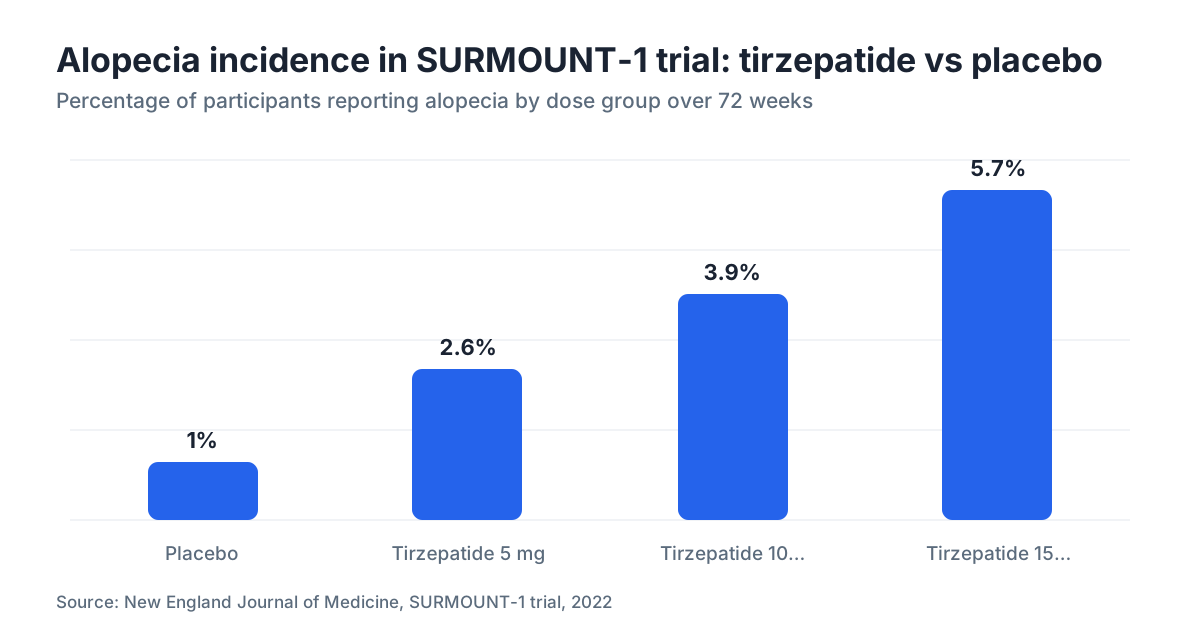
SURMOUNT-1 reported alopecia in about 5.7 percent of participants on the highest dose (15 mg) versus 1 percent on placebo [9]. That gap is real. Hair loss appears in the FDA prescribing information for Mounjaro as an adverse reaction seen in clinical trials.
The mechanism is the same as any rapid weight loss shedding. Under physiological stress the body pulls resources away from hair, a metabolically expensive tissue it can live without. This kind of loss is almost always temporary. Most people regrow once weight stabilizes and intake catches up, usually within 6 to 9 months.
Can you do anything? Protein matters more than most people think. Research suggests hair loss during weight loss tracks with low protein intake, and obesity medicine literature commonly points to roughly 1.2 to 1.6 grams per kilogram of body weight per day, though published trials specific to Mounjaro-associated shedding are still thin. Get iron, zinc, and ferritin checked if the shedding is heavy, since those deficiencies speed telogen effluvium along.
For other medication-related hair loss questions people wrestle with, our article on does creatine cause hair loss covers a different but related worry.
If Mounjaro-associated shedding drags past 9 to 12 months or turns severe, see a dermatologist. Some people carry underlying androgenetic alopecia that the telogen effluvium is uncovering rather than causing.
Can treating dandruff actually help regrow lost hair?
If scalp inflammation from seborrheic dermatitis drove the loss, yes, treating the dandruff should let hair recover. The follicles were suppressed, not destroyed. Once the inflammatory load lifts, the hair cycle resets and shedding slows. You will not see instant regrowth, because anagen takes time to restart and the first hairs back are fine and nearly invisible. Give it at least three to four months of steady treatment before you judge.
If the loss is androgenetic alopecia that happens to sit alongside dandruff, treating the flakes will not undo miniaturization that already happened. You might see modest density gains if Malassezia inflammation was compounding the pattern loss, but ketoconazole shampoo will not bring your hairline back. That takes DHT-blocking treatment or a hair transplant.
The honest expectation: good scalp hygiene and consistent antifungal treatment are worth doing either way, because a calmer scalp is a better base for whatever else you are running. They are cheap, low-risk, and they do not fight with finasteride or minoxidil.
How does scratching worsen hair loss from dandruff?
This gets underrated. Chronic scratching traumatizes the follicle opening and the skin around it. Repeated trauma sets off a wound-healing response that can, over months, lay down localized fibrosis around the follicle. That fibrosis narrows the channel and drops the quality of the hairs it grows. It is not the full scarring you see in cicatricial alopecia, but it is real low-grade damage.
Scratching also drives bacteria into open micro-wounds, raising infection risk and keeping local inflammation lit long after your nails stop. And it yanks out telogen hairs that were already sitting loose, pulling them weeks before they would have dropped on their own. That inflates your daily shed count without actually speeding up follicle turnover.
So controlling itch is more than comfort. Breaking the itch-scratch loop is a genuine part of protecting hair during a flare. Antifungal shampoos cut the Malassezia load and the itch with it. A nighttime oral antihistamine can interrupt the cycle while the antifungal ramps up. Topical calcineurin inhibitors quiet the itch signal without the skin-thinning risk that comes with long-term corticosteroids.
What should you do right now if you have both dandruff and hair loss?
Start with an honest inventory. How long has the loss been going? Patterned or diffuse? Is the scalp red, itchy, and scaly, or just a little flaky? Did you recently change medications, drop significant weight, or come through a serious illness or stress? Those answers will point to your cause faster than any amount of product research.
If you have real seborrheic dermatitis alongside the loss:
- Start a ketoconazole or zinc pyrithione shampoo 2 to 3 times a week, and actually let it sit 3 to 5 minutes before rinsing. Contact time is where antifungals earn their keep.
- Stop picking and scratching. Use a soft-bristle brush instead of your fingernails.
- Give it 8 to 12 weeks before you judge. Seborrheic dermatitis is chronic and flares in cycles; one good month is not a cure.
- See a dermatologist if over-the-counter treatments fail past 12 weeks, if you see pustules or pain, or if the loss is clearly patterned (which points to androgenetic alopecia as the main driver).
If hair loss is the bigger worry, understand the full picture of what causes hair loss before you decide dandruff is the villain. Most visible loss in men is androgenetic alopecia, a genetic and hormonal process that dandruff treatment will not fix.
For a quick read on where your loss stands, try the free AI analysis at MyHairline (/scan). It maps your current pattern and helps you figure out what category you are in before you spend money on treatments.
Sources
- American Academy of Dermatology, Seborrheic Dermatitis Overview
- Journal of the American Academy of Dermatology, 2019 review on scalp conditions and hair loss
- International Journal of Dermatology, 2007, Malassezia colonization in androgenetic alopecia
- American Academy of Dermatology, Hair Loss Types
- Journal of Investigative Dermatology, 2015, Malassezia restricta lipase activity
- Journal of Dermatology, 1998, ketoconazole 2% shampoo and hair density RCT
- FDA, Drugs Section
- FDA, Drugs Section
- New England Journal of Medicine, SURMOUNT-1 trial, tirzepatide for obesity, 2022
- National Institutes of Health, MedlinePlus, Hair Loss
- American Academy of Dermatology, Hair Loss Diagnosis and Treatment