
TL;DR: Yes, using finasteride and minoxidil together produces better regrowth than either drug alone. A 2021 randomized trial found the combination beat minoxidil-only and finasteride-only at 12 months. Finasteride blocks DHT to slow loss. Minoxidil widens follicles to push growth. They attack hair loss through different pathways, which is exactly why stacking them makes sense.
What do finasteride and minoxidil each actually do?
Before you combine anything, you need to understand what each drug does on its own, because they work completely differently.
Finasteride is a 5-alpha-reductase inhibitor. It blocks the enzyme that converts testosterone into dihydrotestosterone (DHT), the androgen responsible for shrinking genetically susceptible follicles [1]. Taken orally at 1 mg daily, it lowers scalp DHT by roughly 60-70% and serum DHT by about 70% [1]. That slowdown in follicle miniaturization is why it holds onto existing hair better than it regrows lost hair.
Minoxidil started as an oral blood pressure medication. Researchers noticed patients grew extra hair as a side effect, and topical versions followed. It works as a potassium channel opener, which widens blood vessels around the follicle and prolongs the anagen (growth) phase. Nobody fully understands every mechanism, but the FDA-approved label is clear that it stimulates hair regrowth in men with androgenetic alopecia [2]. The 5% topical solution or foam is the standard dosage for men.
So here is the key insight: finasteride addresses the hormonal cause of androgenetic alopecia, and minoxidil addresses follicle behavior directly. Neither drug cares what the other is doing. They do not compete for the same receptor, they do not interact pharmacokinetically, and the evidence supports using them simultaneously. If you want to understand what causes hair loss in the first place, that context makes the combination easier to grasp.
Does combining finasteride and minoxidil work better than using just one?
The short answer is yes, and we now have solid randomized trial data to say so.
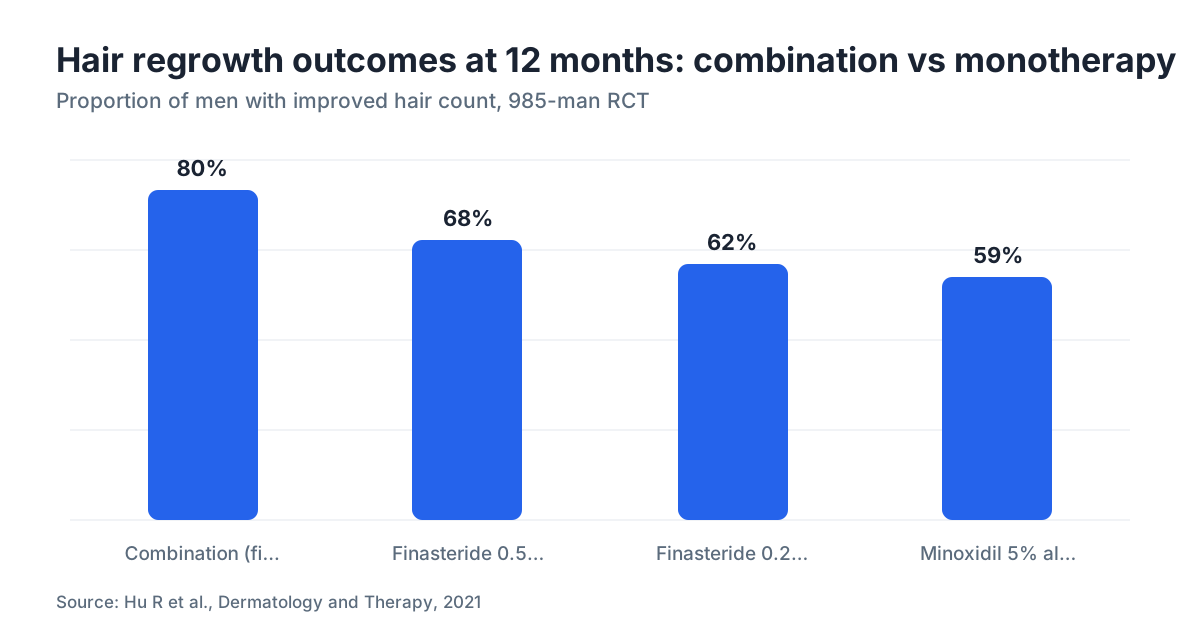
A 2021 randomized controlled trial published in Dermatology and Therapy assigned 985 men with androgenetic alopecia to one of four groups: 0.25 mg finasteride daily, 0.5 mg finasteride daily, 5% minoxidil topical solution, or a combination of 0.25 mg finasteride plus 5% minoxidil [3]. At 12 months, the combination group had statistically significantly greater increases in total hair count than either monotherapy group. The combination with the lower finasteride dose still outperformed topical minoxidil alone.
A separate study in the Journal of the American Academy of Dermatology compared finasteride alone versus finasteride plus 5% minoxidil in men who had not responded to finasteride alone. Adding minoxidil produced additional regrowth in the non-responders [4].
What does this mean practically? If you are already on finasteride and feel like your results have plateaued, adding minoxidil is a reasonable and evidence-backed move. If you are starting from scratch and you are motivated enough to maintain two treatments, starting with both gives you the best odds statistically. Neither drug is a guarantee for any individual, but the combination consistently wins in group comparisons.
One thing worth being honest about: the effect sizes vary. Some men see dramatic regrowth. Others hold the line. Photographs at baseline and 12 months are the only reliable way to measure your personal response, because daily observation is too noisy.
Finasteride vs minoxidil: which one is more effective on its own?
Head-to-head, finasteride has generally shown slightly stronger hair retention in large trials, particularly for stopping further loss. The 5-year finasteride trial published in the Journal of the American Academy of Dermatology found that 48% of men on 1 mg finasteride daily showed improvement in hair growth at year 5, while only 10% of placebo users improved [1].
Minoxidil's registration trials showed that 5% minoxidil produced "significantly greater hair regrowth" versus 2% minoxidil and placebo, with about 45% of men rating their regrowth as moderate to dense at 48 weeks [2]. But those trials measured different things in different populations, so a clean one-number comparison is hard to make.
Here is a simpler way to think about it: finasteride is better at preventing future loss, minoxidil is better at stimulating regrowth of dormant follicles. If your main worry is a receding hairline that keeps moving back, finasteride is probably doing more protective work. If you have diffuse thinning across the crown and want to regrow what is already gone, minoxidil is more directly targeted at that.
For women, the calculus is completely different. Finasteride is not FDA-approved for female pattern hair loss, and it is contraindicated in women who are or may become pregnant due to the risk of fetal harm to a male fetus [1]. Minoxidil 2% is FDA-approved for women, and 5% is widely used off-label. Women researching this combination should be talking to a dermatologist, not deciding on their own.
How do you use finasteride and minoxidil at the same time?
Using both is straightforward in practice. The drugs do not require special timing relative to each other.
Finasteride at 1 mg is taken orally once daily. It does not matter whether you take it in the morning or evening, with food or without. Consistency matters more than timing.
Topical minoxidil for men is typically applied twice daily (the 5% solution label) or once daily (the 5% foam label). Apply it to a dry scalp at the area of thinning, let it dry before going to bed or putting on a hat. If you are considering oral minoxidil instead of topical, that is a separate conversation with your prescriber, since dosing and side effect profiles differ from the topical version.
A few practical notes. Do not apply topical minoxidil and then immediately wash your hair, you will just rinse the drug off before it absorbs. The product should stay on your scalp for at least 4 hours, ideally overnight. Also expect shedding in the first 4-8 weeks on minoxidil. This is the anagen shift, not a sign the drug is failing you. It is alarming every time, but it is normal.
Finasteride takes 3-6 months before you notice any meaningful change in loss rate, and 12 months before you can honestly evaluate regrowth. Stopping either drug reverses the effect. That is not a scare tactic, it is just the mechanism: once DHT rebounds or once you stop the follicle stimulation, the underlying androgenetic alopecia reasserts itself. These are long-term maintenance drugs, not courses you complete.
What are the side effects of taking both finasteride and minoxidil?
The two drugs have non-overlapping side effect profiles, so combining them means you are managing two separate risk sets, not a doubled risk of any single problem.
Finasteride's main concerns are sexual: decreased libido, erectile dysfunction, and reduced ejaculate volume. The FDA label puts these at roughly 1-2% incidence in clinical trials, though post-marketing reports suggest rates may be higher in real-world use [1]. There is also ongoing discussion about post-finasteride syndrome, a claimed persistent sexual dysfunction after stopping the drug. The FDA added a label update in 2012 acknowledging that sexual side effects may persist after discontinuation [8]. If you notice any sexual side effects, stop the drug and talk to a doctor immediately rather than pushing through.
Minoxidil's most common topical side effects are scalp irritation, dryness, and contact dermatitis. Some people react to propylene glycol in the solution, in which case the foam (which does not contain propylene glycol) is an easy switch. Systemic absorption from topical minoxidil is low but real. Unwanted facial hair growth, particularly in women, is a reported effect. For a fuller picture, the minoxidil side effects breakdown covers dose-specific risks in more detail.
The combination does not appear to create new interaction risks. There is no known pharmacokinetic interaction between finasteride and topical minoxidil. What you are managing is the independent side effect profile of each drug simultaneously, which is why discussing this with a prescribing physician is the standard recommendation before starting either one.
One honest note: most men tolerate both drugs well. The side effect rates, while real, are minority events. But "most people are fine" is cold comfort if you are one who is not, so the monitoring matters.
How much does combining finasteride and minoxidil cost per month?
Cost varies a lot depending on how you source the drugs.
Generic finasteride 1 mg is available at most major pharmacies and through telehealth services. The cheapest route is a 90-day supply from a generic manufacturer via a GoodRx coupon, which can bring the cost to $10-20 per month depending on your pharmacy [5]. Brand-name Propecia is much more expensive and offers no clinical advantage over generic finasteride.
Generic topical minoxidil 5% solution is similarly cheap. A two-month supply of the generic solution typically runs $15-25 over the counter. The 5% foam tends to cost a bit more, roughly $25-40 for a two-month supply.
Telehealth platforms like Hims bundle the drugs in various formats. The Hims finasteride and minoxidil spray is a topical combination product containing both drugs, marketed for convenience. The Hims finasteride and minoxidil chewable is an oral combination tablet. These bundled products typically run $50-90 per month, significantly more than buying the generics separately. You are paying for convenience and the packaging, not a pharmacologically superior product.
If cost is a factor, generic finasteride from a compounding pharmacy or GoodRx plus generic minoxidil foam is the lowest-cost combination. If convenience matters more to you than cost, the bundled sprays and chewables are legitimate products, just price-check what you are getting.
For reference, a hair transplant costs $4,000-$15,000+ as a one-time procedure. Medical therapy at even $70 a month adds up to $840 a year, but it is still less than surgery over most time horizons, and surgery works better on a scalp that has been medically stabilized first.
How long does it take to see results from finasteride and minoxidil together?
The honest answer is 12 months minimum before you can meaningfully evaluate the combination.
Finasteride's mechanism is slow by design. It gradually reduces DHT, and the follicle's response to reduced DHT takes months to become visible. Most dermatologists set expectations at 6 months to see slowing of loss and 12 months for any regrowth. Stopping before that and concluding it does not work is one of the most common mistakes.
Minoxidil results appear faster, with some studies showing measurable hair count increases at 16 weeks for the 5% formulation. The 48-week registration trials are the standard benchmark [2]. But the initial shedding phase (the first 4-8 weeks) can make things look worse before they look better, which drives early dropouts.
The combination timeline roughly follows the finasteride curve: expect 3-4 months before you have any sense of whether loss is slowing, and a full 12 months before you take a real inventory of results. Progress photos every 90 days under the same lighting conditions are the most useful tracking method. Trying to evaluate day-to-day is genuinely unreliable because hair cycles are too variable.
If you have not seen any meaningful change at 12 months on the combination, that is a real signal to discuss next steps with a dermatologist. Some men are partial responders; some are non-responders. At that point, the conversation might turn toward hair loss supplements to complement the medical approach, or a consultation about surgical options.
Are there combination finasteride and minoxidil products, or do you have to use them separately?
You can use them separately, and you can also get combination formulations. Both approaches are valid.
The traditional approach is oral finasteride 1 mg daily and topical minoxidil 5% applied to the scalp separately. This lets you dose-adjust each drug independently and is the form with the most clinical trial data.
Compounded topical products that combine finasteride and minoxidil in a single solution have become popular through telehealth. The idea is that you get both drugs with one application. These are not FDA-approved as a combination product; they are compounded, meaning a pharmacy mixes them to a prescriber's specification. The 2021 trial cited earlier actually tested a combined topical finasteride plus minoxidil formulation and found it worked, so the concept is not speculative [3].
Oral combination products also exist. Some compounders offer oral finasteride plus low-dose oral minoxidil in one tablet. Oral minoxidil for hair loss is an off-label use (its FDA indication is as a blood pressure drug) and is increasingly used by dermatologists at doses of 1.25-2.5 mg for hair, far below the hypertension doses of 10-40 mg [6]. If you are curious about the standalone oral route, the oral minoxidil breakdown covers the current evidence.
For most people starting out, I would honestly suggest the separate generic approach first. It is cheapest, gives you independent control over each drug, and has the strongest clinical data behind it. If adherence is genuinely a problem and a single spray or chewable helps you actually take both drugs consistently, the premium is worth it.
Who is a good candidate for the combination, and who should avoid it?
The combination is most studied in men with androgenetic alopecia, specifically Norwood stages II through V. Men who are already in active, rapid loss and want the best medical chance at slowing it and regrowing some density are the clearest candidates.
Men who have been on finasteride for 12 months and feel results have plateaued are also strong candidates for adding minoxidil. The JAAD study specifically addressed this situation and found the add-on strategy worked [4].
Who should not use this combination without a prescriber's guidance: anyone with cardiovascular disease (minoxidil at any dose requires care here), anyone with a history of sexual dysfunction, and women of childbearing age.
Women with androgenetic alopecia are not good candidates for oral finasteride at standard doses. Topical minoxidil 2% is FDA-approved for women, and the 5% is used off-label. Some dermatologists use very low-dose oral or topical finasteride in postmenopausal women as an off-label treatment, but this is not the same as the standard male protocol.
If you have telogen effluvium rather than androgenetic alopecia, the combination may not address your actual condition. Telogen effluvium is triggered by a physical or emotional stress and is typically self-resolving; throwing DHT blockers at it does not fix the underlying cause. Getting a proper diagnosis first matters, and a board-certified dermatologist can do a pull test and review your history to distinguish the two.
If you want a fast read on where you stand before your dermatologist appointment, the free AI hair analysis at MyHairline can help you identify your probable Norwood stage and the loss pattern you are dealing with.
What does the research actually show about long-term use of both drugs?
The long-term evidence on finasteride alone is the best we have for any hair loss drug. The 5-year trial showed that men on continuous finasteride maintained or improved their hair count compared to baseline, while placebo users continued to lose hair, resulting in a progressively larger gap between groups [1]. That is meaningful: the drug does more than slow things temporarily, it keeps working as long as you take it.
Long-term data specifically on the combination is thinner. Most combination trials run 12-24 months. What we know from mechanism is that the two drugs' actions are complementary, and there is no evidence of diminishing returns from combining them over time. The assumption among hair loss dermatologists is that if both drugs work individually long-term, the combination does too, which is reasonable but not yet proven over 5-plus year timeframes.
The American Academy of Dermatology guidelines list both finasteride and minoxidil as first-line treatments for androgenetic alopecia in men, with a level A evidence grade for each [7]. The guidelines do not discourage combination use.
One practical consideration for long-term planning: hair loss is progressive, and even the best medical response has limits. The combination may slow loss dramatically and regrow some density, but it generally cannot restore a very advanced Norwood stage to a Norwood II. Men in later stages often use medical therapy to stabilize their hair before pursuing transplant surgery. Understanding the cost implications of that eventual path is useful; the hair transplant expenses breakdown gives a realistic picture.
The bottom line on the research: both drugs have decades of real-world use behind them. The combination has growing trial support. Neither is a permanent cure, and neither claims to be.
Where can you get finasteride and minoxidil prescribed and what does the process look like?
Finasteride requires a prescription in the United States. Topical minoxidil does not, it is sold OTC. Oral minoxidil requires a prescription.
The traditional route is a visit to a dermatologist or your primary care doctor. A dermatologist is the better choice if you want an actual scalp exam and a correct diagnosis, especially if your pattern is ambiguous or you are a woman. Many insurance plans cover the consultation but not the drugs themselves.
Telehealth platforms (Hims, Keeps, Roman, and others) offer online consultations and prescription finasteride, often bundled with minoxidil. The process is typically an async photo review by a licensed prescriber, a questionnaire, and a prescription sent to their affiliated pharmacy. Turnaround is often same-day. The monthly cost is higher than generic plus GoodRx, but the convenience is real and the prescribers are licensed practitioners.
If you go the telehealth route, read what you are actually getting. Some platforms sell the combination spray (topical finasteride plus minoxidil in one bottle) or the chewable (oral combo). Others sell them separately. The Hims finasteride and minoxidil spray and the Hims finasteride and minoxidil chewable are both real products, but make sure the prescriber reviews your history and discusses sexual side effects with you before you start. A form you fill out in five minutes is not the same as a physician conversation, even if it is technically medically supervised.
If cost is genuinely tight, ask your doctor for a generic finasteride prescription and buy OTC minoxidil separately. That combination works just as well pharmacologically and costs a fraction of any subscription service. If your doctor is unfamiliar with hair loss, the AAD's treatment guidelines are publicly available and you can point them to the evidence yourself [7].
Sources
- FDA, Propecia (finasteride) prescribing information
- FDA, Rogaine (minoxidil) 5% topical solution prescribing information
- Hu R et al., Dermatology and Therapy (2021) - Randomized trial of combination finasteride plus minoxidil
- Journal of the American Academy of Dermatology - study of adding minoxidil to finasteride
- GoodRx, finasteride 1mg price comparison
- Sinclair R, International Journal of Dermatology (2022) - Low-dose oral minoxidil for hair loss
- American Academy of Dermatology, Hair Loss Guidelines
- FDA, MedWatch Safety Communication on finasteride and persistent sexual side effects (2012)
- National Institutes of Health, MedlinePlus - Finasteride
- NIH National Library of Medicine, StatPearls - Minoxidil