

TL;DR: One 2009 trial found creatine raised DHT (the hormone tied to male pattern baldness) by about 56% over three weeks in rugby players. No study has directly shown creatine causes hair loss. If you're genetically prone to androgenetic alopecia, there's a plausible reason to be cautious. The evidence is thin and far from settled.
What is creatine and why would it affect hair at all?
Creatine is a compound your body makes in the liver, kidneys, and pancreas, and you also get it from meat and fish [9]. Most people take it as creatine monohydrate powder to push more strength and power during resistance training. It's one of the most studied sports supplements that exists, with a safety record that's held up across decades of research [1].
The hair worry doesn't come from creatine directly. It comes from what creatine might do to a hormone called dihydrotestosterone, or DHT. DHT is the androgen most responsible for androgenetic alopecia, the pattern baldness that runs in families. It binds to receptors in follicles that are sensitive to it, and over time those follicles shrink and stop making normal hair [2].
So the chain of concern goes: creatine raises DHT, DHT attacks susceptible follicles, follicles quit growing hair. The biology of that chain is sound. The real question is whether the first link is even true.
What did the creatine and DHT study actually find?
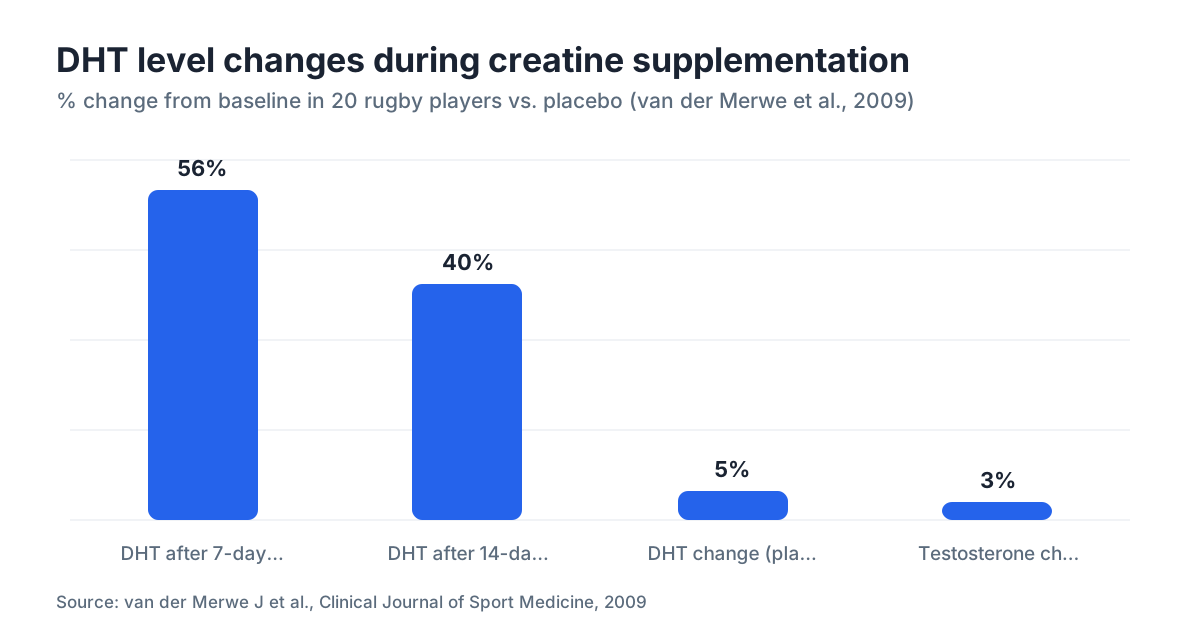
The whole conversation traces back to one study published in 2009 in the Clinical Journal of Sport Medicine [3]. Researchers gave 20 college-aged rugby players in South Africa either creatine monohydrate (25 g/day loading for 7 days, then 5 g/day for 14 days) or a placebo. They measured testosterone, DHT, and the DHT-to-testosterone ratio at baseline, after the loading phase, and at the end of maintenance.
Testosterone didn't move in any meaningful way. DHT did. It rose about 56% after the loading week and stayed roughly 40% above baseline after maintenance. The DHT-to-testosterone ratio also climbed significantly. The authors concluded that "creatine supplementation may, in part, act through an increased rate of conversion of T to DHT" [3].
That one sentence is the origin of nearly everything you've read about creatine and hair loss.
The study was small (20 subjects), short (three weeks), and run in young healthy men. It measured hormones in the blood, not follicle behavior. Nobody's hair was examined. No participant reported hair loss. The study never claimed creatine causes hair loss. It found a hormonal change that, if it held over years, could theoretically matter for people genetically prone to DHT-sensitive hair loss.
Has any other research confirmed the DHT link?
Not really, and that's the honest answer. The 2009 study has never been reproduced with the same result. Several later studies that measured androgen levels in creatine users found no significant rise in DHT or testosterone [4]. A systematic review of creatine and testosterone concluded the evidence was mixed and largely inconclusive [4].
One caveat matters here. Most creatine studies are built to measure muscle performance, not hormones. When hormones do get measured, it's usually a secondary outcome, and the study isn't powered to catch small endocrine shifts. So a flat DHT reading in those trials doesn't prove there's no effect. It mostly means nobody was looking hard enough to find one.
Here's where the science actually sits: one small positive signal, several inconclusive or negative ones. Nobody has good data on this at scale. The closest thing we have is that 2009 paper, well-run for its size, never fully reproduced.
Does creatine directly cause hair loss in practice?
No human trial has shown creatine causes measurable hair loss. That's not a clean bill of health for your hairline. It's a statement about how little targeted research exists.
What we do have is millions of creatine users worldwide over 30-plus years, and hair loss hasn't surfaced as a recognized adverse effect in clinical review or in the FDA's adverse event reporting system [5]. The International Society of Sports Nutrition's position stand calls creatine monohydrate "the most effective ergogenic nutritional supplement currently available" and lists no hair concern at all [1].
But absence of a population signal isn't the same as a controlled study proving safety. People shedding hair on creatine rarely report it to a regulator, and pattern loss creeps so slowly that most users would never link the two.
Here's my read. If you're already losing hair and hunting for a culprit, creatine probably isn't it. If you carry a strong family history of early baldness and you're noticing shedding, dropping or reducing creatine is a low-risk move while you sort out what's really happening. Read up on what causes hair loss to put this in context.
Who is actually at risk if the DHT link is real?
Androgenetic alopecia, both male and female pattern loss, is driven by genetic sensitivity to DHT, more than by how much DHT you have [2]. You can run high DHT and keep a full head of hair if your follicles shrug it off. You can run normal DHT and go bald at 25 if your follicles are hyper-reactive.
So the people with any reason to think about a creatine-DHT connection are those who:
- Have a family history of early or heavy pattern baldness on either parent's side
- Are already seeing signs of a receding hairline or crown thinning
- Are in the window when pattern loss usually speeds up, roughly late teens through the 40s
For someone with none of those, the theoretical DHT bump from creatine is unlikely to change anything you'd see in a mirror. For someone genetically wired to lose hair who's already seeing early signs, even a modest sustained DHT rise could shorten the timeline. The biology is plausible. The evidence is weak. Both of those are true at once.
One more thing. DHT swings naturally with exercise, sleep, body fat, and age. The 56% rise in the 2009 study happened during a high-dose loading phase that most recreational users don't keep up for long.
How does DHT-related hair loss actually work?
An enzyme called 5-alpha reductase converts testosterone into DHT, and it sits inside hair follicle cells among other tissues [10]. In follicles whose androgen receptors are coded to be sensitive, DHT binding shortens the growth phase (anagen) a little more with each cycle. Hair grows back finer and shorter until the follicle makes nothing you can see.
This takes years, sometimes decades. A three-week creatine loading protocol isn't going to noticeably thin your hair by itself. The concern is chronic use in someone whose follicles are already sliding.
Finasteride and dutasteride block 5-alpha reductase and cut scalp DHT by 70% or more [8]. That's the same enzyme creatine may nudge in the other direction. If you're on finasteride for hair loss, the theoretical interaction partly cancels out: finasteride suppresses the enzyme, so even if creatine feeds it more substrate, most of the conversion machinery is already blocked. Nobody has studied this pairing head-to-head.
For a fuller picture of the growth cycle and where it breaks, the hair loss telogen explainer is a good place to start.
What does creatine hair loss look like compared to other types of shedding?
If creatine did speed up hair loss, it would show up as androgenetic alopecia, which means a pattern: temples receding, crown thinning, or both. It would not cause diffuse shedding across the whole scalp, sudden bald patches, or changes in areas that aren't androgen-sensitive.
That distinction matters. Diffuse shedding, called telogen effluvium, has many triggers: crash dieting, major illness, surgery, thyroid problems, and rapid weight changes [6]. If you're shedding diffusely on creatine, the creatine is almost certainly not the reason.
Crash dieting while training hard is common among creatine users cutting weight, and it can trigger telogen effluvium on its own. So can overtraining stress. Both show up as heavier shedding a few months after the stressor, and both usually resolve once your body settles.
Want a quick read on your own pattern? A free AI hair analysis at MyHairline can help you spot whether what you're seeing looks like pattern loss, telogen effluvium, or something else, before you pay for a dermatologist visit.
| Hair loss type | Pattern | Likely cause | Related to DHT? |
|---|---|---|---|
| Androgenetic alopecia | Temples, crown | Genetics + DHT | Yes |
| Telogen effluvium | Diffuse shedding | Stress, diet, illness | No |
| Alopecia areata | Patches | Autoimmune | No |
| Traction alopecia | Hairline | Physical tension | No |
Does ozempic cause hair loss, and how does that compare?
Ozempic (semaglutide) is a GLP-1 receptor agonist used for type 2 diabetes and, as Wegovy, for weight loss. Hair loss does show up in post-market reports and some trial data for this drug class, but the mechanism has nothing to do with what creatine does [7].
The leading explanation for ozempic hair loss is telogen effluvium set off by rapid weight loss. Drop a lot of weight fast and the physical stress pushes a bigger-than-normal share of follicles into the resting phase at once. A few months later, that batch sheds. It's the same thing seen after bariatric surgery.
The FDA label for Wegovy lists alopecia as an adverse reaction that appeared in trials at a rate higher than placebo [7]. So ozempic hair loss is real, documented, and understood. It's also usually temporary. Once weight stabilizes, most people's hair recovers over six to twelve months.
Creatine and ozempic sit at opposite ends of this. Creatine's link is theoretical, resting on one small hormonal study, with no direct clinical evidence. Ozempic's link is documented in trials and printed on the label. The comparison is useful because it shows how far "a supplement might affect hair" is from "a drug with hair shedding written on its label."
If you're worried about ozempic hair loss, the good news is it almost always reverses once the weight loss slows.
Should you stop taking creatine if you're worried about hair loss?
It depends on how much genetic risk you carry and whether early signs are already showing.
For someone with no family history of pattern baldness and no current thinning: the evidence doesn't support stopping. The risk is theoretical, the data is one small study, and creatine's performance and safety record is otherwise excellent.
For someone with clear family history who's already noticing a receding hairline or temple thinning: dropping creatine, or switching to a lower maintenance dose, is a reasonable and cheap precaution. You're not giving up something proven to protect your hair, but you're also not betting on a mechanism that has at least some biological plausibility.
For someone already on finasteride or using finasteride and minoxidil for pattern loss: the case for staying on creatine is stronger, since you're already handling the DHT pathway with medication.
If you're losing hair and trying to work out whether creatine, genetics, stress, or something else is behind it, the most useful first step is a board-certified dermatologist or trichologist. They can examine your scalp, run hormone panels if warranted, and give you a real diagnosis instead of a guess.
MyHairline's free AI scan is a decent way to document your hairline and get a baseline Norwood stage before that appointment, so you show up with data.
What actually works for hair loss if you are losing it?
If pattern hair loss is genuinely happening, creatine or not, you have evidence-backed options.
Minoxidil is FDA-approved for men and women and is the most widely used topical. Topical minoxidil applied twice daily has slowed loss and regrown hair for a meaningful share of users in randomized trials. Minoxidil for men sells over the counter at 5%. Read the minoxidil side effects page first, because there are real ones worth knowing.
Finasteride, a 5-alpha reductase inhibitor (the same enzyme in the creatine-DHT discussion), is FDA-approved for men and the most effective single oral drug for male androgenetic alopecia. It cuts scalp DHT by roughly 70% and either stops progression or regrows hair in most users [8]. Pairing finasteride and minoxidil beats either one alone in most head-to-head data.
If you want to know whether supplements could help or hurt, the hair loss supplements guide covers biotin, saw palmetto, and the rest with the same evidence-first lens.
For advanced or long-standing loss where medication has failed or isn't enough, hair transplant surgery is a permanent fix. Hair transplant expenses vary a lot, usually $4,000 to $15,000 depending on graft count and clinic, so know your options before committing.
What's the bottom line on creatine and hair loss?
One real study found creatine raised DHT by 56% during a loading phase in young athletes. DHT is the main driver of pattern baldness. No study has shown creatine directly causes hair loss in humans. Those three facts have to sit together.
The risk, if it's real, is limited to people already genetically set up to lose their hair. For everyone else, creatine stays one of the safest and most effective supplements in sports nutrition. The International Society of Sports Nutrition found no clinical evidence of harm from long-term creatine monohydrate use at standard doses [1].
If you're losing hair and want answers, don't obsess over creatine while ignoring the far stronger predictors: your father's hairline at 40, your own Norwood stage right now, and whether you've tried any treatment with actual FDA approval behind it. Those matter far more than 5 grams of powder before a workout.
Sources
- International Society of Sports Nutrition, Creatine Supplementation Position Stand
- American Academy of Dermatology, Androgenetic Alopecia overview
- van der Merwe J et al., Clinical Journal of Sport Medicine, 2009; 19(5):399-404
- Lanhers C et al., European Journal of Sport Science, 2017; systematic review on creatine and testosterone
- FDA MedWatch Adverse Event Reporting System
- Hughes EC, Saleh D. Telogen Effluvium. StatPearls, NCBI Bookshelf
- FDA, Wegovy (semaglutide) Prescribing Information and Label
- Kaufman KD et al., Journal of the American Academy of Dermatology, 1998; finasteride 1mg clinical trial
- National Institutes of Health, Office of Dietary Supplements, Creatine Fact Sheet
- Trüeb RM, International Journal of Trichology, 2010; review of DHT and androgenetic alopecia