
TL;DR: Minoxidil is an FDA-approved topical (and now low-dose oral) treatment for male pattern baldness. Applied twice daily to the scalp, it extends hair growth cycles and widens follicles. About 40% of men see moderate regrowth within 4 months. Most others see shedding slow or stop. It doesn't cure baldness, and the hair falls out again if you quit.
What does minoxidil actually do to your hair?
Minoxidil started life as an oral blood pressure drug in the late 1970s. Doctors noticed a side effect: patients grew hair in places they hadn't expected. That observation led to the topical formulation the FDA approved in 1988 for male pattern hair loss, making it the first hair loss drug the agency ever cleared [1].
The mechanism is still not fully nailed down, which is a little uncomfortable but honest. Here's what researchers do know. Minoxidil is a potassium channel opener. It relaxes smooth muscle in blood vessel walls, which increases blood flow to the scalp and delivers more oxygen and nutrients to follicles. Separately, it appears to directly extend the anagen phase (the active growth phase) of the hair cycle and shorten telogen (resting phase), so follicles spend more time growing and less time dormant [2].
Minoxidil also partially reverses follicle miniaturization. With male pattern baldness, rising DHT gradually shrinks follicles over years until they stop producing visible hair. Minoxidil can't stop DHT, but it can push miniaturized follicles back toward producing thicker, pigmented terminal hairs rather than the fine, colorless vellus hairs that precede full loss. That's the engine behind regrowth, more than stabilization.
The practical upshot: it works best on follicles that are miniaturized but not yet dead. Once a follicle is gone, no topical drug brings it back. Early use, when you still have thinning hair rather than a completely bald patch, gives you the best shot.
How well does minoxidil work for men? What does the evidence say?
It works for a meaningful subset of men, moderately well, and it's the most studied topical option you can buy.
The FDA registration trials used 5% topical minoxidil. In those trials, roughly 40% of men reported moderate to dense hair regrowth after four months of twice-daily use [1]. That's not a majority. But another large portion saw stabilization (hair loss slowed or stopped) rather than outright regrowth. True non-responders who see no benefit at all are a smaller group, estimated at around 10 to 15% in most clinical series, though nobody has a clean population-level number for that.
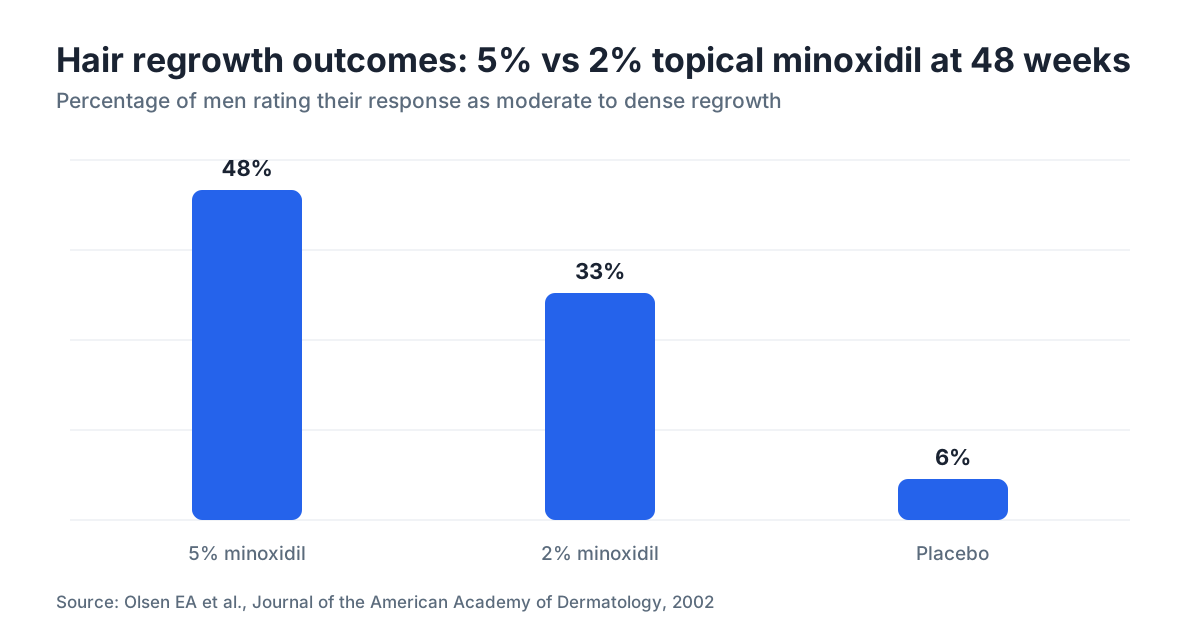
A 2002 randomized controlled trial in the Journal of the American Academy of Dermatology compared 5% topical minoxidil to 2% topical minoxidil in men with androgenetic alopecia. The 5% formulation produced 45% more hair regrowth than the 2% version at 48 weeks, with a statistically significant difference in both hair count and patient self-assessment [3]. That's why 5% is now the standard recommendation for men rather than 2%.
Foam vs liquid doesn't change efficacy much. A non-inferiority trial found 5% foam once daily was comparable to 5% liquid twice daily, though most guidelines still recommend twice-daily dosing for both forms [4].
What minoxidil does not do: it doesn't block DHT, the androgen driving male pattern baldness in the first place. That's why combining it with finasteride or another DHT blocker tends to produce better results than either alone. The two drugs attack the problem from different angles. For a deeper look at combination therapy, see our article on finasteride and minoxidil.
How long does minoxidil take to work?
Give it four months minimum before drawing any conclusions. Most clinical trials use a 16-week endpoint for their primary measures.
Here's what the timeline looks like for most men:
Weeks 1-8: Often nothing visible. Some men notice increased shedding during this phase. That's called telogen effluvium, and it's a sign the drug is working, not failing. Minoxidil pushes resting hairs out of the follicle early so new anagen hairs can take their place. It's alarming the first time it happens. It usually resolves by week 8 to 12. (More detail on this in our telogen effluvium article.)
Months 2-4: Shedding slows. Some men start noticing finer, shorter hairs in areas they'd been losing coverage.
Months 4-12: This is the main growth window. Regrown hairs thicken and lengthen. Hair counts and coverage improve measurably in responders. The 48-week trials show continued improvement beyond the 4-month mark.
Beyond 12 months: Results plateau. You're unlikely to see significant additional regrowth after the first year, though you'll keep what you've gained as long as you keep using it.
Used minoxidil correctly for 12 months and seen nothing? You're probably a non-responder. At that point, a dermatologist visit makes sense before you spend more money on it.
Foam vs liquid minoxidil: which one should men use?
Both come in 5% concentration. The difference is mostly about application experience and scalp sensitivity.
Liquid (solution): The original form. It contains propylene glycol as a carrier, which helps absorption but irritates some scalps. It drips and spreads, which makes application messy and harder to target. It does absorb quickly.
Foam: Introduced partly to fix the propylene glycol irritation problem. Most foam formulations skip propylene glycol, which means lower rates of contact dermatitis. The foam feels dry, spreads easily, and doesn't run into the forehead. Men with sensitive scalps or who found the liquid irritating often tolerate foam much better.
On efficacy, the differences are small. The non-inferiority study mentioned earlier showed foam performed comparably [4]. The AAD (American Academy of Dermatology) doesn't push a strong preference for one over the other in men's use, though foam has become the more popular form partly for convenience [5].
Practical tip: if you have a full head of hair on top with thinning underneath, liquid is hard to apply accurately without getting it everywhere. Foam is easier to work into a specific spot. If you have a receding hairline with patchy thinning, see our piece on receding hairline patterns and what minoxidil does and doesn't address there.
One thing matters more than foam vs liquid: actually using it consistently. Twice a day, every day. Missing doses is the most common reason men underperform relative to clinical trial results.
What's the right dose and how do you apply it?
The FDA-approved dosing for men's topical minoxidil is 1 mL of the 5% solution twice daily, or half a capful of 5% foam twice daily, applied directly to the dry scalp in the area of thinning [1].
That's it. More is not better. Using more than 2 mL (or one full capful of foam) per day increases systemic absorption without increasing efficacy and raises the risk of side effects.
Application steps that actually matter:
- Part your hair to expose the scalp in the thinning area. Don't just spray or rub it over your hair.
- Apply the dose directly to the scalp, not the hair shaft. The follicle is in the scalp.
- Spread with your fingertips. Wash your hands after, because minoxidil on your face or the back of your hands can cause unwanted facial or hand hair growth.
- Let it dry completely (about 2 to 4 hours) before going to bed or using other styling products. Wet minoxidil transferred to a pillowcase is wasted product and can cause facial hair where your face touches the pillow.
- Apply to a dry scalp. Applying to wet hair dilutes the concentration and reduces absorption.
Timing: morning and evening doses spaced roughly 8 to 12 hours apart works well. Some people skip the morning dose and just do evening because they forget. That's better than nothing but below the tested protocol.
What are the side effects of minoxidil in men?
Most men tolerate topical minoxidil fine. Serious side effects are rare with topical use at recommended doses. The full breakdown is in our dedicated minoxidil side effects article, but here's the honest summary.
Common (local):
- Scalp dryness, flaking, or itching, especially with the liquid formulation due to propylene glycol. Switching to foam usually resolves this.
- Initial shedding (telogen effluvium) in the first 2 to 8 weeks.
- Unwanted facial hair if product contacts the face.
Less common (systemic):
- Fluid retention or edema in a small number of users.
- Rapid or irregular heartbeat (rare with topical; more of a concern with oral).
- Low blood pressure, dizziness.
The FDA label includes a warning to contact a doctor if you experience chest pain, rapid heartbeat, faintness, or sudden unexplained weight gain (possible fluid retention) while using topical minoxidil [1]. These are uncommon but real signals to take seriously.
Oral minoxidil at low doses (0.625 to 2.5 mg/day for men) is increasingly used off-label and has its own side effect profile. Hypertrichosis (unwanted body hair) is the most common complaint, and fluid retention matters more here than with topical. See our article on oral minoxidil if you're considering that route.
The contraindications on the FDA label are worth knowing: don't use it if your hair loss is sudden, patchy, or unexplained without a diagnosis, because there may be a treatable underlying cause. Minoxidil is for androgenetic alopecia specifically.
What happens if you stop using minoxidil?
You lose the gains. This is the single most important thing people don't understand about minoxidil before they start.
Minoxidil doesn't fix the underlying cause of male pattern baldness, which is DHT sensitivity in genetically susceptible follicles. It keeps a favorable growth environment for those follicles going as long as it's present. Stop using it, and follicles return to their DHT-driven trajectory. Most men shed the hairs they'd regrown or retained within 3 to 6 months of stopping [2].
This isn't unique to minoxidil. The same is true of finasteride. These are maintenance drugs, not cures. You're committing to daily use essentially forever, or until you decide you're comfortable with the level of loss you have.
If the lifetime commitment feels heavy, think about that before you start rather than after you've regrown hair you don't want to lose again. Some men decide the maintenance makes sense. Others prefer to wait and use a hair transplant as a one-time intervention once their loss pattern has stabilized.
Is minoxidil more effective combined with finasteride?
Yes. In the studies that exist, the combination beats either drug alone.
A 2015 randomized trial in Dermatologic Therapy compared finasteride alone, minoxidil alone, and the combination in men with androgenetic alopecia. After 12 months, the combination group showed significantly greater increases in hair density than either monotherapy group [6]. The logic holds together: finasteride blocks DHT production upstream, addressing the root cause, while minoxidil extends the growth cycle of existing follicles. They're complementary rather than redundant.
The practical implication: if you're committed to medical treatment, the combination is worth discussing with a dermatologist, especially if you're at a stage where thinning is noticeable but follicles are still present. For men working out what causes hair loss at the biological level, understanding the DHT pathway clarifies why this combination makes sense.
Finasteride has its own side effect profile, including sexual side effects that affect a minority of users, so it's not a casual addition. But for men who tolerate it, the evidence for combination therapy is stronger than for minoxidil alone. See the full finasteride article for the complete picture.
What Norwood stages respond best to minoxidil?
Minoxidil works best at Norwood stages 2 through 4. That's the range from mild temple recession with intact vertex coverage through moderate thinning at the crown with more pronounced temple recession.
At Norwood stage 5 and above, the bald areas are larger and the follicles in the central scalp are often completely gone. Minoxidil can't revive dead follicles. You may still benefit at stage 5+ by stabilizing the hair you have left, but the regrowth story gets weaker.
At stage 1 (no real loss yet), you don't need it. Stage 2 to 3 is often the best time to start if you're going to start at all: enough follicles remain viable that you can meaningfully affect the outcome.
This is also why a proper diagnosis matters. If you're not sure where you fall, a dermatologist or trichologist can give you a clinical assessment. The free AI hair analysis at MyHairline is a reasonable first step to understand your pattern before booking a paid appointment.
| Norwood Stage | Typical Description | Minoxidil Likelihood of Regrowth | Minoxidil Value |
|---|---|---|---|
| 1 | No visible loss | N/A | None needed |
| 2 | Slight temple recession | High | Preventive/early |
| 3 | Clear temple recession, early vertex | High | Strong |
| 4 | More crown thinning, wider temples | Moderate-high | Good |
| 5 | Large crown bald area | Moderate (stabilization) | Moderate |
| 6-7 | Extensive loss, band remains | Low for regrowth | Limited |
How much does minoxidil cost, and is the generic as good as Rogaine?
Generic 5% minoxidil is the same drug as branded Rogaine. The FDA requires generic topical minoxidil to demonstrate pharmaceutical equivalence to the reference listed drug [9]. Buy generic. You'll pay roughly $20 to 30 for a 3-month supply of 5% liquid or foam at a major pharmacy or online retailer, vs $50 to 80 for the same amount of Rogaine. Same active ingredient, same concentration [5].
Prescription-strength or higher-concentration formulations (some compounding pharmacies offer 10% or 15% minoxidil) are not FDA-approved at those concentrations for the scalp. There's limited evidence they're more effective and some concern about increased systemic absorption. Stick with the 5% over-the-counter version unless a dermatologist tells you otherwise.
Oral low-dose minoxidil, which requires a prescription, runs roughly $10 to 40/month depending on dose and pharmacy. It's off-label in the US for hair loss at these low doses, meaning the FDA hasn't specifically approved it for that indication, but prescribers can legally prescribe it. The drug itself is FDA-approved (as an antihypertensive), just not at these low doses for this specific use.
Here's how minoxidil stacks up against the other options:
| Treatment | Monthly Cost (approx.) | FDA Approved for Hair Loss | Requires Prescription |
|---|---|---|---|
| Generic topical minoxidil 5% | $7-12 | Yes | No |
| Branded Rogaine 5% | $20-30 | Yes | No |
| Generic finasteride 1mg | $15-25 | Yes | Yes |
| Low-dose oral minoxidil | $10-40 | No (off-label) | Yes |
| PRP (per session) | $500-2000 | No | Yes |
| Hair transplant (FUE) | $4000-15000 one-time | No | Yes |
Should you use minoxidil if you're worried about hair loss but haven't lost much yet?
Reasonable question, and the honest answer depends on how much it bothers you and what your family history looks like.
Minoxidil is most proven as a treatment once androgenetic alopecia is established and visible. The evidence for pure prevention in men who are genetically at risk but haven't yet shown miniaturization is thinner. That said, starting earlier, when follicles are still producing normal terminal hairs, gives you more to work with than waiting until you're clearly at Norwood 4.
If male pattern baldness runs heavily in your family and you're starting to notice early recession or shed more than usual, that's a reasonable point to consider starting. If you're 22 with a full head of hair and just anxious, it's probably not the move yet. Get a dermatologist's read on your actual pattern.
For broader context on what's driving hair loss and which conditions respond to what treatments, the what causes hair loss and does minoxidil work articles give more nuance. Some hair loss isn't androgenetic at all, such as alopecia areata or nutritional deficiency, and minoxidil won't fix those.
One practical note: the FDA label for minoxidil specifies it's for men aged 18 and older. It's not indicated for teenage use, though off-label use under dermatologist supervision exists. It's also not indicated for frontal hairline recession specifically in most labeling language, though many dermatologists do recommend it for that pattern [1].
Want a fast sense of where your hair loss stands? MyHairline's free AI scan can map your pattern before you commit to any treatment. Think of it as homework before the dermatologist visit, not a replacement for one.
Sources
- FDA, Rogaine (minoxidil) 5% topical solution prescribing information / OTC labeling
- American Academy of Dermatology, Hair Loss: Diagnosis and Treatment
- Olsen EA et al. (2002). A randomized clinical trial of 5% topical minoxidil versus 2% topical minoxidil and placebo in the treatment of androgenetic alopecia in men. Journal of the American Academy of Dermatology, 47(3), 377-385.
- Blume-Peytavi U et al. (2011). A randomized, single-blind trial of 5% minoxidil foam once daily versus 2% minoxidil solution twice daily in the treatment of androgenetic alopecia in women. Journal of the American Academy of Dermatology, 65(6), 1126-1134.
- American Academy of Dermatology, Hair Loss: Tips for Managing
- Hu R et al. (2015). Combined treatment with oral finasteride and topical minoxidil in male androgenetic alopecia: a randomized and comparative study in Chinese patients. Dermatologic Therapy, 28(5), 303-308.
- National Library of Medicine, MedlinePlus: Minoxidil Topical
- Suchonwanit P et al. (2019). Minoxidil and its use in hair disorders: a review. Drug Design, Development and Therapy, 13, 2777-2786. (PubMed Central)
- FDA, Orange Book: Approved Drug Products with Therapeutic Equivalence Evaluations
- Sinclair R et al. (2016). Androgenetic alopecia: new insights into the pathogenesis and mechanism of hair loss. F1000Research.