TL;DR: No topical oil has been proven to block DHT at the scalp follicle the way finasteride or dutasteride do systemically. Rosemary oil is the strongest candidate, matching minoxidil 2% for hair count at 6 months in one 2015 trial, but the mechanism probably isn't DHT blockade. Oils can support a routine. They shouldn't replace proven treatments for androgenetic alopecia.
What is DHT and why does it cause hair loss?
Dihydrotestosterone, or DHT, is a hormone your body makes when an enzyme called 5-alpha-reductase converts testosterone in the tissues. In people with androgenetic alopecia, scalp follicles are genetically sensitive to it. DHT binds to androgen receptors in those follicles, shortens the anagen (growth) phase, and slowly shrinks the follicle. Dermatologists call that shrinking process miniaturization [1].
Miniaturization is the core problem. A thick terminal hair doesn't fall out all at once. Over repeated growth cycles it gets finer, shorter, and eventually the follicle may stop producing visible hair at all. The pattern follows predictable stages, which doctors map with the Norwood scale in men and the Ludwig scale in women [2].
The scalp is a busy site for 5-alpha-reductase, especially the type II isoform. That's why systemic inhibitors like finasteride and dutasteride work so well. They cut DHT in blood and tissue by 60-70% (finasteride 1 mg) to over 90% (dutasteride 0.5 mg) [3]. That drop is real and measurable, confirmed in serum assays.
A topical has a much harder job. To copy that effect, it has to cross the stratum corneum, reach the dermal papilla at the base of the follicle, and inhibit 5-alpha-reductase or block androgen receptors there at a concentration that actually matters. That's a high bar. Most oils don't clear it with the evidence we have.
Getting the hormonal picture right is the foundation for judging any treatment claim, including the oils sold as DHT blockers. Start with what causes hair loss.
What does 'DHT blocker oil' actually mean?
The term is a marketing label, not a clinical category. Sellers use it for any oil holding a compound that showed 5-alpha-reductase inhibition in a cell dish, an animal model, or a test tube. The jump from 'inhibits this enzyme in a lab' to 'reduces DHT at your follicle when you rub it on your scalp' is huge. Most products never bridge it with human trial data.
There are three honest ways a product could earn the label. One, it inhibits 5-alpha-reductase so your body makes less DHT. Two, it blocks DHT from binding androgen receptors in the follicle. Three, it protects the follicle from DHT-driven miniaturization through some other pathway. Oils sold as DHT blockers tend to blur all three together.
Before you decide how much weight to give oils, it helps to see them next to the pharmaceutical options in our broader DHT blockers guide.
Is rosemary oil a DHT blocker? What does the research show?
Rosemary oil is the most studied candidate, and the honest answer is this: probably not a true DHT blocker, but possibly useful anyway. It has one real human trial behind it, which puts it ahead of almost everything else in this category.
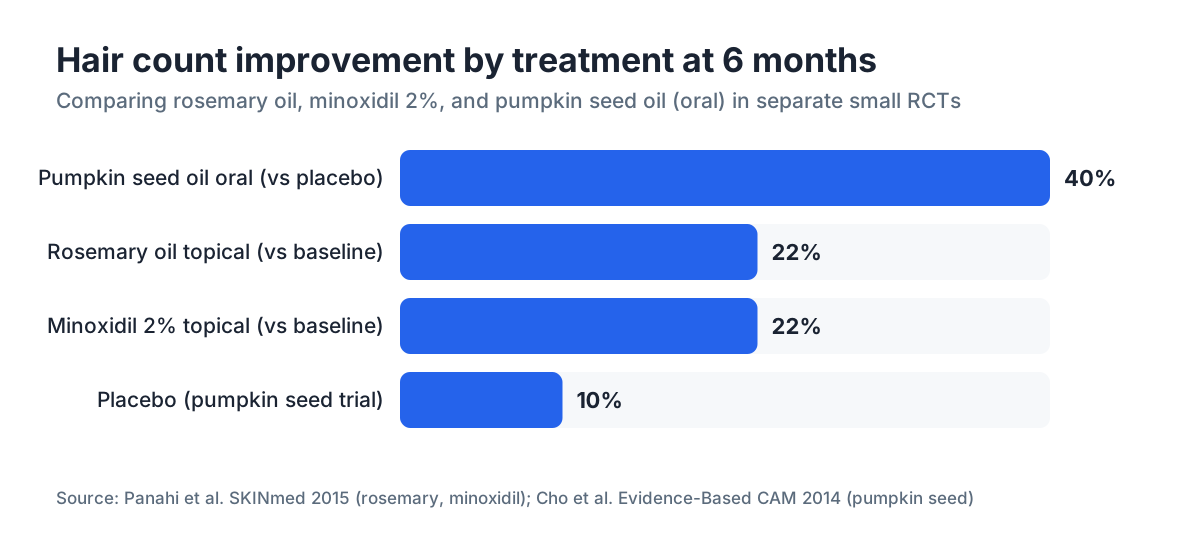
The key study is a 2015 randomized controlled trial in SKINmed journal. Participants with androgenetic alopecia used either rosemary oil or minoxidil 2% for 6 months. Hair count went up in both groups, and rosemary matched minoxidil at the 6-month mark (the minoxidil group shed more at 3 months, a known effect). The researchers pinned rosemary's benefit mainly on better scalp circulation, not on DHT inhibition [4].
There's also lab work showing carnosic acid (a compound in rosemary) raises nerve growth factor expression in dermal papilla cells, plus animal data hinting that rosemary extract inhibits 5-alpha-reductase. Neither finding translates cleanly to a human scalp.
The trial had real limits. Small sample (n=100). No placebo arm, since the control was minoxidil rather than a plain carrier oil. No serum DHT measurements to confirm any hormonal effect. So the fair claim is narrow: rosemary oil matched a mild topical treatment in one small study. It does not mean rosemary blocks DHT.
Why does the distinction matter? If the real mechanism is circulation or cell signaling, then the dose, formulation, and application that help may look nothing like what you'd want for enzyme inhibition. Selling it as a DHT blocker sets up an expectation it almost certainly can't meet for moderate to advanced androgenetic alopecia.
Which oils have the strongest evidence for reducing hair loss?
Rosemary oil has the strongest evidence, with one human trial against minoxidil. Pumpkin seed oil is second, backed by one oral trial. Everything else rests on in-vitro or animal data. No oil in this category has phase III clinical trial support.
| Oil | Best evidence type | Human RCT? | Proposed mechanism |
|---|---|---|---|
| Rosemary oil | 1 RCT (n=100, vs. minoxidil 2%) [4] | Yes, small | Circulation; possible 5AR inhibition |
| Pumpkin seed oil | 1 RCT (n=76, vs. placebo, oral) [5] | Yes, oral only | 5-alpha-reductase inhibition |
| Saw palmetto oil | In-vitro 5AR inhibition; 1 small oral trial | No topical RCT | 5AR inhibition |
| Emu oil | Animal studies only | No | Anti-inflammatory; follicle penetration |
| Castor oil | Anecdotal; no RCT | No | Unknown |
| Coconut oil | Protein loss reduction in hair shaft studies [6] | No hair growth RCT | Lipid coating; penetration |
| Jojoba oil | In-vitro only | No | Carrier; wax ester resembles sebum |
Pumpkin seed oil deserves a specific note. The 2014 RCT gave 400 mg of oral pumpkin seed oil in capsules to men with mild to moderate androgenetic alopecia. After 24 weeks, the pumpkin seed group had 40% more hair count versus baseline compared with 10% in placebo [5]. That was oral, not topical, and the sample was small. Topical pumpkin seed evidence doesn't exist yet.
Saw palmetto has decent in-vitro data for 5-alpha-reductase inhibition and shows up in several over-the-counter topical serums. A 2002 study found oral saw palmetto extract produced mild improvement in 60% of men with androgenetic alopecia, but that study used no validated outcome measures [3]. Topical saw palmetto has never been through a proper trial.
Castor oil is the most popular 'hair growth' oil on social media and has essentially zero clinical support. Popularity and evidence are not the same thing.
Can a topical oil actually reach your hair follicle?
This is the pharmacokinetic question the oil marketing world would rather you skip. The short answer: some compounds can penetrate the scalp, but getting into skin is not the same as reaching the follicle base at a concentration that inhibits an enzyme.
Hair follicles sit deep in the dermis, roughly 3-5 mm below the surface. The stratum corneum, the outermost skin layer, is a lipid-dense barrier that turns away most topical compounds. Fat-soluble (lipophilic) molecules generally penetrate better than water-soluble ones, which is why some essential oil components can slip into the skin. Slipping into skin still isn't the same as reaching the dermal papilla in a meaningful dose.
Minoxidil works topically partly because it acts on potassium channels in follicle cells and triggers vasodilation, effects that happen earlier along its path into the skin. A 5-alpha-reductase inhibitor has to travel further, to the follicle proper. Topical finasteride has been studied for exactly this reason, since oral finasteride carries systemic side effects some men want to avoid. A 2021 review in the Journal of the American Academy of Dermatology reported that topical finasteride at 0.1-0.25% reduced scalp DHT without significantly lowering serum DHT, which suggests local inhibition is possible with the right formulation and concentration [7].
Here's the takeaway. Penetration is achievable for some compounds under the right conditions. You still can't assume an oil is doing anything at follicle level just because it holds a plant compound that inhibited 5AR in a test tube. Formulation chemistry, carrier system, and concentration all matter enormously.
How do DHT blocker oils compare to proven hair loss treatments?
This is the comparison that matters if you're actually losing hair. DHT blocker oils are not in the same league as pharmaceutical options for moderate to advanced loss. If your hairline is actively receding, oils used alone are unlikely to stop it.
Finasteride 1 mg oral is the most proven medical treatment for male androgenetic alopecia. A 2-year trial in the Journal of the American Academy of Dermatology showed finasteride maintained or increased hair count in 83% of men versus 28% in placebo [3]. It works by cutting serum and scalp DHT by roughly 60-70%. The FDA approved it for male pattern hair loss in 1997 [8]. Our finasteride guide covers who it fits and who should skip it.
Minoxidil (topical, 2% or 5%) is the other FDA-approved treatment. It doesn't touch DHT. It extends the anagen phase through vasodilation and other cell-level effects, produces regrowth in roughly 40% of users, and slows loss in a larger share [8]. See minoxidil for men for dosing.
Here's the honest side-by-side:
| Treatment | Evidence level | Mechanism | DHT reduction? | FDA approved? |
|---|---|---|---|---|
| Finasteride 1 mg oral | Multiple large RCTs | 5AR inhibition | Yes, 60-70% serum [3] | Yes (men) [8] |
| Minoxidil 5% topical | Multiple RCTs | Vasodilation, channel modulation | No | Yes [8] |
| Rosemary oil topical | 1 small RCT [4] | Possibly circulation | Unknown | No |
| Pumpkin seed oil oral | 1 small RCT [5] | Possible 5AR inhibition | Unconfirmed | No |
| Saw palmetto topical | No RCT | Possible 5AR inhibition | Unconfirmed | No |
Oils might be a reasonable add-on with low risk. They are not a substitute for a treatment with real trial data.
If you're unsure about your stage and pattern, the free AI scan at MyHairline can give you a baseline before you pick a strategy.
Are DHT blocker oils safe, and do they have side effects?
Generally yes, with a few caveats worth knowing before you slather anything on your scalp.
Essential oils like rosemary, peppermint, and tea tree are strong plant extracts and should always be diluted in a carrier oil before scalp use. Undiluted essential oil on skin causes contact dermatitis in a meaningful share of people. Standard dilution is 2-3 drops of essential oil per teaspoon (5 mL) of carrier oil, or roughly 1-2%.
Contact sensitization is a real concern with repeated essential oil use. The American Contact Dermatitis Society lists fragrance mix compounds, which show up in many essential oils, among common allergens. If you get itching, redness, or scaling, stop and see a dermatologist.
There's one specific safety signal with lavender and tea tree oils. Animal and in-vitro studies suggest they have weak endocrine-disrupting activity, and there are case reports of gynecomastia in prepubertal boys with chronic topical use [9]. Adult scalp use is a different scenario, but it's worth knowing.
Carrier oils like coconut, jojoba, and argan have very low side-effect profiles for most people. Coconut oil can clog pores in anyone prone to folliculitis.
The biggest real cost of leaning on DHT blocker oils for androgenetic alopecia isn't a rash. It's opportunity cost. Every month spent on oils that don't work is a month your follicles keep miniaturizing.
How should you use DHT blocker oil on your scalp?
If you've decided these oils are worth a try alongside other treatments, here's how to give them a fair shot instead of wasting the effort.
Dilute properly. For rosemary specifically, the 2015 trial used 1% rosemary leaf extract in a jojoba base, applied to the scalp twice daily [4]. That's a useful benchmark. Making your own, about 6 drops of rosemary essential oil in 30 mL of carrier oil gives roughly 1%.
Apply to the scalp, not the hair shaft. The follicle lives in the scalp. Rubbing oil through your hair does nothing for growth, though it may cut breakage.
Massage matters. Scalp massage on its own has some evidence for hair thickness. A 2016 study in ePlasty found 4 minutes of standardized scalp massage per day over 24 weeks increased hair thickness [10]. That effect is separate from whatever you're applying, and it may partly explain why oil studies show any benefit at all.
Be consistent and patient. The rosemary trial ran 6 months. Shorter stretches rarely show anything, and hair cycling means you won't see change before 3 months.
Don't apply oil right before heat styling, which can alter essential oil compounds and raise irritation risk.
One more thing, and it's the most useful. Track what you do. If you add an oil at the same time as a new shampoo, a supplement, or a stressful stretch, you'll never know what caused any change. Change one variable at a time.
What ingredients should you look for in a DHT blocker oil product?
Buying a pre-made product instead of mixing your own? Read the label honestly. Ingredient order tells you more than the front-of-bottle claims.
Rosemary leaf extract or rosemary oil (Rosmarinus officinalis) should sit near the top of the ingredient list, not at the bottom where the concentration is basically decorative.
Saw palmetto (Serenoa repens) extract is a legitimate addition given its in-vitro 5AR data, though the topical human trials still don't exist.
Carnosic acid is the rosemary compound most tied to hair-related cell activity. Some products now state the carnosic acid content, which tells you more than a vague 'rosemary extract.'
Peppermint oil had one mouse study where it beat minoxidil 3% on follicle depth and number, but mouse follicle biology doesn't map onto humans [10]. That's not a reason to pick or avoid a product.
Be skeptical of a few things. Any oil labeled a DHT blocker without human evidence. Biotin in an oil, which doesn't absorb through skin in any useful amount. 'Keratin' in an oil, which is a cosmetic film agent, not follicle medicine.
For how supplement-based approaches stack up, including saw palmetto capsules and biotin, see our hair loss supplements guide.
Who is most likely to benefit from DHT blocker oils?
Be honest with yourself about where you are. The answer depends almost entirely on your stage.
If you're in early androgenetic alopecia (Norwood I-II for men, early Ludwig for women) and not ready for pharmaceutical treatment, adding rosemary oil to a scalp massage routine is low-cost and low-risk. The one decent trial supports it as possibly comparable to minoxidil 2%, which is itself weaker than 5% [4]. Worth trying while you gather more information.
If your loss is moving fast or you're already at Norwood III or beyond, oils alone won't stop it. The miniaturization underneath is driven by DHT at a pace that surface plant compounds are unlikely to overcome. That's the honest read.
For women the picture is messier, because female androgenetic alopecia often involves lower DHT levels and different androgen receptor sensitivity. What causes hair loss in women can include telogen effluvium, thyroid dysfunction, and iron deficiency. An oil with speculative DHT-blocking activity may not touch the real cause.
If your shedding is sudden or diffuse rather than a receding pattern, that points to telogen effluvium, a separate condition with different triggers and fixes. DHT blocker oils aren't indicated there.
People who've had a hair transplant sometimes use rosemary oil afterward as a gentle, low-risk adjunct. That's fine as long as you follow your surgeon's guidance on what goes on the scalp during healing.
What does the FDA say about topical DHT blocker oils?
The FDA has approved no plant-derived oil as a treatment for androgenetic alopecia or any other hair loss condition [8]. The only FDA-approved topical treatment for hair loss is minoxidil.
Oils marketed as DHT blockers are sold as cosmetics or dietary supplements, not drugs. That classification matters. A cosmetic can legally say it 'improves the appearance of hair' or 'nourishes the scalp' with no clinical evidence. It cannot legally say it 'treats hair loss,' 'blocks DHT,' or 'regrows hair,' because those are drug claims.
So when you see 'clinically proven DHT blocker' on a bottle with no FDA drug approval behind it, one of two things is happening. Either the claim is stretched past what the law allows, or the 'proof' is an in-vitro study the manufacturer is dressing up as clinical evidence.
The American Academy of Dermatology's clinical guidelines for androgenetic alopecia (published in the Journal of the American Academy of Dermatology) name minoxidil and finasteride as first-line treatments and include no plant oils in the evidence-based recommendations [2].
None of this means oils are useless. It means they haven't been studied at the scale or rigor that FDA approval or AAD guideline inclusion requires. That's a research gap, not a cover-up, and it may narrow as interest grows.
Should you use a DHT blocker oil alongside finasteride or minoxidil?
There's no pharmacokinetic reason to avoid combining a topical oil with finasteride (oral) or minoxidil (topical or oral). The mechanisms don't overlap in a way that creates a known drug interaction.
The real combination question is timing and order. If you use minoxidil and a rosemary oil, apply them separately, ideally at different times of day. Minoxidil needs to dry and absorb on the scalp before you add an oil layer that could change its penetration.
Oral minoxidil (low-dose, typically 0.25-2.5 mg for women, 1.25-5 mg for men) is a different route entirely. If you're on oral minoxidil, a topical scalp oil is unlikely to interfere, though tell your prescribing doctor anyway.
For finasteride and minoxidil used together, a common pairing, adding a topical oil is a low-risk adjunct. If that combination is already working, the oil's contribution will be almost impossible to isolate.
Here's the part that matters most. Don't use a DHT blocker oil as an excuse to put off proven treatment. Follicle miniaturization is far easier to slow than to reverse. Oils work best as a supplement to real treatment, never as a replacement for it.
If you haven't mapped your pattern or gauged how fast you're losing, MyHairline's free AI hair analysis at /scan can show you the current state before you commit to a plan.
Sources
- StatPearls, National Center for Biotechnology Information (NCBI/NIH), Androgenetic Alopecia
- Kaufman KD et al., Journal of the American Academy of Dermatology, 1998, Finasteride in the treatment of men with androgenetic alopecia
- Panahi Y et al., SKINmed journal, 2015, Rosemary oil vs. minoxidil 2% for hair growth
- Cho YH et al., Evidence-Based Complementary and Alternative Medicine, 2014, Pumpkin seed oil for hair growth in men
- Rele AS and Mohile RB, Journal of Cosmetic Science, 2003, Effect of mineral oil, sunflower oil, and coconut oil on hair
- Marks DH et al., Journal of the American Academy of Dermatology, 2021, Topical finasteride review
- FDA, Drug Development and Approval Process, Minoxidil and Finasteride approvals
- Henley DV et al., New England Journal of Medicine, 2007, Prepubertal gynecomastia linked to lavender and tea tree oils
- Koyama T et al., ePlasty, 2016, Standardized scalp massage results in increased hair thickness