TL;DR: Most DHT blocker supplements on Amazon lean on saw palmetto, pumpkin seed oil, or beta-sitosterol. None are FDA-approved for hair loss. The DHT blockers with strong clinical evidence are prescription finasteride and, paired with it, topical minoxidil. Supplements can help mildly. They won't match proven drugs for real regrowth.
What does 'DHT blocker' actually mean?
DHT is dihydrotestosterone, a hormone your body makes when the enzyme 5-alpha reductase converts testosterone. In people genetically prone to androgenetic alopecia (pattern hair loss), DHT binds to receptors inside scalp follicles and slowly shrinks them, shortening each growth cycle until the follicle stops making visible hair [1].
A DHT blocker is anything that lowers DHT or competes with it at the follicle receptor. That label covers everything from prescription drugs tested in large randomized trials to herbal capsules backed by a few small studies and a lot of marketing.
When Amazon sellers say 'DHT blocker,' they almost always mean an oral supplement or a shampoo claiming to slow 5-alpha reductase with plant compounds. The word 'blocker' isn't regulated. On a label, it carries no legal meaning.
For the full picture on what drives pattern hair loss, the what causes hair loss guide covers the hormonal and genetic mechanisms in depth.
Are DHT blocker supplements on Amazon FDA-approved?
No. Not one DHT blocker supplement sold on Amazon is FDA-approved for hair loss or DHT reduction [2].
The FDA regulates dietary supplements under the Dietary Supplement Health and Education Act of 1994 (DSHEA). Manufacturers don't have to prove a product works before selling it. They only have to avoid explicit disease-treatment claims. So a bottle can say 'supports healthy hair' without proving anything. It cannot legally say 'treats androgenetic alopecia' [2].
The only systemic DHT blocker the FDA has approved for androgenetic alopecia is finasteride 1 mg (brand name Propecia), cleared in 1997 for men. A 5 mg dose (Proscar) is approved for benign prostatic hyperplasia. Dutasteride is approved for hair loss in some countries, but not by the FDA for that use [3].
Here's why that matters. When you scroll Amazon and read clinical-sounding label copy, no federal agency ever reviewed those claims. The ingredients might still do something useful. The claims just never cleared the bar a drug has to clear.
Which DHT blocker ingredients sold on Amazon have real evidence?
Here's what the studies actually say, ingredient by ingredient.
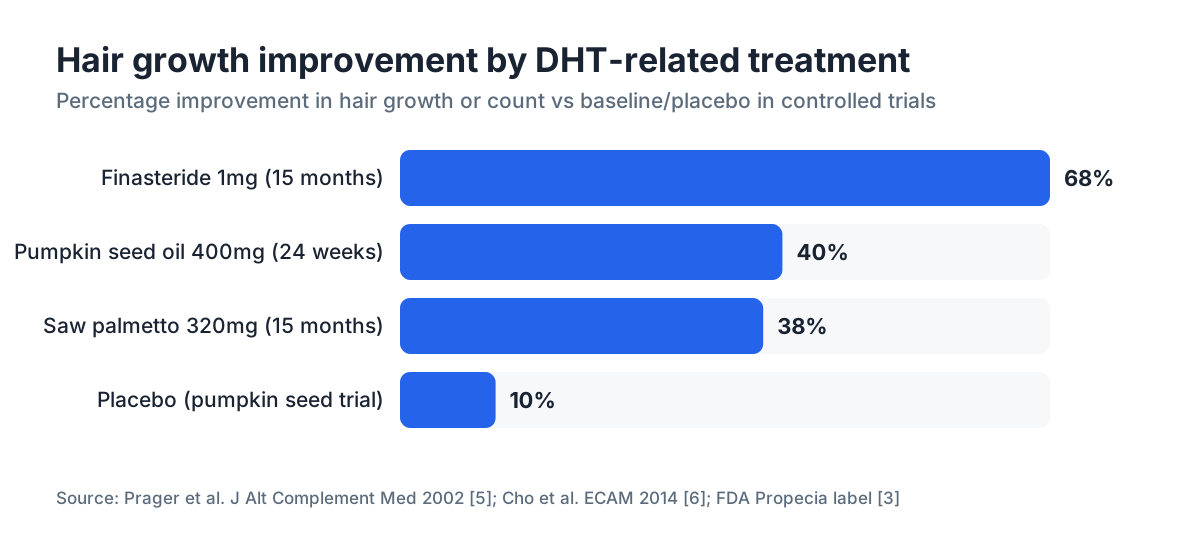
Saw palmetto (Serenoa repens) This is the most-studied herbal 5-alpha reductase inhibitor and the backbone of nearly every Amazon DHT supplement. A 2020 systematic review in Dermatology and Therapy reported that saw palmetto improved hair density in a majority of participants across the included trials, while flagging that those studies were small (mostly under 100 subjects) with methodological limitations [4]. A 2002 head-to-head trial in the Journal of Alternative and Complementary Medicine found saw palmetto 320 mg daily produced a 38% improvement in hair growth versus finasteride's 68% over the study period [5]. So it does something. It just does less.
Pumpkin seed oil A 2014 randomized, double-blind, placebo-controlled trial in Evidence-Based Complementary and Alternative Medicine gave men 400 mg of pumpkin seed oil daily for 24 weeks. The treatment group saw a 40% jump in hair count versus 10% for placebo [6]. Small trial, 76 men. Promising, but one trial doesn't settle a question.
Beta-sitosterol Usually combined with saw palmetto. Thin standalone hair loss data. Better studied for prostate symptom relief. The 2002 trial above included beta-sitosterol in the saw palmetto arm, so the two are hard to pull apart in the literature.
Biotin Biotin deficiency causes hair loss, but real deficiency is rare in people eating normally. Taking more than you need does nothing for hair loss, and the FDA has warned that high-dose biotin can throw off lab test results [7]. Most Amazon DHT blends toss biotin in because it sounds credible. Skip it unless a blood test says you're low.
Zinc and selenium Micronutrient shortfalls do correlate with diffuse shedding, but that's a different problem from DHT-driven miniaturization. If you're not deficient, extra zinc won't block DHT.
The honest summary: saw palmetto and pumpkin seed oil have the strongest (still modest) data. Everything else in these blends is filler from a DHT-blocking standpoint. For a wider look at the supplement landscape, see the hair loss supplements guide.
How do Amazon supplements compare to finasteride and minoxidil?
This is the comparison worth making before you spend a dollar.
| Treatment | Evidence level | Typical result at 1 year | Prescription needed | Avg monthly cost (US) |
|---|---|---|---|---|
| Finasteride 1 mg oral | RCTs, 5-year data, FDA-approved | ~48% increase in hair count vs placebo [3] | Yes | $10-$30 generic |
| Minoxidil 5% topical | RCTs, FDA-approved OTC | Moderate regrowth, halts loss in ~80% | No | $10-$20 |
| Finasteride + minoxidil combined | RCTs showing additive effect | Superior to either alone [8] | Yes (for fin) | $20-$50 |
| Saw palmetto supplement | Small RCTs, not FDA-approved | ~38-60% self-reported improvement, less than finasteride [4][5] | No | $15-$40 |
| Pumpkin seed oil | 1 RCT | ~40% increase in hair count (small trial) [6] | No | $10-$25 |
| Typical Amazon DHT blend | Mostly marketing, mixed ingredients | No reliable data for blends as sold | No | $20-$60 |
Finasteride's numbers trace back to Merck's original trials, where the drug cut scalp DHT by roughly 60-70% [3]. Saw palmetto, in the best-case comparison, lowered 5-alpha reductase activity in lab conditions but has never been tested for serum DHT reduction at anything close to that scale.
Here's the practical read. If your loss is mild and you want to try something without a prescription first, saw palmetto or pumpkin seed oil are reasonable low-risk bets. If you have visible thinning or a receding hairline and you want real regrowth, the evidence points hard at finasteride (with minoxidil alongside it). Read the full finasteride breakdown and the finasteride and minoxidil combination guide before you decide.
Men weighing topical options can start with the minoxidil for men article, which covers dosing, application, and what to expect.
What should I look for on an Amazon DHT blocker label?
The label tells you more than the marketing copy does, once you know what to read.
First, check for a USP Verified, NSF Certified, or Informed Sport mark. These third-party certifications confirm the product actually contains what it claims, in the doses listed. Amazon supplements aren't required to carry them, and plenty don't. A missing certification doesn't prove a product is fake. It just means you're trusting the manufacturer's own testing.
Second, look at the real dose of the active ingredient. The pumpkin seed oil trial used 400 mg daily [6]. The saw palmetto evidence clusters around 320 mg of a standardized extract daily [5]. Many blends pack 100-150 mg of each ingredient, splitting the total across a dozen components so the label looks impressive. A product with 12 ingredients at 50 mg each is almost certainly underdosing all of them.
Third, read the structure/function claim closely. Phrases like 'supports DHT metabolism' or 'promotes healthy follicles' are legally different from 'treats hair loss.' A supplement cannot legally claim to treat a disease under DSHEA [2].
Fourth, check price-per-dose, not price-per-bottle. A 60-count bottle at $40 that needs 4 capsules a day gives you 15 days of supply, not 30.
One thing people skip: if you take any prescription medication, especially hormone-related ones, ask a pharmacist. Saw palmetto has theoretical interactions with anticoagulants and hormonal drugs.
Do DHT blocker shampoos on Amazon actually work?
Probably not much. That's the honest answer.
Ketoconazole shampoo (like Nizoral) is the one topical with reasonable evidence. A 1998 study in Dermatology found ketoconazole 2% shampoo, used every 2-3 days, produced hair density gains comparable to minoxidil 2% over 6 months [9]. The proposed mechanism is anti-androgenic and anti-inflammatory, not straight DHT blockade. You can buy ketoconazole 1% over the counter (Nizoral A-D). The 2% version needs a prescription.
Everything else, including shampoos labeled with saw palmetto, caffeine, or herbal DHT-blocking blends, has almost no clinical backing. Shampoo sits on your scalp for a few minutes. Most active ingredients wash out before meaningful absorption happens, and the scalp barrier is less permeable than marketers claim.
Caffeine shampoo is a partial exception, with a little in-vitro data suggesting it can reach the follicle and partly counter testosterone's effect on hair shaft growth. Human trial evidence is thin, and the effect looks small [9].
If you want a scalp routine, ketoconazole 2-3 times a week plus topical minoxidil beats spending $40 on a botanical DHT shampoo.
Are there side effects from Amazon DHT supplements?
Mostly mild. Not zero risk.
Saw palmetto is generally well tolerated. The common complaints in trials are gut-related: nausea, stomach discomfort, loose stools. There are rare case reports of liver injury at high doses [4]. Saw palmetto has weak anti-androgenic activity, and a small number of men report reduced libido, though that's far less documented than with finasteride.
Pumpkin seed oil at 400 mg daily looked safe in the one published trial, with no notable adverse events [6].
Biotin at very high doses (10,000 mcg, which some supplements pack in) can falsely raise or lower thyroid and hormone lab results. The FDA warned about exactly this in 2019 [7]. If you have blood work coming up, stop biotin 3-5 days before.
The bigger worry with any Amazon blend is that the FDA doesn't verify safety before these products hit shelves. Problems get caught after the fact, through post-market surveillance. Novel herbal combinations sold as proprietary blends have essentially no safety track record at the doses being sold.
If you're eyeing finasteride and worried about its side effects, its risk profile is actually well characterized after more than 25 years of use, which is worth reading before you assume supplements are automatically safer. The minoxidil side effects page covers the OTC option's safety in detail.
Can women use DHT blocker supplements from Amazon?
Women get androgenetic alopecia too, and DHT contributes, though the pattern and mechanism differ from men (usually diffuse thinning rather than a receding hairline) [1].
Saw palmetto and pumpkin seed oil aren't inherently dangerous for women at normal supplement doses, but the evidence base is thinner still. Most of the trials that exist ran in men.
Women who are pregnant or trying to conceive should avoid any 5-alpha reductase inhibitor, herbal ones included. This is explicit for finasteride and dutasteride (FDA Pregnancy Category X) because DHT is required for normal male fetal development [3]. The risk from herbal inhibitors like saw palmetto is less studied, but the same caution applies.
Prescription options for women include topical minoxidil (FDA-approved), spironolactone (off-label but widely used), and low-dose oral minoxidil. Women trying to identify their pattern of loss might find the receding hairline article useful for telling types of thinning apart.
How long does it take to see results from DHT blocker supplements?
The hair cycle is slow. That's true for supplements and prescription drugs alike.
In the pumpkin seed oil trial, the meaningful gap between treatment and placebo showed up at 24 weeks [6]. The saw palmetto comparison ran 15 months [5]. Finasteride trials usually peak around 12 to 24 months [3].
Start any DHT-related treatment and judge it at 4 to 6 weeks, and you'll see nothing conclusive. Hair pushed into the catagen (transition) or telogen (resting) phase by DHT damage doesn't come back overnight.
Give any DHT blocker supplement at least 6 months of consistent daily use before you decide. Photograph your hairline and part width at the start under the same lighting each time. Without a baseline photo, you're relying on memory, which is unreliable for slow changes.
And if your shedding is sudden or diffuse rather than gradual, that pattern points toward telogen effluvium instead of DHT-driven loss, and a DHT supplement won't touch it. The telogen effluvium guide explains the difference.
What is the best DHT blocker supplement on Amazon?
No single product has enough rigorous evidence to call it 'best.' What follows is a framework, not an endorsement.
If you're set on buying from Amazon:
-
Look for at least 320 mg of standardized saw palmetto extract per day, ideally as a single ingredient or paired with pumpkin seed oil at 400 mg, rather than a blend with 10+ ingredients at trace doses.
-
Prioritize products with third-party testing (USP, NSF, or ConsumerLab). Several Amazon brands now list these.
-
Avoid blends with megadose biotin (anything above 2,500 mcg is unnecessary and risks lab interference) [7].
-
Single-ingredient saw palmetto or pumpkin seed oil capsules are usually cheaper and more dose-transparent than branded DHT blends charging a premium for the label design.
The most honest line here: if you're torn between a $35 Amazon supplement and a $15/month generic finasteride prescription, and your loss is past very early diffuse thinning, the prescription has decades of data behind it and will almost certainly do more. The supplement isn't a comparable substitute. It's a low-stakes first step or an add-on.
Want a data-driven read on your specific loss before spending anything? MyHairline's free AI scan (/scan) maps your hairline against Norwood stages and points you toward the right treatment category for what you're actually dealing with.
Is buying DHT blockers on Amazon safe and legitimate?
Amazon is a marketplace, not a pharmacy or a medical supplier. The platform sells reputable supplement brands right next to low-quality and counterfeit products. Third-party sellers can list almost anything that clears Amazon's category rules.
The practical safety risks for supplements:
Contamination. The FDA has found undisclosed pharmaceutical ingredients in some hair and sexual-health supplements, including prescription drugs that never appear on the label. Its analyses of the male sexual-health category repeatedly turned up undisclosed sildenafil or close analogues. Hair supplements are a lower-risk category for this specific problem, but the broader pattern of adulteration is real [2].
Underdosing. Independent testing of saw palmetto products has found that a meaningful share contain less than their claimed dose of active fatty acids. That's not unique to Amazon, but Amazon's low barrier to listing means more unvetted brands reach buyers.
Expiry and storage. Oil-based supplements (pumpkin seed, saw palmetto) can oxidize if stored badly. Third-party fulfillment warehouses don't always control temperature.
How to lower your risk: buy from brands listing a USP or NSF certification, confirm the product is sold by the brand or an authorized reseller, and skip the cheapest options in the category. A 60-day supply priced at $6 is cutting corners somewhere.
When should you stop relying on supplements and see a dermatologist?
The sooner you see a dermatologist, the more options you keep. Follicles that have fully miniaturized and formed scar tissue can't be restored by any drug or supplement. At that point the only route is a hair transplant.
See a dermatologist or hair loss specialist if any of these fit: you've been losing hair for more than 6 months and don't know why; your loss is patchy (could be alopecia areata, not DHT); you shed suddenly after illness, surgery, or major stress; you're a woman with diffuse thinning (many causes beyond DHT); or you've run a supplement for 6 months with no change.
A dermatologist can run a dermoscopy, check ferritin, thyroid, and hormone panels, and offer treatments calibrated to your actual pattern. Supplements from Amazon are a reasonable low-risk starting point for very early thinning. They aren't a substitute for a diagnosis.
The AAD recommends seeing a board-certified dermatologist for hair loss that causes distress or keeps spreading [1]. That recommendation exists for good reason.
Sources
- American Academy of Dermatology, Hair Loss Overview
- FDA, Dietary Supplements section
- FDA, Drugs@FDA database (Propecia, finasteride 1mg, NDA 020788)
- Evron E et al., Dermatology and Therapy, 2020. Saw palmetto systematic review
- Prager N et al., Journal of Alternative and Complementary Medicine, 2002. Saw palmetto vs finasteride
- Cho YH et al., Evidence-Based Complementary and Alternative Medicine, 2014. Pumpkin seed oil RCT
- Hu R et al., Journal of the American Academy of Dermatology, 2015. Finasteride plus minoxidil combination
- Piérard-Franchimont C et al., Dermatology, 1998. Ketoconazole shampoo vs minoxidil