
TL;DR: DHT blockers reduce dihydrotestosterone, the hormone that shrinks hair follicles in people genetically sensitive to it. Finasteride, the most studied oral DHT blocker, stopped further loss in about 83% of men and regrew hair in roughly 66% over two years. How much you get back depends on the drug, your genetics, and how early you start.
What does a DHT blocker actually do?
A DHT blocker lowers the hormone that shrinks your hair follicles. That's the whole job.
Dihydrotestosterone (DHT) forms when an enzyme called 5-alpha reductase converts testosterone inside hair follicle cells. In people with androgenetic alopecia (the most common cause of hair loss), follicles carrying a sensitivity gene read DHT as a signal to miniaturize. Hairs get finer, shorter, and eventually stop growing at all.
A blocker interrupts that. Depending on the drug, it either cuts how much DHT your body makes or stops DHT from binding to the follicle receptor. Less signal means less miniaturization. The follicle doesn't undo 30 years of shrinkage overnight, but it stops getting pushed further, and in many cases it partly recovers.
The payoffs are concrete: slowed loss, held density, and in a meaningful share of cases, regrowth of finer hairs that had shrunk but hadn't died. This is not a cure. Dead follicles do not come back. A follicle still producing even a wispy hair is almost always recoverable with enough DHT reduction, and that's the window you're trying to stay inside.
The mechanism explains why what causes hair loss matters before you spend a dime on a blocker. These drugs do essentially nothing for loss driven by iron deficiency, thyroid disease, or telogen effluvium. They target one thing: androgen-driven follicle miniaturization.
How much do DHT blockers slow or reverse hair loss?
The strongest numbers come from finasteride, studied longer and in bigger populations than any other DHT blocker. A two-year randomized controlled trial in the Journal of the American Academy of Dermatology found 83% of men on 1 mg finasteride daily had no further hair loss, against 72% in the placebo group who kept losing [1]. Some regrowth showed up in about 66% of finasteride users versus 7% on placebo.
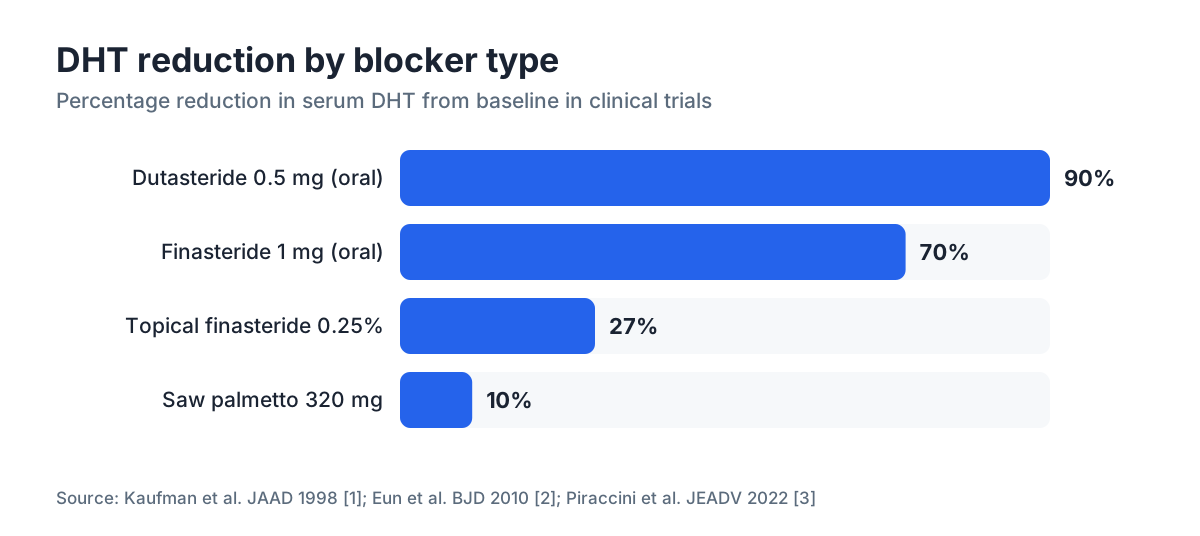
Dutasteride blocks both type I and type II 5-alpha reductase (finasteride hits only type II), so it drops DHT further. A head-to-head trial found dutasteride 0.5 mg cut scalp DHT by about 51% versus 41% for finasteride 1 mg, with numerically higher hair counts at 24 weeks [2]. The catch is a much longer half-life (roughly 5 weeks against finasteride's 6 to 8 hours), so any side effects take longer to clear once you stop.
Topical blockers work through the same enzyme but leak far less into the bloodstream. Topical finasteride 0.25% solution once daily lowered serum DHT by about 27% in one study, against roughly 70% for oral finasteride 1 mg [3]. That lower systemic exposure is the entire point for men worried about side effects. The likely trade is somewhat less power.
Ketoconazole 2% shampoo showed a small benefit in a limited study, raising hair density by about 8% over 21 weeks in men with androgenetic alopecia [4]. It's a complement, never a standalone plan.
| DHT Blocker | Route | DHT Reduction (serum) | Hair count benefit | Evidence level |
|---|---|---|---|---|
| Finasteride 1 mg | Oral | ~70% | Higher counts vs placebo at 2 yr | RCT, FDA-approved [1] |
| Dutasteride 0.5 mg | Oral | ~90% | Greater than finasteride at 24 wk | RCT, off-label in US [2] |
| Topical finasteride 0.25% | Topical | ~27% | Comparable to oral in some trials | Phase 2/3 trials [3] |
| Ketoconazole 2% shampoo | Topical | Indirect | ~8% density gain | Small RCT [4] |
| Saw palmetto | Oral supplement | Modest, variable | Weak positive signal | Low-quality trials [5] |
What are the specific benefits of DHT blockers beyond stopping hair loss?
Stopping loss is the headline. There are a few other wins worth naming.
Follicle recovery comes first. Miniaturized follicles that still push out any hair, even fine vellus hair, can often thicken back toward terminal hair once DHT pressure lifts. Dermatologists call this the treatment window. Start before the follicles have scarred over and you have something to recover. Finasteride's two-year data showed shaft diameter improving alongside count, sometimes more than raw hair numbers [1].
Scalp health is the second. At the scalp, high DHT feeds sebum overproduction in some people, which drives the low-grade inflammation ringing the follicle. Bringing DHT down can cut scalp oiliness and the mild folliculitis that a lot of men with pattern loss notice but never connect to their thinning.
Third, holding density buys time for bigger decisions. If you're weighing a hair transplant, slowing loss first keeps transplanted grafts from ending up marooned in a collapsing native hairline two years later. Most surgeons want stable baseline loss before they operate, and DHT blockers are the most reliable way to get there.
Fourth, they hit harder alongside minoxidil. The two drugs work by completely separate routes. Blockers attack the hormonal root; minoxidil for men stretches the growth phase and pushes blood flow to the follicle. A 2023 systematic review found combined therapy produced significantly better hair count outcomes than either drug alone [6]. If you want real results, the pairing is hard to argue against.
For how these two work together, see our guide on finasteride and minoxidil.
Who actually benefits from a DHT blocker?
Men with pattern hair loss are the main winners, and the earlier you start, the more you keep. The American Academy of Dermatology lists finasteride as a first-line treatment for male androgenetic alopecia [7]. The guidance is blunt that response runs better in men with mild to moderate loss than in those with wide bare scalp, because dead follicles don't answer the call.
Women with pattern loss can benefit too, though the picture is messier. Finasteride isn't FDA-approved for women and carries a hard pregnancy contraindication. Spironolactone, an aldosterone antagonist that also dampens androgen signaling, gets used off-label in women all the time. Dutasteride shows up off-label as well. The evidence in women is thinner than in men, but a 2021 review in Dermatology and Therapy found spironolactone gave clinically meaningful hair density improvement in most of the women with androgenetic alopecia studied [8].
People who likely won't get much from a blocker alone: those whose loss isn't androgen-driven. If your shedding followed a major illness, hard stress, dramatic weight loss, or thyroid trouble, the mechanism is different and a blocker won't touch it. Get a real diagnosis first.
Then there's genetics. Some people carry follicles that are extremely DHT-sensitive from androgen receptor variants, and they tend to respond dramatically. Others sit in the middle and get partial response. A small group loses hair through DHT-independent pathways even with a classic male pattern. Nobody can call which group you're in before you try. A family history heavy with paternal loss is a rough tell for DHT sensitivity.
What are the side effects and risks of DHT blockers?
Sexual side effects are the main worry with oral finasteride and dutasteride. The FDA label for finasteride 1 mg (Propecia) lists decreased libido, erectile dysfunction, and ejaculation disorder, each in roughly 1.3 to 3.8% of men in trials against 0 to 1.3% on placebo [9]. The label also notes post-marketing reports of sexual dysfunction that persisted after stopping the drug, sometimes called post-finasteride syndrome, though pinning down causation in that group has been hard.
The FDA added a label update in 2012 flagging post-marketing reports of libido, ejaculation, and orgasm disorders that continued after men quit [9]. That's a real warning. Anyone with a history of mood disorders or anxiety around sexual function should talk it through carefully with a doctor first.
Dutasteride's profile looks similar, but the long half-life means it clears your system slowly if problems start. Gynecomastia (breast tissue growth) is rare but documented with both drugs.
Topical formulations cut systemic exposure a lot. Topical finasteride 0.25% daily caused fewer sexual side effects than oral finasteride in the comparison studies run so far, though large long-term safety data still don't exist [3].
Ketoconazole at scalp doses barely gets absorbed as a shampoo. At oral or high doses it's hepatotoxic, but 2% shampoo on the scalp is a completely different exposure level.
Saw palmetto and other hair loss supplements that sell themselves as DHT blockers suppress far less DHT, and most studies show minimal side effects, which tracks with their minimal documented benefit next to prescription options.
The full read on finasteride, including how to make sense of the side effect data, is worth your time before you decide.
How long do DHT blockers take to show results?
Slow. That's the honest answer, and misreading the timeline is what makes people quit too early.
The first three to six months, you may see nothing. Hair runs on growth cycles of 2 to 4 years, and a follicle that has been shrinking for years doesn't snap back in weeks. Some men actually shed more in the first couple of months, because as the cycle resets, dying hairs drop out before new ones arrive.
By months four to six, shedding usually settles. Existing hair may look a touch fuller because follicles that were shrinking have stopped getting worse.
By twelve months, most men who respond to finasteride have measurable gains in hair count. The two-year trial data shows counts keep climbing through 24 months, then plateau or slowly slide as the drug holds hair rather than regrowing it forever [1].
Stop the drug and the benefit reverses. DHT returns to baseline, and within 6 to 12 months most of what you gained is gone. This is a chronic medicine for a chronic condition.
For most people, the honest minimum trial is 12 months before you decide it isn't working.
Are natural or over-the-counter DHT blockers actually worth it?
Short version: prescription blockers have 30 years of trial data. Natural options have weaker evidence and lower potency.
Saw palmetto (Serenoa repens) is the most-studied natural 5-alpha reductase inhibitor. A 2020 randomized trial in the Journal of Cosmetic Dermatology found saw palmetto 320 mg daily gave a statistically significant hair density improvement at 24 weeks against placebo, with an effect smaller than what finasteride posts [5]. If you have mild loss and real fear of prescription side effects, saw palmetto is a fair starting point. Just don't expect finasteride numbers.
Pumpkin seed oil gets quoted constantly online. One 2014 study of 76 men found a 40% jump in hair count with pumpkin seed oil 400 mg versus 10% on placebo [10]. It's a real study, not junk, but 76 people is tiny and a supplement company funded it. The effect may be genuine and modest. It's probably not your main play.
Zinc, biotin, collagen, and most of the pills sold as DHT-blocking hair vitamins have essentially no DHT-blocking mechanism that would matter at the doses on the shelf. They may help general hair health if you're deficient, but they aren't DHT blockers in any clinical sense.
Ketoconazole 2% shampoo (Nizoral) is over the counter and has real evidence. It's not a 5-alpha reductase inhibitor, but it does cut scalp DHT activity by another route. Use it two or three times a week as a complement, not a solo fix.
Some people search things like does creatine cause hair loss because of creatine's theoretical effect on DHT conversion. The evidence there is thin, but it shows why understanding the DHT pathway matters before you assume a supplement is helping or hurting.
Do DHT blockers work better when combined with other treatments?
Yes, and consistently. The evidence here is cleaner than almost anything else in hair loss treatment.
A 2023 systematic review and meta-analysis in JAMA Dermatology found combination therapy with finasteride and minoxidil produced significantly higher hair counts at 12 and 24 months than either drug alone [6]. The authors put it plainly: "combination therapy with finasteride and minoxidil was associated with significantly greater improvements in hair count and patient-reported outcomes than monotherapy." That's a direct quote from the stated conclusion.
The logic holds up. Finasteride handles the androgen-driven miniaturization. Minoxidil (a vasodilator that stretches the anagen growth phase) handles blood supply and cycle length. Neither covers the other's gap. Together they hit the problem from two sides.
For men who can't take oral finasteride, topical minoxidil plus ketoconazole shampoo plus topical finasteride (where available) is a fair lower-exposure stack. Data on that exact three-way combination is thin, but each piece has evidence behind it.
Adding a low-level laser therapy (LLLT) device on top of oral finasteride plus minoxidil has shown extra benefit in a handful of trials. The effect is modest and the devices cost a lot, so it's a third-line add-on, not a priority.
Here's the takeaway: if you're going to use a DHT blocker, pair it with minoxidil rather than going solo. That combination is what most dermatologists actually write.
What happens to the receding hairline specifically?
The front hairline is the tough spot. The temples and frontal edge tend to be the most DHT-sensitive areas in men with pattern loss, which is why recession usually starts there. It's also why a receding hairline often responds less completely to DHT blockers than the crown.
Finasteride trials tracking the frontal hairline show improvement, but generally less than at the vertex. A 48-week analysis of frontal scalp zones found a statistically significant hair count gain over placebo, with a smaller magnitude than at the crown [1].
This doesn't make treating a receding hairline with a blocker pointless. Slowing or halting progression at the temples is genuinely worth having, and partial thickening of shrunken hairs can shift how the hairline reads. But if you're hoping finasteride alone will rebuild a teenage hairline after years of recession, the realistic target is stability plus modest gain, not full recovery.
For deeper recession, the plan usually shifts to a blocker for stabilization plus a transplant to restore lost ground. The blocker keeps native hairs steady so the transplant has a stable frame to build inside.
When should I see a doctor before starting a DHT blocker?
Always, for prescription drugs. Finasteride and dutasteride need a prescription in the US and most countries. A physician, dermatologist, or telehealth provider licensed in your state has to evaluate you first.
For women this matters even more. Finasteride can cause genital abnormalities in a male fetus, so no clinician should hand it to a woman who is pregnant or might become pregnant. Even handling crushed finasteride tablets carries a warning on the FDA label [9].
For men, you want a diagnosis confirming androgenetic alopecia and not something else. Sudden diffuse shedding, patchy loss, or scalp inflammation all trace to different causes and won't respond to a blocker. A dermatologist can usually diagnose pattern loss on exam, sometimes with dermoscopy, occasionally with a scalp biopsy for the murky cases.
Baseline bloodwork (testosterone, DHT, thyroid panel) isn't always required but helps rule out other contributors. A telehealth service should ask about your medical history and current medications, since some drugs interact with finasteride.
For a quick read before your appointment, a free AI scan like the one at MyHairline can help you spot your Norwood stage and whether the pattern looks androgenetic, so you walk in with better information.
For most healthy adult men with clear pattern loss, the bar to starting finasteride is low. But self-diagnosing and ordering it from unverified online sellers skips the one step where somebody checks whether you even have a DHT-driven pattern.
How do I know if a DHT blocker is working for me?
The classic mistake is trusting a mirror and a gut feeling. Loss and regrowth move slowly enough that memory lies. Use photos.
Take a standardized set at baseline (same lighting, same angles, dry hair combed back) and repeat at 3, 6, and 12 months. Standardization is the whole game. A different angle or a different light can make the same scalp look 30% better or worse than it is.
Some dermatologists run trichoscopy or a hair density count at baseline and follow-up. That gives objective data but needs a clinic visit. At home, counting hairs shed into a controlled collection (a bag over the shower drain for a full week) gives a baseline shedding rate to check against later.
At 12 months, if shedding is clearly down and photos show held or improved density, the drug is working. If you're losing at the same rate as before treatment, either the diagnosis was off, the DHT-driven part is minor, or you're in the minority who don't respond to that drug.
Blood tests can confirm DHT suppression, but a serum DHT number alone doesn't predict hair outcomes, because scalp DHT and follicular sensitivity both matter. Some clinicians check serum DHT mainly to confirm you're actually taking and metabolizing the drug, not as a direct efficacy read.
The myhairline.ai periodic scan feature can also track visual change over time, giving you a consistent baseline to compare against as treatment goes on.
Sources
- Kaufman KD et al., Journal of the American Academy of Dermatology, 1998, Finasteride 1 mg RCT, 2-year hair count outcomes
- Eun HC et al., British Journal of Dermatology, 2010, Dutasteride vs finasteride comparative trial
- Piraccini BM et al., Journal of the European Academy of Dermatology and Venereology, 2022, Topical finasteride 0.25% spray phase 3 trial
- Piérard-Franchimont C et al., Dermatology, 1998, Ketoconazole shampoo RCT
- Wessagowit V et al., Journal of Cosmetic Dermatology, 2020, Saw palmetto RCT for androgenetic alopecia
- Huang C et al., JAMA Dermatology, 2023, Systematic review and meta-analysis of finasteride plus minoxidil combination
- American Academy of Dermatology, Hair Loss Diagnosis and Treatment guidelines
- Sinclair R et al., Dermatology and Therapy, 2021, Spironolactone for female pattern hair loss review
- FDA, Finasteride 1 mg (Propecia) prescribing information and label
- Cho YH et al., Evidence-Based Complementary and Alternative Medicine, 2014, Pumpkin seed oil RCT
- FDA, Dutasteride (Avodart) prescribing information
- National Institutes of Health MedlinePlus, Finasteride