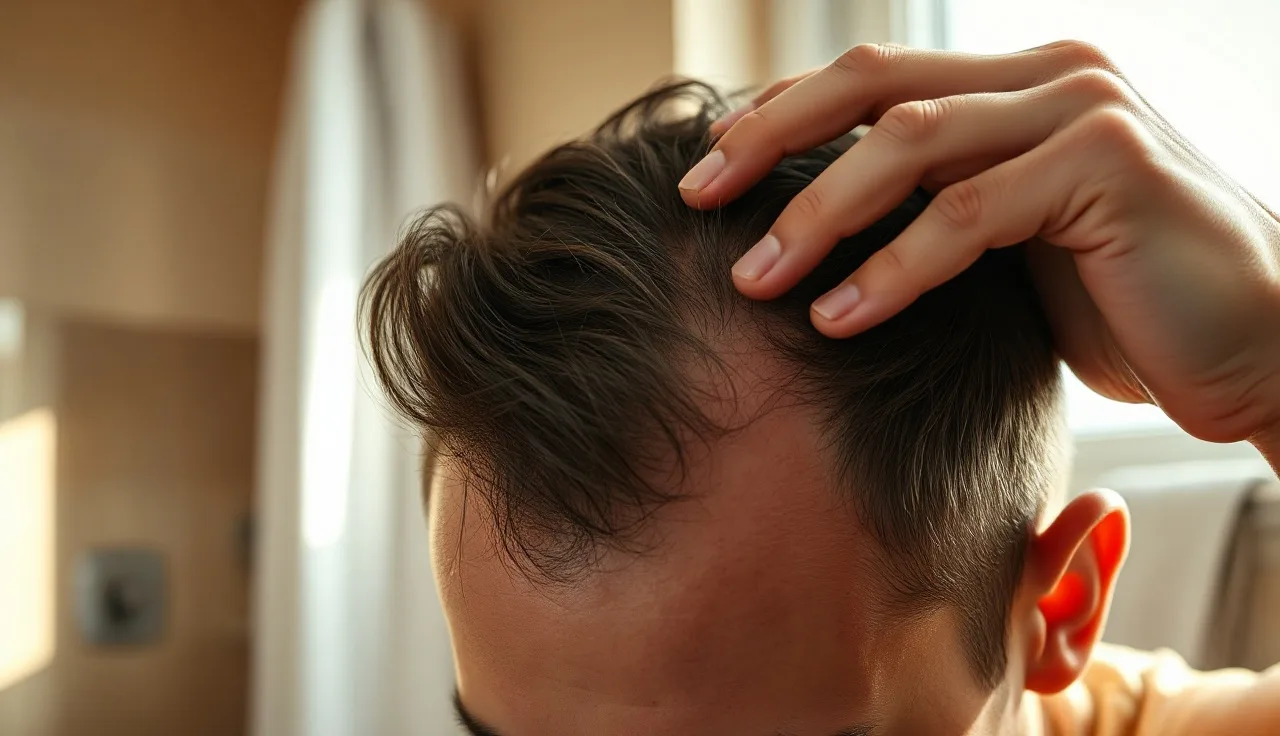
TL;DR: DHT (dihydrotestosterone) is the hormone that shrinks hair follicles in genetically susceptible people, and it drives most male and female pattern hair loss. Finasteride and dutasteride are the only DHT blockers with strong clinical evidence behind them. Topical versions exist but have thinner data. Most supplement-based DHT blockers have little proof they do much of anything.
What is DHT and why does it cause baldness?
Dihydrotestosterone, or DHT, is an androgen hormone your body makes when an enzyme called 5-alpha reductase converts testosterone. That conversion happens in your scalp, skin, liver, and prostate. For most people it does nothing remarkable to the hair. The problem is genetics.
Some people inherit hair follicles that are unusually sensitive to DHT. When DHT binds to androgen receptors in those follicles, it shortens the growth phase (anagen) of each hair cycle. Over repeated cycles, the follicle miniaturizes: the hair grows thinner, shorter, and eventually stops producing a visible shaft at all. That process is called follicular miniaturization, and it's the defining event in androgenetic alopecia (AGA), which accounts for roughly 95% of hair loss in men [1].
The enzyme responsible comes in two forms. Type 1 is active in sebaceous glands and the liver. Type 2 sits mostly in hair follicles and the prostate, which is why drugs that block Type 2 tend to hit scalp hair loss hardest.
Not everyone loses hair at the same rate even with high DHT. Genetics set how many androgen receptors your follicles carry and how sensitive those receptors are. Some men with sky-high testosterone keep thick hair into their eighties. Others start thinning at 22. The hormone alone doesn't decide the outcome. The follicle's response to it does. That distinction sets your realistic expectations for any DHT-blocking treatment. If you want the full picture of what's happening on your head, what causes hair loss covers the other contributing factors too.
How do DHT blockers actually work?
A DHT blocker does one of two things. It either inhibits the 5-alpha reductase enzyme so your body makes less DHT, or it competes with DHT at the androgen receptor so DHT can't bind as well. Almost every treatment worth taking seriously works the first way, by blocking the enzyme.
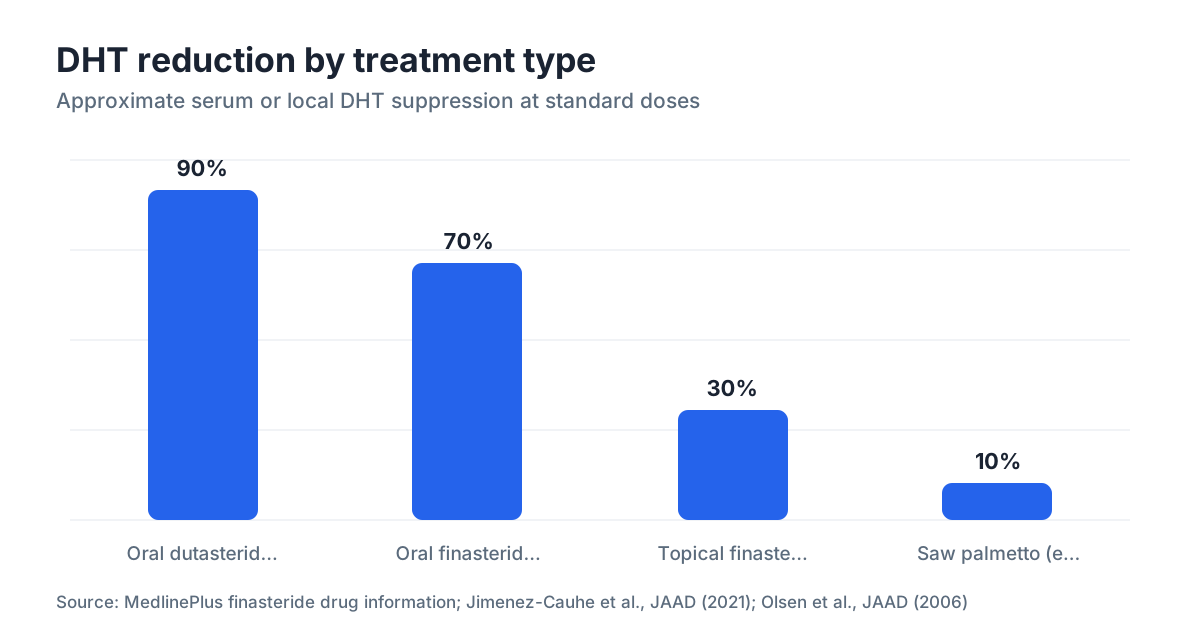
Finasteride selectively inhibits 5-alpha reductase Type 2. At the standard oral dose of 1 mg per day, it cuts serum DHT by roughly 70% [2]. Dutasteride inhibits both Type 1 and Type 2, dropping serum DHT by about 90% at its standard 0.5 mg daily dose [3]. Those two drugs are the backbone of DHT-blocking therapy.
Topical finasteride, topical dutasteride, and topical spironolactone work locally at the scalp. The goal is to block DHT where it matters for hair while keeping systemic hormone exposure low. The data on these is thinner but growing.
Some natural compounds such as saw palmetto also inhibit 5-alpha reductase in test-tube studies. In a living human at realistic doses, the inhibition is far weaker than what a pharmaceutical delivers. More on those below.
Here's one way to picture it. If finasteride removes 70 of every 100 DHT molecules that would otherwise reach your follicles, saw palmetto might remove 5 to 15, with wide variation across studies and people. Whether 5 to 15 is enough to matter is genuinely unclear.
Which DHT blockers have the strongest clinical evidence?
Evidence quality is all over the map across DHT blockers. Here's an honest breakdown.
Finasteride (oral, 1 mg): The most studied option by a wide margin. The registration trials that led to FDA approval showed 83% of men on finasteride held their hair count versus baseline after two years, compared with 28% on placebo [2]. About 66% showed visible improvement. Finasteride got FDA approval for male pattern hair loss in 1997 [2]. It works best at the crown and mid-scalp. The evidence at the hairline is weaker.
Dutasteride (oral, 0.5 mg): More potent than finasteride because it blocks both isoforms of 5-alpha reductase. A 2006 randomized controlled trial in the Journal of the American Academy of Dermatology found dutasteride 0.5 mg beat finasteride 1 mg at increasing hair count over 24 weeks [3]. Dutasteride is FDA-approved for benign prostatic hyperplasia and used off-label for hair loss in the US. It is approved for AGA in South Korea and Japan.
Topical finasteride: Formulations usually run 0.25% to 1%. A 2021 study in the Journal of the American Academy of Dermatology found 0.25% topical finasteride once daily gave scalp DHT suppression comparable to oral finasteride, with much lower systemic exposure [4]. You get it compounded or through certain telehealth providers. It is not yet an FDA-approved standalone product for hair loss.
Topical dutasteride: A 0.1% solution was tested in a 2020 randomized controlled trial and produced statistically significant hair count gains over placebo, with low systemic absorption [5]. Still mostly in the compounding or early-approval stage in most markets.
Spironolactone (oral): An androgen receptor blocker, not a 5-alpha reductase inhibitor. Used often in women with pattern hair loss. Not appropriate for men because of feminizing side effects at effective doses.
See finasteride and dht blocker for more detail on dosing and monitoring.
| Treatment | Mechanism | DHT Reduction | Evidence Level | FDA Status (Hair Loss) |
|---|---|---|---|---|
| Oral finasteride 1 mg | 5AR Type 2 inhibition | ~70% serum | Multiple RCTs | Approved (men) |
| Oral dutasteride 0.5 mg | 5AR Type 1+2 inhibition | ~90% serum | RCTs | Off-label (US) |
| Topical finasteride 0.25% | 5AR Type 2 inhibition | ~30% serum | Small RCTs | Not approved |
| Topical dutasteride 0.1% | 5AR Type 1+2 inhibition | Scalp-local | Early RCTs | Not approved |
| Saw palmetto | Weak 5AR inhibition | Unknown/low | Mixed, small studies | Not approved |
| Spironolactone (oral) | Androgen receptor blockade | N/A | RCTs (women) | Off-label |
What side effects do DHT blockers cause?
This is where most people get anxious, and reasonably so. DHT does more than grow beards and shrink hairlines. It affects libido, erectile function, mood, and in women, several androgen-driven processes.
For oral finasteride, the FDA-approved label reports sexual side effects (decreased libido, erectile dysfunction, decreased ejaculate volume) in 3.8% of men taking 1 mg, compared with 2.1% on placebo [2]. Those numbers come from the original approval trials. Real-world surveys and post-market reports suggest the rate runs higher for some men, though differences in study design make direct comparison hard. A condition called Post-Finasteride Syndrome (PFS), meaning persistent sexual, neurological, and psychological symptoms after stopping the drug, has been reported. The FDA added a label update about this in 2012, but the mechanism and true prevalence are still argued over in the literature [6].
Dutasteride's side effect profile is similar. Because dutasteride's half-life is roughly five weeks (versus six to eight hours for finasteride), side effects can take longer to fade after stopping.
Topical versions cut systemic exposure meaningfully, which in theory should mean fewer systemic side effects. The 2021 topical finasteride study found serum DHT dropped about 30% versus the 70% from oral, pointing to much lower systemic activity [4]. Whether that shows up as fewer sexual side effects in practice needs larger trials to confirm.
Spironolactone in men causes gynecomastia and feminizing effects at doses that work for hair loss, which is why it's basically reserved for women here.
For how minoxidil fits alongside these (it works differently, not as a DHT blocker), see minoxidil side effects.
Do natural or supplement-based DHT blockers work?
Honestly, the evidence is thin. That's not a flat no. But the data does not come close to justifying the confidence you'll find on supplement labels.
Saw palmetto (Serenoa repens): The most studied natural option. It inhibits 5-alpha reductase in vitro, and a 2020 systematic review in Dermatology and Therapy found some evidence of benefit for AGA. The catch: the studies were small, used different doses and formulations, and ran for short periods [7]. The reviewers called the evidence promising but not enough to recommend it as a primary treatment. In a head-to-head trial, finasteride performed better, though saw palmetto did beat placebo.
Pumpkin seed oil: One small randomized trial of 76 men showed more hair count in the pumpkin seed oil group after 24 weeks. Interesting. But one trial of 76 people is not enough to build a plan on.
Beta-sitosterol: A plant sterol that also inhibits 5-alpha reductase in the lab. Human trial data for hair loss is sparse.
Caffeine (topical): Sometimes marketed as a DHT blocker. The proposed mechanism is different. Caffeine appears to counter DHT's effect on follicles through adenosine pathways in cell models, but human clinical data is extremely limited.
Biotin, zinc, and other micronutrients: These support general hair health and matter if you're genuinely deficient, but they are not DHT blockers. Fix a real zinc deficiency and you might help your hair. Pile on zinc when you're not deficient and you block zero DHT. See hair loss supplements for the full breakdown.
If you're shedding real hair and want to stop the slide, supplements alone almost never do the job. They can be reasonable add-ons. They make poor primary strategies.
Can women use DHT blockers for hair loss?
Yes, but the options differ from men's, and the rules are stricter in a few ways.
Finasteride is contraindicated in women who are pregnant or may become pregnant because DHT drives normal fetal development, especially for male fetuses. Exposure during pregnancy can cause birth defects in male babies [2]. The FDA label for finasteride lists pregnancy as a contraindication and warns that women should not handle crushed or broken tablets. As the label puts it, women who are or may become pregnant should not use the drug and should not handle the tablets.
That said, finasteride is used off-label for female pattern hair loss in postmenopausal women, usually at 1 to 2.5 mg. A 2019 review in the Journal of the American Academy of Dermatology found evidence that finasteride at 1 to 5 mg improved hair density in women with AGA, though it noted the trials were small and inconsistent [8].
Spironolactone is the more common first-line oral DHT-pathway blocker for women in the US. It blocks androgen receptors instead of cutting DHT production, and most gynecologists and dermatologists feel more comfortable prescribing it to premenopausal women who use reliable contraception. Doses run 50 to 200 mg daily.
Dutasteride is also used off-label in women, with even less hair-specific trial data than finasteride.
For women, a dermatologist's evaluation matters a lot. Female hair loss often involves other drivers (thyroid problems, iron deficiency, postpartum hormonal shifts) that mimic AGA but need different treatment. See telogen effluvium for one common pattern that looks like AGA and isn't.
How long does it take for DHT blockers to work?
Longer than most people expect. That gap is exactly where people trip: they quit early and decide the treatment failed.
Hair growth cycles run in phases lasting months. Blocking DHT doesn't grow new hair overnight. It stops further miniaturization and lets follicles stuck in a shortened growth phase cycle back toward something healthier. That takes time.
With oral finasteride, the clinical trials used 12 to 24 months as their endpoint for meaningful results [2]. Most hair loss doctors will tell you to give any DHT blocker at least 12 months before you judge it. Some patients see early shedding in the first few months (often follicles cycling in sync, and usually temporary). Some see nothing until month nine or later.
Dutasteride suppresses DHT harder, so results may come a bit faster, but the timeframe is still months, not weeks.
Stop the drug and the DHT suppression reverses. Hair loss typically resumes within six to twelve months, drifting back toward where it would have been without treatment. The drug doesn't cure the genetic sensitivity. It manages the hormonal signal that drives miniaturization. This is ongoing treatment, not a one-time fix.
Tracking with consistent photos (same lighting, angle, and timing) every three months beats what you think you see in the mirror day to day. Some telehealth platforms and tools like the free AI scan at MyHairline help you track hairline and density changes over time without the guesswork.
Can you combine a DHT blocker with minoxidil?
Yes, and it's what most hair loss specialists recommend for anyone with moderate to significant AGA.
Minoxidil and DHT blockers work by completely different mechanisms. Minoxidil is a vasodilator that extends the anagen (growth) phase and increases blood flow to follicles. It does nothing to lower DHT. Finasteride and dutasteride lower DHT but don't directly stimulate follicle activity the way minoxidil does. Together they hit two separate parts of the problem.
The combination has solid support. A 2021 randomized trial in the Journal of the American Academy of Dermatology found oral minoxidil (0.5 to 1 mg daily) combined with finasteride beat either drug alone for hair count improvement [9]. The trial was small (90 participants), but the direction of effect matched what practitioners see in clinic.
Topical minoxidil plus oral finasteride is the most commonly prescribed pairing in the US. Some products now put both in a single topical solution (finasteride and minoxidil together), which can help people actually stick with it.
For men starting at Norwood Stage 2 to 4, a dermatologist will often recommend starting both at once rather than sequencing them. The logic is simple: AGA keeps progressing, and attacking only one pathway while the other runs unchecked means a slower or weaker response.
See finasteride and minoxidil and minoxidil for men for specific dosing guidance.
What about DHT blockers for a receding hairline specifically?
The hairline is one of the harder places to treat with DHT blockers, and being straight about that matters.
Finasteride's original approval trials showed the drug worked better at the vertex (crown) and mid-scalp than at the anterior hairline [2]. Nobody fully understands why, but it may come down to follicle density and androgen receptor expression varying across the scalp.
Still, finasteride and dutasteride can slow hairline recession. Whether they regrow hair at the hairline is less consistent. Most practitioners treat DHT blockers as a way to slow or halt recession, with hairline regrowth as a bonus when it shows up rather than the main expected result.
For men who have already lost real hairline territory, DHT blockers alone rarely rebuild a natural-looking frontal hairline. That's where hair transplants come in. A transplant restores coverage permanently using DHT-resistant follicles from the back of the scalp, but it does nothing to stop ongoing native loss. That's exactly why surgeons almost always tell you to keep taking finasteride or dutasteride after a transplant to protect the native hair you still have.
If a receding hairline is your main worry, receding hairline breaks down what treatments make sense at each stage of recession.
Are there any DHT blockers that don't affect sexual function?
This is the question most men actually want answered while they sit on the fence about finasteride.
Topical finasteride and topical dutasteride are the most promising answers right now. Applied directly to the scalp, they cut systemic absorption a lot. The 2021 topical finasteride study found serum DHT fell about 30% versus 70% for oral finasteride, while local scalp DHT suppression stayed effective [4]. Lower systemic DHT should, in theory, mean fewer systemic side effects.
No large randomized trial has yet compared sexual side effect rates head-to-head between oral and topical finasteride in humans. That data will come. The mechanistic argument is sound. The clinical confirmation at scale is still pending.
Saw palmetto and other natural 5-alpha reductase inhibitors at realistic doses probably don't cause meaningful sexual side effects, but partly because their effect on DHT is also modest.
If you tried oral finasteride and had side effects, talk to a dermatologist about topical formulations before you write off the whole drug class. For some men the switch clears the side effects while keeping the hair benefit.
One honest note. Some sexual side effects blamed on finasteride may be nocebo effects (harm caused by the expectation of harm). A 2007 study in European Urology found that men told about sexual side effects before starting finasteride reported them at roughly three times the rate of men who weren't told [10]. That doesn't mean the side effects aren't real for the men who feel them. It means the picture is messy.
What happens if you stop taking a DHT blocker?
Hair loss resumes. That's the short answer, and you should sit with it before you start.
DHT blockers suppress the hormone signal that drives follicle miniaturization. While you're on the drug, miniaturization slows or stops, and sometimes partially reverses. Stop, and DHT levels return to baseline within days to weeks (fast for finasteride with its six-to-eight-hour half-life, slower for dutasteride with its roughly five-week half-life). As DHT comes back, miniaturization restarts.
Most clinicians and the clinical literature say that within six to twelve months of stopping, men lose a good chunk of the hair they gained or held onto, drifting back toward the trajectory their loss would have followed untreated [2].
This isn't a reason to avoid DHT blockers. It's a reason to think before you start. If you begin at 28 and plan to take finasteride until you decide to stop, understand you're signing up for long-term management, not a cure. Some men pause for a stretch (surgery, fertility, side effects) and restart later. That's reasonable, though you'll lose ground during the gap.
Fertility is worth flagging. Finasteride reduces semen volume and can lower sperm count in some men. The effect appears reversible after stopping. Men actively trying to conceive should sort out timing with the prescribing doctor.
Sources
- American Academy of Dermatology, Hair Loss Overview
- U.S. National Library of Medicine, MedlinePlus, Finasteride drug information
- Olsen EA et al., Journal of the American Academy of Dermatology, 2006. Dutasteride vs finasteride RCT.
- Jimenez-Cauhe J et al., Journal of the American Academy of Dermatology, 2021. Topical finasteride study.
- Gubelin Harcha W et al., Journal of the American Academy of Dermatology, 2020. Topical dutasteride RCT.
- U.S. Food and Drug Administration, Drug Safety and Availability
- Evron E et al., Dermatology and Therapy, 2020. Saw palmetto systematic review.
- Yeon JI et al., Journal of the American Academy of Dermatology, 2019. Finasteride in women review.
- Randolph M and Tosti A, Journal of the American Academy of Dermatology, 2021. Oral minoxidil plus finasteride RCT.
- Mondaini N et al., European Urology, 2007. Nocebo effect and finasteride sexual side effects.
- National Institutes of Health, MedlinePlus, Dutasteride drug information
- U.S. National Center for Biotechnology Information, StatPearls, Androgenetic Alopecia