
TL;DR: DHT blockers, mainly finasteride and dutasteride, slow or stop male pattern hair loss by cutting dihydrotestosterone levels. Most men see stabilization within 3-6 months and real regrowth by month 12. About two-thirds of finasteride users show measurable improvement after two years. Results are real but gradual, and they reverse if you stop.
What is a DHT blocker and how does it work on hair follicles?
Dihydrotestosterone (DHT) is the androgen responsible for shrinking genetically sensitive hair follicles over time, a process called follicular miniaturization. It's made when the enzyme 5-alpha reductase converts testosterone into DHT, mostly in the scalp, skin, and prostate. Follicles that carry the androgen receptor variant linked to androgenetic alopecia respond to DHT by producing progressively thinner, shorter hairs until they stop producing terminal hair entirely.
A DHT blocker is any compound that either blocks 5-alpha reductase (preventing DHT production) or, theoretically, blocks androgen receptors directly. In practice, the two drugs with real clinical evidence are finasteride and dutasteride. Finasteride blocks type II 5-alpha reductase and cuts scalp DHT by roughly 60-70% [1]. Dutasteride blocks both type I and type II isoforms and cuts DHT more aggressively, by around 90% [2].
Topical saw palmetto and other OTC "DHT blockers" exist, but their in-vivo evidence is weak and inconsistent. They're worth knowing about, but they're not in the same league as the prescription 5-alpha reductase inhibitors.
For a broader look at why DHT matters to the hair loss process, see our overview of what causes hair loss and the detailed guide on DHT blockers.
What do DHT blocker before and after results actually look like?
The honest answer is: gradual, and often underwhelming in photos but meaningful in hair count.
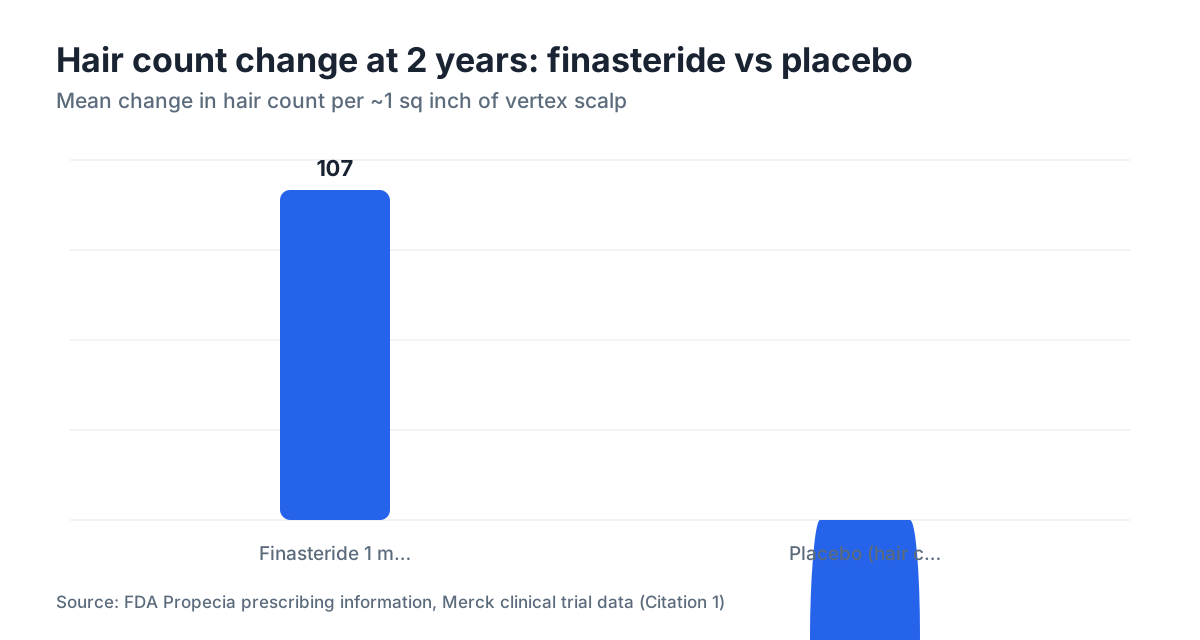
In the two-year finasteride trials published in the Journal of the American Academy of Dermatology, 66% of men taking 1 mg/day finasteride showed increased hair growth versus baseline, compared with 7% in the placebo group [1]. Mean hair count in a 1-inch circle of the vertex (crown) increased by about 107 hairs in the finasteride group and decreased by 75 hairs in placebo over 2 years. That's a swing of roughly 182 hairs per square inch on paper, but what you see in mirror light is a thicker, less see-through zone rather than a dramatic transformation.
The hairline (frontal recession) responds more slowly and less completely than the crown. Most trial photography confirms this. Men with Norwood II-III patterns tend to see better cosmetic outcomes than men at Norwood V-VI, because early intervention preserves follicles that haven't fully miniaturized yet.
Dutasteride's before-and-after data looks stronger numerically. A 24-week randomized controlled trial found dutasteride 0.5 mg produced significantly greater increases in hair count than finasteride 1 mg, and a Korean study showed dutasteride was superior at every measured dose level [3]. Whether that translates into visually dramatic results varies widely by individual.
Before-and-after photos on forums and marketing sites are almost always the best responders, shot under flattering light, at specific angles. They're real results, but they're not average results. If you're trying to set expectations for yourself, the clinical trial numbers are far more useful than the photos.
How long does it take to see before and after changes on a DHT blocker?
Patience is the most underrated part of this treatment.
The hair growth cycle means you won't see results on a short timeline. A telogen (resting) follicle takes 2-3 months to enter anagen (growth) phase, and then the hair has to physically grow to a visible length. The earliest meaningful signal most men notice is reduced shedding, which can start at 3-6 months. Some men also experience a temporary increase in shedding in the first 1-3 months as follicles shift cycles in response to the changed DHT environment. This shed is usually temporary, but it can be alarming if you're not expecting it (see our article on telogen effluvium for more context).
Months 6-12 is where noticeable stabilization becomes visible, and some men start seeing new vellus hairs or thickening.
Month 12-24 is the real window for measuring regrowth. The clinical trials use 2-year endpoints for good reason: that's how long the drug needs to express its full benefit.
If you've taken finasteride consistently for 12 months and see absolutely no change, that's a reasonable point to reassess with a dermatologist. About one-third of men are non-responders, and continuing indefinitely without any benefit doesn't make sense.
Here's a rough timeline based on trial data and clinical observation:
| Timeframe | What typically happens |
|---|---|
| 0-3 months | DHT levels fall quickly; no visible hair change yet |
| 3-6 months | Shedding may decrease; some men see temporary shed |
| 6-12 months | Stabilization visible; early thickening possible |
| 12-24 months | Measurable regrowth for ~66% of responders [1] |
| 24+ months | Continued maintenance; peak benefit around 2 years |
| After stopping | Most gained hair lost within 9-12 months [1] |
Does the before and after differ between finasteride and dutasteride?
Yes, and the difference is worth understanding before you choose.
Finasteride 1 mg (Propecia, and now many generics) is the FDA-approved option for androgenetic alopecia in men [1]. It reduces DHT by approximately 60-70% at the scalp. The clinical data behind it spans decades and tens of thousands of patients.
Dutasteride 0.5 mg (Avodart) is FDA-approved only for benign prostatic hyperplasia, not for hair loss, though it's commonly prescribed off-label by dermatologists. Its deeper DHT suppression, around 90%, does appear to produce greater hair count improvements in head-to-head trials [3]. A 24-week randomized trial published in the Journal of the American Academy of Dermatology found dutasteride 0.5 mg significantly outperformed finasteride 1 mg on total and anagen hair counts [3].
The practical tradeoff is that dutasteride's longer half-life (roughly 5 weeks versus finasteride's 6-8 hours) means if you develop side effects, they take much longer to clear after stopping. For most men who tolerate a 5-alpha reductase inhibitor, the side effect profile is similar between the two drugs, but dutasteride is the less reversible choice in the short term.
If you want the most evidence, start with finasteride. If you've tried finasteride for a year with minimal response and a dermatologist agrees, dutasteride is a reasonable next step.
For a detailed breakdown of finasteride specifically, see our guide on finasteride.
What side effects should you know about before starting a DHT blocker?
The FDA label for finasteride 1 mg reports sexual side effects, including decreased libido, erectile dysfunction, and decreased ejaculate volume, in 1.8-3.8% of men in clinical trials, compared with 1.3-2.1% in the placebo group [1]. Those numbers are modest, and most side effects resolved in men who discontinued the drug.
Post-finasteride syndrome is a contested topic. Some men report persistent sexual, neurological, and psychological symptoms after stopping finasteride. The FDA added a label update in 2012 acknowledging reports of persistent sexual side effects after discontinuation [4]. The causal mechanism is not established and studies on its prevalence are inconsistent, but the reports are real enough that the FDA took them seriously. If you experience any mental health symptoms while on finasteride, contact a doctor immediately.
Dutasteride carries similar warnings. Because it's more potent and longer-acting, any side effects that do develop take longer to resolve after stopping.
Topical finasteride, which some compounding pharmacies offer, delivers the drug to the scalp with lower systemic absorption. A pilot study found topical finasteride 0.25% applied once daily achieved similar hair density improvements to oral 1 mg with substantially lower serum DHT reduction, suggesting a potentially better side effect profile [5]. This is an active area of research, not yet FDA-approved as a standalone formulation, but worth discussing with a dermatologist.
Minoxidil is often added alongside a DHT blocker because it works through a completely different pathway (vasodilation and potassium channel opening rather than DHT suppression). The combination of finasteride plus minoxidil has additive evidence behind it. See our guide on finasteride and minoxidil for the combined data.
Do DHT blockers work the same for women?
No, and this is an area where most "before and after" content misleads people badly.
Finasteride is not FDA-approved for hair loss in women and is specifically contraindicated in women who are pregnant or may become pregnant because of the risk of feminizing a male fetus [1]. Some dermatologists do prescribe it off-label to postmenopausal women at 1-2.5 mg/day, and small studies suggest benefit, but the evidence base is far weaker than in men.
Spironolactone is the most commonly prescribed androgen-blocking option for women in the US. It's an aldosterone antagonist that also blocks androgen receptors and reduces adrenal androgen production. The American Academy of Dermatology recognizes it as a treatment option for female pattern hair loss, typically at 100-200 mg/day [6]. It requires monitoring for potassium levels and blood pressure.
For women, minoxidil (2% or 5% topical, or oral) remains the most reliably proven treatment, with FDA approval for female pattern hair loss [7].
If you're a woman researching DHT blockers because of hair thinning, the before-and-after photos you'll find online are mostly from men on finasteride. Your treatment conversation with a dermatologist will look quite different.
Can you combine a DHT blocker with minoxidil for better before and after results?
Yes, and the combination has real supporting data.
A 12-month randomized trial found that men using finasteride plus topical minoxidil had significantly greater increases in total hair count compared with either drug alone [8]. The logic is straightforward: finasteride stops the cause of miniaturization (DHT), while minoxidil stimulates growth through a separate mechanism. You're attacking the problem from two angles simultaneously.
In clinical practice, many dermatologists start patients on both agents at the same time. Some prefer to establish a baseline on finasteride first before adding minoxidil, partly to isolate any side effects. There's no strong evidence one sequencing approach is better.
The combination does mean doubling your monitoring responsibilities and costs. Oral minoxidil has its own side effect profile, including fluid retention and unwanted body hair growth, which is worth reading about separately. See our articles on minoxidil for men and oral minoxidil for the specifics.
If money is a constraint, generic finasteride costs roughly $15-30 per month and generic topical minoxidil 5% costs $10-20 per month, making the combination around $25-50/month total before any consultation fees. That's meaningfully cheaper than most professional treatments and substantially cheaper than a hair transplant.
What do before and after photos miss about DHT blocker results?
Quite a lot.
Photos can't show the hairs you didn't lose. The most common and arguably most important outcome of a DHT blocker is stabilization, not regrowth. For many men, success looks like hair that looks the same at age 40 as it did at 33. That's a genuinely great result, but it photographs as "no change" and never gets posted to Reddit.
Photo conditions matter enormously. Wet hair, harsh overhead lighting, and a close-up angle will reveal far more thinning than dry hair under a diffuse light. Many before photos are taken under unfavorable conditions, and after photos under flattering ones. The reverse manipulation happens too.
Timing is selective. You're almost never seeing month 3 or 6 results in before-and-after posts. You're seeing the best result at the best time.
Nobody posts the non-responders. Around one-third of men don't see meaningful regrowth from finasteride [1]. They're largely invisible in the before-and-after ecosystem.
The right way to track your own progress is standardized photography: same camera position, same lighting, same wet/dry state, taken every 3 months. Apps like the free AI hair analysis at MyHairline can help you track change objectively over time without relying on your memory of what your hair looked like a year ago.
Don't let the best-case photos create expectations that make you abandon a treatment that's actually working.
What Norwood stages respond best to DHT blockers?
Norwood II through IV is where DHT blockers tend to produce the most visible before-and-after improvement.
At Norwood II-III, many follicles are miniaturized but not yet dead. DHT blockers can allow those follicles to recover to a more normal growth cycle, producing visible thickening and some hairline stabilization. Regrowth is genuinely possible here.
At Norwood IV, the crown is significantly thinned but not fully bald. Finasteride clinical trials focused heavily on vertex (crown) endpoints, and this is where most documented regrowth photographs come from [1]. Frontal recession at this stage may stabilize but is harder to reverse.
At Norwood V-VII, large areas of the scalp have follicles that are permanently miniaturized or gone. DHT blockers can slow further loss in the remaining hair but cannot regenerate follicles that have been destroyed. If you're at this stage, a hair transplant consultation is likely worth having alongside any medical therapy.
This is why timing matters so much. Starting a DHT blocker at Norwood II is categorically different from starting at Norwood VI. The before-and-after potential is not the same.
For context on your current stage, see our guide on receding hairlines.
Are there non-prescription DHT blockers with real before and after evidence?
Honest answer: not much.
Saw palmetto is the most studied OTC option. It inhibits 5-alpha reductase weakly and has some randomized controlled trial data. A 2002 study found 60% of men taking saw palmetto 200 mg twice daily showed improvement in hair quality versus 11% in the placebo group [9]. That sounds good until you look at the sample size (26 men) and realize the outcome was self-reported. A larger Cochrane systematic review concluded saw palmetto trials were too small and poorly controlled to draw firm conclusions [11].
Pumpkin seed oil has one randomized controlled trial (40 men, 24 weeks) showing a 40% increase in hair count versus 10% in placebo [10]. Intriguing, but not replicated in larger trials.
Ketoconazole 2% shampoo has some modest androgen-blocking activity at the scalp and is sometimes discussed alongside DHT blockers. One small study compared it to 2% minoxidil and found similar hair density outcomes, but this hasn't been replicated consistently [6].
None of these options have anywhere near the clinical evidence of finasteride or dutasteride. If you're committed to avoiding prescription drugs, they're reasonable to try and low-risk, but go in with adjusted expectations. The before-and-after results you'll find from OTC DHT blockers online are almost all anecdotal.
For more context on supplements with hair loss claims, see our guide on hair loss supplements.
What happens to your hair if you stop taking a DHT blocker?
The results largely reverse.
Finasteride's mechanism is purely suppressive: it reduces DHT while you take it. When you stop, DHT returns to normal levels within a week or two given the drug's short half-life, and the follicular miniaturization process resumes. The FDA label states that most men who discontinue finasteride lose the hair they gained within 9-12 months [1].
This is the most important thing to understand before starting. A DHT blocker is not a course of treatment that fixes the problem. It's ongoing maintenance. If you're not prepared to take it indefinitely (or until effective alternatives emerge), that changes the cost-benefit calculation.
Some men do taper the dose rather than stopping cold, though there's no strong evidence this preserves more hair than abrupt cessation.
Dutasteride's reversal takes somewhat longer given its 5-week half-life. DHT levels may take 4-6 weeks to fully normalize after stopping, but the end result is the same: loss of benefits over the following months.
If you stop a DHT blocker because of side effects and those side effects resolve, you haven't necessarily ruled out the treatment forever. Some dermatologists will suggest trying a lower dose, switching to topical finasteride, or adding minoxidil monotherapy as a partial alternative. The conversation is worth having rather than just walking away.
Sources
- FDA, Propecia (finasteride 1 mg) prescribing information
- FDA, Avodart (dutasteride 0.5 mg) prescribing information
- Olsen EA et al., Journal of the American Academy of Dermatology, 2006 -- dutasteride vs finasteride RCT
- FDA Drug Safety Communication, finasteride label update on persistent sexual side effects, 2012
- Caserini M et al., International Journal of Clinical Pharmacology and Therapeutics, 2014 -- topical finasteride pilot study
- American Academy of Dermatology, hair loss clinical guidelines
- FDA, Rogaine (minoxidil 2% and 5%) labeling, female pattern hair loss indication
- Khandpur S et al., Journal of Dermatology, 2002 -- finasteride plus minoxidil combination RCT
- Prager N et al., Journal of Alternative and Complementary Medicine, 2002 -- saw palmetto RCT
- Cho YH et al., Evidence-Based Complementary and Alternative Medicine, 2014 -- pumpkin seed oil RCT
- van Zuuren EJ et al., Cochrane Database of Systematic Reviews, 2016 -- interventions for female pattern hair loss
- Traish AM et al., Sexual Medicine Reviews, 2015 -- post-finasteride syndrome review