TL;DR: Advanced Trichology's DHT Blocker is a topical and oral supplement line that uses saw palmetto, pumpkin seed oil, and other plant-derived 5-alpha-reductase inhibitors to reduce DHT at the scalp. There is no prescription-grade clinical trial backing these specific products. Finasteride reduces scalp DHT by roughly 70% in controlled trials; the best evidence for saw palmetto shows roughly 38% reduction. These products are not FDA-approved treatments for androgenetic alopecia.
What is Advanced Trichology's DHT Blocker?
Advanced Trichology is a US-based hair-care company that sells supplements and topicals aimed at people dealing with androgenetic alopecia. Their DHT Blocker line includes an oral capsule formula and a topical serum, both marketed as natural alternatives to prescription DHT-blocking drugs like finasteride.
The company was founded by trichologist William Gaunitz, who holds a certification from the World Trichology Society. That credential is not a medical degree, and trichology is not a licensed medical specialty in the United States. That context matters when you are weighing the clinical authority behind the brand's claims.
The products sell direct-to-consumer and through Amazon, typically from about $60 to $90 per bottle depending on the SKU. The core pitch is simple: block DHT, the hormone mostly responsible for pattern hair loss, without the sexual side-effect risk that some men get on finasteride. That is a real promise, and it deserves real scrutiny.
If you want to understand what causes hair loss before evaluating any product in this category, get that context right first.
How does DHT cause hair loss in the first place?
Dihydrotestosterone (DHT) is a metabolite of testosterone. The enzyme 5-alpha-reductase converts testosterone into DHT in hair follicles, the prostate, and the skin. In people genetically predisposed to androgenetic alopecia, DHT binds to androgen receptors in the follicle and progressively miniaturizes the hair, shortening the growth (anagen) phase until the follicle stops producing visible hair entirely [1].
The androgen sensitivity is genetic. Not everyone with high DHT loses hair, which is why some men with elevated testosterone keep full heads of hair while others bald in their twenties. The follicle's receptor sensitivity, encoded largely by the AR gene on the X chromosome, is the limiting variable.
This is why DHT blockers as a category exist. Reduce the DHT available to those sensitive follicles and you can slow or halt miniaturization. The disagreement in the field is not about the mechanism. It is about how effectively different compounds actually achieve that reduction. Finasteride achieves a well-documented ~70% cut in scalp DHT [2]. The question for any supplement is whether it gets anywhere close to that threshold in a living human being.
For a visual sense of how loss progresses, the Norwood scale stages it from a full hairline (Stage 1) to extensive vertex and frontal loss (Stage 7). A receding hairline that catches you at Norwood 2 or 3 is the stage where DHT blockers of any kind have the most realistic chance of doing something.
What ingredients does Advanced Trichology's DHT Blocker contain?
The oral DHT Blocker capsules list saw palmetto extract, pumpkin seed oil, beta-sitosterol, stinging nettle root, and pygeum africanum as their primary actives. The topical version uses many of the same botanicals in a carrier built for scalp absorption. Here is what the evidence actually says for each.
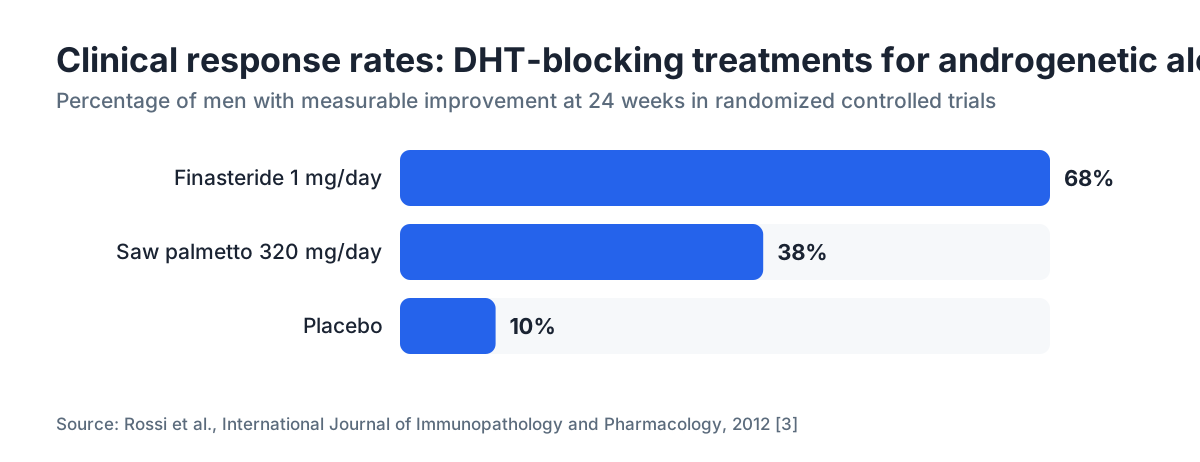
Saw palmetto is the most studied botanical 5-alpha-reductase inhibitor. A 2012 randomized trial in the International Journal of Immunopathology and Pharmacology found that 320 mg/day of saw palmetto produced a 38% response rate in men with androgenetic alopecia, compared to 68% for finasteride 1 mg/day in the same trial [3]. Saw palmetto works. It just doesn't work as well.
Pumpkin seed oil has one small 2014 randomized trial behind it. Forty-seven men took 400 mg/day or placebo for 24 weeks. Hair count rose 40% in the treatment group versus 10% in placebo [4]. Small sample, no large replication. Treat it as promising, not proven.
Beta-sitosterol appeared in a small 1995 double-blind trial (n=19) showing improvement in androgenetic alopecia symptoms. It predates modern trial standards, and the authors measured perceived improvement rather than standardized hair counts [5].
Stinging nettle and pygeum africanum have even less direct hair-loss data. Both inhibit 5-alpha-reductase in in-vitro and prostate studies, but in-vitro inhibition doesn't reliably translate to meaningful scalp DHT reduction in humans.
The honest summary: the ingredients have a plausible mechanism and some positive small-trial data. They are not in the same evidence class as finasteride or even minoxidil, and no head-to-head trial of this specific formulation exists.
| Ingredient | Study type | Best result reported | Limitation |
|---|---|---|---|
| Saw palmetto 320 mg/day | Randomized trial, n=100 | 38% response rate | Lower than finasteride (68%) in same trial [3] |
| Pumpkin seed oil 400 mg/day | Randomized trial, n=47 | +40% hair count vs +10% placebo | Not replicated at scale [4] |
| Beta-sitosterol | Small RCT, n=19 | Perceived improvement | Outdated methodology [5] |
| Stinging nettle / Pygeum | In vitro / prostate studies | 5-AR inhibition in cell models | No direct scalp/hair-loss human RCT |
Is Advanced Trichology's DHT Blocker FDA-approved?
No. This is a dietary supplement, not an FDA-approved drug. In the US, only two treatments carry FDA approval for androgenetic alopecia: minoxidil (topical, OTC for men and women; oral, prescription) and finasteride 1 mg (oral, prescription, men only) [6].
Dietary supplements fall under the Dietary Supplement Health and Education Act of 1994 (DSHEA). Under DSHEA, manufacturers do not have to prove efficacy before selling a product. The FDA states that supplement companies "are responsible for ensuring that their products are safe," but the agency does not review products for effectiveness before they hit the market [7].
That is not a knock on Advanced Trichology specifically. It applies to every hair-loss supplement sold. The regulatory gap between a supplement and a prescription drug is huge. When a company says its product "supports healthy hair growth" instead of "treats androgenetic alopecia," that wording is deliberate and legally required. Structure/function claims are allowed. Disease claims are not.
The practical takeaway for you: no supplement company can legally tell you their product will stop your hair loss. They can only say it supports the conditions for healthy hair. Read that language carefully on anything you consider.
How do Advanced Trichology DHT Blocker reviews look in practice?
Customer reviews for the Advanced Trichology DHT Blocker on Amazon and the brand's own site run mixed to moderately positive, which is exactly the pattern you'd expect from a product with real but modest biological activity.
Positive reviewers tend to report less shedding within 2 to 4 months and modest regrowth at the hairline or temples. Those outcomes line up with what saw palmetto trials show: partial slowing of miniaturization, not dramatic regrowth. Negative reviewers report no change at all after 3 to 6 months, which also fits the data given that saw palmetto has a meaningful non-responder rate.
A few patterns stand out. Many positive reviewers are running Advanced Trichology DHT Blocker alongside minoxidil or other treatments. That stacking makes it impossible to know which product is doing what. The shedding-reduction comment ("I shed less") is the most consistent positive signal, and it tracks with 5-AR inhibition reducing DHT-driven follicle cycling.
Nobody has good independent data on this specific product's responder rate. The closest proxy is the saw palmetto RCT above [3]. If roughly 38% of users respond to the primary active in controlled conditions, you would expect a split review profile, which is exactly what you see.
One thing to watch: the price shows up in a lot of reviews. At $65 to $90 per month, this is not a cheap experiment. Generic finasteride runs $10 to $30 per month and has decades of safety data and a 70% DHT reduction rate behind it. Sit with that comparison before you decide where your money goes.
How does Advanced Trichology's DHT Blocker compare to finasteride?
This is the comparison that matters most for anyone with genetic hair loss. Here are the facts without spin.
Finasteride 1 mg/day inhibits the type II isoform of 5-alpha-reductase. In the trials that led to FDA approval, it cut serum DHT by about 70% and scalp DHT by a similar margin [2]. After two years, 83% of men on finasteride kept their hair count versus 28% on placebo. At five years, 48% showed visible regrowth. Those numbers come from randomized controlled trials with thousands of participants.
Saw palmetto, the main active in Advanced Trichology's formula, inhibits both isoforms (I and II) but with much weaker binding affinity. The 38% clinical response rate in the best randomized trial [3] is real but a lot lower. There is no five-year data for saw palmetto in hair loss.
The side-effect math is where the supplement has a genuine argument. Finasteride's prescribing information lists sexual side effects (decreased libido, erectile dysfunction, ejaculatory disorder) in roughly 3.8% of men in clinical trials, with persistent post-finasteride syndrome reported by some men after stopping [8]. Saw palmetto's side-effect profile in trials has been mild, mostly GI-related. The trade-off is real: less efficacy, less risk.
For a full breakdown of finasteride's evidence and risks, the finasteride guide covers everything you'd want before deciding.
Combining the two is also an option. Some clinicians suggest botanical 5-AR inhibitors alongside finasteride may add inhibition, though no strong trial has proven that combination. If you are already on finasteride and want to stack, there is probably no harm, but you are mostly paying for a theory.
For men who want to combine approaches, the finasteride and minoxidil protocol remains the best-evidenced non-surgical route available.
What does the topical DHT Blocker formulation actually do differently?
The topical version of Advanced Trichology's DHT Blocker is built to deliver 5-AR inhibiting actives straight to the scalp, bypassing systemic absorption and, in theory, cutting any systemic hormonal effects.
The science here is mixed. Finasteride itself has been studied as a topical (finasteride 0.25% solution), with a 2018 randomized trial finding significant DHT reduction and hair growth alongside lower systemic absorption than oral finasteride [9]. That's a pharmaceutical-grade formulation with a known concentration and delivery mechanism.
With botanical topicals, the challenge is bioavailability. Whether saw palmetto extract in a cosmetic carrier actually penetrates the dermis to reach the follicle bulb in meaningful concentrations is not well established. The skin is a good barrier. Most cosmetic formulations don't breach it at the follicle level without a pharmaceutical-grade penetration enhancer.
That said, the scalp is more permeable than body skin, and some studies on minoxidil (also a topical) show that topical delivery can work if the molecule is small and lipophilic enough. Saw palmetto's fat-soluble phytosterols may penetrate skin better than water-soluble compounds. Nobody has run the pharmacokinetic study on this specific formulation.
Bottom line on the topical: plausible mechanism, unquantified delivery, no independent bioavailability data. It probably does something. Whether it does enough to justify the cost against combining oral saw palmetto with proven topical minoxidil is a fair question. For what topical minoxidil does and how it differs, the minoxidil for men article is the right next read.
Are there any side effects to worry about?
For most healthy adults, saw palmetto at 320 mg/day is well tolerated. The most common adverse effects in trials are mild GI symptoms: nausea, diarrhea, or stomach discomfort, usually fixed by taking the supplement with food [3].
A few less-discussed risks are worth knowing. Saw palmetto has anticoagulant properties and can raise bleeding risk. If you are on blood thinners, aspirin, or prepping for surgery, flag it to your doctor. Case reports document perioperative bleeding linked to saw palmetto use [10].
Pumpkin seed oil and beta-sitosterol are considered very safe at supplement doses. Stinging nettle and pygeum have similarly benign safety records in the literature, with no consistent signal of serious adverse effects at standard doses.
One nuance on the sexual side-effect question: because saw palmetto inhibits 5-AR, it does reduce DHT. At the modest reduction levels seen in human studies, sexual side effects have not shown up as a real problem in trials. But the absence of a large, long-term safety dataset means you can't rule out individual sensitivity. A very small number of users in reviews report changes in libido, though it's impossible to know if that's causal.
If you are running this alongside minoxidil, the minoxidil side effects profile is a separate concern worth reviewing, since those effects (scalp irritation, initial shedding, rarely cardiovascular symptoms) work through a completely different mechanism.
Who is this product most likely to help?
Being honest here: Advanced Trichology's DHT Blocker is most likely to produce noticeable results in a fairly narrow profile of person.
First, early-stage loss. If you are at Norwood 2 or 3 with active but recent miniaturization, partially blocking DHT may slow progression in a way you can see. At Norwood 5 or beyond, follicles dormant for years are unlikely to respond to anything short of a hair transplant.
Second, men who cannot or will not take finasteride. If you have a strong personal or medical reason to avoid prescription DHT blockers, this is the next best option in the 5-AR inhibitor category. The evidence is weaker, but it is not zero.
Third, women with androgenetic alopecia. Finasteride is not FDA-approved for women (and is contraindicated in women who are pregnant or may become pregnant, due to teratogenic risk). Topical botanical DHT blockers get used off-label in women with pattern loss, and the risk profile is far more favorable than in men. No large RCT has tested Advanced Trichology's product in women specifically, but the ingredients themselves carry no known contraindications for most adult women.
Fourth, people who want a low-risk add-on to an existing protocol. If you are already on minoxidil and want a DHT-blocking layer without going to finasteride, this is a reasonable stack. Just do the math on cost.
If shedding is your main symptom rather than gradual miniaturization, consider whether telogen effluvium rather than androgenetic alopecia is your actual problem. DHT blockers of any kind won't help with TE-driven shedding.
At this point in your research, if you haven't had your loss pattern assessed objectively, MyHairline's free AI scan (/scan) gives you a baseline Norwood stage estimate before you spend money on any product.
How long does it take to see results?
Hair loss treatments require more patience than most people expect. This is not a marketing hedge. It reflects how the hair growth cycle actually runs.
The anagen (growth) phase for scalp hair lasts 2 to 6 years. Catagen (transition) is about 2 weeks. Telogen (rest/shedding) is 2 to 4 months. Any treatment that changes follicular behavior has to wait for the natural cycle to turn over before you see visible results. You can't shortcut that biology.
For finasteride, the clinical trials saw measurable improvement at 6 months and stronger results at 12 to 24 months [2]. For saw palmetto, the main 24-week trial showed directional but modest improvement at the 6-month mark [3]. That gives you a rough timeline: if something good is going to happen with Advanced Trichology's DHT Blocker, expect reduced shedding at 2 to 4 months and any measurable density change at 6 to 12 months.
Seen no change at all after 6 full months of consistent use? The product is not working for you. Responder rates mean some portion of users get nothing from any given treatment, and the honest move is to reassess rather than wait another year.
Consistency matters. Missing doses regularly cuts efficacy. That applies to every treatment, prescription drugs included.
What does the broader supplement evidence say about hair loss products?
Advanced Trichology's DHT Blocker sits inside a large, mostly underregulated market of hair loss supplements. Worth knowing where it lands in that landscape.
The American Academy of Dermatology (AAD) recommends minoxidil and finasteride as the two evidence-backed treatments for androgenetic alopecia, with no hair-loss supplement earning a recommendation in their clinical guidelines [11]. That doesn't make supplements useless. It means none have enough high-quality trial data to clear guideline-level evidence thresholds.
Nutritional deficiencies (iron, zinc, vitamin D, biotin in genuine deficiency states) can drive hair loss, and correcting them can help. But if your levels are normal, supplementing those nutrients won't grow more hair [12]. Advanced Trichology's formula does include some micronutrients alongside the botanical actives; their contribution depends entirely on whether you are actually deficient.
One supplement worth flagging here: creatine. There's a frequently cited 2009 rugby study suggesting creatine raises DHT. The does creatine cause hair loss article covers whether that finding means anything for your scalp, but the short answer is that the evidence is weak and the mechanism is contested.
The honest read on the hair-loss supplement market: products built on established botanical 5-AR inhibitors (like this one) sit in the top tier. Products selling biotin to non-deficient people or proprietary blends of random vitamins with no mechanism sit lower. Advanced Trichology's ingredient list is at least grounded in the right biology.
What is the bottom line on whether it is worth buying?
My honest opinion: Advanced Trichology's DHT Blocker is a reasonable product in a crowded space, but it is not the most cost-effective first move for most people with androgenetic alopecia.
The ingredients are real. The mechanism is real. The evidence for the primary active (saw palmetto) shows a genuine but partial effect. The formulation quality looks better than bargain-bin supplements that underdose their actives. The price is high relative to buying generic saw palmetto 320 mg capsules, which you can find for $15 to $25 per month and which is essentially the same primary active.
If you are not a candidate for finasteride, or you tried it and had side effects, this is one of the better natural options. If you have not tried finasteride and have no contraindication, starting with $15/month of generic finasteride (under medical supervision) before spending $65+ on a supplement is the more logical order.
The topical version has a theoretical delivery edge but no data confirming it beats the oral form on outcomes. If cost is a factor, the oral capsules are probably where to start.
For anyone who wants to understand their pattern before committing, MyHairline's free AI hair scan (/scan) gives you a Norwood stage baseline in a few minutes, which is genuinely useful context before spending money.
Nothing in this category is a cure. Every treatment, prescription or supplement, slows the process to varying degrees. Managing your expectations accurately is the single most useful thing you can do before starting any hair loss protocol.
Sources
- National Library of Medicine, StatPearls: Androgenetic Alopecia
- Rossi A et al. (2012), International Journal of Immunopathology and Pharmacology, saw palmetto vs finasteride RCT
- Cho YH et al. (2014), Evidence-Based Complementary and Alternative Medicine, pumpkin seed oil RCT
- Prager N et al. (2002), Journal of Alternative and Complementary Medicine, beta-sitosterol double-blind trial
- FDA, Approved Drug Products: Minoxidil and Finasteride
- FDA, Dietary Supplements: What You Need to Know
- Caserini M et al. (2018), Drug Delivery, topical finasteride RCT
- Cheema P et al. (2001), Journal of Internal Medicine, saw palmetto and bleeding risk case report
- American Academy of Dermatology, Hair Loss: Diagnosis and Treatment Guidelines
- Guo EL and Katta R (2017), Dermatology Practical and Conceptual, nutrition and hair loss review