TL;DR: Ketoconazole is an antifungal that also weakly blocks DHT in the scalp. A 1998 randomized trial found 2% ketoconazole shampoo produced hair-density gains comparable to 2% minoxidil over 6 months. It is not a standalone cure. The evidence supports it as a cheap, low-risk add-on to proven treatments like finasteride or minoxidil.
What is ketoconazole and why does it show up in hair-loss research?
Ketoconazole is a synthetic imidazole antifungal the FDA approved to treat fungal infections of the skin and scalp, including seborrheic dermatitis and tinea versicolor [1]. It kills the fungus by wrecking the fungal cell membrane, which is why it clears dandruff so fast. The hair-loss angle showed up as a side observation: ketoconazole also blocks some enzymes in the steroid synthesis pathway, specifically cytochrome P450 enzymes tied to androgen production.
Androgenic alopecia is the most common form of pattern hair loss in both men and women, and dihydrotestosterone (DHT) drives most of it. DHT binds to androgen receptors in susceptible follicles and slowly shrinks them. Anything that interferes with DHT production, or its grip on the scalp, is a hair-loss treatment on paper. Ketoconazole's interference with androgen synthesis is modest and mostly local. But it is real, and it gave researchers a reason to run trials.
A good place to see the bigger mechanism is the overview of dht blocker treatments, which sets ketoconazole next to finasteride, saw palmetto, and the rest. The antifungal effect matters separately too. Seborrheic dermatitis and the scalp inflammation that comes with it may worsen follicle miniaturization, so calming that inflammation has value on its own.
How exactly does ketoconazole block DHT?
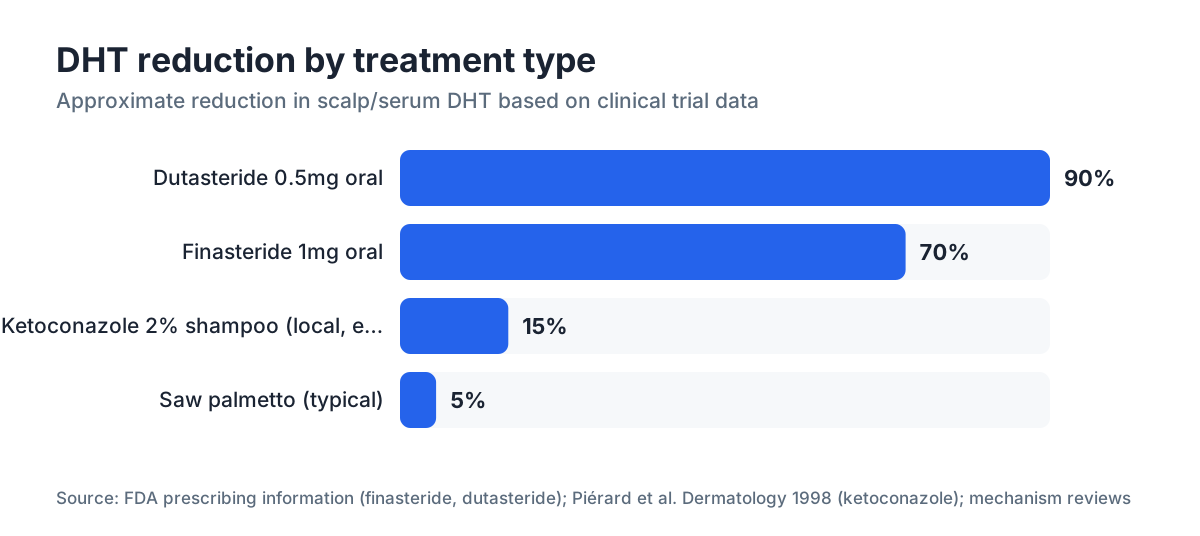
Not the way finasteride does. Finasteride blocks 5-alpha reductase, the enzyme that converts testosterone into DHT, and cuts serum DHT by roughly 70% [2]. Ketoconazole takes a longer, messier route.
Ketoconazole inhibits cytochrome P450 enzymes, including CYP17A1, which sit earlier in the steroid cascade that builds androgens from cholesterol [7]. Applied as a shampoo, it barely absorbs into the bloodstream, so its anti-androgen effect stays mostly on the scalp rather than going body-wide. In vitro studies show ketoconazole can suppress testosterone and DHT synthesis in hair follicle cells. How much of that actually happens in a living human scalp from a rinse-off shampoo is genuinely hard to pin down.
There is a second mechanism: inflammation. Seborrheic dermatitis involves Malassezia yeast overgrowth and local irritation, both of which can speed up the look of thinning. By knocking down the yeast and the inflammatory response, ketoconazole may protect follicles even when the direct DHT effect is small. The two mechanisms probably reinforce each other.
For the full picture of what starts hair loss, the article on what causes hair loss lays out androgens, genetics, and inflammation together [8].
What does the clinical evidence actually say?
The most-cited study is a 1998 randomized controlled trial by Piérard and colleagues in Dermatology. It compared 2% ketoconazole shampoo to 2% minoxidil solution and a non-medicated shampoo in men with androgenic alopecia. After 6 months, both the ketoconazole and minoxidil groups showed statistically significant gains in hair density and shaft diameter versus placebo [3]. The paper described the ketoconazole results as comparable to minoxidil, which surprised a lot of people.
That one trial has carried the ketoconazole-for-hair-loss argument for more than 25 years. It is a legitimate study. It is also small, never replicated at scale, and nobody has run a large Phase III trial pitting ketoconazole against finasteride or against a finasteride-plus-minoxidil stack. The honest read: suggestive, not settled.
AAD guidelines list minoxidil and finasteride as first-line treatments for androgenic alopecia. Ketoconazole shows up as an adjunct, not a primary therapy, and the evidence for topical anti-androgens gets flagged as limited by small study sizes [4]. European S3 guidelines say the same thing, listing ketoconazole shampoo for adjunctive use with a low evidence grade [9].
Nobody has good head-to-head data comparing ketoconazole with finasteride in a large, long-running trial. The closest we have is the 1998 Piérard study and a scatter of smaller mechanistic papers.
How does ketoconazole compare to other DHT-blocking treatments?
Here is a direct comparison of the main approaches, based on trial data and FDA approval status.
| Treatment | Mechanism | DHT reduction | Evidence quality | FDA-approved for hair loss |
|---|---|---|---|---|
| Finasteride 1mg oral | 5-alpha reductase inhibitor | ~70% systemic [2] | Multiple large RCTs | Yes (men only) |
| Dutasteride 0.5mg oral | Dual 5-alpha reductase inhibitor | ~90% systemic | Multiple RCTs | No (off-label) |
| Minoxidil 2%/5% topical | Vasodilator, prolongs anagen | No direct DHT effect | Large RCTs | Yes |
| Ketoconazole 2% shampoo | Weak anti-androgen, antifungal | Modest, local only | 1 RCT + small studies | No (antifungal use only) |
| Saw palmetto | Weak 5-alpha reductase inhibitor | Minimal, unreliable | Very limited | No |
The evidence gap between finasteride and ketoconazole is wide. Finasteride has multiple large multicenter trials, decades of post-market data, and FDA approval specifically for androgenic alopecia [2]. Ketoconazole has one well-built but small RCT and a biological rationale. That does not make it useless. It makes it a reasonable adjunct, not a substitute.
For people who cannot or will not take finasteride by mouth, ketoconazole shampoo is one of the better-supported topical additions to minoxidil for men. It brings a different mechanism, costs almost nothing, and carries a light side-effect load as a rinse-off product.
Which ketoconazole products are available and do you need a prescription?
In the United States, ketoconazole 2% shampoo (brand name Nizoral) needs a prescription, while a 1% version sells over the counter [1]. The 1% OTC shampoo, also sold as generic ketoconazole shampoo, is marketed mainly for dandruff and seborrheic dermatitis.
The practical question for hair loss is whether 1% works as well as 2%. The 1998 Piérard trial used 2%. No published head-to-head RCT compares 1% versus 2% for hair-density outcomes. Most dermatologists who recommend ketoconazole for androgenic alopecia lean toward the prescription 2% for that reason. Some say the OTC 1% still helps keep the scalp environment healthy if you cannot get or afford the stronger version.
Prices swing. Generic prescription 2% ketoconazole shampoo runs roughly $15 to $40 for a 4 oz bottle at major US pharmacies, and that number moves with generic supply. The OTC 1% versions (Nizoral A-D and generics) usually cost $10 to $20 for a similar size. Neither is expensive next to most hair-loss treatments.
Outside the US, the rules differ. The UK and many European regulators allow 2% ketoconazole shampoo without a prescription for seborrheic dermatitis. Check your local regulatory status before you assume.
How should you use ketoconazole shampoo for hair loss?
The Piérard trial had participants use 2% ketoconazole shampoo 2 to 3 times per week, left on the scalp for 3 to 5 minutes before rinsing [3]. Contact time matters. A quick lather and rinse does not give the active ingredient enough time to act.
Most dermatologists suggest that same frequency: 2 to 3 times per week, not daily. Daily use is fine for short stretches, like clearing an acute dandruff flare, but daily use over months dries out the scalp and hair shaft. Alternate ketoconazole with your regular shampoo on the off days and you have a routine you can actually keep.
The steps: wet your hair, apply a small amount to the scalp (more scalp than hair), massage gently, wait 3 to 5 minutes, rinse well. Condition the lengths afterward if your hair runs dry or is colored.
Be clear on one thing. Ketoconazole shampoo is a rinse-off product. Very little absorbs systemically, which is exactly why it lacks the body-wide DHT drop that finasteride delivers. The upside of that same fact is minimal systemic side effects. People worried about finasteride side effects or post-finasteride syndrome often ask about ketoconazole as a safer swap. The efficacy comparison is not flattering to ketoconazole when it stands alone.
What are the side effects and safety concerns?
Topical ketoconazole shampoo, used as directed, is well-tolerated by most people. The FDA label for prescription ketoconazole 2% shampoo lists possible reactions including abnormal hair texture, scalp irritation, contact dermatitis, and, rarely, hair discoloration [1]. Most of these reverse when you stop.
Systemic absorption from a shampoo is low, but not zero. Oral ketoconazole tablets carry serious risks, including liver injury. In 2013 the FDA restricted oral ketoconazole tablets to cases where no alternative therapy is available, citing reports of hepatotoxicity [5]. That warning covers the oral form, not the topical shampoo, but the context is worth knowing.
For colored or chemically treated hair, ketoconazole shampoo can occasionally shift texture or color a little. Patch testing a small area first is reasonable if you are worried.
Pregnancy: the FDA pregnancy category for topical ketoconazole was C (animal studies showed risk, no adequate human studies). Because systemic absorption is low, most dermatologists treat it as low-risk topically, but it should be discussed with a physician before use during pregnancy [1].
Drug interactions are not a real concern with the topical shampoo, again because so little gets into the blood. Oral ketoconazole has an extensive and dangerous interaction profile [10]. That is not the formulation anyone uses for hair loss.
Does ketoconazole work better when combined with finasteride or minoxidil?
This is the most interesting clinical question, and the honest answer is that the combination has never been tested in a properly powered RCT. What we have is reasoning from mechanism.
Finasteride suppresses systemic DHT by about 70% [2]. Minoxidil stretches the anagen (growth) phase of the hair cycle through a vasodilatory effect that has nothing to do with DHT. Ketoconazole adds a local anti-androgen nudge plus control of scalp inflammation and Malassezia. Three different mechanisms, no overlapping toxicity at normal doses. The case for stacking them holds together on mechanism even without a big trial proving extra benefit.
Many hair-loss specialists fold ketoconazole shampoo in as a cheap, low-risk add-on. The combination article at finasteride and minoxidil covers what is actually proven about stacking treatments. Ketoconazole does not carry that same evidence base, but it is cheap enough and safe enough that the risk-benefit math looks good for most people.
If you are thinking about adding ketoconazole to an existing routine, the real issue is not safety. It is consistency. Hair-loss treatments need months before anything shows. The urge to cycle through products without sticking to any is real, and it is probably the top reason treatments fail in practice.
Can women use ketoconazole shampoo for hair loss?
Yes, with caveats. Female-pattern hair loss also involves DHT and androgen sensitivity, though the pattern and hormonal picture run more complex than in men. The evidence for ketoconazole in women is even thinner than in men. The 1998 Piérard trial enrolled men only [3].
Still, women with seborrheic dermatitis and hair thinning at the same time are a logical group for ketoconazole shampoo, because it handles two problems at once. Scalp inflammation from seborrheic dermatitis can unmask or worsen thinning in women who are already hormonally susceptible.
Women with diffuse shedding that does not match a classic androgenic pattern should look at telogen effluvium as a cause before assuming DHT is behind it. Ketoconazole has no known mechanism for telogen effluvium.
For a suspected androgen component, options like spironolactone (an anti-androgen) and topical minoxidil have more evidence than ketoconazole. Ketoconazole shampoo can work as a supporting measure, especially where scalp health is an issue, but a dermatologist visit to nail down the hair-loss type first is genuinely useful.
If you want a starting point before that appointment, the free AI hair scan at MyHairline can help map your thinning pattern and flag which type of loss you might be dealing with.
What does a realistic timeline look like for seeing results?
Scalp hair grows roughly 0.35 to 0.44 mm per day, about 1.25 cm per month [6]. Follicle recovery from miniaturization, if it happens at all, takes multiple hair cycles. That means at least 3 to 6 months of steady use before you see anything. This is true for every hair-loss treatment, ketoconazole included.
In the Piérard trial, measurable differences in density and shaft diameter turned up at 6 months [3]. That is the minimum realistic window. Anyone claiming dramatic regrowth from ketoconazole shampoo alone in 4 to 6 weeks is almost certainly seeing normal hair-cycle variation, not real regrowth.
If your main problem is seborrheic dermatitis, the antifungal effect moves faster, often visible within 2 to 4 weeks of regular use. Better scalp health and less inflammation-driven shedding can show up well before any structural follicle recovery does.
A practical habit: photograph your hairline and crown in the same lighting every 4 weeks. Density changes are slow enough that memory lies. This matters most if you are tracking a receding hairline or crown thinning, where early changes are subtle.
Is ketoconazole shampoo worth adding to your routine?
For most people with androgenic alopecia or scalp inflammation, yes. The cost is low (roughly $15 to $40 for a bottle that lasts months at 2 to 3 uses per week), side effects are minimal with topical use, and there is at least one decent RCT plus a plausible mechanism behind it [3].
Where it falls apart: as a standalone treatment for real androgenic alopecia. If you have noticeable loss, ketoconazole shampoo alone is unlikely to be enough. The evidence for finasteride in men and minoxidil in both sexes is far stronger. Spending money and hope on ketoconazole while dodging the finasteride conversation is a choice worth examining honestly.
For people who cannot take oral medications, topical minoxidil, low-level laser therapy, and ketoconazole shampoo form a reasonable non-systemic stack. For those already on oral minoxidil or finasteride, adding ketoconazole is cheap insurance.
The hair loss supplements aisle is crowded with big claims and thin evidence. Ketoconazole stands apart because it has an actual RCT and a credible mechanism, which puts it well ahead of most supplement ingredients. It is still not finasteride. It is also not snake oil.
If you are early in figuring out what is happening with your hair, a MyHairline AI scan gives you a visual baseline and flags which Norwood or Ludwig stage you might be at before you talk to a dermatologist.
What are the most common mistakes people make with ketoconazole for hair loss?
Using it instead of proven treatments rather than alongside them is the biggest one. Some people find ketoconazole's side-effect profile more comfortable than finasteride's and use that as a reason to skip the finasteride conversation entirely. Emotionally understandable. In practice it means leaning on a weaker tool when a stronger one is right there.
Not leaving it on long enough. A 30-second lather delivers a fraction of the contact time used in the trial. Three to five minutes matters.
Using it daily for months. Ketoconazole shampoo is drying. Daily long-term use can break down the scalp barrier and trigger the irritation it is meant to fix. Two to three times per week is the studied protocol and the right frequency for maintenance.
Expecting results in weeks. Frustration with slow progress pushes people to quit before any measurable change has had time to form. Three to six months is the minimum evaluation window.
Buying the 1% version and assuming it equals 2%. It might. No trial confirms that. If you are using ketoconazole for androgenic alopecia rather than dandruff, the prescription 2% is the formulation with data behind it.
If you track hair loss alongside other habits, the article on does creatine cause hair loss explains how androgen-related loss interacts with common supplements, and helps you avoid blaming the wrong cause for your shedding.
Sources
- FDA, Nizoral (ketoconazole) 2% shampoo prescribing information
- FDA, Propecia (finasteride) 1mg prescribing information
- Piérard GE et al., 'Controlled trial of 2% ketoconazole shampoo vs 2% minoxidil in androgenic alopecia', Dermatology, 1998
- American Academy of Dermatology, 'Guidelines of care for androgenetic alopecia', Journal of the American Academy of Dermatology, 2017
- FDA Drug Safety Communication, 'FDA limits usage of Nizoral (ketoconazole) oral tablets', July 2013
- StatPearls, National Library of Medicine, hair growth physiology
- National Center for Biotechnology Information, PubMed, ketoconazole CYP17A1 inhibition literature
- Inui S, Itami S, 'Androgen actions on the human hair follicle', Journal of Dermatological Science, 2013
- Kanti V et al., 'Evidence-based (S3) guideline for the treatment of androgenetic alopecia in women and in men', Journal of the European Academy of Dermatology and Venereology, 2018
- FDA MedWatch, drug safety communications index