

TL;DR: Short midday sun on the scalp helps your body make vitamin D, and low vitamin D shows up more often in people who shed hair. But years of unprotected UV damages follicle DNA and the stem cells that regrow hair, which speeds up thinning. Both are true. The dose decides which effect wins.
What actually happens to your scalp when the sun hits it?
Your scalp handles UV light the same way the skin on your arm does. UVB rays (wavelengths 290 to 315 nm) hit the epidermis and turn 7-dehydrocholesterol into pre-vitamin D3, which your liver and kidneys then finish into the active hormone, calcitriol [1]. That part is straightforwardly good.
Your scalp is one of the most sun-hammered patches of skin you own, especially once your hair thins. It sits on top of you all day. Dense hair gives you some natural shade. Fine or sparse coverage gives you almost none.
UVA rays (315 to 400 nm) go deeper. They generate reactive oxygen species in the dermis, oxidize the lipids in follicle cell membranes, and cause DNA damage through that oxidative route rather than head-on. Repeated UVA exposure is tied to premature aging of the follicle stem cells in the bulge region, which is where your hair's ability to regenerate actually lives [2].
So in a single hour outside, your scalp does two opposite things at once. It makes vitamin D through UVB. It stacks up low-level oxidative damage through UVA.
Can too much sun cause hair loss?
Yes, under the wrong conditions. The evidence comes from three directions.
There's a condition called actinic folliculitis, where prolonged UV triggers inflammation inside follicles, causing pustules and short-term hair loss. It's uncommon but real and documented.
Second, the oxidative story. A 2021 review in the Journal of Investigative Dermatology found that UV-driven oxidative stress damages hair follicle keratinocytes and melanocytes [2]. Melanocytes in the hair bulb are the most exposed, because making melanin already produces hydrogen peroxide as a byproduct. Pile UV oxidative stress on top of that baseline and you speed up the apoptosis (programmed cell death) of those cells. This is part of why people with androgenetic alopecia who spend a lot of unprotected time in the sun tend to progress faster, though pulling UV apart from genetics in observational data is hard.
Third, a bad scalp sunburn can shove follicles into a resting (telogen) phase, triggering a shedding episode weeks later. That's a form of telogen effluvium. It usually clears on its own in three to six months, but it can scare you if you don't know what set it off.
Here's the honest version. Casual sun does not cause meaningful hair loss in most people. Chronic, unprotected, high-intensity sun in someone already prone to thinning is a genuine risk factor.
Does vitamin D deficiency cause hair loss?
This is one of the better-supported nutritional links in hair loss research, and it's still correlation, not proven cause, in humans.
Vitamin D receptors (VDRs) show up in hair follicle keratinocytes, and mice with the VDR gene knocked out develop alopecia with cyst formation in their follicles even when their blood vitamin D is normal [3]. That's the interesting part. The receptor, more than the hormone itself, is what normal hair cycling seems to need.
In people, multiple studies find lower serum 25-hydroxyvitamin D (25(OH)D) in patients with alopecia areata and telogen effluvium than in controls. A 2013 study in Skin Pharmacology and Physiology reported that women with telogen effluvium and female pattern hair loss had significantly lower vitamin D than matched controls [4]. A 2016 meta-analysis in Dermatology and Therapy pooled several such studies and found low vitamin D associated with non-scarring alopecia, while the authors were clear the evidence does not yet prove supplements reverse hair loss [5].
What the research does not cleanly show is that fixing a deficiency reliably regrows hair in otherwise healthy people. Clinicians report that genuinely deficient patients sometimes improve after correction. But if your vitamin D already sits in the normal range (roughly 20 to 50 ng/mL by most guidelines), taking more doesn't appear to buy you extra hair.
If you're losing hair and have never checked your 25(OH)D, it's one of the cheapest and most useful blood tests going. Figuring out what causes hair loss in your specific case is the place to start.
How much sun does your scalp actually need to make enough vitamin D?
It depends on your skin tone, latitude, season, and time of day, and the honest answer is the numbers swing a lot.
The most cited estimate, from vitamin D researcher Dr. Michael Holick at Boston University, is that fair-skinned people at mid-latitudes can make enough vitamin D from about 10 to 15 minutes of midday sun on exposed skin several days a week in summer [1]. Darker skin needs a lot more, sometimes three to five times as long, because melanin competes with 7-dehydrocholesterol for UVB photons.
Below roughly 35 degrees north latitude (about the level of Atlanta or Los Angeles), year-round UVB production is possible. Above that line, winter UVB is too weak to drive real synthesis for months, no matter how long you stand outside [1].
The scalp counts when it's exposed, but it's not a special surface. Any skin hit by UVB adds to production. Thick hair means less UV reaches the skin under it. People with thinning hair get more scalp-based synthesis, which is a pretty hollow consolation prize given the context.
For most people above 40 degrees latitude from October through March, sun alone can't hold your levels up. Supplements or diet (fatty fish, fortified dairy, eggs) are the practical answer.
What does the research say about vitamin D supplementation and hair regrowth?
The data is promising and incomplete. Don't expect supplements to regrow hair. Expect them to stop deficiency from making an existing problem worse, and maybe to help restore normal follicle cycling.
A 2019 randomized controlled trial in Skin Pharmacology and Physiology gave vitamin-D-deficient women with telogen effluvium either vitamin D3 or placebo for 6 months. The supplemented group showed a statistically significant gain in hair density versus placebo [6]. That's probably the cleanest human trial on this exact question, though these studies usually run small (often under 100 participants) and independent funding is thin.
For alopecia areata, a few small trials tested topical vitamin D analogs like calcipotriol as add-ons to standard treatment, with mixed results. Not strong enough to recommend topical vitamin D on its own.
If your hair loss has a nutritional piece, vitamin D is one part of a bigger picture with iron (ferritin specifically), zinc, and biotin. See hair loss supplements for what the evidence backs versus what's marketing.
For pattern hair loss driven by DHT (dihydrotestosterone), correcting a vitamin D deficiency won't meaningfully reverse the androgenetic process. That takes different tools: finasteride, minoxidil for men, or for advanced cases, a hair transplant.
Does sunscreen on the scalp block vitamin D production?
In theory, yes. SPF 15 cut skin vitamin D synthesis by about 99% in controlled lab conditions [7]. In practice, almost nobody coats every exposed surface evenly or reapplies every two hours, so the real-world drop is far smaller.
For the scalp, spray and mist sunscreens made for hair partings are easy to find now, and they're smart for anyone spending long stretches outdoors, especially with thinning hair and little natural cover. The follicle's UV risk over years outweighs whatever vitamin D your scalp alone contributes, partly because other body surfaces and your diet can cover the vitamin D side.
Worried about blocking it? Do this. Get 10 to 15 minutes of unprotected early sun on your arms and face, then put broad-spectrum sunscreen on everything, scalp included. The American Academy of Dermatology recommends SPF 30 or higher and reapplication every two hours for people with thinning hair [8].
A hat is the simpler fix for scalp UV, though it shuts off scalp vitamin D synthesis entirely. It does nothing to your arms and legs, which keep producing.
Are people with hair loss more vulnerable to scalp UV damage?
Yes, and it's simple physics. Hair is a UV filter. Each strand absorbs and scatters UV before it reaches the skin below, and the melanin in the shaft soaks up UV especially well.
A 2019 study in the British Journal of Dermatology measured UV transmittance through human hair and found a full head of dark hair blocks most UVB from reaching the scalp, while sparse or fine hair blocks far less [9].
So as androgenetic alopecia moves along, the scalp gets more exposed, which piles more stress onto follicles that are already struggling. It's not a major independent cause of pattern baldness, since genetics and DHT run that show (see receding hairline and DHT blocker). But UV is a real added stressor once you're already losing hair.
If a lot of your scalp is showing, protect it the way you protect your face. Consistently. Scalp melanoma is rare but real, and the scalp is the spot people forget when they reach for sunscreen.
Can light therapy or red light help hair growth, and is that different from sun exposure?
Red light and near-infrared therapy (roughly 630 to 670 nm for red, 780 to 1100 nm for near-infrared) are a different category from solar UV. They make no vitamin D. They work through photobiomodulation, where photons get absorbed by mitochondrial cytochrome c oxidase, which may raise ATP production and calm inflammation in follicle cells [10].
The FDA has cleared several low-level laser and LED devices for hair growth in androgenetic alopecia through the 510(k) pathway. "Cleared" means the FDA found them substantially equivalent to already-legal devices on safety and effectiveness, not that it approved them as drugs [10]. Trial results are modest. A 2014 randomized trial in the American Journal of Clinical Dermatology found a statistically significant increase in hair count in men using a laser helmet versus a sham device over 26 weeks, but the effect size was small.
Sun and red light are not swaps for each other. One gives you UV (vitamin D plus oxidative damage). The other gives you non-ionizing visible and near-infrared light (a possible mild follicle nudge with low side-effect risk). If you want every tool on the table alongside the proven ones, comparing finasteride and minoxidil with add-ons like LLLT is a reasonable talk to have with a dermatologist.
What is the right amount of scalp sun exposure, practically speaking?
For most people the answer is: a little, on purpose, then protect.
If vitamin D status worries you, 10 to 15 minutes of midday sun on your face and forearms several days a week in summer is enough for fair skin at mid-latitudes, and you don't need to bare a thinning scalp to get it [1]. Your arms make vitamin D just as well.
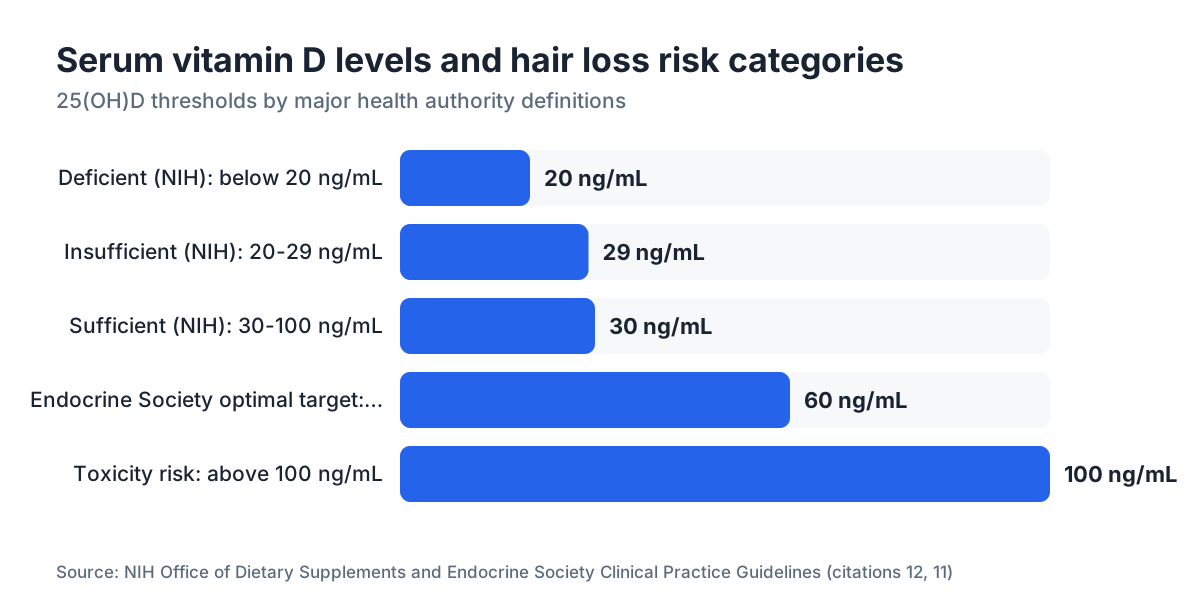
If your 25(OH)D is below 20 ng/mL (deficient by most definitions), supplements are more reliable than chasing the perfect sun schedule, especially in winter or up north. The Endocrine Society recommends 1,500 to 2,000 IU of vitamin D3 daily for deficient adults, though your doctor sets the dose off your labs [11].
Protect exposed scalp like you protect your face. SPF 30 or higher, reapply, or wear a hat for long stretches outdoors. If you're already shedding or thinning, unprotected hours in direct sun add risk with no matching payoff.
Want an objective look at how your hairline is changing? The free AI hair analysis at MyHairline gives you a baseline so you're tracking real change instead of guessing in the mirror.
One last thing. The sun-vitamin-D-hair relationship is real but small in scale. If you have clinically meaningful hair loss, treating it with proven options matters far more than optimizing when you catch some sun. Check whether your shedding might be telogen effluvium, which has its own triggers and often resolves, versus permanent pattern loss.
What blood level of vitamin D is considered deficient, and should you test?
The standard test is serum 25-hydroxyvitamin D (25(OH)D). The National Institutes of Health defines deficiency as below 20 ng/mL (50 nmol/L), insufficiency as 20 to 29 ng/mL, and sufficiency as 30 to 100 ng/mL [12]. The Endocrine Society runs slightly stricter, calling below 20 ng/mL deficient and recommending 40 to 60 ng/mL for optimal health [11].
About 35% of U.S. adults have vitamin D below 20 ng/mL based on NHANES survey data [12]. Deficiency runs higher in people with darker skin, people with obesity, people who spend little time outdoors, and people at higher latitudes.
If you have diffuse shedding or risk factors, testing is reasonable and cheap. A blood draw through your primary care doctor, or increasingly through direct-to-consumer labs, gives you the number. If you're deficient, fixing it is worth doing for your overall health whether or not it moves your hair much.
If your level already sits in the sufficient range, spending money on high-dose vitamin D marketed for hair growth is not supported by the evidence.
Could other things you do in the sun explain hair changes, not UV itself?
Worth asking. Some things blamed on sun exposure trace back to habits that just happen to line up with being outside.
Sweat and salt water sit on the scalp and, left unrinsed, can irritate skin or clog follicles for a while. That's not UV damage.
Chlorine from pools damages the hair shaft, leaving it brittle and prone to snapping, especially in frequent swimmers. Also not UV.
Heat styling on hair that's already UV-stressed compounds structural damage to the shaft, so hair looks and feels thinner even when follicle health hasn't changed.
And people are simply more active in summer. More sweat, more physical stress, sometimes different eating. So seasonal shedding patterns don't pin cleanly on sun.
If you notice more shedding in late summer or fall, it might be partly UV-driven inflammation from the months before, partly the natural hair cycle (which has a small documented autumn shedding peak in at least one large European study), or unrelated to sun altogether [13].
If hair loss genuinely worries you, and you want to rule out things like does creatine cause hair loss or other lifestyle factors, working through causes one at a time beats blaming a single variable.
Summary: what should you actually do about sun and your scalp?
Here's the practical takeaway from all of it.
Test your vitamin D if you haven't lately. If you're deficient, supplement under a doctor's guidance. Short summer sun on your arms and face several days a week is a fine natural source, but don't bank on it in winter or up north, and don't roast a thinning scalp hoping to grow hair. That trade doesn't work in your favor.
Protect your scalp like you protect your face. SPF 30 minimum, broad-spectrum, reapplied every two hours. A hat beats that. This matters more the more scalp your thinning exposes.
Don't expect a vitamin D fix to reverse pattern hair loss. It may cut shedding if deficiency was feeding the problem, but it does nothing to DHT, which drives androgenetic alopecia in men and women. Proven medical treatments handle that part.
If you want to track your hair over time, the free AI hair analysis scan at MyHairline is a fast way to lock in a documented baseline so future comparisons are objective instead of anxious guesswork.
Sources
- National Institutes of Health Office of Dietary Supplements, Vitamin D Fact Sheet for Health Professionals
- Journal of Investigative Dermatology, Schuch et al. 2021, UV radiation and hair follicle damage review
- Journal of Steroid Biochemistry and Molecular Biology, Bikle DD, vitamin D and hair follicle review
- Skin Pharmacology and Physiology, Rasheed et al. 2013, vitamin D in telogen effluvium and female pattern hair loss
- Dermatology and Therapy, Fawzi et al. 2016, study of vitamin D and alopecia
- Skin Pharmacology and Physiology, Banihashemi et al. 2019, vitamin D3 supplementation RCT in telogen effluvium
- Journal of the American Academy of Dermatology, Matsuoka et al. 1992, sunscreen and vitamin D synthesis
- American Academy of Dermatology, Sunscreen FAQs and scalp sun protection recommendations
- British Journal of Dermatology, study of UV transmittance through human hair
- U.S. Food and Drug Administration, 510(k) premarket notification and device clearance information
- The Endocrine Society, Vitamin D Deficiency Clinical Practice Guideline 2011
- NIH Office of Dietary Supplements, Vitamin D Fact Sheet, NHANES prevalence data
- British Journal of Dermatology, study of seasonal variation in human hair shedding