
TL;DR: Vitamin B12 deficiency can cause hair loss, but it's usually one piece of a bigger picture. Severe or prolonged deficiency slows the cells that build hair and pushes follicles into shedding mode, a pattern called telogen effluvium. A blood test diagnoses it. Correcting B12 helps, but regrowth takes 3 to 6 months and won't happen overnight.
Can vitamin B12 deficiency actually cause hair loss?
Yes, it can. The honest caveat is that B12 deficiency rarely causes hair loss by itself, and the evidence linking the two is mostly observational, not from controlled trials. The biology behind it is real though.
B12 keeps DNA synthesis and red blood cell production running [1]. Hair follicles are among the fastest-dividing cells you have. When B12 runs low, cell division slows, follicles struggle to hold the active growth phase (anagen), and more hairs slip into the resting and shedding phase (telogen). What you see is diffuse thinning across the whole scalp, not a receding hairline or a bald spot.
This pattern has a name: telogen effluvium. It's a temporary, reactive kind of hair loss set off by a physiological stressor, and nutritional deficiency is one of its recognized triggers [2].
One cross-sectional study in the International Journal of Trichology found patients with hair loss had significantly lower serum B12 than controls, though the authors called the link associative, not proven [3]. A 2023 review in Dermatology and Therapy reached a similar verdict: micronutrient deficiencies including B12 are "commonly observed" in patients with hair loss, but causality is hard to pin down without intervention trials [8].
So here's the short version. Low B12 is a legitimate contributor to diffuse shedding, especially when it's moderate to severe. It's not a myth. It's also not the first thing to suspect in most people losing hair.
What does B12 deficiency hair loss look like?
Pattern is the whole story here. B12-related hair loss looks nothing like male-pattern baldness or a receding hairline. What you'll usually notice instead:
- Even, diffuse thinning across the entire scalp
- More shedding when you wash or brush (extra hairs on the drain or pillow)
- Hair that feels finer or more fragile
- No defined bald patches, no hairline recession
The shedding tends to start 2 to 4 months after the deficiency sets in, because that's how long a stressed follicle takes to finish its move into telogen and actually let go of the hair [2]. This delay trips people up. You feel fine now, but you were depleted months ago.
Other deficiency symptoms often ride along and can steer you: fatigue that sleep doesn't fix, a sore or smooth tongue (glossitis), tingling or numbness in the hands and feet, trouble concentrating, and pale or slightly yellow skin. Losing hair plus any of those? Move a B12 test up your list.
If your loss follows a clear pattern (temples, crown, distinct patches), B12 is probably not the main driver. In that case, read up on what causes hair loss more broadly.
Who is most at risk for B12 deficiency hair loss?
Not everyone with low B12 loses hair, and not everyone losing hair has low B12. But some groups carry meaningfully higher risk [1].
People who don't eat animal products. B12 lives almost entirely in meat, fish, eggs, and dairy. Vegans who don't supplement consistently are the highest-risk group. One large analysis found up to 86% of unsupplemented vegans were B12 deficient.
People taking metformin. Metformin (for type 2 diabetes) cuts intestinal B12 absorption over time. The FDA label for metformin notes the link with reduced B12 and recommends periodic monitoring [4].
People over 50. Stomach acid production drops with age, and you need enough acid to pry B12 off food proteins. The NIH estimates that 10 to 30% of adults over 50 have trouble absorbing food-bound B12 [1].
People on long-term proton pump inhibitors (PPIs). PPIs suppress stomach acid for months or years, which blunts B12 absorption much like aging does [1].
People with pernicious anemia or certain GI conditions. Crohn's disease, celiac disease, and atrophic gastritis all interfere with absorption. Pernicious anemia destroys the intrinsic factor protein your gut needs to take up B12 at all.
If you land in one of these groups and you're seeing diffuse shedding, checking a B12 level is genuinely sensible, more than precautionary.
How is B12 deficiency diagnosed?
A standard serum B12 blood test is the first step, and any primary care doctor or direct-to-consumer lab can run it [1]. Most labs flag anything under 200 pg/mL (148 pmol/L) as deficient, though some clinicians treat levels under 300 pg/mL as suboptimal in symptomatic patients.
The test has real blind spots. Serum B12 measures total B12, including inactive forms your body can't use. You can post a "normal" number and still be functionally short. That's why two extra markers earn their keep when suspicion is high:
- Methylmalonic acid (MMA): Elevated MMA is a more sensitive sign of functional deficiency at the cellular level [9].
- Homocysteine: Rises with B12 deficiency too (though folate and B6 deficiency raise it as well).
For hair loss, a dermatologist or GP usually runs a wider panel alongside B12: complete blood count (CBC), ferritin (iron stores), thyroid-stimulating hormone (TSH), folate, zinc, and vitamin D. Hair loss is rarely one nutrient's fault, and these tests rule the common culprits in or out.
The American Academy of Dermatology does recommend checking for nutritional deficiencies as part of a hair loss workup [2], though the exact panel depends on how you present.
You don't need a specialist for a B12 test. Your GP can order it, and most insurance covers it when medically indicated. Some people go straight to Labcorp or Quest, where a basic B12 panel runs about $30 to $80 without insurance.
Want a starting point before the lab appointment? An AI-based hair scan like the one at MyHairline can help you describe your shedding pattern and tell whether it reads as diffuse (fits a nutritional trigger) or patterned (points to androgenetic alopecia). That frames the conversation with your doctor.
What B12 levels are considered normal, low, and deficient?
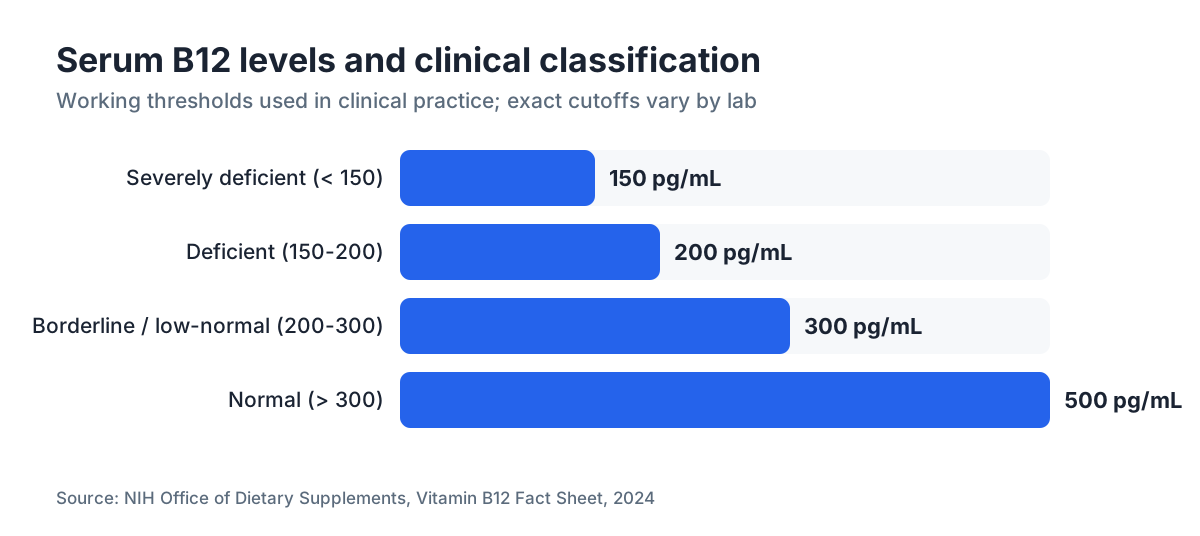
Reference ranges shift a little between labs, but here's a working table you can use:
| Serum B12 Level | Classification | Clinical Implication |
|---|---|---|
| > 300 pg/mL | Normal | Deficiency unlikely to drive hair loss |
| 200-300 pg/mL | Low-normal / borderline | Functional deficiency possible, especially with symptoms |
| 150-200 pg/mL | Deficient | Treatment generally recommended |
| < 150 pg/mL | Severely deficient | Neurological risk; prompt treatment needed |
These cutoffs track NIH guidance [1] and common clinical practice. The borderline zone (200 to 300 pg/mL) is honestly ambiguous. If you're sitting there with hair loss and fatigue and no other clear cause, most practitioners will either start supplementing or retest in 3 months.
Worth knowing: B12 doesn't carry the "too high" worry that some fat-soluble vitamins do. It's water-soluble, so excess leaves in your urine. High serum B12 from supplements isn't dangerous. Very high levels in someone who isn't supplementing can occasionally flag liver disease, and that's worth a follow-up.
How is B12 deficiency treated, and will hair grow back?
Treatment depends on the cause and how severe things are.
Oral supplementation works well for most people with dietary deficiency or mild to moderate malabsorption. The NIH notes that high-dose oral B12 (1,000 to 2,000 mcg/day) can hit adequate absorption even in people with reduced intrinsic factor, because roughly 1% of B12 gets absorbed passively, without intrinsic factor at all [1]. At high enough doses, that 1% adds up.
Intramuscular (IM) injections are the traditional route for severe deficiency, pernicious anemia, or badly compromised gut absorption. Injections skip the GI tract entirely. A common US protocol is 1,000 mcg injected daily for a week, then weekly for a month, then monthly for maintenance, though protocols vary [9].
Sublingual B12 dissolves under the tongue and absorbs through the mucous membranes. Some practitioners like it for patients with gut absorption problems, though the evidence comparing it to high-dose oral is thin.
Now the hair. Yes, it generally grows back after you correct the deficiency, but you'll need patience. Follicles have to cycle back into anagen, and that takes time. Most people see less shedding within 4 to 8 weeks of correction and real regrowth within 3 to 6 months [2]. Full recovery can run 12 months or longer, depending on how long you were deficient and how heavy the shedding was.
If your hair still isn't recovering after 6 months of corrected B12, something else is going on. That's the moment a dermatologist can check whether androgenetic alopecia (pattern baldness) was in the picture the whole time. Pattern loss answers to different treatments entirely, from minoxidil for men to finasteride.
Can you take too much B12? Is supplementing safe?
B12 has no tolerable upper limit (UL) from the NIH, because high oral or injected doses show no established toxicity in healthy people [1]. Extra B12 leaves through the kidneys. The FDA hasn't set a UL either.
That said, "no known toxicity" isn't a reason to megadose for no reason. Very high circulating B12 in someone who isn't supplementing can be a signal worth chasing down. Liver disease, myeloproliferative disorders, and certain cancers have been linked to elevated serum B12 in some studies, but that's the disease releasing B12, not the supplement causing harm.
For hair loss, 500 to 1,000 mcg/day orally is within standard practice for anyone with documented deficiency. A general multivitamin carrying B12 at 100% of the daily value (2.4 mcg for adults [1]) is fine for prevention in low-risk people, but nowhere near enough to fix an established deficiency.
Here's the part that actually matters: if you're taking B12 for hair loss without confirming you're deficient, you may be treating the wrong problem. Unconfirmed deficiency is a big reason hair loss supplements disappoint. See hair loss supplements for a wider look at what the evidence actually backs.
Is hair loss from B12 deficiency different from other types of hair loss?
Yes, and the differences change how you treat it.
B12-related hair loss is a form of telogen effluvium: diffuse, temporary, driven by a systemic stressor. It hits the whole scalp with no pattern. It usually reverses once you fix the cause.
Androgenetic alopecia (male or female pattern hair loss) runs on DHT sensitivity at the follicle. It follows a predictable map: temples and crown in men, central thinning in women. It's genetic, progressive, and B12 does nothing for it. This is the loss that responds to finasteride and minoxidil for men, or eventually a hair transplant. If pattern loss is your concern, read about DHT blockers.
Alopecia areata is an autoimmune condition that carves out patchy, circular bald spots. B12 won't touch it.
Why the distinction matters so much: plenty of people spot a low-normal B12 result, start supplementing, and expect a full recovery that never arrives, because they have underlying androgenetic alopecia. The B12 deficiency was real, but it was making an existing pattern worse, not creating it. Fixing B12 helps. It won't override genetic hair loss.
Unsure which type you're dealing with? A dermatologist's assessment (or a preliminary AI scan) is the fastest next move before you spend money on treatments.
What other nutrient deficiencies cause hair loss besides B12?
B12 gets the spotlight, but iron deficiency (specifically low ferritin) is probably the most common nutritional driver of hair loss in women. A 2018 review in the Journal of the American Academy of Dermatology found serum ferritin under 30 ng/mL associated with telogen effluvium, and some dermatologists push for ferritin above 70 ng/mL in actively shedding patients [5].
Other deficiencies with evidence behind them:
- Vitamin D: Low vitamin D shows up often in people with alopecia areata and telogen effluvium, though whether it's a cause or a bystander is still debated [6].
- Zinc: Zinc deficiency can cause hair loss, and zinc levels are frequently low in alopecia patients. But excess zinc causes hair loss too, so supplementing without testing can backfire [10].
- Folate (B9): Works next to B12 in DNA synthesis, and deficiency produces the same diffuse shedding pattern.
- Biotin (B7): True biotin deficiency is rare. Despite the mountain of biotin marketing for hair, no evidence supports supplementing it in people who aren't deficient [7].
The point: a full nutritional panel, not a lone B12 test, gives you the real picture. Treat one deficiency while another lingers and you get half a recovery.
For a wider view of hair loss triggers beyond nutrition, see what causes hair loss.
How long does it take for hair to grow back after fixing B12 deficiency?
This is the question everyone asks once their B12 is treated, and the honest answer carries a lot of variability.
The hair growth cycle has three main phases: anagen (active growth, 2 to 6 years), catagen (transition, 2 to 3 weeks), and telogen (resting and shedding, about 3 months) [2]. When deficiency shoves follicles into telogen, they park there until conditions improve. Correct the B12 and follicles have to re-enter anagen, which doesn't flip on instantly.
Most people see:
- Less daily shedding within 4 to 8 weeks of correction
- Visible regrowth (short new hairs) at 3 to 4 months
- Meaningful density gains at 6 to 9 months
- Full recovery, if it's coming, by 12 months
Six months into corrected B12 with verified lab values and still losing real hair? That's a signal to see a dermatologist. The shedding may be multifactorial, or a concurrent androgenetic process may have started before or alongside the deficiency.
One practical note: don't judge recovery by daily shed counts alone. A hair pull test or trichoscopy, both of which dermatologists use, gives a more objective read of what's happening at the follicle.
Should you take B12 supplements for hair loss even without a deficiency?
Probably not, at least not as a standalone hair loss fix.
If you're not deficient, B12 almost certainly won't grow more hair. The follicle isn't limited by B12 once your levels are adequate. No well-designed randomized trial shows B12 supplementation promoting hair growth in people who aren't deficient.
Where it does make sense:
- You've tested and confirmed deficiency or borderline levels
- You're vegan or vegetarian and not already supplementing consistently
- You're on long-term metformin and your doctor hasn't checked B12 lately
- You're over 50 and haven't had a recent B12 check
If you want a multivitamin as general nutritional insurance, that's reasonable. A standard multivitamin usually carries 6 to 25 mcg of B12, enough to prevent deficiency in most people with normal absorption. It won't treat an established one.
The hair loss supplement aisle is stacked with products listing B12 in big letters on the front. That labeling isn't dishonest, but it's built to imply more than the evidence delivers. For a full breakdown of what does and doesn't hold up, read our guide to hair loss supplements.
Sources
- NIH Office of Dietary Supplements, Vitamin B12 Fact Sheet for Health Professionals
- American Academy of Dermatology, Hair Loss Resource Center
- International Journal of Trichology, Micronutrient deficiencies in patients with hair loss (2013)
- FDA, Metformin Hydrochloride Tablets Label (DailyMed)
- Journal of the American Academy of Dermatology, Iron and Hair Loss Review (2018)
- NIH Office of Dietary Supplements, Vitamin D Fact Sheet for Health Professionals
- NIH Office of Dietary Supplements, Biotin Fact Sheet for Health Professionals
- Dermatology and Therapy, Micronutrients and Hair Loss Review (2023)
- NIH National Library of Medicine, StatPearls: Vitamin B12 Deficiency
- NIH Office of Dietary Supplements, Zinc Fact Sheet for Health Professionals