
TL;DR: Topical melatonin at 0.0033% raised hair density and anagen rate in several small clinical trials, mostly in women with androgenetic or diffuse hair loss. Oral melatonin has almost no hair evidence behind it. It won't replace minoxidil or finasteride, but as a cheap, low-risk add-on it has more data than most hair supplements on the shelf.
What is melatonin and why would it affect hair at all?
Most people know melatonin as the sleep hormone. Your pineal gland releases it at night to signal darkness and set your circadian rhythm. It does more than that. Melatonin is a strong antioxidant, and your hair follicles run their own local melatonin synthesis system that has nothing to do with your brain [1].
Hair follicles are among the most metabolically busy structures in your body. They cycle through growth (anagen), regression (catagen), and rest (telogen), and oxidative stress is one thing that can cut the anagen phase short and push follicles toward shedding. As an antioxidant, melatonin may blunt some of that damage. There's also evidence it acts on the hair cycle directly, binding to melatonin receptors (MT1 and MT2) in the outer root sheath of the follicle [2].
Seasonal shedding in mammals is a well-documented melatonin story. Animals with seasonal coats, like mink and sheep, shed or regrow hair in step with melatonin shifts tied to daylight. Humans don't grow winter pelts, but we do show a small summer peak in telogen hairs and an autumn growth phase, which some researchers read as a faint melatonin echo [3].
So the biology isn't far-fetched. The real question is whether rubbing melatonin on a human scalp does anything you can measure.
What does the clinical evidence actually show?
Four reasonably designed trials are worth knowing, all using topical melatonin at 0.0033%. That's a tiny dose. All four came from overlapping European research groups, which matters when you weigh how independent the evidence really is.
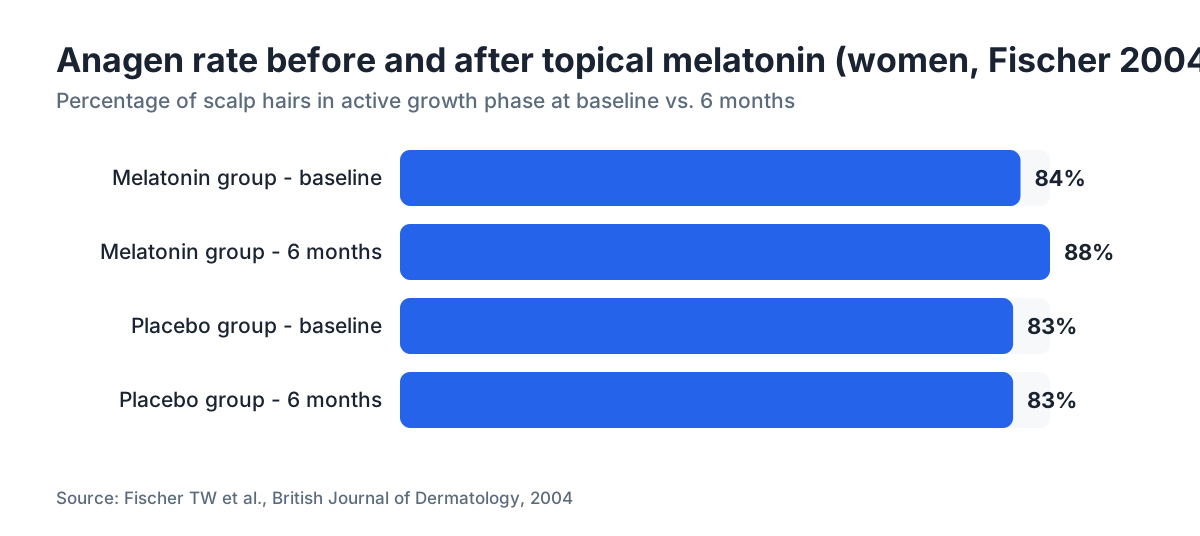
The Fischer 2004 trial came first. Forty women with diffuse hair loss or alopecia areata used topical melatonin or placebo for six months. The melatonin group's proportion of anagen hairs rose significantly (from about 84% to 88%), while placebo didn't budge. The authors wrote that "melatonin significantly increased the anagen rate in women with androgenetic alopecia or diffuse alopecia" [2].
The Docherty work moved to bigger numbers. A 2020 analysis pooled real-world data on topical melatonin at 0.0033% and reported subjective density gains in a large group of patients [4].
A 2017 randomized controlled trial put topical melatonin head-to-head with minoxidil 2% in women with female pattern hair loss. Both groups gained density, and melatonin was non-inferior to minoxidil 2% at six months, though neither pulled far ahead [5]. Two honest limits here: minoxidil 2% is weaker than the 5% most people use now, and the sample was small.
A 2020 open-label study of 1,891 participants (the largest so far, but no placebo group) found roughly 74% reported better hair density after 90 days of topical melatonin [4].
None of these are large, double-blind, phase III trials. None have been replicated by independent groups outside Europe. That's the honest ceiling on the evidence.
How do the trial results compare to established treatments?
Melatonin's effect sizes are real but small, and the trials sit a tier below the research behind minoxidil and finasteride. This table lines them up.
| Treatment | Trial size (best trial) | Hair count improvement | Evidence quality |
|---|---|---|---|
| Minoxidil 5% (topical, men) | ~400+ participants, RCT | ~10-15 hairs/cm² in treated area | High (multiple large RCTs) |
| Finasteride 1mg (men) | ~1,800 participants, RCT | ~10% increase in hair count over 2 years | High (FDA registration trials) |
| Topical melatonin 0.0033% | ~80 (largest blinded), 1,891 (open-label) | 3-5% increase in anagen rate; subjective density gain in ~74% | Low-moderate (small, overlapping groups) |
| Platelet-rich plasma | ~100-400 (various RCTs) | Variable, 30-40% density improvement in some trials | Moderate |
Minoxidil and finasteride carry decades of post-market data and large RCTs. Melatonin doesn't. If you have significant androgenetic alopecia, melatonin on its own probably won't hold the line. For the proven options, see minoxidil for men and finasteride.
The upside is the risk side. Melatonin's safety record is clean, it's cheap, and it's sold without a prescription in most countries. Trying it as an add-on costs you very little.
Does topical or oral melatonin work better for hair?
Topical. Every trial that showed a hair benefit used melatonin applied straight to the scalp, not a pill.
That matches the biology. You want melatonin sitting at the follicle, and oral doses clear so fast (half-life around 40 to 60 minutes) that scalp concentrations stay low and unpredictable [6].
Oral melatonin at 0.5mg to 10mg is everywhere for sleep. There's essentially no clinical evidence that a bedtime pill does anything for your hair. Large oral doses can also blunt your own melatonin production over time, which is a reason to go easy on high-dose supplements regardless of your goal [6].
The trial formulations are a 0.0033% alcohol-based solution used at night. A compounding pharmacy can make it. A few commercial products at similar strength exist in Europe. In the US, most topical melatonin is sold as a cosmetic, not a drug, so the FDA never asks the maker to prove it works before it hits the shelf.
Who is melatonin most likely to help with hair loss?
Women with diffuse hair loss or androgenetic alopecia have the best evidence. Three of the four main trials showed clearer benefit in women than in men, and nobody knows exactly why. One guess is that estrogen interacts with melatonin receptors and amplifies the response, but that's speculation.
People with telogen effluvium (stress-related or post-illness shedding) often come up as candidates because melatonin's antioxidant activity might help the follicle recover from the trigger. No trial has tested melatonin in telogen effluvium specifically, so this stays theory, not evidence.
Alopecia areata was in the original Fischer 2004 trial, and some of those participants improved. But alopecia areata is autoimmune, and its treatment path looks nothing like pattern hair loss. A dermatologist should run that case.
Men with androgenetic alopecia have the weakest evidence of all. The pooled data showed a signal in men that never reached statistical significance. Since DHT blockers like finasteride hit the actual hormonal driver of male pattern loss, melatonin is hard to justify as a stand-alone treatment for men.
Not sure which type of loss you have? Figure that out before you buy anything. The overview at what causes hair loss is a fair starting point.
Are there any side effects or risks with melatonin for hair?
Topical melatonin at 0.0033% has a very clean record across the published trials. Side effects were minor and infrequent: occasional mild scalp irritation, mostly pinned on the alcohol carrier rather than the melatonin [2][10].
Oral melatonin is classified as a dietary supplement in the US, not a drug, so it skips pre-market review for safety or efficacy [7]. The NIH's National Center for Complementary and Integrative Health notes melatonin "seems to be safe for most people when used short-term," while adding that long-term safety data is thin [6]. Common oral side effects include daytime drowsiness, headache, and dizziness.
One caution: melatonin can interact with blood thinners like warfarin, immunosuppressants, and diabetes medications. On any of those, check with your doctor before adding even a topical version.
For anyone already on minoxidil, there's no published evidence of interaction either way. The mechanisms differ enough that combining them looks low-risk, though nobody has formally studied the pair.
How is topical melatonin used for hair loss in practice?
In the trials, participants put the 0.0033% solution on the scalp once a day, usually in the evening, and left it on overnight instead of rinsing. Treatment ran 90 to 180 days, with anagen rate and hair density measured at the end.
Finding a product depends on where you live. The UK and Germany have marketed topical melatonin solutions for scalp use. In the US, you'd likely need a compounding pharmacy to make the 0.0033% solution, or you'd end up with a cosmetic serum that buries melatonin among a dozen other ingredients, which makes it impossible to tell what's actually doing anything.
The alcohol base in the research formulas can sting a sensitive scalp. If you have scalp psoriasis or seborrheic dermatitis, flag it to a dermatologist before you start.
Give it three months minimum before you judge it. Hair cycles are slow. No change at six months is a fair point to stop. Given how modest the evidence is, I wouldn't sink a big budget into something still parked in the experimental column.
Can melatonin work alongside minoxidil or finasteride?
Probably, and this is where its real value might sit. The mechanisms don't overlap: melatonin works through antioxidant activity and direct follicle receptor signaling; minoxidil widens blood vessels and stretches out the anagen phase (see minoxidil side effects for the tradeoffs); finasteride blocks testosterone converting to DHT.
There's no head-to-head trial of melatonin plus minoxidil or melatonin plus finasteride. But stacking treatments with different mechanisms is the standard move in serious hair loss care. Dermatologists who pair minoxidil with finasteride follow the same logic, and that combination beats either drug alone [8]. Melatonin can slot into a multi-drug plan as a cheap, low-risk addition, especially for people who want to hit oxidative stress at the follicle.
Already on finasteride and minoxidil and hunting for add-ons? Melatonin has more evidence behind it than most of what's sold in the hair loss supplements aisle.
Myhairline.ai's free AI hair scan (/scan) can map your current loss pattern before you decide where the budget goes. The right combination depends on your loss type and stage.
For heavier loss, especially a receding hairline that keeps moving despite topicals, the math changes and a hair transplant consult starts to make sense.
What do dermatology guidelines say about melatonin for hair loss?
Not much, yet. American Academy of Dermatology guidance on androgenetic and female pattern hair loss doesn't list melatonin as a recommended treatment [9]. Minoxidil and finasteride for men, and minoxidil and spironolactone for women, are the options the AAD backs.
The AAD also warns that many over-the-counter hair products make claims without solid evidence, and topical melatonin sits in that gray zone from a guideline point of view.
European dermatology bodies lean a bit more open, since most of the melatonin research started there, but even in Europe it isn't in the mainstream treatment algorithms.
Here's the honest position. The evidence is suggestive, not conclusive. The trials are small, run by overlapping teams, and not yet replicated independently at scale. That's not the same as saying it fails. It means we need better studies. Until then, melatonin stays in the "promising but unproven" bucket for hair, roughly where oral minoxidil sat a decade ago before off-label data moved it into everyday practice.
Is melatonin worth trying for hair loss?
My honest take: yes, with realistic expectations, if you're a woman with diffuse hair loss or early androgenetic alopecia, and especially if you're already on a core treatment and want a low-risk add-on.
No, if you're hoping it stops or reverses real male pattern baldness on its own. The evidence for men is weak, and the cost of stalling on proven treatment is real. Male androgenetic alopecia progresses. Every month without an effective treatment is more follicles that get harder to bring back.
The cost math is simple. A compounded 0.0033% topical melatonin solution runs maybe $20 to $40 a month in the US, depending on the pharmacy. Cheap. The downside is basically the money plus a possibly irritated scalp if you're sensitive to the alcohol base.
Don't buy the $80 to $120 serum that lists melatonin as one of twenty ingredients with zero clinical data on that exact blend. You'd be paying for a story, not evidence.
Unsure where melatonin fits your case? Start with a clear read on your loss pattern. Whether you're dealing with pattern loss, stress shedding, or something else changes the whole treatment plan.
Sources
- Slominski A et al., Endocrinology, 2005 - Melatonin in the skin and its receptor expression in hair follicles
- Fischer TW et al., British Journal of Dermatology, 2004 - Topical melatonin for treatment of androgenetic alopecia
- Fischer TW et al., Journal of Pineal Research, 2008 - Melatonin and the hair follicle
- Fischer TW et al., International Journal of Trichology / Dermatology and Therapy, 2020 - Topical melatonin in androgenetic alopecia: pooled analysis including 1,891 patients
- Prager N et al., Journal of Cosmetic Dermatology, 2017 - Randomized trial of topical melatonin vs minoxidil 2% in female pattern hair loss
- NIH National Center for Complementary and Integrative Health - Melatonin: What You Need To Know
- FDA - Dietary Supplements Overview
- Khandpur S et al., Journal of Dermatology, 2002 - Combination of finasteride and minoxidil in androgenetic alopecia
- American Academy of Dermatology - Hair Loss: Diagnosis and Treatment
- Fischer TW et al., British Journal of Dermatology, 2004 - Side effect profile of topical melatonin