
TL;DR: Severe calorie restriction and crash dieting can cause hair loss called telogen effluvium. Shedding usually starts 2 to 4 months after the dietary stress begins, once resting hairs cycle out. Mild intermittent fasting rarely does it. The shed is temporary if you fix the nutritional gap, but full regrowth takes 6 to 12 months.
What does fasting actually do to your hair follicles?
Cut your food supply hard and your hair follicles do something rational: they quit early. Follicles are among the most metabolically demanding tissues in your body. They divide faster than almost any other cell type, so they need a steady flow of protein, iron, zinc, and calories. Starve that flow and the follicle shifts more hairs into the resting (telogen) phase to conserve resources [1].
Under normal conditions, roughly 85 to 90 percent of your scalp hairs are in the anagen (growth) phase at any moment, with about 10 to 15 percent resting. A metabolic shock, whether from fasting, a very low-calorie diet, surgery, or illness, can push an abnormal share of follicles into telogen at once. Two to four months later, when those resting hairs get shed and replaced, you see a sudden jump in daily hair fall [2].
That delay trips everyone up. You started a new diet in January, you're shedding hard in March, and you blame your shampoo. The timing points straight at the diet.
Short fasting windows (the 16:8 style) look much less likely to cause this, because total calories and protein across the day stay roughly the same. The trigger is the deficit, not the clock.
What is telogen effluvium and how does dieting cause it?
Telogen effluvium (TE) is the medical name for diffuse, temporary hair shedding set off by a systemic stressor [2]. It's the same mechanism behind postpartum shedding, major illness, and high fever. Telogen effluvium is one of the most common types of hair loss dermatologists see, and dietary restriction is a documented cause.
The pathway is straightforward. Severe caloric restriction drops circulating insulin-like growth factor 1 (IGF-1), a hormone that keeps follicles in the growth phase. A 2017 review in Skin Appendage Disorders found that nutritional deficiencies, particularly protein and iron, are consistently tied to telogen effluvium across multiple patient groups [3]. The follicle reads low IGF-1 and low ferritin as a signal that the body is under stress and growth is a luxury it can't afford.
The good news: TE from dieting is not androgenetic alopecia (male or female pattern baldness). It doesn't permanently shrink the follicle. Restore adequate nutrition and the follicle restarts. Shedding usually peaks around 3 to 4 months after the trigger, slows over the next 3 to 6 months, and visible regrowth follows a few months after that [2].
The bad news: if you already carry a genetic tendency toward pattern hair loss, a TE episode can unmask or speed it up. The two conditions can run at the same time.
How many calories is 'too few' before hair starts falling out?
There's no single hard number, and honest researchers admit the data here is messy. The literature still points to a few useful markers.
Very low-calorie diets (VLCDs), defined as below 800 kilocalories per day, show up repeatedly in case reports of diet-induced telogen effluvium [3][4]. A 2020 review in the Journal of the American Academy of Dermatology noted that rapid weight loss, more than roughly 1 to 1.5 pounds per week sustained over weeks, is a recognized trigger for TE [4].
Protein probably matters as much as raw calories. Hair is almost entirely a protein called keratin. Diets that push protein below about 0.8 grams per kilogram of body weight per day, the minimum recommended dietary allowance set by the U.S. National Academies, create a keratin shortage that can speed follicle shutdown [5].
Iron deficiency is the other big lever. Many weight-loss diets, especially plant-heavy ones, run low in bioavailable iron. Low serum ferritin (below about 30 nanograms per milliliter in most hair loss guidelines) is independently linked to TE even when calories are fine [3].
So the real answer: it's rarely one thing. Too few calories AND too little protein AND micronutrient depletion is the combination that most reliably costs you hair. A moderate deficit of 300 to 500 calories a day with solid protein is much less likely to do follicular damage.
Does intermittent fasting cause hair loss specifically?
Probably not for most people, but the evidence is thin. That's the honest answer to a question people search constantly.
There are no large randomized controlled trials looking at hair outcomes in people doing intermittent fasting (IF). What we have is mechanistic reasoning and scattered case reports. The reasoning: if IF doesn't produce a real net calorie or protein deficit, the follicle has no reason to enter early telogen. A 2022 review in Nutrients concluded that the health effects of IF are mostly explained by the caloric restriction it produces rather than the fasting window itself [6].
Some people do report shedding during IF. The likelier explanation is that their IF is quietly producing a big overall deficit, or they're eating too little protein in their compressed window, or another stressor (poor sleep, thyroid changes from rapid weight loss) is stacked on top.
One mechanism deserves more study. Fasting briefly raises cortisol, and chronically high cortisol can disrupt the hair cycle. But the short cortisol bump from a 16-hour fast is nothing like the sustained HPA-axis activation seen in clinical stress research. Nobody has good data on this specifically; the closest studies look at more extreme protocols or animal models.
Bottom line: if you're doing 16:8 or 5:2, hitting your protein target, and not dropping weight faster than about a pound a week, your hair is probably fine.
Which specific nutritional deficiencies are most linked to hair loss?
When diet quality slips, a handful of nutrients matter for the follicle. Here's what the research actually supports, versus what supplement labels want you to believe.
| Nutrient | Role in hair growth | Deficiency evidence | Source |
|---|---|---|---|
| Protein / amino acids | Keratin synthesis, IGF-1 support | Strong: TE consistently seen with protein malnutrition | [3][5] |
| Iron (ferritin) | Supports cell proliferation in follicle matrix | Moderate-strong: low ferritin associated with TE in multiple studies | [3] |
| Zinc | Enzyme cofactor for follicle cell division | Moderate: deficiency causes hair loss; excess also harmful | [3] |
| Vitamin D | Receptor expression in follicle; unclear exact role | Moderate: low levels associated with TE and alopecia areata | [3] |
| Biotin | Heavily marketed; deficiency is rare in adults | Weak: only clear in true deficiency (rare without raw egg intake or a genetic disorder) | [3] |
| Niacin / B vitamins | Cellular energy metabolism | Moderate: pellagra (severe niacin deficiency) causes hair loss | [3] |
The takeaway: iron and protein have the best evidence behind them. Biotin supplements are almost certainly wasted money if you're not deficient, which most adults aren't. Our hair loss supplements guide covers the evidence across the main ones.
A full blood panel (CBC, ferritin, TIBC, B12, vitamin D, thyroid) is a reasonable first move if you're shedding and recently changed your diet. Your dermatologist can order it.
How do you know if your hair loss is from dieting or something else?
Timing is your single best clue. Diet-induced telogen effluvium follows a predictable arc: the stressor hits, then after a 2 to 4 month lag, diffuse shedding starts across the whole scalp. If you can map your shedding onset to a dietary change roughly 2 to 3 months earlier, the pieces fit [2].
The pattern of loss also tells you a lot. TE thins the entire scalp evenly. You lose density everywhere, not a receding hairline or a bald spot at the crown. Losing ground specifically at the temples and crown points toward androgenetic alopecia, the pattern hair loss driven by DHT sensitivity [7]. A receding hairline with miniaturizing hairs at the temples is a different diagnosis from a diffuse shed.
A dermatologist can run a pull test: grasping 40 to 60 hairs between two fingers and tugging gently. Pulling out more than 6 hairs is a positive result and suggests active TE. They can also examine shed hairs under a microscope; TE hairs have a telogen (club-shaped) root, while anagen hairs keep a sheath attached.
Blood work is essential when the pattern isn't obvious. Thyroid disorders, both underactive and overactive, cause diffuse loss that looks identical to TE on the scalp. Autoimmune conditions can too. Don't assume diet is the cause without ruling these out, especially if you haven't changed how you eat recently.
Myhairline.ai's free AI scan can help you map your shedding pattern and see whether it looks more diffuse or patterned before you book a dermatologist visit.
Can Ozempic or GLP-1 weight loss drugs cause hair loss?
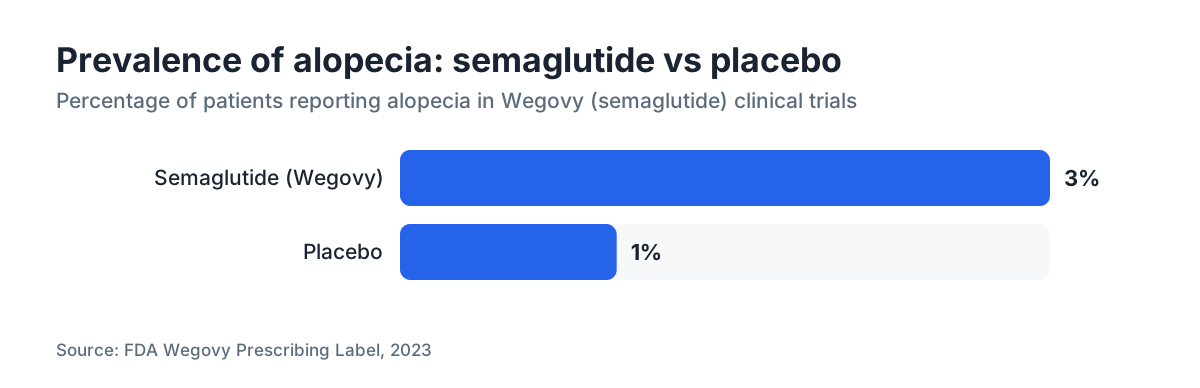
Yes, and the question has exploded since 2022. Semaglutide (Ozempic, Wegovy) and other GLP-1 receptor agonists cause rapid, significant weight loss in many users, and the FDA prescribing information for Wegovy lists alopecia as an adverse reaction in about 3 percent of patients in clinical trials [8].
The mechanism is almost certainly the same telogen effluvium pathway. The drug suppresses appetite hard, total intake drops, and the follicle responds to the metabolic stress. Some users also miss their protein target on these drugs, because appetite suppression kills the desire for all food, not only junk.
This isn't a reason to skip these medications if they're medically indicated. It is a reason to be deliberate about protein (most clinicians now suggest 1.2 to 1.6 grams per kilogram of body weight for people on GLP-1 drugs) and to expect a temporary shed that usually improves once weight stabilizes.
The Wegovy label states that alopecia was reported in "3.0%" of semaglutide-treated patients versus "1.0%" of placebo patients [8]. That gap is a real signal, not random noise.
Is the hair loss from dieting permanent?
Usually not. This is the genuinely reassuring part of diet-induced telogen effluvium.
Because TE interrupts the follicle's cycle rather than destroying the follicle, growth can restart once the nutritional stressor is gone. Most people see shedding slow within 3 to 6 months of fixing the deficit and start seeing new growth soon after. Full density recovery can take 12 to 18 months, because hair grows only about half an inch per month [2].
Permanence becomes a real worry in two situations. First, if severe restriction runs for years rather than weeks, case reports suggest chronic malnutrition can eventually damage follicle stem cells, though that's uncommon. Second, if you're genetically primed for androgenetic alopecia, a TE episode can accelerate the underlying miniaturization. In that case you might recover most of the shed hair but end up with slightly less density than before, because the pattern loss kept running in the background.
Worried that what you're seeing is pattern hair loss sped up by dieting rather than pure TE? That's worth a dermatologist visit. Treatments like minoxidil for men or finasteride address the androgenetic side, while nutrition handles the TE side. The two work together.
How do you prevent hair loss when dieting or fasting?
You don't have to pick between losing weight and keeping your hair. A few adjustments cut your risk sharply.
Keep protein high. This is the single most effective lever. Aim for at least 1.2 grams per kilogram of body weight per day while in a deficit. Prioritize complete proteins: eggs, poultry, fish, Greek yogurt, legumes paired with grains. Hair is keratin, and keratin is protein. Don't shortchange it.
Avoid extreme deficits. A deficit of 300 to 500 calories per day produces about 0.5 to 1 pound of loss per week, well inside the range most research considers safe for follicle health. Faster is worse for your hair.
Get bloodwork before a big diet change if you can. Knowing your baseline ferritin, vitamin D, thyroid, and B12 lets you fix deficiencies before they compound the dietary stress. Low ferritin is extremely common in menstruating women and is an independent risk factor for TE.
Doing intermittent fasting? Front-load protein in your eating window. A 16:8 protocol where you eat 25 grams of protein at your first meal and another 30 to 40 grams across the rest is very different from the same window spent mostly on carbs.
Cut other stressors where you can. TE is usually multifactorial: a moderate diet, plus poor sleep, plus a rough month, plus low ferritin adds up to a trigger that none of them alone would have caused. Address the whole stack, not one layer.
Our what causes hair loss guide covers the full set of contributing factors if you want the wider picture.
When should you see a doctor about diet-related hair loss?
See a dermatologist, ideally one focused on hair loss, if any of the following holds. You're losing what looks like clumps rather than the 100 to 150 hairs a day that TE produces at its worst. You've corrected your diet and shedding hasn't slowed after 6 months. Your loss is patterned (hairline recession, bald crown) rather than diffuse. You have other symptoms pointing at something systemic: fatigue, cold intolerance, weight changes unrelated to dieting, irregular periods, or joint pain. Or a home pull test keeps producing more than 6 to 10 hairs from a small section.
A board-certified dermatologist can separate TE from androgenetic alopecia, alopecia areata, and other causes with a scalp exam and a targeted blood panel. The American Academy of Dermatology runs a physician finder on its website [9].
Don't sit on it for 18 months hoping it clears if other symptoms suggest a systemic problem. Pattern hair loss in particular responds far better to early treatment. If there's an androgenetic component, a dermatologist might raise options from topical minoxidil to finasteride, or in severe cases a hair transplant. Those conversations go best when you start them early.
For a quick first read on your shedding before the appointment, the free AI hair analysis at myhairline.ai can tell you whether your loss looks diffuse (more like TE) or patterned.
Does eating more hair-healthy foods speed up recovery?
Yes, within a hard ceiling. Once you've closed the nutritional gap, your follicles restart on their own biological clock, and you can't really override that pace. But reaching adequate nutrition faster does matter, and some nutrients pull more weight than others.
Iron-rich foods (red meat, lentils, spinach with a vitamin C source to boost absorption) are worth prioritizing if your ferritin is low. Rebuilding ferritin takes weeks to months even with supplements, so don't wait for a pill to do what food can start today.
Omega-3 fatty acids (oily fish, walnuts, flaxseed) get promoted for hair growth. A small randomized trial in the Journal of Cosmetic Dermatology in 2015 found that a supplement combining omega-3s, omega-6s, and antioxidants reduced hair loss and improved density versus placebo over 6 months [10]. The effect sizes were modest and the formula packed several ingredients, so pinning the benefit on omega-3s alone isn't possible. Oily fish is good for you regardless, so there's no downside.
Zinc from food (oysters, pumpkin seeds, beef) beats high-dose supplements: too much zinc can block iron absorption and cause hair loss of its own. More is not better.
And no, there's no food or supplement that grows your hair back in 3 weeks. Anyone selling that is lying to you.
Sources
- National Institutes of Health, National Library of Medicine: Hair follicle biology and the hair growth cycle
- American Academy of Dermatology: Telogen effluvium overview
- Skin Appendage Disorders (Karger), 2017: The Role of Vitamins and Minerals in Hair Loss
- Journal of the American Academy of Dermatology, 2020: Diet and hair loss
- NIH Office of Dietary Supplements / U.S. National Academies: Protein recommended dietary allowance
- Nutrients (MDPI), 2022: Intermittent Fasting: Is There a Role in Dermatology?
- American Academy of Dermatology: Hair loss causes and types
- FDA Prescribing Information: Wegovy (semaglutide) label, adverse reactions
- American Academy of Dermatology: Find a dermatologist
- Journal of Cosmetic Dermatology, 2015: Omega-3 and antioxidant supplement for hair loss
- NIH Office of Dietary Supplements: Iron fact sheet for health professionals