
TL;DR: Biotin supplements help with hair loss only if you have a true biotin deficiency, which is rare. In people with normal biotin levels, no good clinical evidence shows that extra biotin grows hair or stops shedding. The supplement industry built a multi-billion dollar category on that shaky footing. For most people researching hair loss, biotin is the wrong place to spend money.
What is biotin and what does it actually do for hair?
Biotin is a B-vitamin, specifically vitamin B7, that your body uses to metabolize fats, carbohydrates, and amino acids [1]. Hair follicles need amino acids to build keratin, the structural protein in the hair shaft, so the idea that biotin feeds hair growth isn't fully invented. The problem sits in the gap between "needed for normal metabolism" and "supplementing extra will grow more hair."
Think about your car. It needs oil. Run it dry and you destroy the engine. Pour in twice the recommended amount and it does not go faster. Biotin behaves the same way in most bodies.
Your gut bacteria produce some biotin on their own [1]. The adequate intake set by the National Institutes of Health Office of Dietary Supplements is just 30 micrograms per day for adults, an amount most people clear easily through eggs, meat, fish, seeds, and sweet potato [1]. The typical bottle at the pharmacy holds 5,000 to 10,000 micrograms. That is 166 to 333 times the adequate intake.
Who actually has a biotin deficiency?
True biotin deficiency is rare [1]. The groups genuinely at risk are narrow: people with biotinidase deficiency (a rare genetic disorder), people on long-term anticonvulsant therapy with drugs like valproic acid, heavy raw-egg-white consumers (avidin in raw egg whites binds biotin and blocks absorption), and people with inflammatory bowel disease or other severe malabsorption conditions [1][2].
If you fall into one of those categories, your dermatologist or gastroenterologist probably already knows.
True deficiency shows up as hair thinning, brittle nails, and a scaly red rash around the face, not a slightly receding hairline [2]. If you have those symptoms together, get a blood test. If you just have a receding hairline or a widening part, something else is going on.
Most people buying biotin at the pharmacy are not deficient and will see no measurable benefit [2].
What does the clinical evidence actually show?
This is where the supplement industry's story falls apart.
A 2017 systematic review published in Skin Appendage Disorders looked at all available published case reports and trials involving biotin supplementation and hair or nail changes [2]. The authors found 18 reported cases where biotin supplementation showed improvement. Every single one involved an underlying condition causing biotin deficiency or a disorder of biotin metabolism. "There is no evidence to suggest that biotin supplementation in healthy, non-deficient individuals causes hair or nail changes," the review concluded [2].
Read that sentence twice. Every case of improvement involved someone who was already deficient or had a metabolic disorder.
A 2019 review in the Journal of the American Academy of Dermatology reached the same place, noting that biotin deficiency as a cause of hair loss is exceedingly rare, and that routine supplementation in the general population lacks clinical support [3].
No large randomized controlled trials show that biotin regrows hair in people with androgenetic alopecia (the common genetic pattern loss), telogen effluvium, or other common causes of shedding.
| Cause of hair loss | Biotin shown to help? | Evidence quality |
|---|---|---|
| True biotin deficiency | Yes | Case reports, small series |
| Biotinidase deficiency (genetic) | Yes | Case reports |
| Androgenetic alopecia (MPB/FPHL) | No | No RCT evidence |
| Telogen effluvium | No | No RCT evidence |
| Alopecia areata | No | No RCT evidence |
| Healthy adults, normal biotin levels | No | Systematic review evidence against |
Why do so many people say biotin worked for them?
A few things happen when someone swears biotin fixed their hair.
Hair cycles. Telogen effluvium, the most common cause of sudden shedding, usually resolves on its own in three to six months [4]. Someone starts biotin during peak shedding, the shedding stops on its own schedule, and the biotin gets the credit. That is textbook post hoc reasoning.
Most people doing one thing are doing several. New shampoo, less stress, better sleep, stopped crash dieting. Any of those can shift hair cycling. The biotin still gets the credit.
Nails do tend to respond to biotin even in non-deficient people, based on the small amount of evidence that exists [2]. Nails growing faster and feeling stronger is real and noticeable. Hair cycles more slowly and varies more between individuals, so it is much harder to judge without a controlled study. People feel something changing and generalize.
Then there is placebo, which is well documented in cosmetic categories. Hair is emotionally loaded. People want something to be working.
Is biotin safe to take?
Biotin is water-soluble, so your body excretes whatever it does not use, and no tolerable upper intake level exists because toxicity has not been reported at any oral dose studied [1]. In that sense, biotin is not dangerous.
There is a real safety issue the FDA has warned about: high-dose biotin interferes with certain laboratory immunoassay tests [5]. The FDA issued a safety communication in 2017 and updated it in 2019, warning that biotin at doses commonly found in supplements (1,000 micrograms and above) can cause falsely high or falsely low results in tests for thyroid hormones, troponin (the heart attack marker), vitamin D, and other hormones [5].
The FDA stated: "The FDA has received reports of incorrect lab test results in patients taking high levels of biotin that have led to misdiagnoses, including one reported patient death" [5].
That is not theoretical. If you take high-dose biotin and go in for blood work, tell your doctor. Most labs now ask about supplement use for exactly this reason.
What treatments actually have evidence for hair loss?
If you have androgenetic alopecia (the genetic pattern loss that gives men a receding hairline and women a widening part), the treatments with real evidence are a short list.
Minoxidil for men is FDA-approved at 2% and 5% topical concentrations, and the 2.5mg oral dose has growing evidence behind it too [6]. It works by prolonging the anagen (growth) phase of the hair cycle and increasing blood flow to the follicle. It does not address the underlying hormonal cause, but it slows loss and regrows some hair in many users.
Finasteride is an oral prescription drug FDA-approved for male pattern hair loss that blocks the conversion of testosterone to dihydrotestosterone (DHT). DHT is the primary driver of follicle miniaturization in androgenetic alopecia [7]. If you want the mechanism in detail, the DHT blocker explainer goes deeper.
Combining finasteride and minoxidil outperforms either alone in head-to-head studies.
Hair transplant surgery, for those with enough donor density, permanently relocates DHT-resistant follicles to thinning areas. The results last but the cost is real, typically $4,000 to $15,000+ depending on graft count and surgeon, and not everyone is a candidate [8].
None of these are perfect. All of them have more evidence than biotin for the common forms of hair loss. If you want a clearer read on what is driving your specific pattern, a free AI scan at MyHairline can map your hairline stage and help you figure out which category you are probably in before you spend a dollar.
For the wider landscape of what else is sold, the hair loss supplements article covers saw palmetto, marine collagen, and others with the same evidence-first lens.
Does biotin help with hair loss caused by nutritional deficiency?
This is the one scenario where the answer shifts toward "possibly, but check first."
Iron deficiency is far more common than biotin deficiency as a nutritional cause of shedding, particularly in premenopausal women. Zinc deficiency, vitamin D deficiency, and protein insufficiency all have more documented links to hair loss than biotin does [3]. If you are losing hair and suspect nutrition, the more useful blood tests are ferritin (stored iron), a complete blood count, vitamin D 25-OH, and a thyroid panel.
If your ferritin comes back low, correcting that is far more likely to improve your hair than buying biotin. The what causes hair loss explainer covers the full diagnostic picture.
If you genuinely want to cover the biotin angle, a standard B-complex at normal doses gives you the 30 micrograms the NIH considers adequate. No evidence shows that going to 5,000 or 10,000 micrograms adds anything [1].
Does biotin work differently for women than for men?
No meaningful clinical difference exists in how biotin is metabolized between men and women once you control for body weight and caloric intake. The deficiency thresholds are the same. The lack of evidence for supplementation in non-deficient people applies equally to both sexes.
The gender angle matters in the type of hair loss. Female pattern hair loss (FPHL) presents differently than male pattern loss, often as diffuse thinning across the crown rather than a receding front. Women are also more likely to carry iron deficiency anemia as a concurrent driver of shedding. So women researching biotin for hair loss are, statistically, more likely to have a nutritional issue, but it is probably iron, not biotin.
Pregnancy-related shedding (postpartum telogen effluvium) is very common and resolves without intervention in most cases [4]. Biotin gets marketed hard to postpartum women, but the evidence for efficacy in this group is absent.
How much does biotin cost compared to treatments that actually work?
This comparison matters if you have a real budget to allocate.
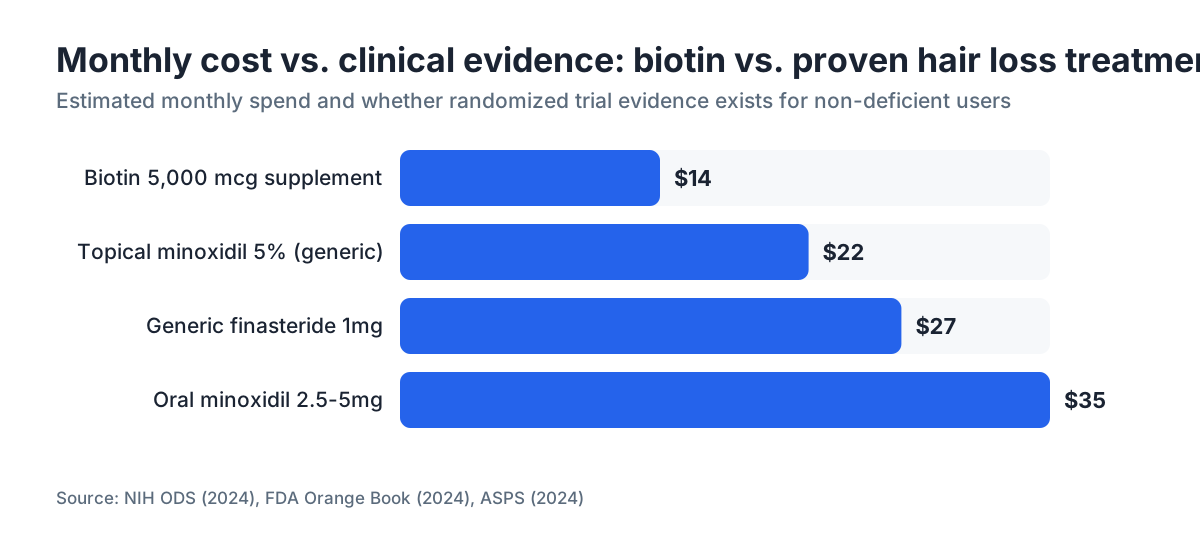
A typical 5,000 mcg biotin supplement runs $8 to $20 per month at major retailers. Over a year that is $96 to $240 for something with no clinical evidence of benefit in non-deficient individuals.
Topical minoxidil 5% (generic, over the counter) costs roughly $15 to $30 per month [6]. FDA-approved. Shown in multiple randomized trials to slow loss and, for many users, regrow hair.
Generic finasteride by prescription runs $15 to $40 per month depending on the pharmacy and whether you use a coupon service like GoodRx [7]. Also FDA-approved. Also backed by trials.
You can spend the same money on biotin that you would on a proven treatment. That is not a small point if you are early in your loss and deciding where to focus.
| Product | Monthly cost (est.) | FDA approved for hair loss | Clinical trial evidence in non-deficient users |
|---|---|---|---|
| Biotin 5,000 mcg | $8-$20 | No | None |
| Topical minoxidil 5% | $15-$30 | Yes | Yes (multiple RCTs) |
| Generic finasteride 1mg | $15-$40 | Yes (men) | Yes (multiple RCTs) |
| Oral minoxidil 2.5-5mg | $20-$50 | Off-label | Growing evidence |
| Hair transplant | $4,000-$15,000+ (one time) | Yes (surgical) | Yes |
Should you bother getting a biotin blood test?
Probably not, unless your doctor specifically suspects a deficiency based on symptoms. Biotin blood tests are not standardized across labs, they are not reliably accurate at detecting marginal deficiency, and the result rarely changes management for someone with garden-variety hair thinning [2].
If you have the risk factors from earlier, heavy raw egg consumption, long-term anticonvulsant use, known gut malabsorption, then yes, raise it with your doctor. Otherwise the more useful tests for a hair loss workup are ferritin, TSH (thyroid), CBC, and in women, total and free androgen levels.
A dermatologist can do a scalp exam and sometimes a dermoscopy or scalp biopsy to separate androgenetic alopecia from other causes. That information is more actionable than a biotin number in almost every case.
What about shampoos and topical products with biotin in them?
Biotin in shampoo is mostly a marketing play. Biotin is a water-soluble vitamin. Applied to the scalp and rinsed off, the amount that penetrates the stratum corneum to reach the follicle bulb is negligible [3]. The follicle bulb sits several millimeters below the skin surface.
Whatever you notice from a "biotin shampoo" usually comes from other ingredients: panthenol, which coats the hair shaft and makes it feel thicker for a while; proteins that fill surface damage; or milder surfactants that reduce breakage. Those effects are real. The biotin in the formula is not the reason.
Spend on a shampoo that suits your scalp, not one that lists biotin as the hero ingredient.
What's the bottom line on biotin for hair loss?
Biotin is not a scam in the technical sense. It is a real vitamin doing real work in the body. The scam is the implication, pushed by supplements marketing, that taking 100 to 300 times the adequate intake will meaningfully grow or thicken hair in people who already have normal levels.
The evidence is clear enough that the American Academy of Dermatology does not recommend routine biotin supplementation for hair loss in otherwise healthy people [3]. The systematic review in Skin Appendage Disorders found zero cases of benefit in non-deficient individuals [2]. The FDA has flagged the lab test interference risk from high-dose supplementation [5].
Want to rule out a true deficiency? A standard B-complex at normal doses is cheap and harmless. But if you have androgenetic alopecia or heavy shedding, biotin is not what stands between you and your hair. The treatments with actual trial evidence are minoxidil and finasteride, sometimes together, and for some people eventually a hair transplant.
Not sure which type of hair loss you have, or how far along it is? MyHairline's free AI scan gives you a starting point before you commit to any path.
Sources
- NIH Office of Dietary Supplements, Biotin Fact Sheet for Health Professionals
- Skin Appendage Disorders, 2017, Patel et al., 'Examining the Evidence for the Use of Vitamin B7 (Biotin) in Hair and Nail Growth'
- Journal of the American Academy of Dermatology, 2019, Almohanna et al., 'The Role of Vitamins and Minerals in Hair Loss'
- American Academy of Dermatology, Hair Loss Resource Center
- FDA, Approved Drug Products with Therapeutic Equivalence Evaluations (Orange Book) — Minoxidil
- FDA, Approved Drug Products — Finasteride 1mg (Propecia)
- American Society of Plastic Surgeons, Hair Transplant Procedure Cost
- NIH Office of Dietary Supplements, Biotin Consumer Fact Sheet