

TL;DR: Yes, smoking is independently linked to hair loss. Smokers are roughly twice as likely to develop male or female pattern baldness as non-smokers. The mechanisms are real. Nicotine cuts blood flow to follicles, smoke chemicals raise DHT-related enzyme activity, oxidative stress damages follicle DNA, and the whole process pushes hairs into shedding early. Quitting slows the damage. It rarely reverses loss that's years old.
What does the research say about smoking and hair loss?
The link isn't a guess. It's been measured. A 2020 cross-sectional study in Skin Appendage Disorders examined 1,000 male twins and found smoking was significantly associated with androgenetic alopecia (male pattern hair loss), with smokers more than twice as likely to show moderate-to-severe loss than their non-smoking twins [1]. The twin design is what makes this stand out. Comparing twins controls for genetics, so the smoking signal wasn't just underlying genetic risk showing through.
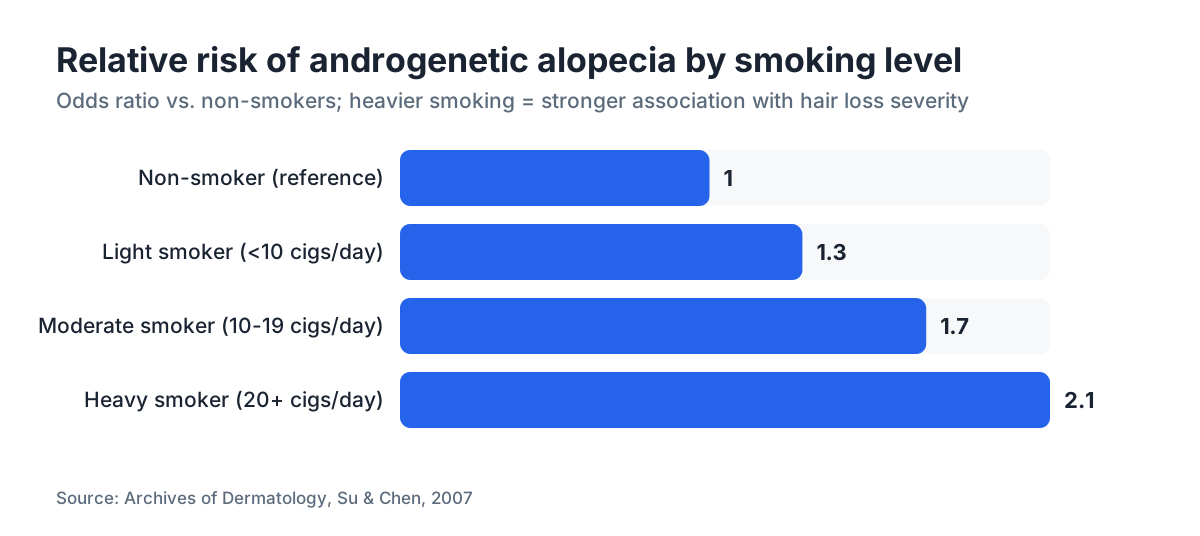
An earlier and widely cited 2007 study in the Archives of Dermatology by Su and Chen found a dose-response pattern. The more cigarettes per day, the worse the baldness [2]. Men who smoked more than 20 a day had the highest severity scores.
The data aren't perfect. Most of these studies are observational, so they can't prove cause the way a randomized trial would. But the association holds up across different populations and study designs. For a lifestyle factor, that's about as strong as the evidence gets.
How does smoking actually damage hair follicles?
This is where it gets specific. Understanding the mechanisms tells you exactly what's happening under your scalp.
Reduced blood flow. Nicotine is a vasoconstrictor. It narrows blood vessels, including the tiny capillaries that feed each follicle's dermal papilla, the cluster of cells at the base that signals hair growth. Starve it of oxygen and nutrients and the follicle cuts its growth phase short, producing a thinner, weaker shaft. Scalp blood flow is measurably lower in smokers than non-smokers [3].
Oxidative stress. Cigarette smoke carries thousands of free radicals per puff. Follicle cells are especially exposed because they divide so fast. Oxidative damage to follicle DNA can permanently impair a follicle's ability to grow hair [4]. The same pathway is thought to speed up graying.
DHT amplification. Smoke chemicals appear to increase 5-alpha reductase, the enzyme that turns testosterone into dihydrotestosterone (DHT). DHT is the main driver of androgenetic alopecia. Smoking doesn't invent the problem. It pours fuel on a fire that's already lit. If you carry genetic sensitivity to DHT, smoking can move your timeline forward by years [2]. See the article on dht blocker for how DHT blockers work against this pathway.
Telogen effluvium trigger. Nicotine withdrawal, stress from smoking-related illness, and the systemic inflammation smoking causes can all push follicles into the telogen (resting and shedding) phase early. That produces the diffuse shed called telogen effluvium.
Microvascular fibrosis. Chronic smoking scars the small blood vessels, including those feeding the scalp. Vasoconstriction is at least partly reversible when you quit. Fibrosis is structural scarring, and it isn't. That's likely why heavy long-term smokers don't always recover hair after they stop.
Does smoking cause male pattern baldness or just make it worse?
Smoking almost certainly won't cause androgenetic alopecia in a man with zero genetic sensitivity to DHT. Male pattern baldness is a genetic condition at its core. What smoking does is speed it up in men who already carry the genes.
Genetics decides whether you have a lit fuse. Smoking shortens it.
The twin studies back this up. When one twin smokes and the other doesn't, the smoker shows earlier onset and worse severity, but both may eventually bald if they share the same variants. Smoking moves the timeline forward, sometimes by years [1].
For women, the research is thinner but points the same way. A 2019 study in the Journal of the American Academy of Dermatology found female smokers had higher rates of female pattern hair loss (FPHL) than non-smoking controls [5]. The mechanisms look similar, though women's hormonal setting is different.
If you already see a receding hairline and you smoke, you're almost certainly speeding up the clock.
How much do you have to smoke for it to affect your hair?
The dose-response data from Su and Chen (2007) is the clearest answer we have [2]. Light smokers, under 10 a day, showed elevated risk over non-smokers, but the effect was modest. Heavy smokers, 20 or more a day, showed the strongest link to severe androgenetic alopecia.
Nobody has found a safe threshold. Even occasional smoking hits your cardiovascular system, which cuts scalp perfusion. Duration matters too. A 30-year habit at 10 a day probably does more cumulative follicle damage than a 5-year habit at 20 a day, though neither is good.
Vaping is a near-total blank in the research. There's almost no direct hair loss data on it yet. But nicotine is nicotine. The vasoconstriction and oxidative effects should behave the same regardless of how you take it in. Skipping the tar and combustion chemicals may cut some oxidative damage, but the blood-flow effects from nicotine stay.
Does quitting smoking reverse hair loss?
Partly. Here are the honest caveats.
Quit, and scalp blood flow improves within weeks as vasoconstriction fades. Oxidative stress drops sharply over the following year. If your loss was driven mostly by the vascular and oxidative side, some recovery is plausible, especially in early stages.
The bad news: follicles already miniaturized from years of DHT plus poor blood supply may not bounce back. Miniaturization is partly structural. And the fibrotic changes in scalp vessels from long-term smoking may be permanent.
Set expectations honestly. Quitting is one of the best moves you can make for your overall health, and it probably slows further loss. It won't regrow hair you lost years ago. Think of it as stopping the bleed, not undoing it.
If you quit and want to push for regrowth, the two treatments with real FDA-cleared evidence are minoxidil and finasteride. Minoxidil for men dilates blood vessels around the follicle, which lines up with the exact vascular damage smoking causes. Finasteride blocks DHT, hitting the enzyme boost smoking amplifies. Together they have the strongest evidence base for androgenetic alopecia. See finasteride and minoxidil for how the combination stacks up.
Is the hair loss from smoking different from regular pattern baldness?
Not in any way you can see. Smoking-accelerated androgenetic alopecia looks like standard male or female pattern hair loss, because that's what it is, just arriving sooner. No photo will tell you whether smoking played a part.
The one clue researchers note is early onset. Smokers in their 20s and 30s with genetic risk can show Norwood Stage 3 or 4 patterns that a non-smoking peer with the same genes might not hit until their 40s [2].
Smoking can also add a diffuse shed on top, through telogen effluvium, where hairs come out more evenly across the scalp rather than in the temple-and-crown pattern of androgenetic alopecia. The two can run at once. If you see both overall thinning and recession, both processes may be going.
A dermatologist can usually tell them apart with a scalp exam and trichoscopy (dermoscopy of the scalp), which shows the follicle miniaturization pattern specific to androgenetic alopecia versus the uniform miniaturization of telogen effluvium.
Does secondhand smoke affect hair loss?
Honest answer: no study has directly measured hair loss in people exposed only to secondhand smoke. It would be hard to design and fund.
What we do know is that secondhand smoke does real, measurable cardiovascular and oxidative damage in non-smokers. The CDC states that secondhand smoke contains more than 7,000 chemicals, hundreds of which are toxic [6]. The same oxidative and vascular pathways tied to hair loss get switched on by secondhand exposure.
The dose in secondhand smoke is far lower than direct smoking, so any hair-specific effect is almost certainly smaller. This is a spot where nobody has good data. The closest evidence is indirect extrapolation from cardiovascular research.
Can smoking affect hair loss from chemotherapy or other conditions?
Chemotherapy hair loss runs on a different mechanism entirely. Chemo drugs target rapidly dividing cells, which includes follicle matrix cells. Smoking doesn't meaningfully worsen that process, and nothing you do about smoking will stop chemo-induced shedding.
For alopecia areata, an autoimmune condition, the evidence is mixed. Some studies suggest smokers run higher baseline autoimmune inflammation, but no direct causal link between smoking and alopecia areata has been shown [7].
For telogen effluvium driven by other things (nutritional deficiency, thyroid disease, severe physical stress), smoking piles on as one more systemic stressor. It doesn't cause these conditions, but it may worsen the severity or drag out recovery. The full picture of what causes hair loss has many moving parts, and smoking sits among the handful you can actually change.
What other lifestyle factors combine with smoking to worsen hair loss?
Smoking rarely travels alone. The habits that go with heavy smoking often include high alcohol intake, poor diet, chronic stress, and bad sleep. Each one hits follicle biology on its own.
Excess alcohol disrupts zinc and biotin absorption, both used to build keratin. Chronic stress raises cortisol, which throws off the hair cycle. Poor sleep cuts growth hormone, which the follicle cycle depends on. Smoking makes all of it worse.
Nutritional deficiency deserves a specific callout. Smokers burn through vitamin C faster than non-smokers because of the oxidative load. Vitamin C is a cofactor in collagen synthesis, which matters to the tissue surrounding each follicle. Fixing these downstream gaps through diet or targeted supplements may help, though the evidence for specific hair loss supplements is generally weaker than for topical or systemic medications.
If you've run a free AI hair scan like the one at MyHairline to map your loss, the honest next step is pairing that baseline with a hard look at every factor you can change, rather than reaching for a product first.
What should you actually do if you smoke and are losing hair?
Here's what I'd tell a friend.
Quit smoking. Not because it'll magically regrow hair, but because it's probably speeding up what your genes were going to do anyway. Slowing that while you still have follicles left is the rational move. Nicotine replacement therapy (NRT), varenicline (Chantix), and bupropion are all FDA-approved cessation tools with real efficacy data [8].
Get a baseline. See a dermatologist or use a photo-based assessment to document your current Norwood or Ludwig stage. Without a baseline, you can't tell whether treatment is working.
Consider evidence-based treatments. The two with the most evidence are minoxidil (FDA-cleared, applied topically or taken orally, read minoxidil side effects before you start) and finasteride (prescription, blocks DHT, proven in men). Both work on the underlying androgenetic alopecia process no matter what set it off. If you're not a candidate for medication, a hair transplant is a surgical option once your loss is stable.
Don't wait. Miniaturization is progressive. Follicles that are thinning but still active can recover. Follicles dormant for years can't. The earlier you act, the more options you keep.
A baseline scan can clarify how much loss you're actually dealing with. MyHairline's free AI scan at /scan maps your current pattern, which helps you and any clinician read your stage before you make decisions.
Is the research strong enough to say smoking definitely causes hair loss?
Strong enough to act on. Not strong enough to say "definitely" in a strict causal sense.
The case for: multiple independent studies across different populations, a specific and plausible biological mechanism, a dose-response relationship, and consistency with what we already know about how nicotine and oxidative stress hit vascular and cellular biology.
The limit: no randomized trial has ever assigned people to smoke or not for 20 years and measured their hair. That experiment will never run, for obvious ethical reasons. Every bit of human evidence here is observational.
The American Academy of Dermatology, in its patient-facing guidance on hair loss, lists smoking among the lifestyle factors tied to accelerated androgenetic alopecia and advises counseling patients to quit [9].
For a real-world decision, the evidence is more than enough. Smoking harms nearly every organ system you have. Hair isn't the main reason to quit. But if your hair matters to you, put it on the list.
Sources
- Skin Appendage Disorders, 2020: Smoking and androgenetic alopecia in male twins
- Archives of Dermatology, Su & Chen, 2007: Androgenetic alopecia and smoking
- British Journal of Dermatology: Scalp blood flow in smokers vs non-smokers
- International Journal of Trichology: Oxidative stress and hair follicle damage
- Journal of the American Academy of Dermatology, 2019: Female pattern hair loss and smoking
- CDC: Health Effects of Secondhand Smoke
- Journal of the American Academy of Dermatology: Alopecia areata and systemic associations
- FDA: Smoking Cessation Products
- American Academy of Dermatology: Hair loss patient guidance
- NIH National Library of Medicine: Nicotine and vasoconstriction
- NIH: 5-alpha reductase and DHT in androgenetic alopecia