
TL;DR: Chlorine weakens hair shafts by stripping lipids and oxidizing keratin. That causes breakage, dryness, and a thinner look. It does not reach the follicle or trigger true hair loss. If you're shedding more than 100 hairs a day after heavy pool use, something else (telogen effluvium or androgenetic alopecia) is almost certainly the real driver.
What does chlorine actually do to hair?
Chlorine damages the hair you can see, not the follicle you can't. Pools carry it as a disinfectant, usually between 1 and 3 parts per million for recreational water, per the CDC [1]. That's safe to swallow in tiny amounts. Your hair is a different story.
Hair shafts are keratin, a fibrous protein wrapped in a cuticle of overlapping scales. The cuticle locks moisture in and keeps chemicals out. Chlorine breaks that barrier two ways. It oxidizes the disulfide bonds that hold keratin together, so each strand gets weaker and snaps more easily. It also strips the 18-methyleicosanoic acid (18-MEA) lipid layer on the outer cuticle, the thin waxy coat that keeps hair smooth and the scales lying flat [2].
What you feel afterward is rough, dull hair that tangles fast and breaks at lower tension than healthy hair. None of that is follicle damage. It's shaft and surface damage, and it stays on the outside.
Green tint in blonde hair is a separate problem. It comes from copper ions that bond to bleached or porous hair, not from chlorine itself [3].
Can chlorine actually damage hair follicles?
No, not at normal pool concentrations. The follicle sits 2 to 4 millimeters below the skin, and the scalp's oils, barrier, and blood supply shield it from topical chemicals at recreational levels. A 2000 study in the Journal of Investigative Dermatology found no measurable follicular damage in competitive swimmers despite chronic pool exposure [4]. Changes stayed in the shaft, not the dermal papilla or matrix cells that run actual growth.
There's one narrow scenario where the follicle could get involved. Occupational or elite swimmers who spend hours a day in poorly maintained water can face high chloramine levels. Chloramine is the compound chlorine forms after reacting with sweat and urine, and it irritates skin and mucous membranes more than free chlorine does. Chronic scalp irritation can sometimes feed inflammatory conditions like folliculitis. Severe, untreated folliculitis can scar follicles.
That's a long chain of unlikely events, not a straight line from a 45-minute swim to a bald spot.
For almost every recreational swimmer, the follicle is fine.
Why do swimmers sometimes notice more shedding after pool time?
It's mechanical, and it has a simple cause. Wet hair is fragile. Water temporarily breaks the hydrogen bonds in keratin, so each strand can stretch up to 30% more before snapping but also becomes far more vulnerable to friction and pulling [5]. When you swim, the churn of the water plus rubbing against your shoulders plus any tangling loads real stress onto wet shafts.
Then people towel-dry hard or brush while hair is still damp. Both habits snap already-weakened, chlorine-exposed hair at mid-shaft or near the root sheath. The strands land on the towel or in the drain with a white bulb attached, which looks alarming but usually just means the hair broke cleanly, not that the follicle let go early.
Real follicular shedding, what dermatologists call telogen effluvium, has nothing to do with chlorine. Telogen effluvium comes from internal stressors: illness, surgery, crash dieting, major stress, thyroid problems, or iron deficiency. The scalp pushes 20 to 50% of hairs into the resting phase at once, and they shed 2 to 4 months later. Start swimming around the same time as one of those triggers, and chlorine takes the blame it didn't earn.
Normal daily shedding is 50 to 100 hairs. More than that, consistently, is a reason to look at the real causes of hair loss instead of your pool schedule.
What does the research say? A look at swimmer studies
The published work is thin but points the same direction: shaft damage, not follicle damage. A 1999 study in Dermatology compared 67 competitive swimmers (8 to 12 hours of pool time a week for at least two years) to non-swimmers [6]. Swimmers had far more hair shaft damage under electron microscopy: rougher cuticles, more weathering, more porosity. Hair density and follicle counts showed no significant difference between the groups.
A 2012 Brazilian study of 105 swimmers found elevated hair calcium and copper and a direct link between weekly pool hours and breakage frequency [3]. Follicular parameters were untouched.
Nobody has published a long-term randomized trial tracking androgenetic alopecia in swimmers versus non-swimmers, and that gap matters. The honest read: existing data says shaft damage, full stop, but no one has rigorously tracked whether decades of swimming could nudge miniaturization in genetically susceptible people. That's absence of evidence, not evidence of absence. Given the biology, it's hard to draw a plausible path from chlorine to DHT-driven follicle miniaturization.
How much chlorine exposure causes visible hair damage?
There's no clean threshold in the literature, because damage depends on three moving parts: chlorine concentration, how often and how long you're in, and your hair's baseline condition.
The EPA sets a maximum contaminant level goal (MCLG) for chlorine in drinking water at 4 mg/L (4 ppm) [7]. Pools usually run 1 to 3 ppm, and some spas push to 10 ppm. Damage shows up reliably in people swimming 6 or more hours a week for months, especially in heavily treated competition pools or outdoor pools where UV piles on more oxidative stress.
Already-damaged hair raises the stakes. Bleached, heat-treated, or color-processed hair has lost much of its 18-MEA lipid layer, so exposure a healthy head shrugs off can trigger fast breakage.
Here's a rough framework from available data:
| Exposure level | Likely shaft effect | Follicular risk |
|---|---|---|
| Recreational (<3 hrs/week) | Minimal dryness | None |
| Moderate (3-6 hrs/week) | Noticeable dryness, some roughness | None |
| Heavy competitive (6-12+ hrs/week) | Measurable breakage, weathering | Negligible (shaft only) |
| Occupational + poor pool chemistry | Significant breakage, scalp irritation possible | Low; folliculitis risk if chronic inflammation |
Is green, crunchy, or thinning-feeling hair from chlorine reversible?
Yes, mostly, because it's shaft damage rather than follicular damage.
The shaft is dead tissue. You can't heal it the way skin heals. But the right steps restore how it looks and how much force it takes before it breaks. Protein-based conditioners and keratin treatments temporarily patch damaged cuticle scales. Bond-repair products (the Olaplex category) claim to rebuild broken disulfide bonds, and there's peer-reviewed support for that mechanism even if some marketing runs ahead of the science [8]. Deep conditioning with silicone products smooths the cuticle and cuts friction breakage.
New growth from an unharmed follicle comes in with a healthy shaft, so even badly damaged hair recovers fully over 6 to 18 months of grow-out with gentle habits.
For green tint, a chelating shampoo (one with EDTA or citric acid) strips the copper deposits. "Swimmer's shampoo" is basically a chelating shampoo. Use it once or twice a week during swim season, not daily, since it strips conditioning agents too.
What protective measures actually reduce chlorine damage?
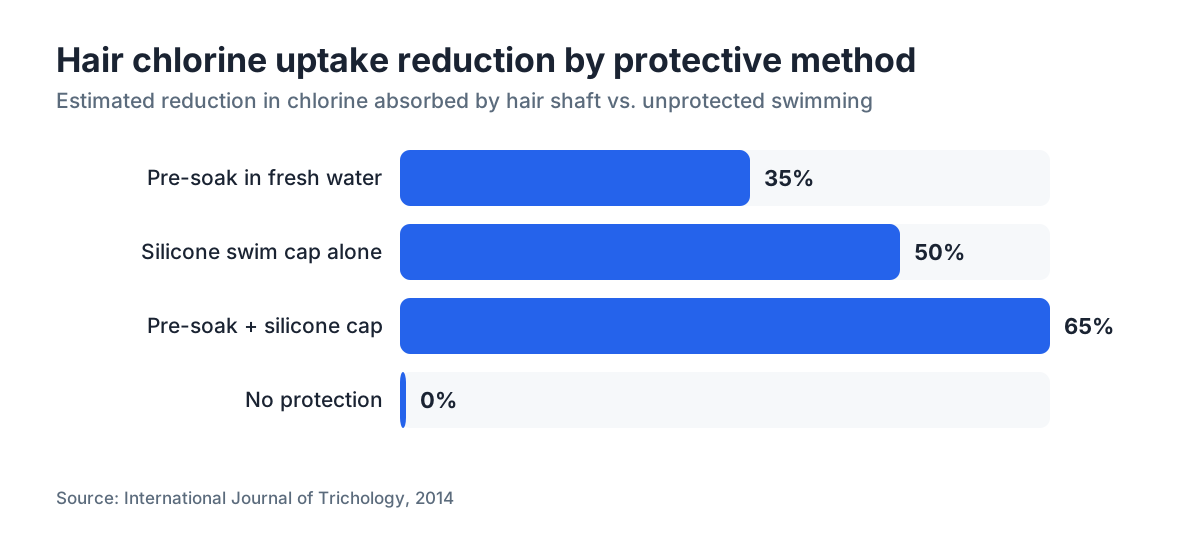
A handful of things work, and the evidence is reasonably solid. Start with the easiest one: soak your hair in fresh water before you get in. Hair is porous and absorbs water. If it's already full of clean water, it takes up far less chlorinated water. A 2014 study in the International Journal of Trichology found pre-soaking cut chlorine uptake in hair samples by roughly 30 to 40% [9].
A well-fitted silicone swim cap does even more. It isn't watertight, but it slashes contact time and the volume of chlorinated water reaching your hair. Serious athletes use both: pre-soak and cap.
Rinsing right after you swim matters more than people think. The longer chlorinated water sits in your hair, the more oxidation runs. A rinse within 5 to 10 minutes of getting out beats waiting until you're home.
A leave-in conditioner or oil before swimming coats the cuticle and slows chlorine from getting in. Coconut oil has some evidence for cutting protein loss from hair in wet conditions, though chlorine-specific data is limited [10].
Last, go easy on wet hair after the pool. Pat, don't rub. Comb with a wide-tooth comb from the ends up to the roots before it dries. Skip heat styling the same day if you can.
If chlorine isn't causing my hair loss, what is?
This is the question that matters. Chlorine is a visible, convenient scapegoat. But if you're truly losing density (more than breaking shafts), the cause is elsewhere.
Androgenetic alopecia (AGA) is the most common one by far, hitting roughly 50% of men by age 50 and up to 40% of women by their mid-40s, per AAD estimates [11]. It runs on dihydrotestosterone (DHT) acting on genetically sensitive follicles, shrinking them over years. Swimming does nothing to that process. Part widening, temples receding, crown thinning? Check your family history before you blame the pool. Sorting out whether DHT blockers would help you is a better use of your time.
For AGA, two treatments have FDA approval: minoxidil (topical and oral) and finasteride (for men). Minoxidil for men works by extending the anagen growth phase and enlarging follicles. Finasteride blocks the 5-alpha reductase enzyme that turns testosterone into DHT. The finasteride and minoxidil combination has more evidence behind it than either drug alone.
Shedding heavily all over your scalp without clear miniaturization points more toward telogen effluvium. Find the trigger (usually something 2 to 4 months before the shedding began) and deal with it. TE usually resolves on its own.
Not sure which type you have? Get an objective look at your hairline and density over time. The free AI scan at MyHairline maps your pattern against Norwood stages before you book a dermatology visit.
Do swimmers have higher rates of hair loss than non-swimmers?
No published epidemiological data shows higher rates of androgenetic alopecia or permanent hair loss in competitive swimmers than in the general population. The swimmer studies that exist (mainly the Llau 1999 paper and similar work) show shaft weathering and cosmetic change, not more clinical alopecia [6].
Anecdotally, some swimmers and coaches worry about hair quality among athletes. But cosmetic shaft damage and visible thinning aren't the same as follicular miniaturization or permanent loss. The lack of large-scale data is because nobody funded that study, not because harm is being hidden.
Elite swimmers also tend to have strong health markers, higher cardiorespiratory fitness, and lower rates of the metabolic conditions (insulin resistance, obesity) that some research ties to faster hair loss. So any chlorine signal would have to fight protective factors pushing the other way.
Here's the clean version: if chlorine meaningfully drove balding, decades of regular pool use would leave a population-level signal. That signal has never shown up in published data.
What about saltwater pools or other pool chemicals?
Saltwater pools still use chlorine. The salt (sodium chloride) just generates it through electrolysis instead of coming from a bottle. Chlorine tends to run slightly lower in saltwater pools (around 1 to 2 ppm) than in traditionally chlorinated ones, so hair takes marginally less oxidative stress. The difference is real but small.
Bromine turns up in spas and hot tubs as an alternative disinfectant. It oxidizes about like chlorine and causes comparable shaft damage. Hot water in a spa also opens the cuticle and speeds chemical penetration, so spa time can be more damaging per minute than a pool.
Bicarbonate-based or UV-only systems exist and would, in theory, be gentler on hair, but they're rare and expensive. Given the choice, a lower-chlorine system with good pH (7.2 to 7.8 is the standard range) beats a poorly maintained high-chlorine pool for both skin and hair.
pH matters on its own, separate from chlorine level. Acidic water (below pH 6.5) damages the cuticle directly. Alkaline water (above pH 8) swells the shaft and lifts the cuticle. Well-run pool chemistry protects hair no matter the disinfection method.
Should you worry about chlorine if you're already treating hair loss?
If you're on minoxidil or finasteride for androgenetic alopecia, swimming doesn't get in the way in any real sense. Topical minoxidil goes on the scalp, not the hair shaft, and dries before you'd normally swim. Swim right after applying it and you're rinsing some off early. So apply after swimming, or give it at least 4 hours to absorb first, per standard labeling guidance.
For oral minoxidil, pool exposure is irrelevant since the drug is systemic.
If you're mid-research on minoxidil side effects or weighing a hair transplant, chlorine belongs near the bottom of your worry list. After a transplant, surgeons usually say avoid pools for at least 4 weeks while grafts heal, because submerging healing tissue in pool chemicals raises infection risk. That's temporary, not permanent.
If you're looking at hair loss supplements, some carry biotin, which at very high doses can throw off certain lab tests. Unrelated to chlorine, but worth knowing if you're getting bloodwork to investigate shedding.
With a receding hairline, chlorine breakage near the front can make an early recession look worse than it is. Better post-swim care can make a real cosmetic difference while you decide whether treatment is warranted.
Practical summary: what to actually do
If your hair looks worse since you started swimming, the fix is almost all about shaft care, not about whether your follicles are under siege.
Saturate your hair with fresh water before you get in. Wear a silicone cap if your hair matters to you. Rinse within 5 to 10 minutes of getting out. Use a chelating shampoo once or twice a week during swim season. Condition deeply, especially mid-shaft to ends. Handle wet hair gently.
Do all of that and still see your part widening or overall density dropping? That's not chlorine. That earns a proper dermatology workup. A full blood panel (ferritin, thyroid, total testosterone, DHEA-S for women, sex hormone binding globulin) clears the reversible causes. If it's androgenetic alopecia, you have real options. Want a baseline picture of your hairline and Norwood stage before that appointment? The free AI scan at MyHairline (myhairline.ai/scan) gives you a visual starting point.
Don't quit swimming over hair fears. The heart benefits of regular swimming outweigh any cosmetic shaft damage a pool can hand you. Manage the shaft, investigate if there's real density loss, and don't confuse breakage with balding.
Sources
- CDC, Healthy Swimming: Pool Chemical Safety
- International Journal of Cosmetic Science, Bhushan et al. 2003: Role of 18-MEA in hair surface properties
- Journal of Human Trichology, Gavazzoni Dias et al. 2012: Hair cosmetic properties in competitive swimmers
- Journal of Investigative Dermatology, 2000: Follicular changes in chronic pool exposure
- Dermatology, Llau et al. 1999: Hair damage in competitive swimmers
- US EPA, National Primary Drinking Water Regulations: Chlorine
- International Journal of Cosmetic Science, Lohala et al. 2020: Bond-repair treatments and disulfide bond restoration in hair
- International Journal of Trichology, 2014: Pre-soaking reduces chlorine uptake in hair
- Journal of Cosmetic Science, Rele & Mohile 2003: Effect of coconut oil on protein loss in hair
- American Academy of Dermatology, Hair Loss: Who Gets and Causes