
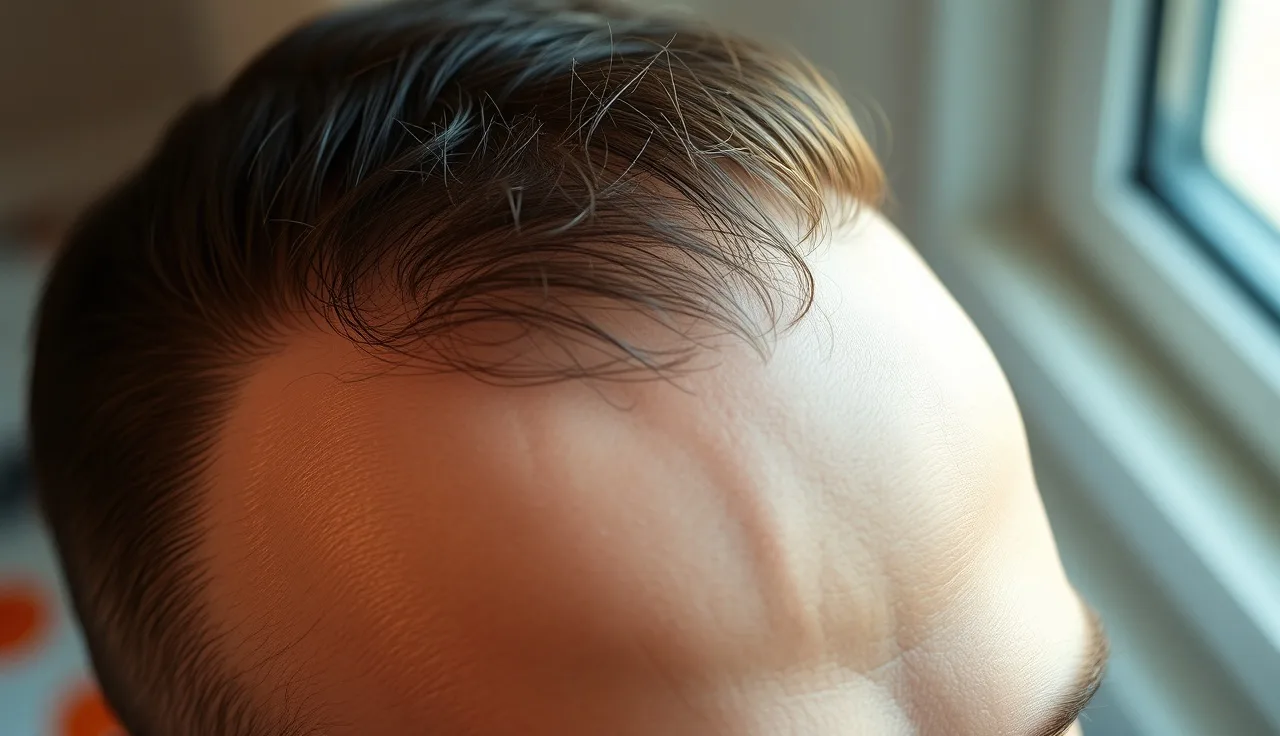
TL;DR: DHT causes hair loss only in follicles that carry a genetic sensitivity to androgens, mainly the frontal scalp and crown. Follicles on the back and sides of the scalp lack this sensitivity and survive even with high DHT levels. That is why hair transplants work and why blocking DHT with finasteride slows loss without stripping hair from the whole body.
What is DHT and where does it come from?
Dihydrotestosterone, or DHT, is an androgen that forms when testosterone meets an enzyme called 5-alpha reductase, mostly in skin, the prostate, and liver. The conversion is efficient: in adult men, roughly 5 to 10 percent of circulating testosterone becomes DHT, and DHT binds the androgen receptor about five times more tightly than testosterone does [1].
DHT is not a mistake of metabolism. It drives prostate growth, body hair development, and secondary sex characteristics. The problem is that some follicles, through inherited androgen receptor variants, respond to it by shrinking instead of growing.
Why does DHT only shrink some follicles and not others?
A follicle's response to DHT comes down to two things: how many androgen receptors it carries and how sensitive those receptors are. Both are coded by genes inherited from both parents [2]. That is the whole answer in one sentence, and it explains almost everything else about pattern hair loss.
Follicles on the frontal scalp and crown express much higher androgen receptor density than follicles on the occipital scalp (the back and sides). When DHT binds a receptor in a susceptible follicle, it triggers a signaling cascade that gradually shortens the anagen (growth) phase of the hair cycle and miniaturizes the follicle over successive cycles. Each new hair grows thinner and shorter than the last until the follicle goes dormant. Follicles on the back of the head see the same DHT exposure. Their receptor density is low, so the signal is too weak to cause the same damage.
A 1997 study by Sawaya and Price, published in the Journal of Investigative Dermatology, measured androgen receptor content directly in balding frontal follicles versus non-balding occipital follicles from the same scalp. They found significantly higher androgen receptor levels in the balding zones [3]. That paper put numbers on what transplant surgeons had watched happen in the clinic for decades: donor follicles from the occipital region keep their resistance after being moved to bald scalp, because the resistance lives in the follicle, not the address.
Which parts of the scalp are most susceptible to DHT?
Androgenetic alopecia follows a predictable geographic pattern on the scalp, codified in the Norwood scale for men and the Ludwig scale for women [4]. The most vulnerable zones are:
| Zone | Susceptibility | Notes |
|---|---|---|
| Frontal hairline / temples | High | First area to recede in most men |
| Crown (vertex) | High | Often progresses independently of frontal loss |
| Top of scalp (mid-scalp) | High | Connects frontal and vertex loss at Norwood 5+ |
| Occipital (back) | Very low | Classic safe donor zone for transplants |
| Parietal sides (above ears) | Low to moderate | Usually preserved until very advanced loss |
The safe donor area on the back of the scalp, roughly between 6.5 cm and 8 cm above the nape in a typical adult, is the region surgeons call the "permanent zone." Hair taken from there and transplanted to a bald crown keeps growing decades later because the follicle itself never acquired DHT sensitivity [5].
If you are mapping where your own hairline is thinning, a receding hairline guide can help you match your pattern to a Norwood stage before you decide on treatment.
Does DHT affect body hair the same way it affects scalp hair?
No, and the contrast is sharp. DHT promotes the growth of beard, chest, back, and pubic hair. The same molecule that miniaturizes scalp follicles stimulates follicles in those body regions.
The difference again comes down to receptor sensitivity and local co-factors. Beard follicles respond to androgen signaling with growth, while vertex scalp follicles respond with regression. This paradox pushed researchers to look at the signaling molecules inside the follicle environment. Susceptible scalp follicles produce higher levels of TGF-beta1 and DKK-1 in response to DHT, both of which shut down the hair growth pathway. Beard follicles respond to DHT by increasing IGF-1, a growth promoter [6].
So DHT is not inherently destructive to hair. It behaves differently in different tissues because of the local genetic and molecular environment of each follicle.
Does having higher DHT levels mean faster or worse hair loss?
Not necessarily, and this surprises most people. Men with androgenetic alopecia do not reliably carry higher circulating DHT than men with full hair. Studies comparing serum DHT between bald and non-bald men have found inconsistent differences, which points to follicle sensitivity, rather than the raw concentration of DHT in the blood, as the thing that drives how bad the loss gets [7].
This also explains why some men go bald with testosterone in the normal range while others with elevated androgens keep a full head of hair. The follicle's inherited receptor sensitivity is the gating factor.
That said, locally within the scalp, DHT concentration does appear elevated in bald areas compared to non-bald areas of the same scalp, likely because 5-alpha reductase type 2 activity runs higher in susceptible follicular cells. The problem is local, not systemic.
How does finasteride work if DHT is everywhere in the body?
Finasteride blocks 5-alpha reductase type 2, the isoform most active in scalp follicles and the prostate. In clinical trials, 1 mg daily (the dose the FDA approved for hair loss) reduced serum DHT by roughly 70 percent [8]. Susceptible follicles need a threshold level of DHT to keep miniaturizing. Drop DHT below that threshold and the damage slows or stops.
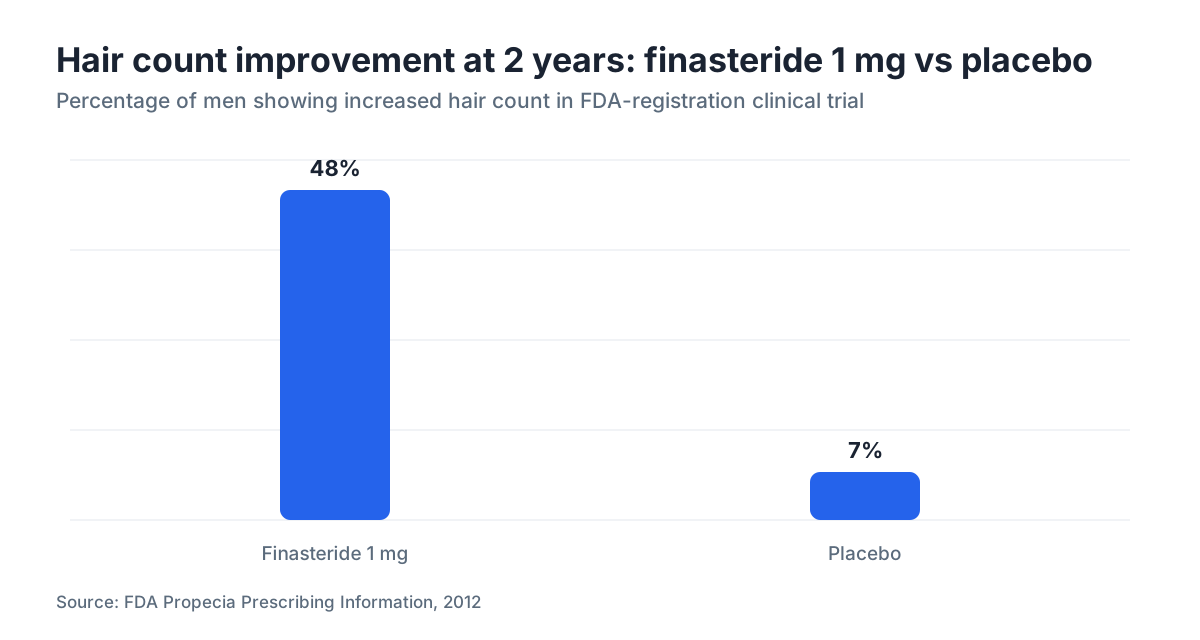
The FDA-approved label states that finasteride "inhibits the conversion of testosterone to DHT," and the registration trials found that 48 percent of men taking 1 mg finasteride for two years showed increased hair count, compared to 7 percent on placebo [8].
Because the underlying follicle sensitivity stays put, hair loss can resume if finasteride stops. The drug suppresses DHT's effect. It does not erase the genetic receptor vulnerability.
For a full breakdown of how finasteride works, its side effect profile, and what to ask before starting, see our guide to finasteride. If you are thinking about pairing finasteride with a topical, the finasteride and minoxidil article covers what the trial data actually shows.
Does blocking DHT with a DHT blocker protect follicles that are not yet affected?
Probably yes, to a meaningful degree. Miniaturization is gradual. Follicles that are just starting to respond to DHT, producing slightly thinner hair but not yet visibly bald, can stabilize or improve when DHT drops. That is the main argument for starting treatment early. Follicles that have fully stopped producing hair are much harder to revive.
Hair transplant surgeons see transplanted occipital follicles stay protected after relocation, while the native susceptible follicles around the graft keep dying if DHT goes unaddressed. That is why many surgeons recommend continuing a DHT blocker after a transplant to protect the remaining native hair.
Minoxidil works through a different mechanism entirely. It does not block DHT. It extends the anagen phase and improves follicle blood flow. Using both together hits two separate parts of the problem, which is why combination therapy tends to outperform either alone in clinical evidence [9].
Can women experience DHT-related hair loss?
Yes. Women produce androgens from the ovaries and adrenal glands, and they carry androgen receptors in susceptible scalp follicles just as men do, usually at lower expression levels. Female pattern hair loss follows the Ludwig scale, with diffuse thinning over the crown and mid-scalp rather than the sharp frontal recession seen in men. The occipital region is usually preserved in women too, for the same reason it is in men: lower androgen receptor density.
Women with elevated androgens, such as those with polycystic ovary syndrome (PCOS), often show accelerated pattern hair loss. Anti-androgenic medications like spironolactone get used in women for this reason, though they are not FDA-approved specifically for hair loss [10].
Finasteride is not approved for use in premenopausal women because of the risk of fetal exposure, but it is sometimes used off-label in postmenopausal women. The American Academy of Dermatology (AAD) guidelines name minoxidil as the first-line topical treatment for women with androgenetic alopecia [10].
If you are not sure whether your hair loss fits the androgenetic pattern or something else, the what causes hair loss article covers the full differential, including telogen effluvium, which can look similar but has completely different causes and a different treatment path.
Is there any hair loss that is not related to DHT?
Quite a bit of it. DHT-driven androgenetic alopecia is the most common cause of hair loss, hitting roughly 50 percent of men by age 50 and about 40 percent of women at some point in their lives [11]. It is far from the only cause.
Telogen effluvium is diffuse shedding triggered by physical or emotional stress, illness, surgery, rapid weight loss, or hormonal changes like postpartum shifts. It has nothing to do with androgen sensitivity. The follicles are healthy. They just enter the resting phase early and all at once.
Alopecia areata is an autoimmune condition where the immune system attacks follicles across the scalp, eyebrows, and sometimes the whole body. DHT blockers do nothing for it.
Scarring alopecias (like lichen planopilaris and frontal fibrosing alopecia) destroy follicles through inflammation. Traction alopecia comes from repeated physical tension on the hair. Nutritional deficiencies can cause diffuse shedding with no hormonal component at all.
The point: if your hair loss does not fit the Norwood or Ludwig pattern, or if it is happening fast or spread evenly across the whole scalp, DHT is probably not the main driver and a DHT blocker is not the right first tool. A dermatologist can check ferritin, thyroid, and other markers before you spend money on treatments aimed at the wrong target.
Why does hair transplant surgery work if DHT is still present after surgery?
Because the transplanted follicles come from the DHT-resistant occipital zone. The resistance is written into the follicle's genetic programming, not into the location on the scalp. Once those follicles move to the bald crown, they keep behaving like occipital follicles: they cycle normally, produce terminal hair, and ignore the local DHT signal that destroyed the original follicles in that spot.
This is called donor dominance, and it is the founding principle that makes modern hair transplantation viable. Studies tracking transplanted follicles for ten or more years confirm the grafts keep producing hair long-term in the vast majority of patients [5].
The catch is that donor supply is finite. If loss keeps advancing after the transplant (because native susceptible follicles keep dying), the transplanted hair can end up looking isolated over time. That is why pairing a transplant with medical DHT suppression tends to produce better long-term cosmetic results. Our hair transplant guide covers donor zone planning, graft counts by Norwood stage, and what realistic outcomes look like.
What about supplements that claim to block DHT naturally?
Saw palmetto is the most studied. It inhibits 5-alpha reductase in vitro and, in some small trials, showed modest effects on hair density. A 2020 systematic review found saw palmetto produced statistically significant improvement in hair density in some studies, but the evidence quality is low and the trial sizes are small [12]. It is not FDA-approved for hair loss, and no head-to-head trial has shown it matches finasteride.
Pumpkin seed oil showed a borderline significant effect in one small randomized trial (112 men, 24 weeks). Biotin is sold everywhere for hair health, but there is no evidence it blocks DHT or helps people who are not actually biotin-deficient.
Before you spend money on a supplement stack, know what you actually need. If your follicles are sensitive to DHT and you want to block DHT, finasteride has more than 30 years of clinical data behind it. If you want to size up the supplement landscape with realistic expectations, the hair loss supplements article breaks down what each ingredient's evidence actually shows.
Myhairline.ai's free AI scan (/scan) can map your current loss pattern so you know whether you are dealing with androgenetic alopecia in the first place, before you commit to any treatment.
Can lifestyle changes meaningfully affect DHT levels?
Somewhat, but probably not enough to reverse established androgenetic alopecia on their own. Obesity raises 5-alpha reductase activity and can push DHT production up. Weight loss in obese individuals can modestly lower androgen levels. Resistance training raises testosterone (and therefore DHT) transiently, though the effect on hair loss in genetically susceptible men is not clearly established by clinical trials.
Some people ask about creatine specifically. A single study in rugby players found creatine supplementation raised DHT by around 56 percent after loading, though the sample was small and the study was short. For more on that question, the does creatine cause hair loss piece covers what the evidence actually shows and whether the worry is proportionate.
A diet high in processed foods and low in nutrients does not help, but no dietary pattern has clinical evidence strong enough to recommend as a hair loss treatment. Treat lifestyle changes as background support, not a primary intervention.
Sources
- Endocrine Society, Journal of Clinical Endocrinology and Metabolism — Rittmaster RS, 5-alpha reductase review
- National Library of Medicine, NCBI — Androgen receptor gene and androgenetic alopecia
- Journal of Investigative Dermatology — Sawaya ME, Price VH, 1997, Different levels of 5-alpha-reductase in hair follicles of women and men
- American Academy of Dermatology — Androgenetic alopecia overview
- International Society of Hair Restoration Surgery — ISHRS practice standards on donor dominance
- British Journal of Dermatology — Randall VA, androgen paradox in hair follicles, 2008
- Journal of the American Academy of Dermatology — Kaufman KD, 2002, serum DHT and androgenetic alopecia
- U.S. Food and Drug Administration — Propecia (finasteride) Prescribing Information
- Journal of the American Academy of Dermatology — Kanti V et al., 2018, combination finasteride and minoxidil vs monotherapy
- American Academy of Dermatology — Hair loss in women, AAD clinical guidelines
- National Institutes of Health, MedlinePlus — Androgenetic alopecia genetics review
- Skin Appendage Disorders — Evron E et al., 2020, systematic review of saw palmetto for hair loss