

TL;DR: Frontal hair loss in women most often comes from female pattern hair loss (androgenetic alopecia), traction alopecia, or frontal fibrosing alopecia. Treatment depends entirely on the cause. Minoxidil is the only FDA-approved topical for women; some oral options exist off-label. Catching the cause early matters because some types cause permanent follicle loss if ignored.
Why is my hairline receding as a woman?
Most women who notice their frontal hairline thinning or moving back assume it's stress or a bad shampoo. Usually it isn't. The three most common culprits behind female frontal hair loss are androgenetic alopecia (female pattern hair loss), traction alopecia from tight hairstyles, and frontal fibrosing alopecia (FFA), a scarring condition that is showing up more often in clinics and is still not fully understood [1].
Female pattern hair loss typically thins the crown and midpart first, but the frontal hairline can also recede, especially in women with higher androgen sensitivity. Traction alopecia hits the hairline directly because that's where tension from braids, ponytails, and weaves is greatest. FFA is a different beast: a slow, progressive scarring alopecia that destroys follicles along the frontal and temporal hairline, leaving a pale, slightly shiny band of skin where hair used to be [2].
Less common causes include lichen planopilaris (a related scarring type), lupus, secondary syphilis, and severe nutritional deficiencies. Telogen effluvium can temporarily thin the hairline after illness, surgery, or major weight loss, but it usually grows back.
The honest answer is: you can't know which type you have from symptoms alone. A dermatologist, ideally one who does trichoscopy (a dermoscope exam of the scalp), can usually tell the types apart without a biopsy, though FFA sometimes needs one to confirm.
What does female frontal hair loss actually look like?
The pattern matters for diagnosis. Here's how the main types present differently.
Female pattern hair loss (FPHL): The Ludwig scale describes three stages. Stage I is slight widening of the central part near the front. Stage II is a clearly wider midpart with frontal thinning. Stage III is diffuse thinning over the crown with near-complete loss at the front [3]. The frontal hairline itself is often somewhat preserved, which is different from men. A variant called the "Christmas tree pattern" shows pronounced frontal accentuation.
Traction alopecia: Look for thinning right along the hairline, especially at the temples and forehead margin. Folliculitis (little red bumps or pustules) around the hairline is an early warning sign before permanent loss sets in. The rest of the scalp is usually unaffected [4].
Frontal fibrosing alopecia: The hairline recedes in a smooth, even band, often by 1 to 5 centimeters. The skin left behind looks slightly paler than the face. Eyebrow and eyelash loss happens in many FFA patients. There may be mild itching or burning, but many women notice no symptoms at all until significant recession has already happened [2].
Photograph your hairline every 3 months in the same lighting. That gives you something objective to track. Most people wildly underestimate how much has changed because the loss is slow.
How common is frontal hair loss in women?
More common than most people realize, and the numbers vary a lot by type and age.
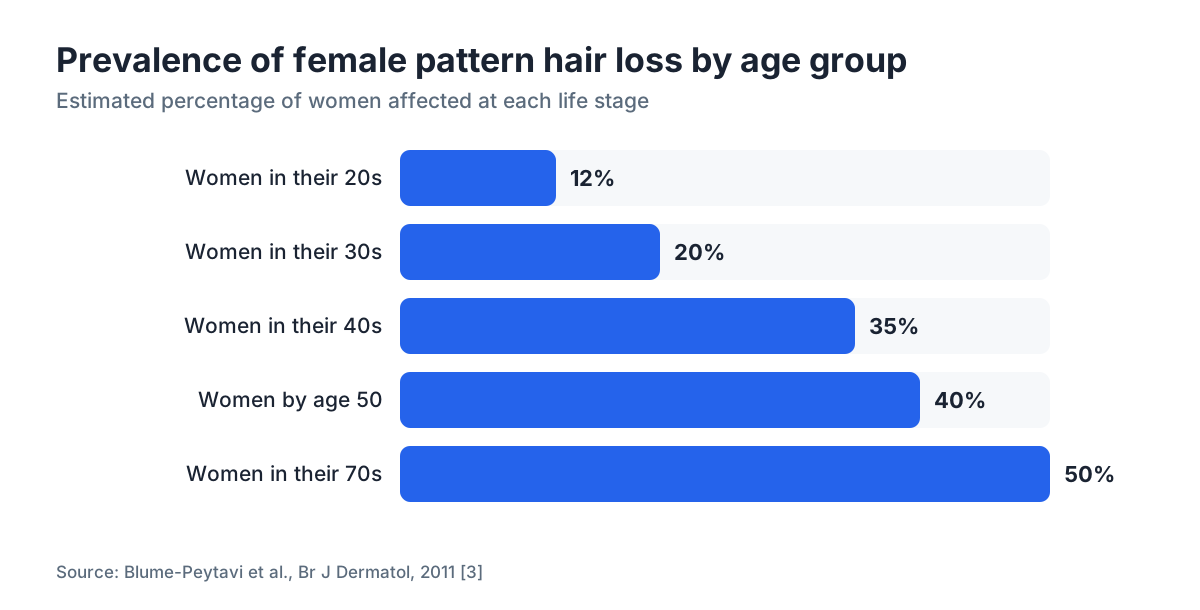
Female pattern hair loss affects roughly 40% of women by age 50 according to the American Academy of Dermatology [1]. Prevalence rises with age. Estimates from dermatology literature suggest around 12% of women show signs in their 20s, climbing to about 50% by their 70s [3].
Frontal fibrosing alopecia was considered rare 20 years ago. It's now seen far more often in dermatology clinics, particularly in postmenopausal women, though it also affects premenopausal women and some men. Exact prevalence figures don't exist because it stays underdiagnosed [2].
Traction alopecia is especially prevalent in Black women. A survey reported in the dermatology literature found that nearly one-third of Black women reported traction alopecia, making it the most common cause of hair loss in that population [4].
The takeaway: frontal hair loss in women is not rare, not a personal failing, and not something you have to just accept without options.
Which conditions cause scarring vs. non-scarring frontal hair loss?
This distinction is the single most important clinical question because it determines whether you can regrow hair.
Non-scarring (reversible if treated):
- Female pattern hair loss
- Traction alopecia (early stages)
- Telogen effluvium
- Alopecia areata affecting the hairline
Scarring (follicles permanently destroyed):
- Frontal fibrosing alopecia
- Lichen planopilaris
- Discoid lupus
- Central centrifugal cicatricial alopecia (CCCA)
With scarring alopecias, the goal shifts from regrowth to halting progression. No treatment reliably reverses scarring hair loss once fibrosis has set in. That's why early diagnosis matters so much for FFA specifically: a woman who catches it at 1 cm of recession has far more options than one who reaches 5 cm [2].
Trichoscopy findings help tell them apart without waiting for a biopsy. In FFA, the dermoscope shows absence of follicular openings and perifollicular scaling at the advancing edge. In FPHL, follicular miniaturization is visible but openings are still present. A good dermatologist can often diagnose on this alone [5].
What treatments actually work for female frontal hair loss?
Treatment depends on type. There is no single answer, and anyone selling you one product for every kind of female hair loss is not being straight with you.
For female pattern hair loss:
Minoxidil 2% topical solution is the only FDA-approved topical treatment for women with androgenetic alopecia [6]. The 5% foam is approved for men but widely used off-label in women; some dermatologists prefer it because the solution's propylene glycol base irritates the scalp in some women. A 48-week randomized trial in the Journal of the American Academy of Dermatology found that 2% minoxidil produced statistically significant increases in total hair count versus placebo [7]. Results take 4 to 6 months to become visible. You have to keep using it or the gains reverse.
Oral minoxidil at low doses (0.25 to 1.25 mg daily for women) is increasingly used off-label and has real evidence behind it. A 2021 review in the Journal of the American Academy of Dermatology pooled data from multiple studies and found meaningful improvement in women [8]. The side effect profile at low doses differs from topical; facial hypertrichosis (fine hair growth on the face) is the most common complaint. You can read more about the full oral minoxidil picture before deciding.
Finasteride (1 mg) is FDA-approved for men but used off-label in postmenopausal women. Evidence in women is mixed; a Cochrane review found modest benefit in postmenopausal women but data are limited [9]. It is absolutely contraindicated in women of childbearing potential due to teratogenicity. Spironolactone (50 to 200 mg daily) is another off-label anti-androgen with a reasonable evidence base; dermatologists commonly prescribe it for FPHL in premenopausal women who can't take finasteride. Learn more about the finasteride evidence and risks before approaching your doctor.
For traction alopecia:
Stop the traction. That's the primary treatment. Hairstyle changes alone can halt progression and allow regrowth if the follicles aren't yet scarred. Minoxidil may help stimulate regrowth in the transition period, but without removing the mechanical cause, nothing else will work. A receding hairline caused by traction in its early stages is one of the most reversible forms of hair loss there is.
For frontal fibrosing alopecia:
No treatment has shown consistent ability to regrow hair in FFA. The goal is halting progression. Options used include topical and intralesional corticosteroids, hydroxychloroquine, 5-alpha reductase inhibitors (finasteride or dutasteride), and topical calcineurin inhibitors like tacrolimus. A 2014 multicenter review of 355 patients found that 5-alpha reductase inhibitors were associated with stabilization in a meaningful share of patients, but we're talking about stopping loss, not reversing it [2]. This condition really does need a specialist.
Platelet-rich plasma (PRP):
PRP has a growing evidence base for FPHL. A meta-analysis found statistically significant improvements in hair density and thickness, though trial quality varied [12]. It's not FDA-approved as a hair loss treatment, but the procedure uses your own blood, so it doesn't require FDA drug approval. Costs run $500 to $2,000 per session, and multiple sessions are typically needed. Results are not guaranteed.
Hair transplant:
For FPHL, hair transplant surgery is an option for the right candidate, but it's more complicated in women than men. Because FPHL causes diffuse thinning rather than a stable donor zone, many women don't have enough good donor hair to make transplant worthwhile. FFA patients are generally not good candidates because the scarring process can attack transplanted grafts. A consultation with a transplant surgeon who specializes in women is the only way to know if you qualify.
What hairstyles help disguise frontal hair loss in women?
This section isn't about giving up. It's about looking good while you treat the underlying cause, which takes months.
For thinning along the frontal hairline, the core strategy is adding visual weight at the top while reducing tension at the hairline. Some genuinely useful options:
Bangs: Side-swept or curtain bangs can cover a receding or thinning frontal hairline completely. They're probably the single most effective cosmetic fix for this specific pattern. The catch: if you have traction alopecia, tight or pulled-back bangs can worsen it.
Loose styles: Letting hair fall naturally rather than pulling it back takes mechanical tension off the hairline. For women who have relied on tight ponytails or slicked-back styles, switching to loose buns or down styles can halt traction-related thinning.
Volume at the root: Dry shampoo, volumizing mousse, and blow-drying upward at the roots make thinning hair look denser. Fibers like Toppik (keratin-based) bond to existing hair and can visually fill sparse areas; they wash out but work well day-to-day.
Scalp-toned products: Scalp concealers (spray or powder) in your hair color mask the contrast between pale scalp and darker hair, making thinning less visible in parted or styled-up areas.
A word on what to avoid: styles that involve high heat and tight tension at the hairline (sleek updos, tight cornrows, extensions attached near the hairline) actively worsen traction alopecia and should be minimized. Extensions in general add weight and tension and are a known risk factor for female frontal hair loss [4].
If you want a realistic sense of where your hairline stands now versus 6 months ago, the free AI scan at MyHairline can photograph and track your hairline over time so you're not relying on memory.
Does diet or nutrition affect female frontal hair loss?
Yes, but probably less than the supplement industry wants you to believe.
Iron deficiency is legitimately linked to hair loss in women. Ferritin (stored iron) levels below 30 ng/mL are associated with increased telogen shedding in some studies, though the exact threshold is debated. Women with heavy periods are at particular risk. A simple blood panel (CBC, serum ferritin) from your GP can rule this in or out cheaply [5].
Zinc deficiency can contribute to hair shedding, and shows up more in women following restrictive diets or with inflammatory bowel disease. Vitamin D deficiency is associated with alopecia areata specifically, and low levels are common in FFA patients, though causality isn't proven.
Biotin deficiency causes hair loss, but true biotin deficiency is extremely rare in people eating a normal diet. Most over-the-counter biotin supplements for hair loss are taken by people who aren't deficient, and the evidence that supplementation helps non-deficient people is essentially nonexistent. The FDA has specifically warned that high-dose biotin can interfere with thyroid and cardiac troponin lab tests, producing false results [6].
The honest summary: fix deficiencies if you have them, because that can genuinely improve hair loss. Spending money on hair loss supplements beyond that is mostly marketing.
For women with pattern hair loss, no diet changes the genetic programming of follicle sensitivity to androgens. Nutrition can improve the environment; it can't override your genetics.
When should you see a dermatologist for frontal hair loss?
See one sooner than you think you need to.
The window for effective treatment is often narrow, especially with scarring conditions. By the time hair loss is obviously visible to other people, a woman has typically lost 30 to 50% of hair density in that area. Follicles in early traction alopecia can recover. Follicles replaced by fibrosis in FFA cannot.
See a dermatologist if:
- Your hairline has moved back by more than a centimeter
- You're losing eyebrows or eyelashes alongside hairline recession (an FFA red flag)
- You have scalp itching, burning, or tenderness at the hairline
- You've used minoxidil for 6 months with no improvement
- Hair loss started suddenly or after a major physical or emotional stress
- You have a family history of autoimmune conditions
A primary care doctor can run the basics (thyroid, iron, hormones), but diagnosing FFA versus FPHL versus lichen planopilaris really needs a dermatologist with trichoscopy experience. If your area has a hair loss specialist (a trichologist or dermatologist with a dedicated hair clinic), that's worth seeking out.
For tracking changes between appointments, MyHairline's AI analysis can give you objective hairline measurements from photos, which is useful data to bring to a doctor rather than trying to describe changes from memory.
Is frontal hair loss in women hormonal?
Often, yes, at least in part.
Androgenetic alopecia, the most common cause of female pattern hair loss, involves androgen sensitivity in scalp follicles. But women's hormonal picture is more complicated than men's. In men, DHT drives the bulk of pattern loss. In women, estrogen seems to protect hair, which is why many women notice faster hair loss after menopause when estrogen drops sharply [3].
Some women with FPHL have elevated androgens (DHEA-S, testosterone) or conditions like polycystic ovary syndrome (PCOS). Checking androgen levels is worth doing in premenopausal women with new-onset pattern hair loss, particularly if they have other signs of hyperandrogenism like irregular periods or acne. If PCOS is the driver, treating it (with metformin, oral contraceptives, or spironolactone) can slow hair loss.
Menopause is a major trigger. Many women first notice their hairline changing in their late 40s and 50s, coinciding with perimenopause. Hormone replacement therapy (HRT) may help hair loss in some postmenopausal women, but the evidence is limited and HRT carries its own considerations that go beyond a hair article.
Thyroid dysfunction, both hypo- and hyperthyroid, is another hormonal cause worth ruling out early. It shows up as diffuse shedding more than frontal recession specifically, but it's so common in women and so fixable that it should always be on the checklist [5].
The connection to DHT and how DHT blockers work is worth understanding if you're considering anti-androgen treatments.
What's the difference between FPHL, FFA, and traction alopecia?
These three conditions account for the vast majority of female frontal hair loss, but they need different treatments. Getting them confused wastes time and money.
| Feature | FPHL | Traction Alopecia | Frontal Fibrosing Alopecia |
|---|---|---|---|
| Pattern | Crown/midpart, some frontal thinning | Hairline margins, temples | Even band recession at frontal/temporal line |
| Scarring? | No | Early: no. Late: yes | Yes |
| Eyebrow/lash loss? | No | No | Common |
| Scalp symptoms | Usually none | Pustules early | Mild itch/burn possible |
| Primary cause | Genetic/hormonal | Mechanical tension | Autoimmune/unknown |
| Reversible? | Yes, with treatment | Early yes, late no | Progression can be halted, loss not reversed |
| First-line treatment | Minoxidil, anti-androgens | Stop traction | 5-alpha reductase inhibitors, steroids |
| Who gets it | Any woman, peaks post-menopause | Women using tight styles | Postmenopausal women, others |
One complication: these conditions can coexist. A woman can have FPHL and traction alopecia at the same time, which makes the clinical picture messier. A dermatologist with trichoscopy experience is your best bet for sorting them out [5].
Are there any new or emerging treatments for female frontal hair loss?
A few worth knowing about, though most are early-stage.
JAK inhibitors: Oral JAK inhibitors (baricitinib, ritlecitinib) are FDA-approved for severe alopecia areata, not for FPHL or FFA. Ritlecitinib received FDA approval for alopecia areata in 2023 [6]. Researchers are investigating whether JAK inhibitors help FFA, given its autoimmune features, but strong clinical trial data don't exist yet for FFA specifically.
Topical anti-androgens: Clascoterone (brand name Winlevi) is an androgen receptor inhibitor approved for acne; researchers are studying scalp formulations for androgenetic alopecia in women. Phase II trials have been conducted, but results weren't fully published as of early 2025.
Low-level laser therapy (LLLT): Several laser/light devices are FDA-cleared (not approved, cleared, a different standard) for hair growth. A 2014 randomized trial in the American Journal of Clinical Dermatology found improvements in hair density in women with FPHL [7]. The effect size is modest. These devices cost $200 to $800 for home use. They aren't harmful, but they're unlikely to be enough as a standalone treatment for significant loss.
Microneedling with minoxidil: A small but well-designed 2013 randomized trial compared minoxidil alone versus minoxidil plus microneedling in men with androgenetic alopecia and found the combination produced nearly 4 times more hair count improvement [10]. Research in women specifically is more limited, but the combination is increasingly used in practice.
Nobody should wait for emerging treatments if current ones apply to their situation. Minoxidil and anti-androgens have decades of data behind them. Novel options are worth watching but not worth delaying proven treatment.
Sources
- American Academy of Dermatology, Hair Loss Overview
- Vañó-Galván S et al., Frontal Fibrosing Alopecia: A Multicenter Review of 355 Patients. J Am Acad Dermatol. 2014
- Blume-Peytavi U et al., S1 guideline for diagnostic evaluation in androgenetic alopecia in men, women and adolescents. Br J Dermatol. 2011
- Gathers RC, Mahan MG, African American Women, Hair Care, and Health Barriers. J Clin Aesthet Dermatol. 2014; also references JAAD survey on traction alopecia prevalence
- Shapiro J, Clinical practice: Hair loss in women. N Engl J Med. 2007;357(16):1620-1630
- FDA, Drug Approvals and Databases
- Olsen EA et al., A randomized clinical trial of 2% minoxidil topical solution vs placebo for androgenetic alopecia. J Am Acad Dermatol. 2002
- Randolph M, Tosti A. Oral minoxidil treatment for hair loss: A review of efficacy and safety. J Am Acad Dermatol. 2021
- Cochrane Library, Finasteride for female androgenetic alopecia
- Dhurat R et al., A randomized evaluator blinded study of effect of microneedling in androgenetic alopecia. Int J Trichology. 2013
- Cervantes J et al., Platelet-Rich Plasma for Androgenetic Alopecia: A Review of the Literature and Proposed Treatment Protocol. Int J Dermatol. 2018