
TL;DR: DHT (dihydrotestosterone) shrinks hair follicles and drives male and female pattern hair loss. Finasteride cuts scalp DHT by roughly 60-70% and has the strongest evidence of any blocker. Dutasteride goes further. Natural options like saw palmetto show modest effects in small trials. This guide ranks every approach by real evidence so you can decide what's worth your money.
What is DHT and why does blocking it matter for hair?
DHT is a hormone your body makes when an enzyme called 5-alpha reductase converts testosterone. It's more potent than testosterone itself. Scalp follicles that carry a genetic sensitivity to DHT respond badly: they miniaturize, produce thinner and shorter hairs over time, and eventually stop producing hair at all. This process is called androgenetic alopecia, and it's the most common cause of hair loss in both men and women. [1]
The follicles most at risk sit on the top and front of the scalp, which is why receding hairlines and crown thinning are the signature patterns. The back and sides carry different receptor profiles. That's why hair survives there and why hair transplants use that donor hair. [1]
Blocking DHT means one of two things: interrupting 5-alpha reductase before it can make DHT, or stopping DHT from binding to the androgen receptors inside the follicle. Both approaches exist. The first works far better. [2]
Here's the part people miss. Blocking DHT does not regrow all your lost hair. It mainly slows or stops ongoing loss. Follicles that have been miniaturized for years may not come back. That's an honest limit any dermatologist will tell you, and it's the reason starting early beats starting late.
How much does DHT actually drive hair loss?
A lot. Men born with a genetic deficiency in 5-alpha reductase type II simply don't develop male pattern baldness. [2] That single observation, documented decades ago, is why the entire field of DHT-blocking drugs exists. It proved causation, more than correlation.
In people with androgenetic alopecia, scalp DHT concentrations run measurably higher than in people without it, even when blood testosterone is identical. The follicle isn't a passive target. It actively amplifies local DHT production. [2]
For women, the story gets messier. Androgen sensitivity varies more widely, and many women with pattern loss have normal DHT on a blood test. That's one reason DHT blockers aren't always the right first move for women, and why what causes hair loss in women is genuinely harder to pin down. [1]
Which FDA-approved drugs block DHT most effectively?
Two drugs lead by a wide margin. Both are 5-alpha reductase inhibitors.
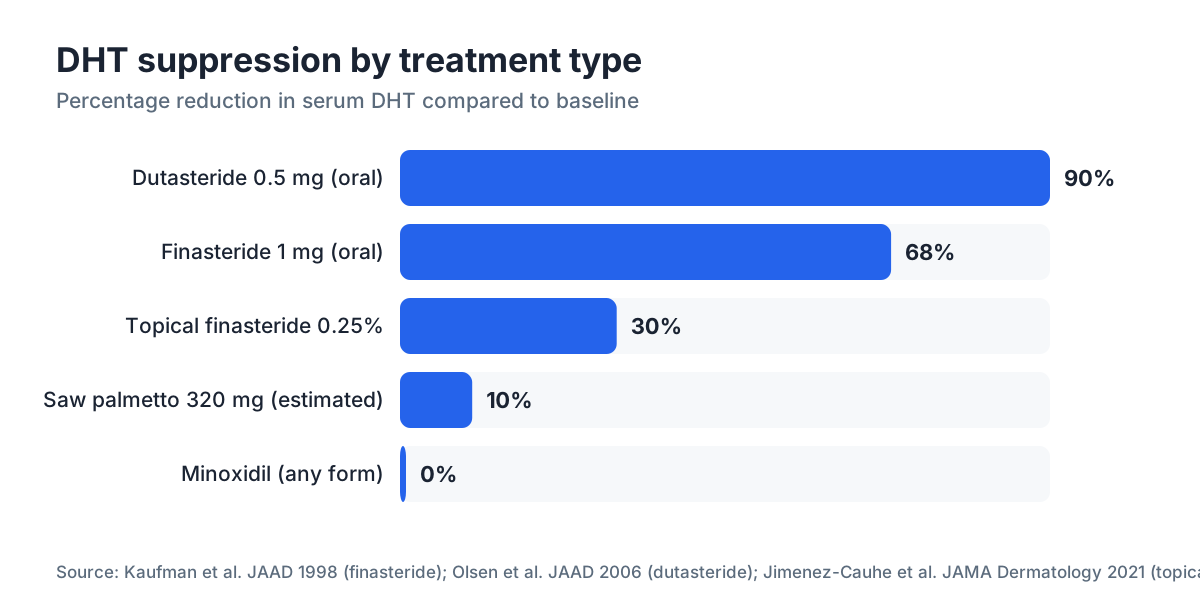
Finasteride blocks the type II isoform of 5-alpha reductase. A major clinical trial published in the Journal of the American Academy of Dermatology found that 1 mg daily finasteride reduced scalp DHT by about 64% and serum DHT by about 68% after 42 days. [3] The same trial found 83% of men taking finasteride either kept or increased their hair count over two years, against 28% on placebo. [3] The FDA approved finasteride 1 mg (Propecia) for male pattern hair loss in 1997. [4]
Dutasteride blocks both the type I and type II isoforms. It suppresses serum DHT by roughly 90% at a 0.5 mg daily dose, compared to finasteride's roughly 70%. [5] The FDA approved dutasteride for benign prostatic hyperplasia, not hair loss, so its use in alopecia is off-label in the United States. South Korea and Japan have approved it specifically for androgenetic alopecia. [5]
Here's the practical comparison:
| Drug | Mechanism | DHT suppression (serum) | FDA-approved for hair loss? | Typical cost (US, generic) |
|---|---|---|---|---|
| Finasteride 1 mg | 5-AR type II inhibitor | ~68% | Yes (men) | $15-40/month |
| Dutasteride 0.5 mg | 5-AR type I + II inhibitor | ~90% | No (off-label) | $30-80/month |
| Minoxidil (topical/oral) | Vasodilator, not DHT blocker | 0% | Yes (topical, men + women) | $10-30/month |
Minoxidil sits in that table because people pair it with DHT blockers constantly, but it doesn't block DHT at all. It works through a separate mechanism entirely. See minoxidil for men for how that fits into a treatment plan.
Read the full breakdown of finasteride if you want the mechanism, dosing schedule, and side effect profile in detail.
What are the side effects of pharmaceutical DHT blockers?
This is where people reasonably hesitate, and you deserve a straight answer.
The FDA-mandated label for finasteride lists sexual side effects: decreased libido, erectile dysfunction, and decreased ejaculate volume, in 1-2% more men taking the drug than men on placebo in clinical trials. [4] Most of these resolved after stopping the drug. A small number of men have reported persistent sexual dysfunction after discontinuation, a condition sometimes called post-finasteride syndrome. Causality is debated. The FDA reviewed the issue in 2012 and added it to the labeling rather than pulling the drug. [4]
Dutasteride carries the same class of warnings, amplified by its deeper DHT suppression and longer half-life (about five weeks versus six to eight hours for finasteride). [5] That half-life matters. If you get side effects, they take much longer to clear after you stop dutasteride.
For women of childbearing age, both drugs are contraindicated because DHT suppression can cause abnormal development of male fetal genitalia. [4] Pregnant women should not even handle crushed finasteride tablets.
Most men tolerate finasteride without any problem. The nocebo effect (side effects caused by expectation) is well-documented in placebo-controlled trials and probably explains some reported cases. But waving away every concern is wrong too. If you're considering these drugs, talk to a physician who can review your full health picture.
Can you block DHT naturally without medication?
Yes, modestly. Nowhere near the scale of finasteride, but the evidence for a few natural compounds is real, and it goes beyond supplement-company marketing.
Saw palmetto (Serenoa repens) is the most-studied natural 5-alpha reductase inhibitor. A randomized controlled trial in 2002 found saw palmetto extract beat placebo for men with mild to moderate androgenetic alopecia, though the effect was smaller than finasteride. [6] A 2021 review in the Journal of Cosmetic Dermatology concluded that saw palmetto "may have a positive effect in the treatment of androgenetic alopecia" while noting that evidence quality stays limited and trials are small. [6] Typical doses studied are 160 mg twice daily or 320 mg once daily.
Pumpkin seed oil produced a 40% increase in hair count versus 10% in the placebo group in a small 2014 Korean randomized controlled trial (76 men, 24 weeks). [7] The proposed mechanism is partial 5-alpha reductase inhibition. The trial was small and nobody has replicated it at scale, so read that number with caution.
Caffeine (topical) has been studied in vitro and in small human trials as a way to counter DHT's effects at the follicle. A German study found topical caffeine extended the hair follicle growth cycle in laboratory models, but human data is thin. [8]
Foods sometimes called natural DHT blockers include green tea (EGCG has shown 5-alpha reductase inhibition in lab models), lycopene-rich foods like tomatoes, and foods high in zinc. None of these have human RCT data showing meaningful hair-loss reversal. They won't hurt you. They just don't replace proven treatments if you're losing real ground.
The honest summary: if you want to block DHT naturally, saw palmetto is the only option with more than one reasonably controlled human trial behind it. Losing ground fast? Natural options alone probably won't hold the line. If your loss is early and you want to skip medication for now, a natural approach paired with regular monitoring is reasonable.
For a deeper look at supplements with real evidence, see hair loss supplements.
How do DHT-blocking shampoos and topical treatments compare?
Topical DHT blockers sound great because they promise local action without systemic side effects. The reality is mixed.
Ketoconazole shampoo is the most credible option here. Ketoconazole is an antifungal, but it also has weak androgen-blocking activity. A 1998 trial in Dermatology found 2% ketoconazole shampoo improved hair density and cut the proportion of shedding hairs, comparable in some measures to 2% minoxidil. [9] It's not a DHT blocker in the classic 5-alpha reductase sense, but it seems to interfere with androgenic signaling at the follicle. Prescription 2% and over-the-counter 1% versions both exist.
Topical finasteride is a newer formulation. A 2021 study in JAMA Dermatology found topical finasteride 0.25% once daily produced scalp DHT suppression similar to oral finasteride 1 mg, with much lower serum DHT suppression (around 30% vs 70%), which could reduce systemic side effect risk. [10] This formulation isn't FDA-approved for hair loss yet but gets prescribed off-label in plenty of clinics.
Saw palmetto in shampoos and serums is popular but has essentially no controlled human trial data for topical use specifically. How much absorbs through the skin isn't well characterized.
Bottom line on topicals: ketoconazole shampoo is a low-risk add-on to a treatment plan. Topical finasteride looks genuinely promising for people worried about systemic side effects. Saw palmetto serums are probably harmless but unproven.
Does blocking DHT actually regrow hair, or just stop loss?
Mostly it stops loss, with some regrowth on top.
The main finasteride trials showed about 48% of men had visible regrowth (measured by standardized hair count photos) after two years. [3] That's a real number, not a rounding error. But most regrowth comes from follicles that were miniaturized, not dead. Follicles dormant for many years, producing no vellus hair at all, are unlikely to respond.
This is exactly why starting treatment early matters more than which specific DHT blocker you choose. A Norwood 2 who starts finasteride at 25 has a very different trajectory than a Norwood 5 who starts at 45. If you're trying to figure out your stage, reading your receding hairline pattern is a useful first step.
Dutasteride appears to produce slightly more regrowth than finasteride in head-to-head trials, likely from deeper DHT suppression, but the difference isn't dramatic and the side effect tradeoff is real. [5]
Combining a DHT blocker with minoxidil improves outcomes. A 2016 Cochrane review found combination therapy outperformed either drug alone for hair count increases. [11] See finasteride and minoxidil for how to combine them practically.
Should women use DHT blockers for hair loss?
Sometimes, but with more caution and always under physician supervision.
Finasteride isn't FDA-approved for women. Small studies in postmenopausal women have shown benefits. A 2012 trial found no meaningful improvement in premenopausal women with normal androgen levels, which fits what we know about female pattern hair loss being less androgen-driven than the male version. [1]
Spironolactone is an antiandrogen (not a 5-alpha reductase inhibitor) that many dermatologists prescribe off-label for women with androgenetic alopecia, especially when androgen levels run high. It works by blocking androgen receptors rather than cutting DHT production. [1]
For women, the cause of hair loss matters enormously before starting any androgen-targeting treatment. Telogen effluvium, thyroid problems, and nutritional deficiencies are common and don't respond to DHT blockers. Getting the diagnosis right first isn't optional.
If you're a woman researching hair loss and want to know whether DHT might be your issue, the myhairline.ai free AI scan at [/scan] can help identify your pattern and flag whether an androgen-driven cause is likely, which you can then take to your doctor.
How long does it take for DHT blockers to show results?
Longer than most people expect. That gap is the source of most early dropouts.
With finasteride, the clinical trials measured results at 12 and 24 months. [3] The minimum meaningful evaluation window is 12 months. In the first few months you may even see increased shedding as follicles cycle through phases. That doesn't mean the treatment is failing.
DHT levels in the scalp drop within weeks of starting finasteride. [3] But the follicle response, the actual regrowth or stabilization, takes months, because hair grows in cycles that run months at a time.
Saw palmetto studies have generally run 24 weeks. [6] Going natural means the same patience.
Dutasteride's longer half-life means it builds to steady-state concentration more slowly, but it also means effects linger longer after stopping. Give any DHT blocker at least a year before you call it a failure.
What about lifestyle changes that might reduce DHT?
Some lifestyle factors nudge DHT production, though the effect sizes are small next to medication.
Body fat percentage matters. Adipose tissue contains 5-alpha reductase, so higher body fat can mean more local DHT production. Weight loss in men with obesity has been shown to lower DHT levels. [2] That doesn't mean losing weight cures hair loss, but it's a plausible mechanism.
Alcohol has a complicated relationship with androgen metabolism. Heavy use can lower testosterone but may also shift DHT ratios. The evidence for any direct effect on scalp hair is weak.
Zinc is a cofactor for 5-alpha reductase, and zinc deficiency has been linked to hair loss. Correcting a true deficiency may reduce excess enzyme activity, but loading up on zinc past normal levels hasn't been shown to block DHT in people who aren't deficient. [7]
Stress raises cortisol, which can disrupt androgen signaling and trigger telogen effluvium, a different mechanism from DHT-driven loss but one that stacks on top of the problem. Managing stress helps your hair for several reasons.
Creatine deserves a mention. A frequently cited 2009 study found creatine loading raised DHT significantly in college rugby players. The sample was small (20 men) and the mechanism isn't fully established, but it's a reason some people with genetic risk pause creatine. See does creatine cause hair loss for the full picture.
Ranking every DHT-blocking option by evidence strength
Here's a straight ranking based on the evidence, not the marketing:
Tier 1 (strong RCT evidence, meaningful effect):
- Finasteride 1 mg daily: ~64% scalp DHT reduction, 83% of users maintain or improve hair count at 2 years [3]
- Dutasteride 0.5 mg daily: ~90% serum DHT reduction, head-to-head data shows slightly better regrowth than finasteride [5]
Tier 2 (reasonable evidence, smaller effect or limited data):
- Topical finasteride 0.25%: similar scalp DHT reduction to oral with lower systemic exposure [10]
- Ketoconazole 2% shampoo: weak androgen antagonism, improved hair density in one RCT [9]
- Saw palmetto 320 mg daily: positive trend in small RCTs, effect is real but modest [6]
- Pumpkin seed oil: one small RCT showed 40% vs 10% hair count increase [7]
Tier 3 (lab or mechanistic data only, no strong human trials):
- Topical caffeine
- EGCG (green tea extract)
- Lycopene
- Zinc supplementation (beyond correcting deficiency)
- Rosemary oil (one small 2015 trial comparable to minoxidil 2%; mechanism unclear)
If your hair loss is progressing and you want to stop it, Tier 1 is where you should put your effort. If you want to support treatment naturally or aren't ready for medication, Tier 2 is a reasonable complement. Tier 3 options carry negligible risk and negligible proven benefit.
For a deeper look at the dht blocker category as a whole, including newer topical formulations entering the market, that article covers product-level detail.
When should you see a doctor instead of going it alone?
Honestly, before you start any DHT blocker. That's not a liability disclaimer. It's practical advice.
Finasteride and dutasteride need a prescription in the United States. [4] Many telehealth platforms now prescribe them after an online consult, which makes access easy, but you still need someone to confirm your diagnosis. Pattern baldness looks obvious, yet other causes of hair loss mimic it and don't respond to DHT blockers. Scalp conditions, autoimmune alopecia areata, and nutritional deficiencies all call for different treatment.
If you're a woman, the case for seeing a dermatologist first is stronger. An androgen workup (measuring free testosterone, DHEA-S, prolactin) tells you whether DHT-targeted treatment makes sense at all.
A board-certified dermatologist is the right specialist. The American Academy of Dermatology's "Find a Dermatologist" tool at aad.org is the easiest way to find one. [1]
If you're not ready for an in-person visit, a free AI hair loss analysis at myhairline.ai/scan can help you understand your pattern and bring sharper questions to a doctor. It's a starting point, not a diagnosis.
Sources
- American Academy of Dermatology, Hair Loss Overview and Treatment
- National Institutes of Health, StatPearls: Androgenetic Alopecia
- Kaufman KD et al., Journal of the American Academy of Dermatology, 1998: Finasteride 1 mg clinical trial
- Olsen EA et al., Journal of the American Academy of Dermatology, 2006: Dutasteride vs finasteride for androgenetic alopecia
- Wessagowit V et al., Journal of Cosmetic Dermatology, 2021: Saw palmetto systematic review
- Cho YH et al., Evidence-Based Complementary and Alternative Medicine, 2014: Pumpkin seed oil RCT
- Fischer TW et al., International Journal of Dermatology, 2007: Topical caffeine and hair follicle growth
- Pierard-Franchimont C et al., Dermatology, 1998: Ketoconazole shampoo and hair density
- Jimenez-Cauhe J et al., JAMA Dermatology, 2021: Topical finasteride 0.25% vs oral finasteride
- van Zuuren EJ et al., Cochrane Database of Systematic Reviews, 2016: Interventions for female pattern hair loss