
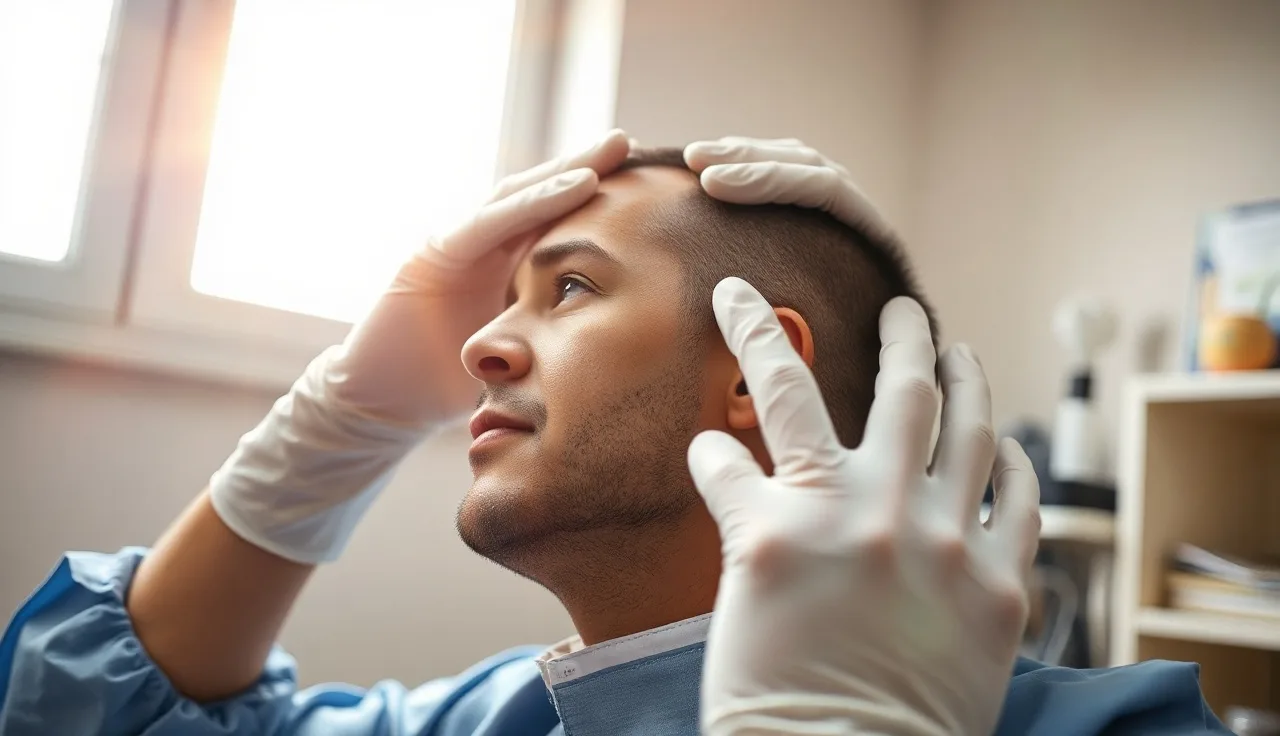
TL;DR: A hair transplant moves follicles from the back and sides of your scalp, where hair resists DHT, into thinning or bald areas. Two techniques do this: FUT (strip surgery) and FUE (individual extraction). Both give permanent results in most patients. Transplanted hair sheds first, then regrows, with final density visible 12 to 18 months out.
What actually happens during a hair transplant?
A hair transplant is a same-day outpatient procedure. A surgeon takes living hair follicles from a donor area, usually the back and sides of your scalp, and places them into tiny recipient sites cut in your thinning zones. That's the mechanical part. The biology underneath is what makes it last.
The reason it works comes down to donor dominance. Follicles from the back and sides of your scalp are genetically programmed to resist dihydrotestosterone (DHT), the hormone behind most male and female pattern hair loss. [1] Move those follicles to a DHT-sensitive zone like the hairline or crown and they keep that resistance. They behave as if they never left the donor site.
The procedure runs four to eight hours depending on how many grafts you need. You're awake throughout. Local anesthetic handles the pain, and most people say the worst part is the injections, not the surgery itself. A typical session moves 1,000 to 4,000 grafts, with each graft holding one to four hairs.
After placement, the follicles go through a temporary shed (more on that below), then enter a growth phase that delivers visible results over 9 to 18 months. The transplanted hairs are permanent. Your surrounding native hair can still thin, which is why ongoing treatment like finasteride and minoxidil often matters even after surgery.
What is the difference between FUE and FUT?
Surgeons harvest donor follicles two ways, and the choice shapes your recovery, your scar, and your cost.
FUT (Follicular Unit Transplantation) cuts a horizontal strip of scalp from the donor area, dissects it into individual follicular units under a microscope, and closes the wound with stitches or staples. This leaves a linear scar. It's usually hidden under normal hair length, but it's there permanently. FUT harvests a large number of grafts efficiently in one session, which is why it's still preferred for patients who need 3,000 or more grafts and don't plan to shave their head.
FUE (Follicular Unit Extraction) removes follicles one by one using a small punch tool, typically 0.8 to 1.0 mm across. No strip, no linear scar, no stitches. The tiny circular punch marks fade to near-invisible white dots over a few months. Recovery is faster. The tradeoff: FUE takes longer per graft and costs more per graft. [2]
A newer variant, robotic FUE (marketed as ARTAS and similar systems), uses image-guided robotics to select and extract follicles. Studies show graft survival comparable to manual FUE, but the equipment cost raises the total price without proven superiority for the average patient.
| Feature | FUT (Strip) | FUE (Punch) |
|---|---|---|
| Scar type | Linear (1 scar) | Scattered dots |
| Max grafts/session | 3,000-4,000+ | 2,000-3,000 typical |
| Recovery time | 10-14 days | 5-7 days |
| Cost per graft (US) | $4-$7 | $5-$10 |
| Best for | High graft count | Short hair wearers |
Neither technique wins universally. A good surgeon recommends one over the other based on your donor density, the area you need covered, and how you wear your hair.
Do hair transplants actually work, and what does the evidence say?
Yes, hair transplants work. The medical literature doesn't argue this. The real question is how well they work for a specific patient, which depends on donor density, surgeon skill, graft handling, and whether the patient uses supporting medications afterward.
Graft survival rates from well-run clinics run 90% to 95%, meaning 90 to 95 out of every 100 transplanted follicles survive and produce hair. [2] A 2021 review in the Journal of the American Academy of Dermatology reported high patient satisfaction across both FUE and FUT groups, though the authors noted most studies have short follow-up periods and lack standardized outcome measures. [3]
The American Academy of Dermatology treats transplants as the most effective permanent option for androgenetic alopecia. [4] "Permanent" is accurate for the transplanted follicles, but it doesn't mean your result is frozen. If your native hair keeps thinning, the transplanted area can end up looking like an island of density surrounded by loss. That's why most surgeons say a transplant without a plan for ongoing loss is a short-sighted buy.
Patients who get the best outcomes have realistic expectations, stable donor areas, and early-to-moderate loss (Norwood II through V). Very advanced loss (Norwood VI or VII) is harder because there simply isn't enough donor hair to cover the area credibly.
For what's driving your loss in the first place, what causes hair loss covers androgenetic alopecia, telogen effluvium, and other conditions a transplant may or may not address.
How much does a hair transplant cost?
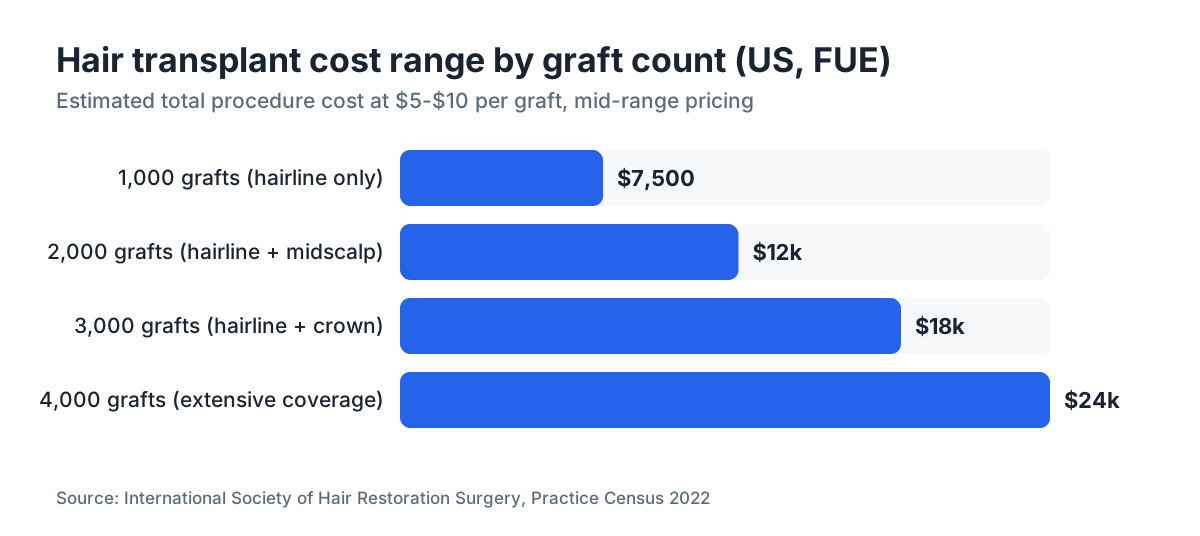
In the United States, a hair transplant runs roughly $5,000 to $25,000 depending on graft count, technique, and the surgeon's reputation and location. [5] Most clinics charge per graft, not a flat fee. FUE tends to run $5 to $10 per graft and FUT $4 to $7, though high-demand surgeons in major cities charge more.
A 2,000-graft FUE session in a mid-tier US clinic usually lands between $10,000 and $14,000. The same procedure in Turkey, now a major medical tourism destination, runs $2,000 to $4,000 all-in including accommodation packages. Price is a poor guide to quality. Graft survival depends heavily on how follicles are handled between extraction and implantation, and clinics that rush sessions to cut cost often see worse outcomes.
US health insurers treat hair transplants as cosmetic almost without exception, and don't cover them. [6] Some HSA or FSA plans may cover part of the cost when there's an underlying medical cause for the loss, but that's uncommon. For a full breakdown of what drives the price, see hair transplant expenses.
One thing worth knowing: the consultation is where a surgeon sets your graft estimate, and that number drives your total cost. Get at least two opinions before committing, because estimates vary widely from clinic to clinic.
How should you prepare for a hair transplant?
Preparation starts weeks out, not the morning of.
Most surgeons ask you to stop minoxidil two to four weeks before surgery to reduce scalp bleeding and swelling. Finasteride is usually continued. Stop blood thinners, aspirin, and NSAIDs (unless prescribed for a serious condition) at least one to two weeks out, since these raise bleeding and can hurt graft survival. Alcohol adds bleeding risk too; most protocols say none for a week before.
Smoking is a real problem. Nicotine constricts blood vessels and starves the blood supply new grafts need to survive. Multiple studies report higher graft failure in smokers. Surgeons generally ask patients to quit at least two weeks before and two weeks after. Longer is better.
On surgery day, wear a loose button-front shirt. You can't pull anything over your head without risking the grafts. Come with a clean scalp. Skip styling products entirely.
A few days before, take photos of your hairline and donor area. You'll want the baseline record when you evaluate results at 6, 9, and 12 months. If you're unsure where your loss stands, a receding hairline guide can help you map your Norwood stage before the consultation.
What happens step by step on the day of the procedure?
Here's the order of events.
First, the design phase. The surgeon marks your hairline and recipient area while you're awake and seated, because a hairline looks different standing versus lying down and the shape is personal. Take this seriously. The hairline you agree to in the chair is the one you live with.
Next, anesthesia. Local anesthetic goes into both the donor and recipient zones. Each injection stings for 20 to 30 seconds. After that, you feel pressure but not pain.
For FUT: the strip is excised, the wound is sutured, and a team of technicians immediately dissects the strip into individual follicular units under microscopes. The units sit in chilled saline or a holding solution to stay viable.
For FUE: the surgeon or a technician extracts follicles one by one from the shaved donor area with a motorized punch tool. This takes one to three hours depending on graft count.
Then recipient site creation. The surgeon makes small incisions in the recipient area at precise angles and densities. Angle matters enormously. Grafts placed at the wrong angle produce hair that grows in an unnatural direction.
Finally, placement. Technicians insert each graft into the prepared sites with fine forceps. This is painstaking work. A 2,500-graft session means 2,500 individual placements.
Total chair time from first injection to last graft runs four to eight hours. You can eat, use your phone, watch something, take breaks. Most clinics provide lunch.
What does recovery look like in the weeks after a hair transplant?
Recovery moves through predictable stages. Most people find it manageable, though the first ten days need real care.
Days 1-3: The scalp is swollen and tender. The recipient area looks like a field of tiny red dots with small scabs forming around each graft. Swelling can travel forward to the forehead and around the eyes. It looks alarming and it's normal, usually gone by day three or four.
Days 4-10: Scabs harden. You can gently wash the scalp starting around day three or four using the exact technique your clinic gives you, usually a slow pour of diluted shampoo with no rubbing. Dislodging grafts during this window is the main risk. Avoid direct water pressure, combing, and anything that spikes your heart rate.
Days 10-14: Scabs start falling off. The recipient area looks pink and relatively normal. Most FUT patients have sutures removed around day ten. You can return to most normal activities.
Weeks 2-6: This is the shock loss phase. The transplanted hairs shed. Nearly all of them. This is expected and does not mean the transplant failed. The follicle is alive under the skin, just resting before it re-enters the growth cycle.
Months 3-6: Thin, fine hairs start emerging. Wispy and irregular at first.
Months 6-12: Hair thickens and darkens. This is when results start looking like results.
Months 12-18: Final density assessment. Most surgeons schedule a follow-up at 12 months. Some patients, particularly those over 50, keep improving through 18 months.
When does hair grow back after a transplant, and what does the timeline look like?
The honest answer: visible improvement takes months, and most patients feel frustrated by what they see in the first three to four.
Transplanted hairs almost always shed two to six weeks after surgery. This is telogen effluvium triggered by the trauma of transplantation, the same process covered in hair loss telogen. [12] The follicle drops into a resting phase, then re-enters the anagen (growth) phase on its own schedule.
Here's a realistic timeline for most patients:
- Weeks 2-8: Shedding of transplanted hairs. Normal. Distressing.
- Months 3-4: First new growth appears, often fine and colorless.
- Month 6: Roughly 40-50% of final density visible.
- Month 9: 70-80% of final density visible for most patients.
- Month 12: 90%+ of final density for most patients.
- Month 18: True final result, particularly for slow responders.
Some clinics start patients on minoxidil right after surgery to speed re-entry into the growth phase. The evidence for this specific use is modest, but the risk is low. If you're thinking about supporting the transplant with medication, does minoxidil work covers what the clinical data actually shows.
What are the risks and side effects of hair transplant surgery?
Hair transplants are generally safe with an experienced surgeon in a proper facility, but risks exist and some get buried in marketing.
Common, expected side effects: scalp swelling, temporary numbness in the donor and recipient areas, itching as scabs form, and the shock loss above. These resolve on their own.
Less common but real: folliculitis (ingrown hairs or small infections in the recipient area), cysts, and hypertrophic or keloid scarring in patients prone to abnormal scarring. Anyone with a personal or family history of keloids should raise it before surgery.
Graft failure gets underplayed. Poor graft handling, too much time between extraction and placement, operator fatigue during long sessions, and patient smoking or non-compliance during recovery all cut survival rates. A batch of 2,500 grafts at 80% survival gives you 2,000 growing follicles. The same batch at 95% gives you 2,375. That gap changes your result noticeably.
Unnatural-looking results aren't a medical risk, but they matter enormously. A hairline set too low for the patient's age, grafts placed at the wrong angle, or a patchy distribution can look worse than careful baldness. You avoid almost all of this by choosing a surgeon with a large, independently verifiable portfolio and specific experience with your type of loss.
Sedation complications are rare because most procedures use only local anesthetic, but clinics offering IV sedation or general anesthesia add risk.
The FDA has cleared specific devices used in hair transplant procedures but has not approved any transplant technique as a drug or biologic, so the procedure itself sits outside FDA premarket review. [7]
Who is a good candidate for a hair transplant?
Candidacy comes down to four things: the health and density of your donor area, the extent and stability of your loss, your age, and your expectations.
The best candidates have thick, dense donor hair at the back and sides. High donor density means more grafts available and better natural coverage per square centimeter. People with fine, low-density donor hair can still get results, but the math is harder.
Age matters more than most patients realize. Surgeons are cautious about operating on anyone under 25 to 30 because loss patterns aren't set yet. Transplant into a young hairline that keeps receding around the grafts and you get a patchy, unnatural look over time. A 22-year-old with a Norwood III hairline may be a Norwood VI by 35. Designing around a lifetime of potential loss takes experience and conservative planning.
Loss should ideally be stable or managed before surgery. Patients on finasteride or minoxidil for at least a year with stabilized loss are better candidates than someone shedding ground fast. If you're unsure what's driving your loss, minoxidil for men explains the medical treatment options many patients use to stabilize before a transplant.
Some conditions rule out transplants entirely or need specialist evaluation first. Active alopecia areata, certain autoimmune conditions, and severe scalp scarring from burns or prior surgery all change the picture. Diffuse unpatterned alopecia, where the donor area itself is thinning, is a particular concern because donor follicles may not hold their resistance.
For an objective read on where your hairline sits before you book consultations, MyHairline's free AI scan at myhairline.ai/scan estimates your Norwood stage from photos and gives you a baseline to bring to surgeons.
Should you combine a hair transplant with finasteride or minoxidil?
Most experienced surgeons say yes, and the logic is simple. A transplant replaces hair you've already lost. Finasteride and minoxidil protect the native hair you still have.
Finasteride cuts scalp DHT by about 70% and slows or stops androgenetic alopecia in roughly 80-90% of men who take it. [8] Skip it and the non-transplanted native hairs in and around the recipient area keep thinning, eventually leaving the transplanted follicles looking isolated.
Minoxidil extends the anagen (growing) phase and may improve blood supply to follicles. Several small trials on post-transplant minoxidil found faster re-entry into the growth cycle for patients who started early. The effect is modest, the downside low for most patients.
The combination matters most for anyone under 40 with years of continued loss ahead. Surgeons who operate on young patients without recommending medical management leave a real gap in the plan.
For how the two drugs work together and whether the combination fits your situation, the finasteride and minoxidil guide covers dosing, timing, and what the trials show. And minoxidil side effects is worth reading before you start, especially if you're considering the oral form.
How do you choose a hair transplant surgeon?
This is where the biggest outcome differences come from. Technique (FUE vs FUT) matters less than who holds the punch tool.
The International Society of Hair Restoration Surgery (ISHRS) keeps a member directory of surgeons who have met training requirements in the specialty. [9] Board certification in dermatology or plastic surgery is a baseline, not enough on its own. Look for surgeons who do hair restoration as a primary or major part of their practice, not an occasional add-on.
Ask for before-and-after photos shot with the same lighting, angle, and hair length. Patients with hairline patterns and density like yours are the most useful. Any reputable surgeon has hundreds on file.
Ask who performs the extractions and implantations. In some clinics the surgeon designs the hairline and supervised technicians do most of the actual work. Nothing is inherently wrong with that model, but know what you're paying for. In the best clinics, the surgeon stays involved throughout.
Ask about graft out-of-body time, the gap between extraction and implantation. Research suggests graft survival drops when follicles stay outside the scalp longer than two to four hours without proper storage. [10] Clinics that overbook or rush sessions sometimes push that limit.
Be skeptical of guaranteed graft counts, guaranteed density outcomes, or any surgeon who never mentions the possibility of a second session. A second session (closing gaps or adding density after the first heals) is normal and common, particularly for patients with significant loss.
Sources
- National Institutes of Health, MedlinePlus: Androgenetic Alopecia
- Journal of Cosmetic Dermatology: Graft survival rates in hair transplantation (2020), via PubMed
- Journal of the American Academy of Dermatology: Systematic review of hair transplant outcomes (2021), via PubMed
- American Academy of Dermatology: Hair loss treatments
- International Society of Hair Restoration Surgery: Practice Census 2022
- Healthcare.gov: What Marketplace health insurance plans cover
- U.S. Food and Drug Administration: Medical Devices
- National Institutes of Health, MedlinePlus: Finasteride
- International Society of Hair Restoration Surgery: Find a Doctor
- Dermatologic Surgery: Effect of graft out-of-body time on follicle survival, via PubMed
- NIH National Library of Medicine, StatPearls: Telogen Effluvium