TL;DR: Ketoconazole doesn't lower blood DHT the way finasteride does. It interferes with androgen signaling inside scalp tissue, cuts local DHT activity, and calms the fungal inflammation that damages follicles. One controlled trial found 83% of ketoconazole users had improved hair counts. Treat it as a supporting player alongside proven treatments, never as your whole plan.
What is ketoconazole and why does it keep coming up in hair loss conversations?
Ketoconazole is an antifungal drug. That's its day job. The FDA approved it in 1981 for fungal infections, and it's been sitting on pharmacy shelves in shampoo form (2% prescription, 1% over the counter) for decades [1]. Most people first meet it as a dandruff treatment, because it kills the Malassezia yeast that drives seborrheic dermatitis.
The hair loss angle showed up later, mostly by accident. Clinicians noticed that patients washing with ketoconazole shampoo seemed to shed less and, in some cases, appeared to grow a little back. That observation sent scientists looking harder at the mechanism, and what they found was more interesting than a plain antifungal effect.
Ketoconazole belongs to a class of azole antifungals with a side property: they can interfere with androgen synthesis and androgen receptor binding in tissue. That's the piece that makes it relevant to androgenetic alopecia, the pattern hair loss driven by DHT. It isn't a clean, powerful DHT blocker. But it isn't nothing either, and understanding the gap between those two things matters before you decide how to use it.
How does ketoconazole interact with DHT in the scalp?
DHT (dihydrotestosterone) is the androgen most responsible for shrinking hair follicles in genetically susceptible people. Testosterone converts to DHT through the enzyme 5-alpha reductase, and DHT then binds to androgen receptors in follicle cells, miniaturizing them over time. This is the core mechanism behind what causes hair loss in androgenetic alopecia.
Ketoconazole interferes with this in two ways, neither as potent as a dedicated 5-alpha reductase inhibitor like finasteride.
First, it inhibits cytochrome P450 enzymes involved in steroid synthesis, including some that produce androgens locally in scalp tissue. Scalp follicles can make DHT independently of the testes or adrenal glands, so cutting local androgen production has real relevance even when systemic DHT barely moves from a topical wash [2].
Second, some research suggests ketoconazole competes with DHT at the androgen receptor itself, partially blocking DHT from binding. The evidence for that is softer than the enzyme data, but published review literature has characterized ketoconazole as having "antiandrogen properties" in cell and animal models [3].
Here's the distinction that matters. When you wash with 2% ketoconazole shampoo, contact time is a few minutes and systemic absorption is low. You are not meaningfully lowering blood DHT the way finasteride does. You're working locally, at the scalp, and the size of that androgen effect is far smaller. Say that plainly to yourself before you choose between treatments.
What does the clinical evidence actually show for hair regrowth?
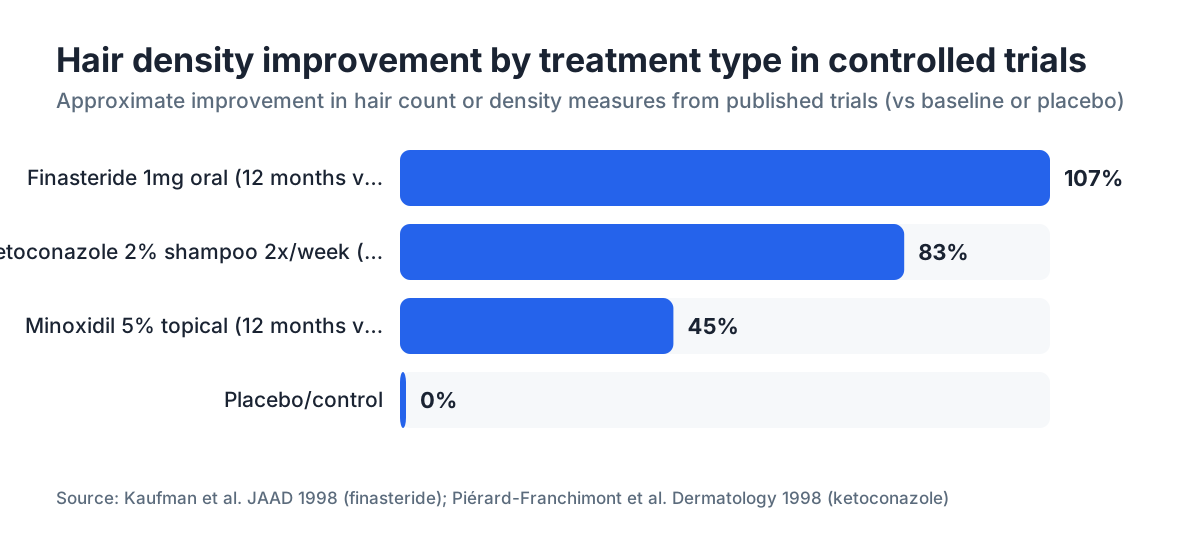
The most-cited human data comes from Belgian work published in Dermatology in 1998. It compared 2% ketoconazole shampoo used twice weekly against 1% selenium sulfide shampoo in men with androgenetic alopecia and dandruff. After six months, the ketoconazole group showed an 83% improvement in hair density and a drop in the share of follicles stuck in the telogen (shedding) phase [4].
That 83% figure gets repeated everywhere, and it sounds huge. Context deflates it. The study was small (about 39 patients), not placebo-controlled, and compared ketoconazole to selenium sulfide rather than an inert shampoo. Selenium sulfide has its own anti-inflammatory effect, so this wasn't a clean head-to-head. The hair-count gains were real and measured by phototrichogram, which is a legitimate method, but the design was weak.
A 2019 review in Skin Appendage Disorders looked at the available evidence and concluded ketoconazole shampoo "may represent a useful adjunctive therapy" for androgenetic alopecia, while noting the evidence base is thin next to minoxidil and finasteride [5].
One randomized study pitted ketoconazole 2% shampoo against minoxidil 2% solution. Hair counts rose in both groups, with ketoconazole holding its own on some measures, though minoxidil is generally accepted as the stronger regrowth agent. The honest read: ketoconazole probably does something real for density, the effect is modest, and the trials are underpowered by modern standards.
For women, the picture is blurrier. Nearly every trial enrolled men. Women with androgenetic alopecia or telogen effluvium sometimes use ketoconazole shampoo empirically, but no strong randomized controlled trials exist in female populations.
How does ketoconazole compare to finasteride and minoxidil for DHT and hair loss?
You need a side-by-side here, because the mechanisms and evidence levels are genuinely different.
| Treatment | Primary mechanism | DHT reduction | Evidence level | Typical use |
|---|---|---|---|---|
| Finasteride 1mg oral | 5-alpha reductase inhibitor (type II) | 60-70% serum DHT reduction [6] | Multiple large RCTs, FDA-approved | Daily oral tablet |
| Dutasteride 0.5mg oral | 5-alpha reductase inhibitor (type I + II) | ~90% serum DHT reduction | FDA-approved (prostate), off-label hair loss | Daily oral tablet |
| Minoxidil (topical/oral) | Vasodilator, potassium channel opener | None | Multiple large RCTs, FDA-approved | Daily topical or oral |
| Ketoconazole 2% shampoo | Local androgen interference, anti-inflammatory | Local scalp reduction, not systemic | Small trials, not FDA-approved for hair loss | 2-3x weekly wash |
Finasteride's DHT-blocking effect is documented, consistent, and systemic. A 1998 multicenter trial in the Journal of the American Academy of Dermatology found that 1mg finasteride increased hair count by 107 hairs per square centimeter over 12 months compared to placebo [6]. That's a well-powered study. Ketoconazole has no equivalent trial anywhere.
Minoxidil for men works through a completely different door, improving blood flow and keeping follicles in the growth phase. It doesn't touch DHT at all, yet it beats ketoconazole for regrowth. That tells you something useful: you don't need to block DHT to regrow hair, and blocking DHT locally doesn't guarantee results.
The combination of finasteride and minoxidil is the most evidence-backed pairing you can get without a transplant. Adding ketoconazole to that stack isn't unreasonable given its anti-inflammatory effect and low risk. It's a supporting player, not a lead.
Does the antifungal effect matter for hair loss, separate from DHT?
Yes, and this might be ketoconazole's most defensible hair-loss mechanism.
Scalp inflammation is increasingly recognized as a contributor to miniaturization, separate from androgen signaling. Malassezia yeast lives on every human scalp to some degree. In people with dandruff or seborrheic dermatitis, that yeast drives a chronic, low-grade inflammatory response. The inflammation damages the follicular microenvironment and speeds up the miniaturization that DHT is already pushing [10].
Ketoconazole clears Malassezia effectively. That reduces seborrheic dermatitis and the inflammation riding along with it. A calmer scalp is a better home for follicles, full stop [5].
This mechanism has nothing to do with DHT. It also means ketoconazole shampoo is probably more useful if you actually have dandruff or a visibly flaky, inflamed scalp than if your scalp is clean. On a healthy scalp the antifungal benefit shrinks, though the potential androgen-related effect still applies.
That's why many dermatologists don't object to patients adding ketoconazole shampoo. The downside is small. The upside, especially with a troubled scalp, is real.
What's the right way to use ketoconazole shampoo for hair loss?
The protocol in the Belgian trial was twice-weekly application of 2% ketoconazole shampoo, left on the scalp for three to five minutes before rinsing [4]. That's the closest thing to a validated regimen. Most dermatologists who recommend it suggest two to three times per week.
The 1% version (Nizoral A-D, over the counter in the US) is the easiest starting point. The 2% version needs a prescription. If you have active seborrheic dermatitis, a doctor is more likely to prescribe 2%, which is also the concentration studied for hair effects.
Leave time matters. Lather and rinse right away like normal shampoo and you probably limit the benefit. Let it sit.
Daily use is likely too much and can cause dryness or irritation, especially with color-treated or already-dry hair. Two to three times a week is the sweet spot.
One practical note: this is not a conditioner. Your hair may feel drier than usual, especially at the ends. Plenty of people follow with a separate conditioner on the lengths, kept off the scalp.
If you're already on a proven regimen and wondering whether to add ketoconazole, ask a dermatologist or hair specialist. For a look at your own pattern before that appointment, MyHairline's free AI hair scan can give you a baseline to bring into the conversation.
Is ketoconazole safe? What are the real risks?
Topical ketoconazole (shampoo, cream) has a strong safety record. Systemic absorption from a shampoo is minimal. Skin irritation, contact dermatitis, and hair dryness are the usual complaints, and they're rare and reversible.
Oral ketoconazole is a different animal. The FDA issued a safety communication in 2013 warning that oral ketoconazole tablets carry serious risks of liver injury and adrenal gland problems, and recommended the tablets not be used as first-line treatment for any fungal infection [1]. That warning does not touch the shampoo. When people read scary things about ketoconazole and the liver, they're reading about the pill, not the wash.
Because oral ketoconazole suppresses systemic androgen production in a real way, older studies did test it for hair loss in pill form. That approach has been almost entirely abandoned over the liver risk. Nobody serious recommends oral ketoconazole for hair loss in 2025.
For the shampoo, people with a known allergy to azole antifungals should skip it. Pregnant or breastfeeding women should check with a physician first, as with any topical medication, though systemic exposure from shampoo is very low.
The minoxidil side effects profile is more complicated than ketoconazole's, which gives some perspective. Ketoconazole shampoo is one of the lower-risk additions to a hair loss regimen.
Can ketoconazole work for women with hair loss?
Women can use ketoconazole shampoo, and some dermatologists do recommend it, but the evidence in women specifically is sparse. The 1998 Belgian trial enrolled men. Most ketoconazole hair studies did.
The antifungal and anti-inflammatory logic applies to women just as well. If a woman has androgenetic alopecia or diffuse shedding plus an inflamed, flaky scalp, there's reasonable ground for trying it. The androgen-receptor angle is relevant too, since DHT and androgen sensitivity contribute to female-pattern hair loss, though the picture is messier in women than in men.
Topical risk is very low for women, so the math tilts toward trying it when scalp inflammation is part of the problem. The AAD notes that evidence for ketoconazole in androgenetic alopecia is limited but that it may be used as an adjunct therapy [7].
One caution for women: don't use it as a substitute for treatments with stronger evidence. If female-pattern hair loss is significant, a dermatologist workup to rule out thyroid disease, iron deficiency, or other causes (see what causes hair loss) should come before you settle on any topical.
Does ketoconazole shampoo block DHT better than other DHT-blocking shampoos?
The market for shampoos claiming to block DHT is large and mostly unsupported. Saw palmetto, pumpkin seed oil, and various herbal extracts show up in dozens of products branded as DHT blockers. Almost none of them carry the controlled trial data ketoconazole has, thin as that data is.
Saw palmetto has some systemic evidence as a weak 5-alpha reductase inhibitor when taken orally (see hair loss supplements) [9], but the case for topical saw palmetto in a rinse-off shampoo is essentially empty. Contact time is short, penetration through the epidermis is limited, and no controlled trials have validated an effect on hair counts.
Among rinse-off shampoos, ketoconazole has more trial data than any other ingredient. That's a low bar given how small those trials are. It's still a real distinction.
If someone insists on a DHT-focused shampoo, ketoconazole 1-2% is the one with the most clinical support. The rest is mostly marketing.
Pyrithione zinc and selenium sulfide shampoos help scalp health through different mechanisms (antimicrobial and antifungal). They may improve the scalp environment without any androgen effect. They're not DHT blockers in any meaningful sense.
What should you actually do if you're losing hair and considering ketoconazole?
Here's the honest, practical breakdown.
If you're in early androgenetic alopecia, a receding hairline, or noticing thinning, ketoconazole shampoo is a reasonable low-cost, low-risk add-on. It is not a replacement for finasteride or minoxidil. Treating it as one buys you slower, smaller results than the proven options deliver.
The best-supported plan for male androgenetic alopecia is still oral finasteride (or topical finasteride if you worry about systemic exposure) and/or minoxidil. Layering ketoconazole shampoo on top is sensible, especially if you have any scalp inflammation or dandruff. Running ketoconazole alone as your entire plan is undertreatment.
For women, the options differ. Finasteride is used off-label in postmenopausal women, and oral minoxidil has growing evidence. Ketoconazole shampoo is a reasonable addition to whatever else a dermatologist recommends.
If hair loss is progressing hard and you've already tried medical treatment, a hair transplant consultation is a separate conversation worth having.
For an objective starting point on your pattern and severity before you spend money, MyHairline's free AI scan can map your hairline and place you on the Norwood scale, useful information to carry into a dermatology appointment.
Nobody should spend years on ketoconazole shampoo alone while real hair loss marches on. Use it as part of a thought-out stack, not as comfort that you're "doing something".
Does ketoconazole affect testosterone levels or cause hormonal side effects?
This comes up because ketoconazole does suppress androgen synthesis, and some people worry about testosterone suppression producing the same side effects that concern men on finasteride.
Oral ketoconazole at therapeutic doses (400mg/day and up) measurably suppresses serum testosterone and cortisol. That's one reason the FDA's 2013 communication flagged such serious concerns about the tablet form [1]. It's also why oral ketoconazole was historically studied for prostate cancer and other hormone-sensitive conditions.
The shampoo is a different case. Systemic absorption from a topical rinse-off product is low enough that meaningful changes in serum testosterone or cortisol are not expected at normal use frequencies. No published trials show significant hormonal changes from 1% or 2% ketoconazole shampoo used two to three times per week.
Long-term data on hormonal effects from years of regular scalp use is limited, so the honest position is this: the shampoo at standard frequency has a negligible systemic hormonal effect, but anyone with a hormone-sensitive condition should discuss it with their physician.
The sexual side effects documented with finasteride, which does meaningfully suppress systemic DHT, have not been documented with ketoconazole shampoo. The mechanism and the level of systemic exposure are too far apart to draw a parallel.
Sources
- FDA, Drug Safety Communication: FDA limits usage of Nizoral (ketoconazole) oral tablets due to potentially fatal liver injury and risk of drug interactions and adrenal gland problems (2013)
- Inui S, Itami S. Androgen actions on the human hair follicle: perspectives. Experimental Dermatology, 2013
- Review literature on ketoconazole in androgenetic alopecia, Journal of Investigative Dermatology and related dermatology reviews
- Piérard-Franchimont C et al. Ketoconazole shampoo: effect of long-term use in androgenic alopecia. Dermatology, 1998
- Fischer TW et al. review of ketoconazole in androgenetic alopecia, Skin Appendage Disorders, 2019
- Kaufman KD et al. Finasteride in the treatment of men with androgenetic alopecia. Journal of the American Academy of Dermatology, 1998
- American Academy of Dermatology Association, Hair Loss: Diagnosis and Treatment guidelines
- FDA, Minoxidil OTC label and approved indications (Rogaine)
- Rossi A et al. Comparative effectiveness of finasteride vs Serenoa repens in male androgenetic alopecia. International Journal of Immunopathology and Pharmacology, 2012
- Trüeb RM. The impact of oxidative stress on hair, International Journal of Trichology, 2015