TL;DR: Licorice root contains compounds, mainly glabridin and glycyrrhizin, that inhibit 5-alpha reductase in test-tube and animal studies. That enzyme converts testosterone into DHT, the hormone behind androgenetic alopecia. No human clinical trial has confirmed these effects translate to measurable hair regrowth or DHT reduction in people. It is not a proven DHT blocker.
What is DHT and why does it cause hair loss?
DHT, short for dihydrotestosterone, is an androgen hormone made when 5-alpha reductase converts free testosterone. Hair follicles on the scalp, particularly those genetically sensitive to androgens, respond to DHT by gradually miniaturizing. Each growth cycle gets shorter, the hair shaft gets thinner, and eventually the follicle stops producing a visible hair altogether. This process is called androgenetic alopecia, and it accounts for the overwhelming majority of receding hairlines in men and diffuse thinning in women [1].
The two enzymes responsible are 5-alpha reductase type 1 and type 2. Type 2 is the more active form in scalp tissue. Finasteride, the FDA-approved oral treatment, works specifically by inhibiting type 2. Dutasteride inhibits both. Any compound you read about as a "natural DHT blocker" is being judged against that same mechanism: does it actually reduce 5-alpha reductase activity, and does it do so in a living human scalp?
Understanding what causes hair loss matters before spending money on anything. DHT is a real driver, but it is not the only one. Stress, nutritional deficiencies, thyroid problems, and other hormonal shifts all cause shedding through separate pathways. A compound that touches DHT does nothing for those.
What compounds in licorice root could affect DHT?
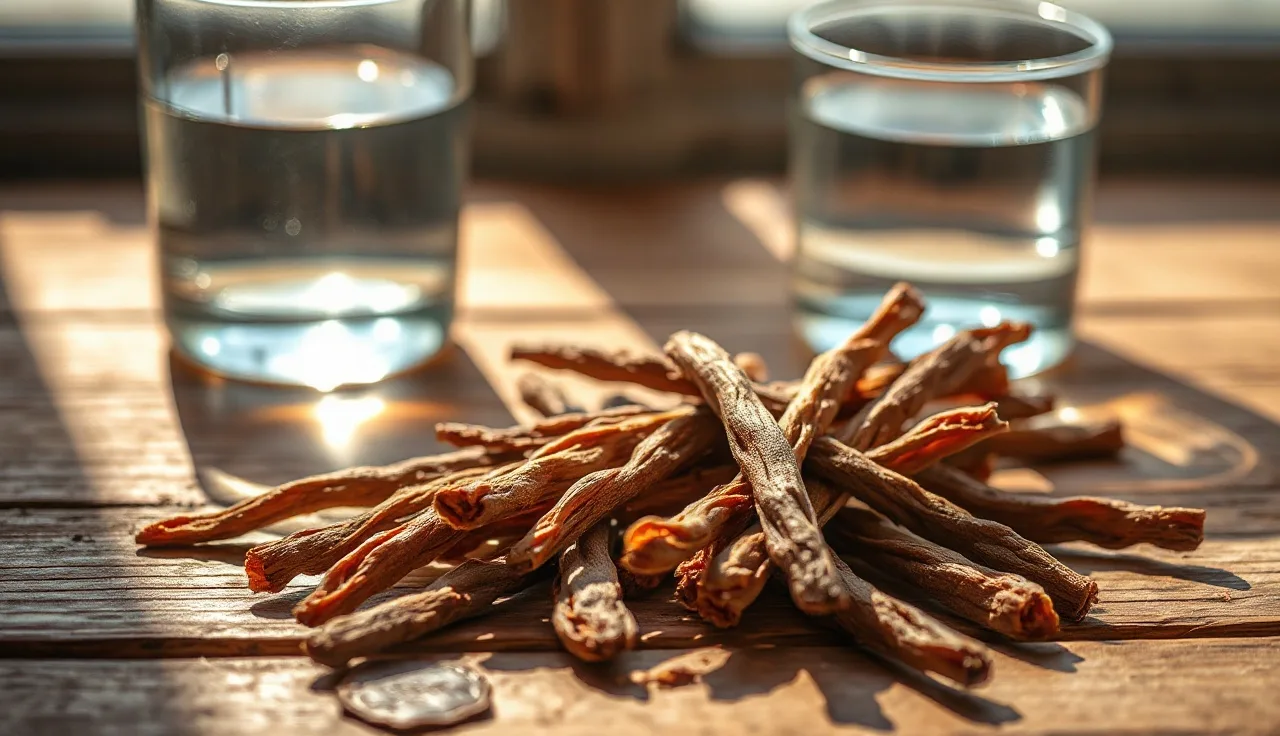
Licorice root (Glycyrrhiza glabra and related species) contains dozens of bioactive molecules. Two get most of the attention in hair loss discussions.
Glabridin is a flavonoid found in the root extract. A 2011 in vitro study published in Phytotherapy Research tested glabridin against human 5-alpha reductase type 1 and found concentration-dependent inhibition, meaning higher concentrations blocked more enzyme activity [2]. The same paper noted weaker effects on type 2, which is the isoform most relevant to scalp DHT production. That asymmetry matters a lot.
Glycyrrhizin is the compound responsible for licorice's characteristic sweetness. It has anti-inflammatory and some anti-androgenic properties in cell and animal models. One proposed mechanism is reduced conversion of androstenedione to testosterone in the adrenal pathway, which would cut the substrate available for DHT synthesis. But that effect is indirect and has mainly turned up in women with polycystic ovary syndrome at high oral doses [3].
Licochalcone A, another flavonoid, has shown anti-inflammatory activity relevant to the scalp microenvironment, but its direct effect on 5-alpha reductase is not well established in the literature.
Here is the honest framing. These compounds do something in a petri dish. Whether they survive digestion, reach the scalp follicle at effective concentrations, and stay there long enough to matter is a completely separate question, and no published human trial has answered it.
What does the actual research show on licorice root and hair loss?
The evidence breaks down into three tiers, and you need to keep them straight.
Tier 1 (in vitro, cell studies): Multiple papers confirm that glabridin and glycyrrhizin can inhibit 5-alpha reductase or reduce androgen receptor activity in isolated cells [2][3]. This is real data. It is also the weakest tier of evidence for a clinical outcome.
Tier 2 (animal studies): A 2012 study in rodents found that topical licorice extract increased the anagen (growth) phase of the hair cycle and reduced hair follicle miniaturization in DHT-treated mice [4]. Rodent hair biology differs meaningfully from human hair biology, and drug effects routinely fail to translate between species.
Tier 3 (human clinical trials): As of mid-2025, no peer-reviewed randomized controlled trial has shown that licorice root, in any form or dose, produces statistically significant DHT reduction or hair regrowth in humans. A search of ClinicalTrials.gov using terms "licorice" and "hair loss" returns no completed trials with primary hair outcome endpoints [5].
Some shampoo manufacturers have run small, unregistered studies and published marketing claims citing them, but these are not peer-reviewed and routinely lack control groups.
Compare this to finasteride. The registration trial published in the Journal of the American Academy of Dermatology enrolled 1,553 men and showed a 48% mean increase in hair count versus placebo over two years [6]. That is the evidentiary bar a treatment needs to clear before you should rely on it. Licorice root is not close to that bar.
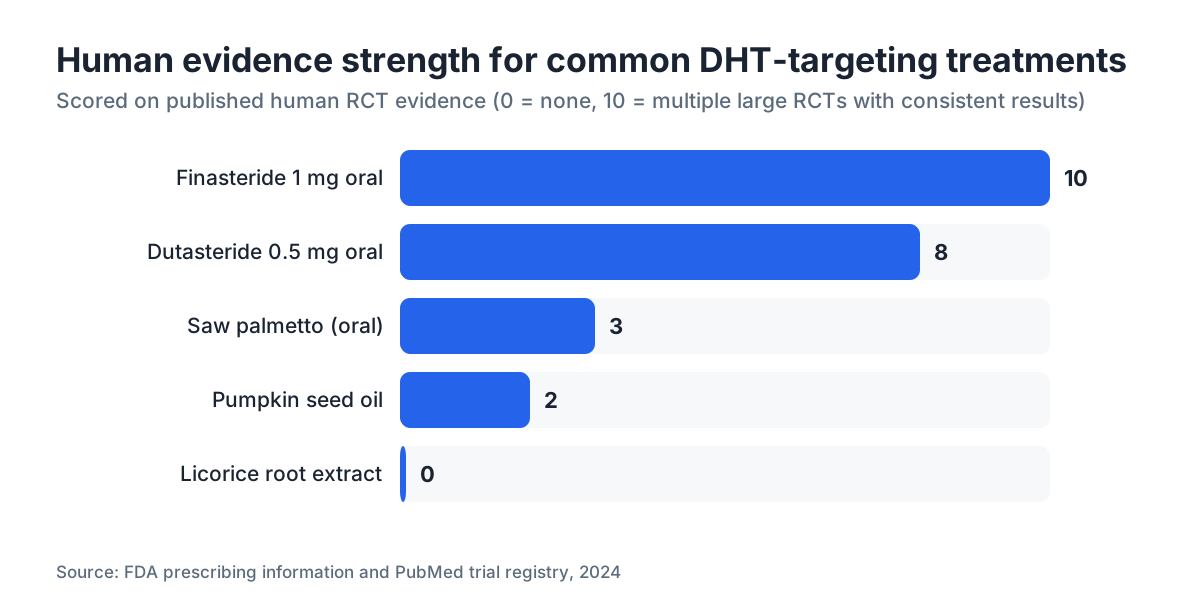
For context on proven DHT blockers and how they compare, the gap between cell-study ingredients and prescription drugs is enormous.
How does licorice root compare to proven DHT-blocking treatments?
| Treatment | Mechanism | Human trial evidence | FDA status | Typical cost/month |
|---|---|---|---|---|
| Finasteride 1 mg oral | Type 2 5AR inhibitor | Yes, multiple large RCTs [6] | Approved for male AGA | $10-40 generic |
| Dutasteride 0.5 mg oral | Type 1 + 2 5AR inhibitor | Yes, head-to-head vs finasteride [7] | Approved for BPH; off-label for hair | $20-60 |
| Topical minoxidil 5% | Vasodilator, non-DHT | Yes, extensive RCT record | Approved for AGA | $10-30 |
| Saw palmetto (oral) | Weak 5AR inhibition | One small RCT, limited effect | Supplement, not FDA-approved | $10-25 |
| Licorice root extract | Possible 5AR inhibition | No human RCTs | Supplement, not FDA-approved | $8-20 |
Finasteride's prescribing information, approved by the FDA, states the drug "inhibits the conversion of testosterone to dihydrotestosterone (DHT) in the prostate, liver, and skin" [6]. That language reflects decades of pharmacokinetic data in humans. No equivalent statement exists for licorice root because the human data do not exist.
Saw palmetto at least has one published randomized trial, though the effect was modest. Licorice root does not have that yet. That is the comparison that should matter most to someone deciding where to spend money.
If you are already using minoxidil for men and wondering whether adding licorice root to your regimen adds anything, the honest answer is: nobody knows, because nobody has studied that combination in humans.
Can licorice root help with androgenetic alopecia in women?
Women with androgenetic alopecia tend to have lower but still meaningful DHT sensitivity in their follicles. The anti-androgenic angle of licorice has drawn more study in women because of its use in managing hyperandrogenism in polycystic ovary syndrome.
A 2004 clinical paper found that oral glycyrrhizin at doses found in licorice candy consumption (roughly 100 mg/day) lowered testosterone levels in women with PCOS over a one-month period [3]. Lower circulating testosterone means less substrate for DHT conversion. That is an interesting signal. It is also far from a hair loss trial.
No published study has tracked scalp hair count or density in women taking licorice root for androgenetic alopecia. The theoretical pathway exists. The clinical confirmation does not.
Women also face fewer FDA-approved options than men. Minoxidil 2% and 5% topical are approved for women. Finasteride is not recommended during pregnancy or for women of childbearing potential without strict contraception due to teratogenicity risk [6]. That gap makes natural supplement interest understandable. But a lack of good alternatives is not the same as evidence that licorice root works.
What are the risks and side effects of using licorice root?
Licorice is not harmless at high or prolonged doses. This is where most supplement marketing goes quiet.
Glycoside-form licorice (containing glycyrrhizin) consumed regularly can cause pseudoaldosteronism, a syndrome where the body retains sodium and loses potassium, raising blood pressure. The FDA has noted that "very large amounts of black licorice" consumed over two weeks can cause arrhythmia, and at least one case report links chronic high-dose licorice ingestion to hypokalemic cardiac arrest [8]. The European Commission's Scientific Committee on Food put the safe daily limit for glycyrrhizinic acid at 100 mg/day for most adults [9].
Deglycyrrhizinated licorice (DGL), the form used in most gut-health supplements, removes most of the glycyrrhizin and avoids these effects. But DGL has less of the bioactive content theorized to affect androgens, so the forms most likely to do something to DHT are also the forms with real cardiovascular caution attached.
Topical licorice preparations, such as shampoos or serums containing licorice extract, likely carry lower systemic risk because absorption through intact scalp skin is minimal. There is also less evidence that topical application delivers the compound to the dermal papilla, where follicle signaling actually happens.
Drug interactions are real too. People on antihypertensives, diuretics, or corticosteroids should talk to a physician before taking meaningful oral doses of whole licorice extract.
How would licorice root be used for hair loss, and what doses appear in studies?
There is no established clinical dose for licorice root in hair loss because no clinical trial has set one. What exists is a loose patchwork of doses from studies targeting other endpoints.
The PCOS testosterone-reduction study used glycyrrhizin equivalent to about 3.5 grams of licorice root per day [3]. The in vitro 5AR inhibition studies used concentrations of glabridin that do not map cleanly to an oral supplement dose, because the bioavailability of glabridin after oral ingestion is genuinely uncertain.
Supplement products on the market typically contain 250 mg to 1,000 mg of standardized licorice root extract. Whether those doses deliver enough active compound to the scalp to matter is unknown.
Topical preparations, typically 1-5% licorice extract in a carrier, appear in cosmetic formulations and some dermatological protocols for hyperpigmentation (where licorice extract has somewhat stronger evidence). The same products are sometimes marketed for hair. The rodent study that showed positive hair cycle effects used a topical application at 1% concentration [4], but stretching that to a human shampoo application is a leap.
If you are tracking your own hair with something like the free AI hair scan at MyHairline, you can at least get a baseline measure before and after trying any supplement, which is the closest most people will get to a personal n-of-1 experiment.
Should you try licorice root for hair loss, or is there something better?
This is the question that actually matters. Here is my honest read.
If you have confirmed androgenetic alopecia and want to meaningfully slow or reverse it, licorice root should not be your first or second or third move. The evidence gap between it and prescription options is not small. Finasteride stops DHT production in the scalp with documented, replicated evidence, and its generic form costs roughly $10-30 a month. Finasteride is not perfect, the side effect discussions are real and worth reading carefully, but it has shown it works. Licorice root has not.
If you have already committed to the evidence-based stack (finasteride or another proven option plus topical minoxidil, tracked consistently for at least six months) and want to experiment with add-ons at low cost and low risk, topical licorice extract is not crazy. The risk profile for a topical application is low. The expectation should be low too.
If you are early in your hair loss journey and mainly want to understand what is happening, read the full breakdown of what causes hair loss and consider whether you are dealing with androgenetic alopecia at all. Licorice root does nothing useful for telogen effluvium, for example, which is often mistaken for pattern hair loss.
People interested in the broader supplement landscape should see the full review of hair loss supplements to understand which ingredients have more (or less) support than licorice root. Some do. Most do not.
A transparent summary: licorice root is interesting, genuinely not a scam at the biochemistry level, and completely unproven in humans for hair. Spend your time and money accordingly.
Is licorice root in shampoo or conditioner worth buying?
Licorice extract shows up in a growing number of scalp shampoos, serums, and conditioners, often alongside other botanicals like saw palmetto, pumpkin seed oil, and biotin. The marketing typically implies DHT blocking without making an explicit drug claim, because an explicit claim would require FDA drug approval.
For rinse-off products like shampoo, contact time with the scalp runs roughly 1-3 minutes before washing out. Delivering a meaningful dose of any active compound to a hair follicle sitting 2-4 mm below the scalp surface in that window is pharmacologically very difficult. Leave-in serums or conditioners do better on contact time, but absorption studies for glabridin through human scalp skin do not exist in the published literature.
The American Academy of Dermatology's guidance on hair loss does not list licorice root as a recommended treatment [10]. The AAD does recommend minoxidil and finasteride as first-line options for androgenetic alopecia, with some evidence support for low-level laser and platelet-rich plasma as adjuncts.
My read on licorice shampoos: if you like how they feel and the price is reasonable, fine. Do not pay a premium for the DHT-blocking claim. The claim is not supported.
Does licorice root interact with other hair loss treatments?
No human study has looked at licorice root combined with finasteride, minoxidil, or any other hair loss treatment, so there is no direct interaction data.
Theoretically, if licorice root does have any weak androgenic suppression effect through reduced testosterone, stacking it with finasteride (which already dramatically reduces scalp DHT) could marginally add to the anti-androgen load. Whether that adds meaningful benefit or just adds unnecessary complexity is unknown.
For people using finasteride and minoxidil together, the combination is already the most evidence-supported oral-plus-topical approach. Adding a third unproven compound does not obviously help and potentially complicates tracking what is working.
The blood pressure concern with whole licorice extract is more relevant for people on antihypertensives, ACE inhibitors, or thiazide diuretics. Oral minoxidil already carries blood pressure effects, so adding a compound that can itself raise blood pressure is something to flag to a doctor. The oral minoxidil side effect profile already requires some cardiovascular awareness.
Bottom line on interactions: no proven added benefit, some theoretical caution for certain drug combinations, and no reason to assume it makes existing treatments work better.
What do dermatologists actually think about licorice root for hair loss?
Dermatologists who specialize in hair disorders (trichologists and hair loss-focused derms) generally take one of two positions.
The first is cautious acknowledgment: the biochemical activity is real and worth studying, but there is not enough human evidence to recommend it clinically. This is the majority position among academic hair loss researchers.
The second, rarer position is outright skepticism, noting that hundreds of plant extracts show in vitro 5-alpha reductase inhibition and almost none of them translate to clinical hair benefit. The history of natural DHT blockers is full of promising lab results that went nowhere in people.
No major dermatology society, including the American Academy of Dermatology [10], the International Society of Hair Restoration Surgery [11], or the European Academy of Dermatology and Venereology, lists licorice root as a recommended or even adjunct treatment for androgenetic alopecia in its current clinical guidelines.
If you want to discuss it with a dermatologist, frame it as a question: "I'm considering adding licorice root extract topically alongside my current regimen. Is there any reason not to?" That is a more productive conversation than asking whether it works, because most honest clinicians will tell you the evidence is not there yet.
Sources
- American Academy of Dermatology, Hair Loss Overview
- Phytotherapy Research, 2011: Glabridin and 5-alpha reductase inhibition
- Steroids, 2004: Glycyrrhizin and testosterone reduction in PCOS
- Journal of Ethnopharmacology, 2012: Topical licorice extract and hair cycle in rodents
- ClinicalTrials.gov, NIH search: licorice and hair loss
- Journal of the American Academy of Dermatology, 1998: Finasteride male pattern hair loss trial
- Journal of the American Academy of Dermatology, 2006: Dutasteride vs finasteride RCT
- FDA, Consumer Update: Black Licorice Safety Warning
- European Commission Scientific Committee on Food, Glycyrrhizinic Acid Safety
- American Academy of Dermatology, Clinical Guidelines: Androgenetic Alopecia
- International Society of Hair Restoration Surgery, Evidence-Based Hair Loss Treatments