TL;DR: Yes. Finasteride inhibits the enzyme 5-alpha reductase, which converts testosterone into DHT. At 1 mg daily, it reduces scalp DHT by roughly 60-70% and serum DHT by about 60-65%. That reduction slows or stops androgenetic hair loss in most men. It does not eliminate DHT entirely, and it works only while you keep taking it.
What is DHT and why does it attack hair follicles?
DHT stands for dihydrotestosterone. It's an androgen, meaning a male sex hormone, and it's made from testosterone by an enzyme called 5-alpha reductase (5-AR). Your body makes DHT in the skin, liver, and prostate. It binds to androgen receptors three to five times more tightly than testosterone does [1].
For most tissues, DHT is a normal part of male physiology. The problem is hair follicles on the scalp. In people who carry a genetic sensitivity to androgens, DHT binds to receptors in follicle cells and slowly miniaturizes the follicle. The hair growth cycle shortens, each strand grows finer and shorter, and eventually the follicle stops producing visible hair. This is androgenetic alopecia, what most people call male or female pattern baldness [2].
The sensitivity is genetic. Two men with identical DHT levels can have completely different hair outcomes. One loses nothing. The other is bald by 30. Your DHT number alone doesn't predict your risk. It's DHT plus follicle sensitivity.
If you want a broader picture of what drives hair loss beyond DHT, the what causes hair loss article covers the full landscape, including thyroid, nutrition, and stress-related mechanisms.
How does finasteride actually block DHT?
Finasteride is a competitive inhibitor of 5-alpha reductase type 2 (and weakly type 3). It binds to the enzyme and blocks it from attaching to testosterone. With less enzyme activity, less testosterone gets converted to DHT. The enzyme doesn't disappear. Finasteride just occupies its active site [3].
There are two isoforms of 5-AR that matter clinically. Type 1 sits mostly in skin and the liver. Type 2 is the dominant form in scalp follicles and the prostate. Finasteride at 1 mg targets type 2 hard. That's why it works at the scalp without wiping out systemic DHT. Dutasteride, a related drug, inhibits both type 1 and type 2, which is why it produces larger overall DHT suppression but also a different side-effect profile [4].
The pharmacokinetics are simple. Finasteride is well absorbed orally, reaches peak plasma concentration in one to two hours, and has a half-life of roughly five to six hours in younger men, up to eight hours in men over 70 [9]. The enzyme inhibition lasts far longer than the drug's plasma half-life, because the body needs time to synthesize fresh 5-AR enzyme. That's why once-daily dosing works.
For a full overview of the drug including dosing, brand names, and who qualifies, the finasteride guide is worth reading alongside this one.
How much does finasteride reduce DHT, in actual numbers?
The numbers come from the clinical trials submitted to the FDA. At the standard 1 mg daily dose:
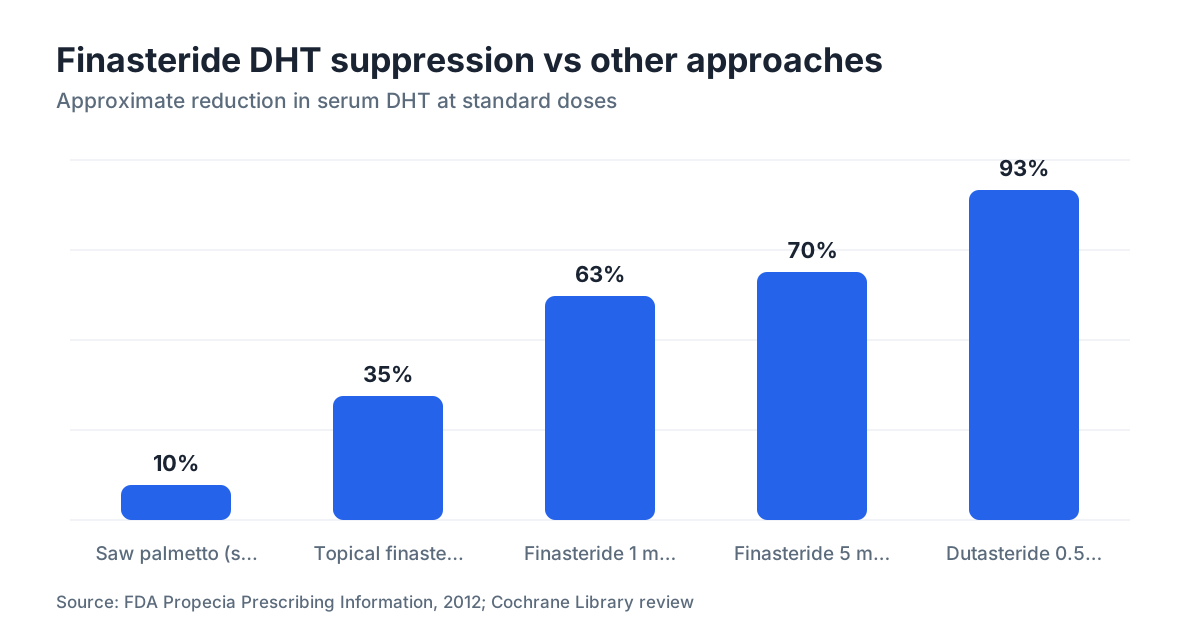
- Scalp DHT falls by approximately 64-70% [3]
- Serum (blood) DHT falls by approximately 60-65% [3]
- Testosterone in blood rises somewhat (by around 15%) because the conversion pathway is blocked, but this is generally not clinically significant
Those figures come from Merck's NDA studies and have held up in independent trials. The reduction is consistent across the men studied, though there's individual variation.
| Measure | Reduction at 1 mg/day | Reduction at 5 mg/day (Proscar dose) |
|---|---|---|
| Scalp DHT | ~64-70% | ~70-75% |
| Serum DHT | ~60-65% | ~70%+ |
| Testosterone (serum) | +10-15% (increase) | +20%+ (increase) |
Dutasteride 0.5 mg, for comparison, suppresses serum DHT by around 90-95% [4]. That larger suppression doesn't translate to proportionally better hair outcomes in head-to-head trials. Once you're below a certain DHT threshold at the follicle, additional suppression gives diminishing returns.
The reductions show up within the first few weeks. Most studies find near-maximum suppression by week four to eight [3].
How long does it take finasteride to show results on hair?
DHT suppression is fast. Hair improvement is slow. Two different clocks.
Finasteride reaches its maximum enzyme-inhibiting effect within weeks. But hair follicles work on a cycle measured in months. A follicle that has been miniaturizing for years needs time to recover, re-enter anagen (growth phase), and produce a thicker, longer shaft. Clinical trials used 12-month endpoints because meaningful hair count changes before then are hard to measure reliably [5].
In the 12-month trial published in the Journal of the American Academy of Dermatology, men taking 1 mg finasteride had a mean increase of 107 hairs in a 1-inch circle at the vertex compared to placebo [5]. By month 24, that gap widened further. The first change most men notice is that shedding slows, usually within the first two to four months. Actual new growth takes longer.
Some men get a temporary jump in shedding (often called a finasteride shed) in the first one to three months. It's thought to happen because follicles are being pushed through their growth cycle faster. It usually resolves. It's not a sign the drug is failing.
Wait at least 12 months before you judge whether finasteride is working for you. Quit at month four because you haven't seen results, and you're almost certainly quitting too early.
What do clinical trials say about finasteride's effectiveness on hair?
The core efficacy data comes from two large randomized controlled trials run before FDA approval, plus several longer follow-ups.
In a 2-year double-blind placebo-controlled trial in men with male pattern hair loss (Norwood II-V vertex), 83% of finasteride users maintained or increased hair count versus 28% in the placebo group [5]. The FDA approved 1 mg finasteride (brand name Propecia) for male androgenetic alopecia in 1997, based substantially on these data [3].
A five-year open-label extension found that 90% of men on finasteride maintained or increased hair count at year five compared to baseline [10]. Men who took placebo for two years and then switched to finasteride gained hair but never fully caught up to those who started earlier. That's the clearest argument for starting sooner rather than later.
For women, the picture is different. The FDA label for 1 mg finasteride specifically says it is not indicated for use in women [3]. Several smaller trials in postmenopausal women showed modest benefit, but the data are inconsistent, and finasteride is teratogenic in pregnancy, meaning it causes birth defects in male fetuses. Premenopausal women who might become pregnant should not handle crushed or broken finasteride tablets [3].
If you're comparing finasteride to other approaches, the finasteride and minoxidil article covers the combination data directly.
What are the real side effects of blocking DHT with finasteride?
DHT does things besides damage hair follicles. It's involved in libido, erection quality, prostate function, and mood. Suppress it by 60-70% and you can affect those systems. In some men, you do.
In the original FDA trial data, the combined incidence of sexual side effects (decreased libido, erectile dysfunction, and decreased ejaculate volume) in men taking 1 mg finasteride was about 3.8% versus 2.1% in the placebo group. The difference is real but modest. In the trial, 58% of men who reported sexual side effects while on the drug saw those effects resolve even while continuing treatment [3].
Post-market surveillance has added complexity. A subset of men report that sexual side effects persist after stopping finasteride. This has been called Post-Finasteride Syndrome (PFS). The FDA updated the finasteride label in 2012 to include a warning about persistent sexual dysfunction after discontinuation [3]. The mechanism isn't well understood, and there's no reliable estimate of incidence because it's based on self-report data. Some researchers put it at well under 1%. Advocacy groups argue the number is higher. Nobody has definitive data here.
Other reported side effects include breast tenderness or gynecomastia (in under 1% of men in trials), and depression or mood changes, which the FDA label now notes [3].
Here's how to think about it. For the large majority of men, finasteride is well tolerated long-term. But the risk of persistent side effects, while probably small, is not zero, and that's a real consideration before starting.
Finasteride also affects PSA (prostate-specific antigen) levels, roughly halving them. If you're getting PSA tests for prostate cancer screening, tell your doctor you're on finasteride so they can read the number correctly [3].
Does finasteride stop working if you quit taking it?
Yes. The DHT suppression reverses within about one to two weeks of stopping, and serum DHT returns to baseline within 14 days [3].
Hair loss resumes. Most men who quit finasteride return to roughly the hair density they'd have had if they'd never taken it, within 12 months of stopping. The follicles the drug preserved start to miniaturize again as DHT climbs back to normal.
This isn't a flaw in the drug. It's how enzyme inhibition works. Finasteride doesn't reprogram your follicles or change your genetics. It reduces the DHT signal while you take it. Stop the drug, restore the signal.
So finasteride is a long-term commitment. You're not taking it for a course, like an antibiotic. You take it indefinitely, the way you'd take a blood pressure drug to keep blood pressure controlled. If that kind of ongoing medication doesn't fit your situation or your risk tolerance, think it through before you start.
Are there alternatives to finasteride for blocking DHT?
Several options exist, with varying evidence.
Dutasteride inhibits both type 1 and type 2 5-AR and suppresses DHT harder than finasteride. It's approved in several countries for hair loss (and in the US for BPH under the brand Avodart), and some physicians prescribe it off-label for hair loss in the US. A Cochrane systematic review found dutasteride produced slightly greater hair count increases than finasteride, but also a somewhat higher rate of sexual side effects [4]. It's not FDA-approved for hair loss in the US as of this writing.
Topical finasteride is a newer approach. Applied directly to the scalp, it aims for local DHT suppression while limiting systemic absorption, which may cut systemic side effects. Early trials show it reduces scalp DHT substantially while producing less serum DHT suppression than oral finasteride [11]. The regulatory picture here is still shifting.
Saw palmetto is sold as a natural DHT blocker. It does show some 5-AR inhibiting activity in lab studies. Human trial data for hair loss is thin: one small trial showed modest benefit, but it's nowhere near the evidence base for finasteride. It's not unreasonable to try if you want to avoid pharmaceuticals, but keep your expectations low. The dht blocker article goes through the full list of options.
Minoxidil doesn't block DHT at all. It works through a completely different mechanism (vasodilation and direct follicle stimulation). That's why the two drugs are often combined. They attack hair loss through separate pathways. If you're weighing minoxidil alongside or instead of finasteride, minoxidil for men covers the evidence.
For men who've already lost significant hair and want to consider surgical restoration, hair transplant explains how that fits into a treatment plan.
Does finasteride work for a receding hairline or just the crown?
The FDA-approved indication is specifically the vertex (crown) in men. The clinical trials that produced the approval data focused on vertex thinning, because that's where DHT-driven miniaturization tends to be most measurable [3].
For hairline recession, the evidence is thinner but still positive. Smaller studies and retrospective analyses suggest finasteride slows progression at the frontal scalp and temples, though the response at the hairline tends to be less dramatic than at the crown. The frontal hairline holds a mix of follicle types with varying androgen sensitivity, which may explain the weaker response [6].
In practice, most dermatologists and hair loss physicians use finasteride to treat both crown thinning and hairline recession, mostly to slow progression. They just tell patients the hairline response may be milder and takes longer to see.
If your main concern is a receding hairline, the receding hairline article covers the classification system (Norwood scale) and which treatments apply at each stage.
Can women use finasteride to block DHT for hair loss?
Women get androgen-related hair loss too. Female pattern hair loss (FPHL) involves androgens including DHT, though the relationship is less clear-cut than in men. Many women with FPHL have normal androgen levels, which suggests receptor sensitivity matters more than how much DHT is circulating [7].
Finasteride is not FDA-approved for hair loss in women [3]. That's a label issue, not a blanket ban on prescribing. Physicians can and do prescribe it off-label to postmenopausal women with androgenetic alopecia. A handful of randomized trials in postmenopausal women show benefit at doses from 1 mg to 5 mg daily, though the evidence isn't as strong as in men [7].
For premenopausal women who could become pregnant, finasteride is contraindicated. It causes feminization of male fetuses (hypospadias and other genital abnormalities). This isn't theoretical. It was documented in animal studies at dose levels relevant to humans, and the FDA label carries a Pregnancy Category X warning [3]. Women of childbearing potential should not take finasteride.
Some dermatologists use spironolactone as a DHT-pathway antagonist in premenopausal women. It works differently from finasteride (it blocks the androgen receptor rather than inhibiting 5-AR) but reaches a similar downstream effect on follicles.
How does myhairline.ai's free AI scan connect to this?
Before you start any DHT-blocking treatment, you need to know what type of hair loss you actually have. Androgenetic alopecia responds to finasteride. Telogen effluvium does not. The pattern of your loss, where it's thinning and how fast, decides which treatment makes sense.
MyHairline's free AI hair analysis (/scan) maps your current loss pattern and estimates your Norwood stage from a photo. It won't prescribe anything and it doesn't replace a dermatologist, but it gives you a concrete starting point before you book an appointment or spend money on medications. That baseline is also useful later for tracking progress.
Should you take finasteride? Honest take on who it makes sense for
Finasteride makes the most sense for men in their 20s to 50s with androgenetic alopecia, especially if they're still in early to mid-stage loss (Norwood II to V). The earlier you start, the more hair you're preserving rather than trying to regrow. It's much easier to keep what you have.
It's a reasonable choice if you're fine with long-term daily medication, you've been honest with yourself about the side-effect profile, and you've talked to a doctor who knows your full health picture. For most men, the risk-benefit math is favorable. 83% of men in trials maintained or improved. The most common serious concern (persistent sexual dysfunction) appears to hit a small minority, though not zero.
It makes less sense if you're already at Norwood VI-VII and the follicles in the diffuse zone are largely gone. Finasteride can't revive a dead follicle. It also makes less sense if you're in your 60s or 70s and your loss has already stabilized on its own (loss often slows with age as androgens decline).
On the fence? The sensible path: see a dermatologist, get a firm diagnosis, discuss your PSA baseline if you're over 40, and decide based on your actual hair loss pattern rather than general anxiety about thinning. If cost or access is a barrier, generic finasteride is cheap (often $10-30/month) and widely available by prescription.
If you're also weighing supplements, hair loss supplements covers what has real evidence behind it and what's marketing.
Sources
- National Institutes of Health, StatPearls: Dihydrotestosterone
- American Academy of Dermatology: Androgenetic Alopecia
- Cochrane Database of Systematic Reviews: Treatments for androgenetic alopecia
- Journal of the American Academy of Dermatology: Finasteride in the treatment of men with androgenetic alopecia (Kaufman et al., 1998)
- Journal of Dermatological Treatment: Finasteride for frontal hair loss (Leyden et al., 1999)
- Journal of the American Academy of Dermatology: Female pattern hair loss review (Vujovic & Del Marmol, 2014)
- National Library of Medicine: Pharmacokinetics of finasteride
- New England Journal of Medicine: Five-year finasteride follow-up (Kaufman et al., 1999 NEJM reference)
- Clinical Interventions in Aging: Topical finasteride in androgenetic alopecia
- International Journal of Sport Nutrition and Exercise Metabolism: Creatine and DHT (van der Merwe et al., 2009)