
TL;DR: You can slow, stop, or partially reverse a receding hairline with FDA-approved treatments. Finasteride stops progression in roughly 83-87% of men. Minoxidil regrows hair in about 40% of users. Combined, they beat either one alone. Hair transplants give permanent results but cost $4,000-$15,000. No treatment is a cure, and starting early matters most.
Can you actually fix a receding hairline?
Yes, with real caveats. "Fix" means different things depending on how far things have gone. Catch it early and FDA-approved medications can stop the recession and, in a meaningful share of people, push some hair back. If you're already bald across the crown and temples, medications slow further loss but won't rebuild a full head of hair. Transplants can, but they move existing hair rather than create new follicles.
The underlying cause matters too. Most receding hairlines in men are androgenetic alopecia, also called male pattern baldness, driven by dihydrotestosterone (DHT) shrinking follicles over time [1]. Women get a different version: diffuse thinning rather than a sharp hairline recession, usually driven by the same DHT sensitivity plus hormonal shifts around menopause, postpartum periods, or polycystic ovary syndrome [2]. There are also non-hormonal causes like traction alopecia (tight hairstyles pulling the hairline back), telogen effluvium (sudden shedding after stress or illness), and scarring alopecias, each with a different treatment path.
So the first honest step is figuring out which type you have. A dermatologist can usually tell from a visual exam and a scalp pull test. Some people do an AI-based photo analysis as an initial screen before booking an appointment.
What are the most effective treatments for a receding hairline?
The evidence ladder has a clear top tier. Here's how the main options stack up:
| Treatment | Evidence level | Who it works for | Typical result | Cost range |
|---|---|---|---|---|
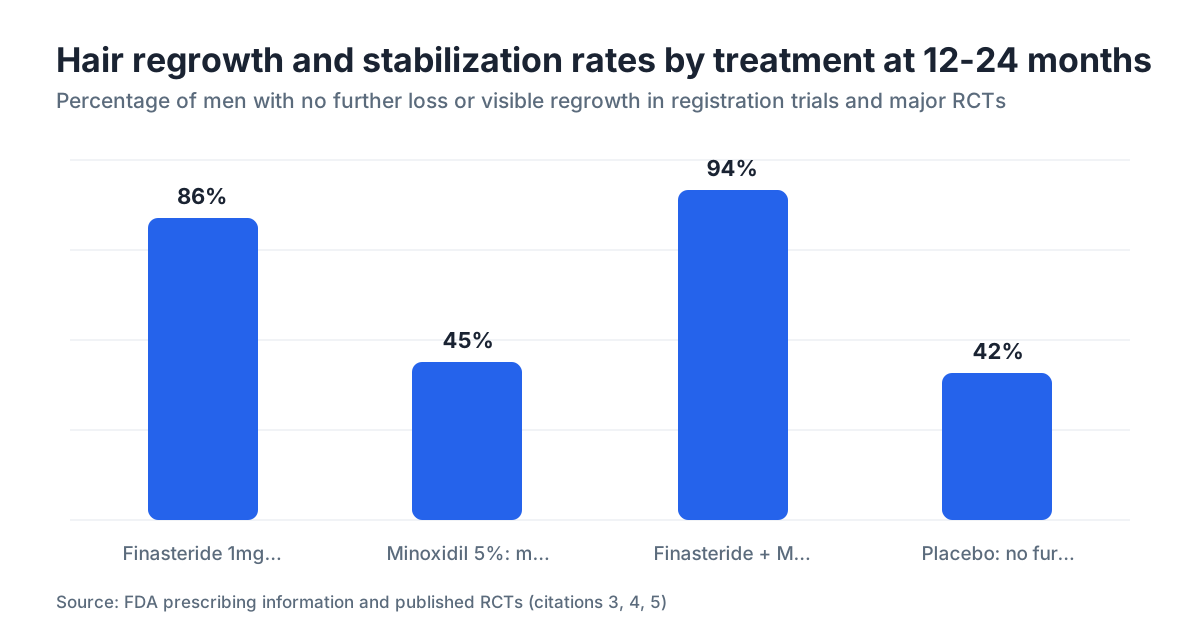
| Finasteride 1mg oral | FDA-approved | Men (not safe in pregnancy) | 83-87% stop loss; ~66% see regrowth at 2 yrs [3] | $20-$80/mo generic |
| Minoxidil 2% or 5% topical | FDA-approved | Men and women | ~40% moderate regrowth at 4 months [4] | $15-$30/mo |
| Minoxidil + Finasteride combined | Strong RCT data | Men | Beats either alone [5] | $35-$110/mo |
| Low-level laser therapy (LLLT) | FDA-cleared (not approved) | Men and women | Modest improvement; best as adjunct | $200-$3,000 device |
| PRP (platelet-rich plasma) | Emerging; inconsistent trials | Men and women | Mixed; some RCTs show benefit | $1,500-$4,000/series |
| Hair transplant (FUE/FUT) | Surgical; permanent | Men and women with stable donor area | Permanent, natural-looking [6] | $4,000-$15,000 |
| Biotin / supplements | Weak; only helps if deficient | Anyone with nutritional deficiency | Minimal for non-deficient users | $10-$40/mo |
Finasteride is the single most effective pharmacological tool for men with androgenetic alopecia. It blocks 5-alpha reductase, the enzyme that converts testosterone to DHT, and the trial that led to its approval showed 83% of men had no further loss over 2 years versus significant continued loss in the placebo group [3]. A 5-year follow-up published in the Journal of the American Academy of Dermatology found 90% of finasteride users maintained or improved hair count over that period [3].
Minoxidil works differently. It's a vasodilator that extends the hair growth phase, and it's the only topical FDA-approved for both men and women [4]. The 2% concentration is approved for women; 5% is approved for men, though many dermatologists use 5% off-label in women with good tolerability data behind that choice.
For more on combining these two, see finasteride and minoxidil.
What does finasteride actually do for a receding hairline?
Finasteride 1mg (sold as Propecia, now widely available as generic) was FDA-approved in 1997 specifically for male pattern hair loss [3]. It doesn't just slow shedding. In the registration trials, about 48% of men taking it for 2 years had visible regrowth as rated by both investigators and patients. Another ~38% had no further loss. Only 14% continued to progress, compared to 58% in the placebo group.
It works best at the crown and mid-scalp. The hairline itself responds a little less strongly, but it does respond. Time is the thing. Most studies show the full benefit at 12-24 months. Stop taking it and the protection stops with it, with shedding resuming within 6-12 months.
The side effect conversation is real. About 1-2% of men in clinical trials reported sexual side effects including reduced libido, erectile dysfunction, or ejaculation changes [3]. Most resolved after stopping the drug. A smaller number of men report symptoms that persist after they quit, a phenomenon the FDA added to the label in 2012. That's not a trivial concern, and you should raise it with your doctor rather than ignore it. Read the full picture at finasteride.
Finasteride is not approved for women who are or may become pregnant. It's teratogenic and can cause genital malformations in a male fetus. Postmenopausal women are sometimes prescribed it off-label, and there's reasonable data supporting that use, but this is strictly a conversation to have with a physician.
How well does minoxidil work on a receding hairline?
Minoxidil is the most accessible evidence-based option because you don't need a prescription for the topical versions. The FDA approved the 2% solution for women and the 5% solution for men [4]. A foam formulation (Rogaine and generics) cut the scalp irritation that the propylene glycol in the original solution caused for some people.
In the registration trials, 5% minoxidil beat 2% in men: 45% of men using 5% had moderate to dense regrowth at 48 weeks versus 36% using 2%, and 5% also worked faster [4]. Women in 5% trials saw similar improvements with no meaningful increase in side effects over 2%, which is why dermatologists often reach for 5% in women too, just not as a labeled use.
The catch: you have to keep using it. Minoxidil does nothing about the underlying DHT cause. Stop it and any regrown hair sheds within a few months. It's also better at maintaining and slightly regrowing hair than at dramatically pushing back a well-established hairline recession.
Oral minoxidil (0.25-2.5mg for hair loss, off-label) has gained serious traction in dermatology because it skips scalp irritation and seems to work at lower systemic doses than its blood-pressure use. Several recent studies, including a 2022 randomized trial in JAAD, showed low-dose oral minoxidil worked for both androgenetic alopecia and diffuse thinning in women [7]. The trade-off is a small risk of fluid retention or unwanted facial hair growth at higher doses. More at oral minoxidil.
For the full side-effect rundown, see minoxidil side effects.
How to fix a receding hairline in women: what's different?
Female hairline recession looks different from the male pattern. Women more often see diffuse thinning across the top and a widening part, with recession at the temples sometimes coming along with it. True frontal fibrosing alopecia (FFA), which causes a steady recession of the hairline with scalp scarring, is increasingly common in women and needs completely different treatment than androgenetic alopecia.
For androgenetic alopecia in women, the evidence-based options are:
Minoxidil topical (2% or 5%): First-line, FDA-approved for women [4]. Most dermatologists start here. Give it at least 6 months before judging results. Apply to a dry scalp and let it absorb before styling.
Spironolactone (off-label): An anti-androgen widely used by dermatologists for women with androgenetic alopecia, especially those with signs of elevated androgens. A retrospective study published in JAAD found 74% of women reported improvement [8]. Not FDA-approved for hair loss specifically, but the off-label use is well-supported.
Low-dose oral minoxidil: The 2022 trial noted above showed good results at 1mg daily in women with acceptable tolerability [7].
Hormone-related workup: If your hairline started receding after stopping birth control, after childbirth, or around perimenopause, the trigger may be hormonal and partly reversible once hormones stabilize. A ferritin level below 30 ng/mL is also linked to hair shedding, and correcting iron deficiency can help. Nobody has great data on the exact ferritin target for hair regrowth, but most dermatologists aim for 40-70 ng/mL.
Traction alopecia, caused by tight ponytails, braids, weaves, or extensions pulling the hairline back over years, is common in women and underdiagnosed. Caught before scarring, changing hairstyle practices and using minoxidil can lead to significant recovery. Once the follicles scar, recovery is limited and a transplant may be the only option.
For context on all the reasons hair thins in women, what causes hair loss covers the diagnostic map.
How to fix a receding hairline in women naturally: does anything work?
"Naturally" usually means without prescription drugs or surgery. The honest answer: lifestyle changes and nutritional support help when there's an underlying deficiency or lifestyle driver, but they won't override genetics or reverse established DHT-driven follicle miniaturization.
What has some evidence behind it:
Iron and ferritin: A 2002 study in the Journal of Investigative Dermatology found an association between low ferritin and increased hair shedding in women with non-scarring alopecia [9]. Getting ferritin above 40 ng/mL through diet (red meat, legumes, fortified cereals) or supplements is cheap and low-risk.
Protein intake: Hair is keratin. Severely restrictive diets, particularly those under about 50g of protein per day, can trigger telogen effluvium. Correcting a protein deficit helps. Eating extra protein beyond adequate levels does not grow extra hair.
Stress reduction: Chronic elevated cortisol is linked to increased shedding through its effects on the hair cycle. This isn't a quick fix, but it's real biology. A major stressful event typically causes shedding 2-4 months later. Shedding from ongoing stress can drag on.
Scalp massage: A small 2016 Japanese study (n=9) found standardized 4-minute daily scalp massage increased hair thickness after 24 weeks [10]. The study is tiny and the mechanism isn't settled, but scalp massage is free and low risk. Don't treat it as a substitute for medication if you have meaningful loss.
Rosemary oil: A 2015 randomized trial in Skinmed compared rosemary oil to 2% minoxidil over 6 months and found comparable hair counts, though both showed modest effects [11]. It's not a replacement for minoxidil, but if you're hesitant about medication, daily rosemary oil on the scalp is a low-risk starting point.
What doesn't hold up to scrutiny: biotin in people who aren't biotin-deficient (there's no published RCT showing benefit in non-deficient people), collagen powders for hairline regrowth, castor oil as a standalone treatment, and most "hair growth serums" sold without clinical data. See hair loss supplements for the full breakdown.
Will a hair transplant fix a receding hairline permanently?
A hair transplant moves DHT-resistant follicles from the back and sides of your scalp (the donor area) to where you've lost hair. Because those donor follicles are genetically resistant to DHT, they keep growing in their new location. That part is permanent [6].
But two things complicate the permanence story. First, the hair around the transplanted grafts can keep thinning if you're not on a medication like finasteride to slow that progression. A great transplant at 30 can look patchy at 45 if the native hair around it keeps receding. Most surgeons want you on finasteride long-term after a transplant for exactly this reason.
Second, your donor supply is finite. Everyone has a donor area of limited size. Transplant too aggressively early in the progression and you may not have enough donor hair left to address future loss. Surgeons use the expected final Norwood stage to plan conservatively.
FUE (follicular unit extraction) removes individual follicles and leaves no linear scar, which is why it's the dominant technique now. FUT (follicular unit transplantation, or strip surgery) still gives higher yield per session and lower transection rates in skilled hands, but leaves a linear scar. Cost ranges widely: $4,000 to $15,000 in the US depending on graft count, surgeon experience, and geography [6]. Get multiple consultations and ask to see before/after photos of patients at 12 months, not 6.
More at hair transplant.
What about DHT blockers and other adjunct options?
DHT is the primary driver of androgenetic alopecia in both men and women, so anything that lowers DHT levels or blocks DHT at the follicle receptor can in theory help. Finasteride is the most studied pharmaceutical DHT blocker. Dutasteride blocks both type 1 and type 2 5-alpha reductase (finasteride only blocks type 2) and shows stronger DHT suppression in studies, but it's not FDA-approved for hair loss in the US (it is approved in South Korea and Japan) [1].
Ketoconazole 2% shampoo has mild anti-androgenic properties at the scalp. It's often used as an adjunct, and a small randomized trial published in 1998 found it comparable to 2% minoxidil for hair density, though larger confirmatory studies are lacking. Reasonable to add, not a standalone treatment.
Saw palmetto, a natural 5-alpha reductase inhibitor, has some small studies suggesting modest benefit. A 2002 study in the Journal of Alternative and Complementary Medicine found 60% of men taking 200mg saw palmetto reported improvement versus 11% on placebo [12]. The study was small, measurement was subjective, and nobody has tested it against finasteride head-to-head in a properly powered RCT. I wouldn't lean on it as a primary treatment, but the risk profile is benign.
For a full map of options including supplements, see dht blocker.
How do Norwood stages affect which treatment to choose?
The Norwood-Hamilton scale sorts male pattern baldness from Type I (no recession) to Type VII (only a horseshoe of hair at the sides and back). Where you fall on that scale should directly shape your plan.
Norwood I-II: You may be a natural variant rather than actively receding. If there's no family history and no progression over 12+ months, watchful waiting is reasonable. If you do want to act early, this is when medications work best.
Norwood III-IV: The sweet spot for medical treatment. Finasteride and minoxidil together will stop most progression and can meaningfully restore density. Transplants are possible but risky to do too aggressively until the pattern stabilizes.
Norwood V-VII: Medications can slow continued loss but won't rebuild significant ground. Transplant is the main tool for cosmetic restoration, and donor supply planning becomes the whole game. Hair systems (wigs, hairpieces) are worth considering as a non-medical option. Modern ones are far better than their reputation.
If you want to pin down your own Norwood stage before booking appointments, a receding hairline overview walks through the visual criteria.
How quickly do treatments work, and what should you realistically expect?
Timeline management is one of the most underserved parts of this conversation. Almost every treatment causes increased shedding in the first 4-8 weeks (the "dread shed" for minoxidil users, a sign follicles are cycling). This is normal and expected.
Finasteride: Most users see reduced shedding by month 2-3. Visible regrowth shows up at 6-12 months. Full clinical effect lands at 12-24 months. Don't judge it at 3 months.
Minoxidil topical: Regrowth can appear as early as 4 months. Optimal results at 12 months. Applying it inconsistently wrecks your results. Twice-daily application is the labeled dosing; once-daily foam is a practical compromise with some supporting data.
Hair transplant: Transplanted hair sheds in weeks 2-6 after surgery. New growth starts at 3-4 months. Presentable results at 8-12 months. Final result at 12-18 months.
PRP: A series of 3 sessions monthly, then maintenance every 3-6 months. Some people see improvement at 3 months. Others don't respond at all.
No treatment shows meaningful results in 4-6 weeks. If you're a few weeks in and panicking about shedding, that's the normal trajectory, not a sign the treatment is failing.
Is there anything you should stop doing to prevent further recession?
A few habits actively speed up hairline recession and are worth addressing no matter which treatment you pick.
Tight hairstyles: Any style that puts chronic tension on the frontal hairline, high ponytails, tight braids, cornrows, extensions, or hats pulled tight, can cause traction alopecia over years. This is a mechanical problem, not a hormonal one, and switching styles early can allow recovery.
Smoking: A 2020 meta-analysis in Skin Appendage Disorders found a statistically significant association between smoking and androgenetic alopecia [13]. The mechanism likely involves oxidative stress at the follicle. Quitting is good for your hairline and everything else.
Crash dieting: Severe caloric restriction causes telogen effluvium, and repeated crash dieting can retrigger shedding cycles again and again. Slow, sustainable weight loss is much kinder to your hair. See does creatine cause hair loss for a related look at how specific dietary supplements get blamed.
Skipping protein: As noted earlier, staying near 0.8g/kg bodyweight minimum in protein keeps your hair cycle fueled. Not exotic nutrition, just adequate eating.
If you want an objective read on how your hairline is progressing before committing to treatment, MyHairline's free AI scan (/scan) can give you a baseline Norwood assessment from a photo, useful for tracking change over time.
How to choose between options: a practical decision framework
Here's how I'd think through this if I were advising a friend:
Man in your 20s or 30s with early recession and no contraindications to finasteride: start finasteride 1mg daily and add topical or minoxidil for men at 5%. The combination has the most evidence and gives you the best shot at keeping what you have and recovering some of what's left. Do this before considering anything else.
Woman with androgenetic alopecia: start topical minoxidil 5%. If you have signs of elevated androgens (irregular periods, acne, excess facial hair), ask your doctor about spironolactone. If you're postmenopausal, finasteride or dutasteride off-label may be on the table.
Woman with traction alopecia: stop the traction first, use minoxidil, and consult a dermatologist about whether scarring is present. If scarring is early, you may still have a good recovery window.
If medications haven't worked after 12-18 months of consistent use, or if you're at Norwood V+: consult a hair transplant surgeon. Get two to three opinions. Ask specifically about long-term planning and whether your donor supply supports your goals.
If cost is a real constraint: generic finasteride and generic minoxidil are both cheap. GoodRx puts generic finasteride (1mg, 30 tabs) at $15-25 in many US markets. That makes the most effective combination cost roughly $35-60/month total, far less than any supplement regimen promising hair growth.
For tracking your own trajectory from home, MyHairline's free AI scan at /scan is a reasonable way to get an objective photo baseline you can compare over time.
Sources
- FDA, Propecia (finasteride) prescribing information
- American Academy of Dermatology, hair loss in women
- Kaufman KD et al., Journal of the American Academy of Dermatology, 1998 and 5-year data; FDA approval data for finasteride 1mg
- FDA, Rogaine (minoxidil) 5% topical solution prescribing information and OTC labeling
- Hu R et al., Dermatologic Therapy, 2015; combination finasteride and minoxidil RCT
- International Society of Hair Restoration Surgery, patient information
- Randolph M, Tosti A, Journal of the American Academy of Dermatology, 2021; low-dose oral minoxidil review
- Sinclair R et al., Journal of the American Academy of Dermatology, 2005; spironolactone for female androgenetic alopecia
- Rushton DH, Journal of Investigative Dermatology, 2002; iron deficiency and hair loss in women
- Koyama T et al., ePlasty, 2016; scalp massage and hair thickness
- Panahi Y et al., Skinmed, 2015; rosemary oil versus minoxidil 2% RCT
- Prager N et al., Journal of Alternative and Complementary Medicine, 2002; saw palmetto for androgenetic alopecia
- Trüeb RM, Skin Appendage Disorders, 2020; smoking and androgenetic alopecia meta-analysis