TL;DR: No vitamin fully blocks DHT the way finasteride does, but several nutrients reduce DHT production or 5-alpha reductase activity in lab and clinical settings. Saw palmetto, zinc, and pumpkin seed oil have the most human trial data. Expect modest effects, not a cure, and combine them with proven treatments if hair loss is progressing.
What is DHT and why does it matter for hair loss?
DHT stands for dihydrotestosterone. It's made when the enzyme 5-alpha reductase converts testosterone into a more potent androgen, and it's the main driver of androgenetic alopecia, the pattern hair loss that affects roughly 50 percent of men by age 50 and a meaningful share of women too [1].
Hair follicles on the scalp contain androgen receptors. When DHT binds to those receptors, it shortens the hair growth cycle, shrinks the follicle over time, and eventually stops producing visible hair altogether. The back and sides of the scalp have fewer androgen receptors, which is why they stay full while the top thins.
The gold-standard pharmaceutical approach is to block 5-alpha reductase directly. Finasteride (a prescription drug) does this and lowers scalp and serum DHT by around 60-70 percent at the 1 mg daily dose [2]. That level of blockade is hard for any supplement to match. But some compounds do show measurable 5-alpha reductase inhibiting activity in real human studies, more than test tubes, and that's where this article focuses.
For a broader look at the mechanisms behind hair thinning, what causes hair loss is a good starting point.
Can vitamins and supplements actually block DHT?
Honestly, no single vitamin blocks DHT the way a drug does. What several nutrients do is partially inhibit 5-alpha reductase, reduce inflammation around the follicle, or correct a deficiency that is worsening hair shedding. The distinction matters because the marketing around "DHT-blocking vitamins" often implies a pharmacological effect that the evidence doesn't support at the doses you'd get in a supplement.
That said, dismissing all of them is also wrong. A 2021 review in the Journal of Cosmetic Dermatology found that pumpkin seed oil, saw palmetto, and a few other plant-derived compounds showed statistically significant improvements in hair count in randomized controlled trials, even if the effect size was smaller than finasteride [3]. For someone with early-stage hair loss who doesn't want to take a prescription drug, "smaller effect" is not the same as "no effect."
The honest framing: these are low-risk, lower-cost interventions worth trying if you have mild-to-moderate loss, you're watching for side effects from medications, or you want to add something to a pharmaceutical regimen. They are not a substitute for finasteride or minoxidil if your hair loss is progressing fast.
Which vitamins and nutrients have the strongest DHT-blocking evidence?
Here's what the research actually shows for the most studied candidates.
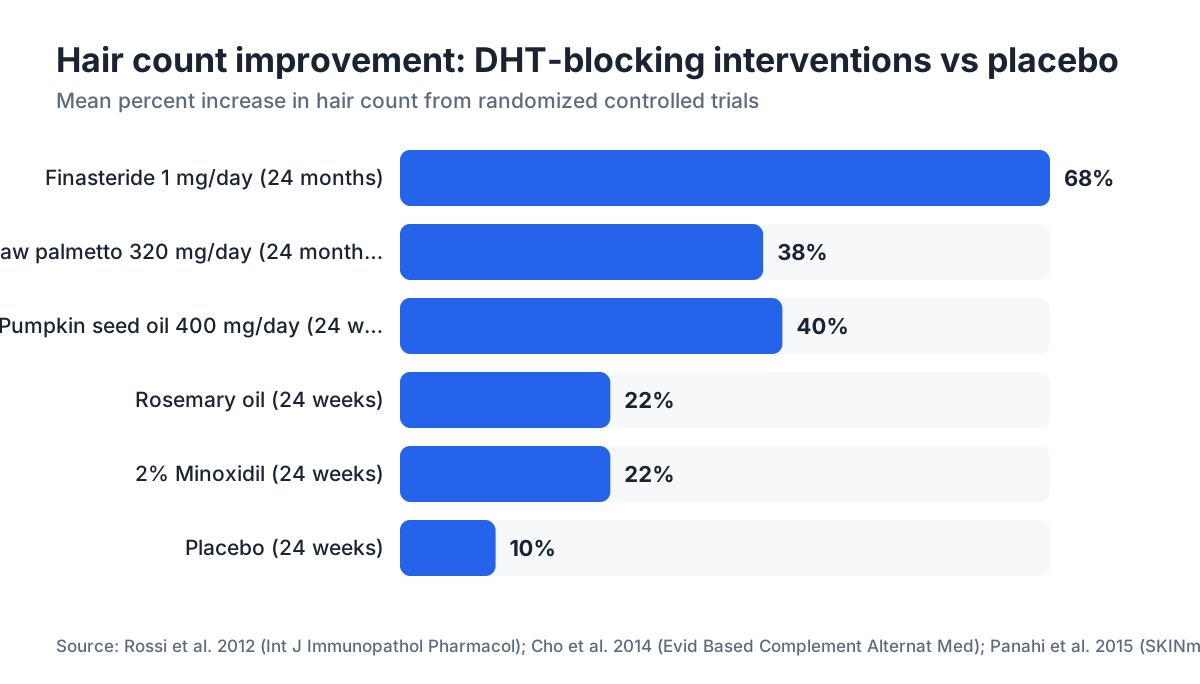
Saw palmetto (Serenoa repens) This is the best-studied plant-based DHT blocker. A 2012 randomized trial published in the International Journal of Immunopathology and Pharmacology tested 320 mg/day of saw palmetto lipid extract against finasteride 1 mg in 100 men with androgenetic alopecia for 24 months. Finasteride won on every measure, but 38 percent of the saw palmetto group still improved, mostly at the vertex (crown), versus 68 percent in the finasteride group [4]. That's a real effect, even if it's roughly half as potent.
Saw palmetto inhibits both type I and type II 5-alpha reductase, whereas finasteride at 1 mg primarily targets type II. Some researchers think this dual inhibition could be an advantage, though the clinical data hasn't confirmed a meaningful benefit over finasteride.
Zinc Zinc deficiency is associated with hair loss, and zinc supplementation has shown 5-alpha reductase inhibiting properties in lab models. A 1988 study in Acta Dermato-Venereologica found that zinc, combined with azelaic acid, significantly inhibited 5-alpha reductase activity in human skin tissue [5]. The practical takeaway: if you're deficient, correcting that deficiency probably helps. If your zinc is already normal, taking more is unlikely to drive additional DHT suppression and can cause GI side effects or copper depletion at high doses.
A safe dietary reference intake for adult men is 11 mg/day and 8 mg/day for women, per the NIH Office of Dietary Supplements [6].
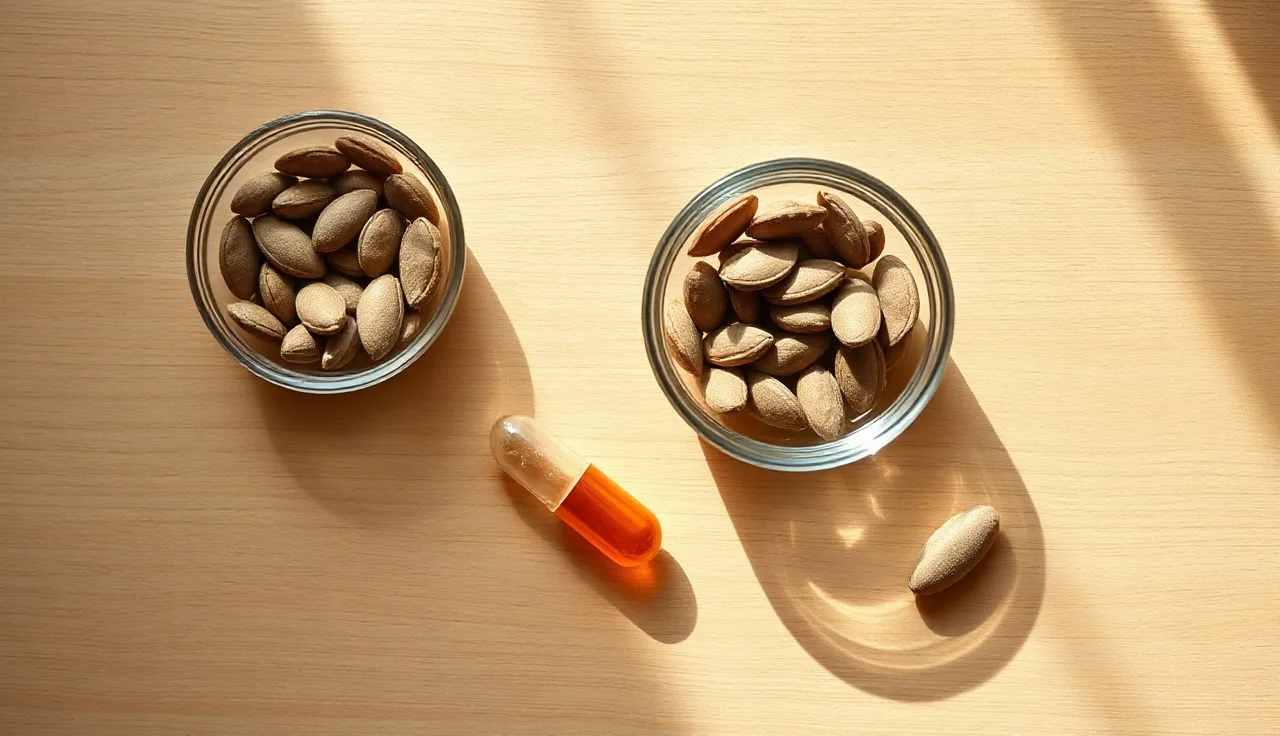
Pumpkin seed oil A 2014 randomized, double-blind, placebo-controlled trial in Evidence-Based Complementary and Alternative Medicine enrolled 76 men with mild-to-moderate androgenetic alopecia and gave them 400 mg/day of pumpkin seed oil or placebo for 24 weeks. The pumpkin seed oil group showed a 40 percent increase in mean hair count compared to 10 percent in the placebo group [7]. The mechanism isn't fully nailed down, but 5-alpha reductase inhibition is the leading explanation. That trial is small but it is a proper RCT.
Vitamin D Vitamin D receptors are present in hair follicles, and deficiency is associated with various forms of alopecia including alopecia areata and possibly androgenetic alopecia. A 2019 review in the International Journal of Dermatology found that low vitamin D levels correlated with hair loss severity, though causality is harder to establish than correlation [8]. Vitamin D doesn't directly block 5-alpha reductase, but correcting a deficiency (most guidelines suggest targeting 30-50 ng/mL serum 25-hydroxyvitamin D) can normalize follicle cycling.
Biotin Biotin (vitamin B7) is the most heavily marketed hair supplement on the shelf. Here's the honest truth: biotin deficiency causes hair loss, and supplementing a deficient person will help. True biotin deficiency is rare in people eating a normal diet. The FDA issued a safety communication in 2019 warning that high-dose biotin supplements can interfere with laboratory test results, including thyroid tests and cardiac troponin assays [9]. For people who aren't deficient, the evidence that biotin does anything for androgenetic alopecia is weak to nonexistent. It doesn't block DHT at all.
Rosemary oil (active: rosmarinic acid) Technically a botanical, not a vitamin, but it appears on every DHT-blocker list so it earns a mention. A 2015 randomized clinical trial in SKINmed compared rosemary oil to 2% minoxidil in 100 patients over 6 months. Both groups had similar increases in hair count by week 24, though rosemary oil caused more scalp itching early on [10]. The mechanism likely involves increased scalp circulation and possibly mild 5-alpha reductase inhibition. This is not a DHT-blocker in a pharmacological sense, but it's one of the few topical naturals with real comparison data.
See dht blocker for a broader breakdown of blocking strategies beyond vitamins.
How do DHT-blocking supplements compare to finasteride and minoxidil?
This is the question that actually matters for your decision, and the answer is: supplements are meaningfully weaker but meaningfully safer on the side-effect profile.
| Intervention | DHT reduction | Evidence level | Main risks |
|---|---|---|---|
| Finasteride 1 mg/day (oral) | ~60-70% serum DHT [2] | Multiple large RCTs, FDA-approved | Sexual side effects (~2-4% in trials), rare persistent effects |
| Saw palmetto 320 mg/day | Partial inhibition, no serum DHT % confirmed | 2 RCTs, multiple open trials | Mild GI upset, possible mild antiandrogen effects |
| Pumpkin seed oil 400 mg/day | Unknown % | 1 RCT (n=76) | Well-tolerated in trials |
| Zinc (correcting deficiency) | In vitro inhibition | Observational + in vitro | GI upset, copper depletion at high doses |
| Vitamin D (correcting deficiency) | Doesn't block DHT directly | Observational | Toxicity above 4,000 IU/day per NIH |
| Biotin | None | No RCT data for AGA | Lab test interference at high doses |
For someone at a Norwood 2 or early Norwood 3 (receding hairline covers the stages) who catches it early and wants to slow progression without prescription drugs, saw palmetto plus pumpkin seed oil is a reasonable starting point. For someone at Norwood 4 and above with active, fast progression, supplements alone are unlikely to keep pace with the loss, and a dermatologist conversation about finasteride and minoxidil for men makes more sense.
If you're already on finasteride and minoxidil and want to add supplements as a complement, there's no known interaction concern with the compounds above at normal doses, but confirm with your prescribing physician.
What does the research say about pumpkin seed oil specifically?
Pumpkin seed oil gets more attention lately because it has one of the better-designed trials behind it for a supplement. The 2014 trial by Cho et al., published in Evidence-Based Complementary and Alternative Medicine, was randomized, double-blind, and placebo-controlled [7]. Seventy-six Korean men with mild-to-moderate androgenetic alopecia took 400 mg/day of pumpkin seed oil or placebo for 24 weeks.
At week 24, the pumpkin seed oil group had a 40 percent mean increase in hair count while the placebo group had around 10 percent. Scalp photographs and hair count assessments were done by blinded evaluators. No serious adverse effects were reported.
The limitations are real. Small sample size. Only one ethnic group studied. No comparison to finasteride or minoxidil, and 24 weeks may not be long enough to observe the full trajectory of androgenetic alopecia. The trial also used a specific branded pumpkin seed oil extract, so whether you'd get the same results from any pumpkin seed oil capsule off a shelf is unknown.
But as supplement trials go, it's more rigorous than most. For someone looking for a low-risk add-on, 400 mg/day of pumpkin seed oil is backed by more than just theory.
Is there a DHT-blocking vitamin for women specifically?
Women's hair loss is more complicated than men's. Androgenetic alopecia in women (female-pattern hair loss) does involve DHT and androgen receptors, but hormonal factors like estrogen fluctuations, thyroid dysfunction, iron deficiency, and telogen effluvium all overlap. Simply blocking DHT won't address every driver.
Finasteride is not FDA-approved for women and carries a pregnancy risk (category X) because of the risk of male fetal genital abnormalities [2]. Some dermatologists prescribe it off-label to postmenopausal women, but that's a clinical conversation, not a supplement question.
For women specifically, the supplements with most relevance are different. Correcting iron deficiency (ferritin below 30 mcg/L is associated with hair shedding in several studies) and vitamin D deficiency probably matters more than saw palmetto. That said, saw palmetto has been used in female-pattern hair loss studies and is generally well-tolerated. Zinc correction is similarly relevant when deficiency is present.
Women with suspected hormonal hair loss who want supplement options should get a full blood panel first, including ferritin, vitamin D, thyroid function, and total and free testosterone. Treating a confirmed deficiency is far more productive than stacking supplements when levels are already normal.
How long do DHT-blocking vitamins take to work?
Hair grows slowly. The anagen (active growth) phase lasts 2-7 years, but the shedding-and-regrowth cycle after you change any DHT-related intervention takes at least 3-6 months before you'll see a difference in hair count. Most supplement trials ran 24 weeks (about 6 months) for a reason: that's roughly the minimum time needed to see a signal.
Expect no visible change at 6-8 weeks. Some people notice reduced shedding (fewer hairs on the pillow or in the shower) around the 8-12 week mark if a supplement is working. Actual regrowth at the temples or crown takes longer, and may not happen at all if follicles are already miniaturized to the point of being non-functional.
Patience is genuinely required here. The bigger risk is abandoning something that's working after 2 months because you don't see results, or continuing something for 12 months that isn't doing anything. Taking baseline photographs in good lighting before you start, and then comparing at 3 months and 6 months, is the most reliable way to track whether anything is happening. MyHairline's free AI scan at myhairline.ai/scan can help you document your baseline and track changes over time.
If there's no measurable improvement after 6 months of a supplement at the tested dose, it's reasonable to conclude it isn't working for you.
What foods are highest in natural DHT-blocking nutrients?
If you'd rather get these from diet than capsules, some of the relevant compounds do appear in whole foods in meaningful amounts.
Zinc-rich foods: Oysters are by far the highest source (74 mg per 3-oz serving, according to USDA data). Beef, pumpkin seeds, crab, and fortified cereals are good secondary sources [6].
Foods with 5-alpha reductase-inhibiting compounds: Green tea (EGCG), flaxseeds (lignans), spearmint tea, and soy-based foods contain phytoestrogens and polyphenols that show modest 5-alpha reductase inhibition in lab studies. The concentration in food is lower than in standardized supplements, so the effect is probably smaller, but there's no downside to including these in a regular diet.
Vitamin D: Fatty fish (salmon, mackerel, sardines), egg yolks, and fortified dairy and plant milks contribute. Most people in northern latitudes still struggle to hit optimal serum levels through diet alone without some sun exposure or supplementation, especially in winter months.
Lycopene: Found in cooked tomatoes, watermelon, and pink grapefruit. Some in vitro studies suggest lycopene inhibits 5-alpha reductase, but human hair loss trials don't exist yet. Eat cooked tomatoes for the lycopene if you like them; don't buy a lycopene capsule expecting hair regrowth.
Diet won't replace meaningful DHT suppression if your hair loss is progressing, but it's a zero-cost foundation.
Are there any risks or side effects to DHT-blocking supplements?
The good news is that most supplements in this category are well-tolerated at the doses used in trials. The risks worth knowing about:
Saw palmetto can cause mild GI distress (nausea, stomach pain) in some users, especially on an empty stomach. Because it has mild antiandrogen effects, there are theoretical concerns about taking it during pregnancy or in young males, though the evidence for clinical harm at supplement doses is thin. Men taking blood thinners should note that saw palmetto may have mild antiplatelet effects.
Zinc at high doses (above 40 mg/day, which is the NIH tolerable upper limit) causes nausea, vomiting, and over time can deplete copper, which itself causes neurological and hematological problems [6]. Many zinc supplements on the market are 50 mg or higher per serving, which routinely exceeds the safe upper limit. More is not better.
Vitamin D is fat-soluble and accumulates. The NIH sets the tolerable upper intake level at 4,000 IU/day for adults, though toxicity in practice is rare below 10,000 IU/day long-term [11]. Get your 25-hydroxyvitamin D tested before supplementing aggressively.
Biotin doesn't cause systemic harm at the doses in typical supplements, but the FDA warning about lab test interference is real and documented [9]. Tell your doctor if you take high-dose biotin before bloodwork.
None of these supplements carry the sexual side-effect profile associated with finasteride. That's a genuine differentiator for men worried about that risk, though it comes alongside a genuine difference in efficacy.
For people exploring the finasteride and minoxidil combination, supplements can be layered on top without known interactions at typical doses, but always disclose everything to your prescriber.
What should you look for in a DHT-blocking supplement?
The supplement industry is lightly regulated compared to pharmaceuticals. The FDA requires supplement manufacturers to follow Current Good Manufacturing Practices (cGMP) but does not pre-approve supplements for safety or efficacy before they reach store shelves [12]. That means the label might not match what's in the bottle.
Third-party testing is the most reliable quality signal. Look for products certified by USP (United States Pharmacopeia), NSF International, or ConsumerLab. These organizations test for identity, potency, and contaminants independently.
For specific compounds, look for:
- Saw palmetto: lipid (fat-soluble) extract standardized to 85-95% fatty acids, 160 mg twice daily or 320 mg once daily to match trial doses [4]
- Pumpkin seed oil: 400 mg/day as used in the Cho 2014 trial [7]
- Zinc: 11 mg/day (DRI for men) from zinc picolinate or zinc citrate, not zinc oxide which absorbs poorly
- Vitamin D3 (cholecalciferol): dose depends on your current serum level; 1,000-2,000 IU/day is reasonable for maintenance if not deficient
Combination "hair vitamins" with 15 ingredients at sub-therapeutic doses are generally a waste of money. A product with 10 mg of saw palmetto isn't going to inhibit much 5-alpha reductase. Dose concentration matters more than ingredient count.
If you want to map out whether supplements or stronger treatment is warranted for your specific pattern, the free AI analysis at myhairline.ai/scan can help you assess where you are before spending on treatments.
Do DHT-blocking vitamins work better combined with minoxidil or finasteride?
Nobody has done a rigorous four-arm trial comparing finasteride alone, finasteride plus saw palmetto, minoxidil alone, and minoxidil plus saw palmetto. That study doesn't exist. So the answer here requires some inference.
The mechanism logic: minoxidil works by extending the anagen phase and widening blood vessels to the follicle. It doesn't block DHT at all [13]. Combining a DHT-reducing supplement with minoxidil addresses two different pathways, which is reasonable in theory. The hair loss supplements article covers how these pieces fit together in a treatment stack.
Finasteride already hits the same mechanism as saw palmetto (5-alpha reductase inhibition), so stacking them is unlikely to add dramatically more DHT reduction, though saw palmetto's type I inhibition and finasteride's type II preference could theoretically give slightly broader coverage. In practice, if finasteride is doing its job, adding saw palmetto probably adds little. If someone can't tolerate finasteride at full dose, some clinicians have used saw palmetto as a partial substitute, though the evidence for that specific approach is anecdotal.
Pumpkin seed oil and vitamin D correction alongside either pharmaceutical seem harmless and potentially additive. These address inflammatory and follicle health pathways that finasteride and minoxidil don't directly target.
The honest answer: the combination approach is reasonable but not proven superior in a controlled trial. Don't let supplement stacking delay starting an evidence-based treatment if your hair loss is progressing.
When should you see a dermatologist instead of trying supplements?
Supplements are a reasonable first step for mild, early-stage hair loss with slow progression. They are not appropriate as a primary strategy if:
You're losing hair rapidly (noticeable change over weeks or a few months). You've progressed past Norwood 3 and are still actively thinning. Your hair loss is patchy or asymmetric (which could indicate alopecia areata, scalp conditions, or other causes that supplements won't address). You're a woman with diffuse shedding that hasn't been worked up medically.
A board-certified dermatologist can do a scalp biopsy, dermoscopy, and blood work to differentiate androgenetic alopecia from other causes. The American Academy of Dermatology recommends seeing a dermatologist for hair loss that is progressing, causing distress, or unclear in cause [1]. If someone tells you to just "try more biotin" for unexplained hair loss, that's not good advice.
For people who've exhausted medical therapies or have significant permanent loss, hair transplant is the only way to restore hair in bald areas; no supplement will regrow hair in a follicle that has completely stopped functioning. If supplements are going to help, they work best early, while the follicle is miniaturized but still active.
Sources
- American Academy of Dermatology, Hair Loss overview
- MedlinePlus (NIH), Finasteride drug information
- Journal of Cosmetic Dermatology, 2021 review of plant-based DHT inhibitors
- Rossi et al., International Journal of Immunopathology and Pharmacology, 2012
- Stamatiadis et al., Acta Dermato-Venereologica, 1988
- NIH Office of Dietary Supplements, Zinc Fact Sheet for Health Professionals
- Cho et al., Evidence-Based Complementary and Alternative Medicine, 2014
- International Journal of Dermatology, 2019 review on vitamin D and alopecia
- FDA, Safety Communication on biotin interference with lab tests (2019)
- Panahi et al., SKINmed, 2015
- NIH Office of Dietary Supplements, Vitamin D Fact Sheet for Health Professionals
- FDA, Dietary Supplements overview
- MedlinePlus (NIH), Minoxidil topical drug information