
TL;DR: Ketoconazole, the antifungal in Nizoral shampoo, weakly blocks DHT at the scalp and calms the inflammation tied to pattern hair loss. A 1998 randomized trial found 2% ketoconazole improved hair diameter and growth-phase hairs, and a 2011 trial found it matched 2% minoxidil for density. It won't replace finasteride. As an add-on, it has real evidence.
What does Nizoral actually do to DHT?
Ketoconazole, the active ingredient in Nizoral, is an antifungal first. That's what it was built for. But in the late 1990s researchers noticed a second act: it interferes with androgen production at the local level.
Here's the mechanism. Ketoconazole blocks cytochrome P450 enzymes, including the 17,20-lyase step involved in making androgens [1]. At the scalp, that means less local dihydrotestosterone (DHT) activity. DHT is the androgen most responsible for shrinking hair follicles in people genetically prone to androgenetic alopecia. Our guide on what causes hair loss walks through the full chain.
The key word is "local." Ketoconazole applied topically doesn't crash your systemic testosterone or DHT the way oral finasteride does. It works at the scalp surface. That's both its appeal (few systemic side effects) and its ceiling (weaker overall DHT suppression). See our breakdown of how dht blockers work for where ketoconazole sits in the ranking.
There's more to the story. Research from 2001 found ketoconazole also acts on the hair follicle cycle directly, separate from its anti-androgen effect, which may explain part of its benefit [8]. So calling it purely a "DHT blocker" is a half-truth. It does at least two things.
What does the clinical research say about ketoconazole and hair growth?
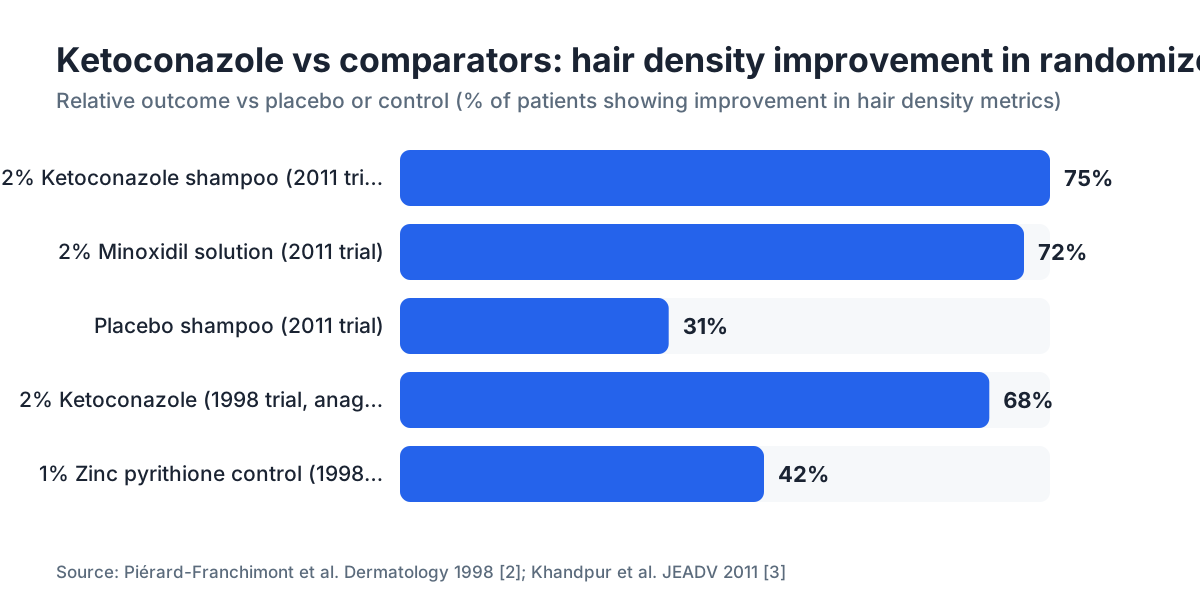
The most-cited trial is a 1998 study in Dermatology by Piérard and colleagues. People with androgenetic alopecia got either 2% ketoconazole shampoo or 1% zinc pyrithione shampoo (the active in Head & Shoulders) two to three times a week. After six months, the ketoconazole group had significantly bigger gains in hair shaft diameter and in the proportion of anagen (growth-phase) hairs than the zinc pyrithione group [2].
The finding that turned heads came from a 2011 study in the Journal of the European Academy of Dermatology and Venereology. It put 2% ketoconazole shampoo against 2% minoxidil solution and placebo. Ketoconazole and minoxidil produced similar density improvements, and both beat placebo [3]. That is not a throwaway result. Minoxidil for men is the most-used topical hair loss treatment on earth.
Here's the honest caveat. These trials are small. The 2011 study ran 45 participants. Dermatology is full of small trials that fail to replicate, and nobody has funded a large Phase III ketoconazole-versus-minoxidil head-to-head with hundreds of subjects. The best evidence we have is decent, not definitive.
What the data keeps showing is consistent: ketoconazole shampoo beats plain shampoo and roughly matches minoxidil for density in the small trials we have. That's enough for most dermatologists to add it, and not enough to call it a cure on its own.
| Treatment | Trial comparison | Result vs placebo |
|---|---|---|
| 2% ketoconazole shampoo | vs zinc pyrithione | Significantly better hair diameter and anagen ratio [2] |
| 2% ketoconazole shampoo | vs 2% minoxidil | Similar density gains, both beat placebo [3] |
| 1% ketoconazole shampoo (OTC Nizoral) | Limited data | Probably weaker than 2%; no large trials [4] |
Is 1% Nizoral (OTC) as effective as 2% prescription ketoconazole?
Probably not, but the gap may be smaller than the label difference suggests. That's the honest answer.
Every compelling hair-growth trial used 2% ketoconazole. The over-the-counter Nizoral sold in the US is 1%. Prescription strength is 2%. The FDA cleared 1% Nizoral for dandruff control, and it makes no hair-loss claims [4].
No published trial compares 1% against 2% ketoconazole for androgenetic alopecia head to head. The idea that 2% works better is reasonable (more active ingredient, stronger enzyme inhibition) but it hasn't been proven in hair-loss research. Some dermatologists write for compounded 2% shampoo or prescription-strength Nizoral just to get the studied dose.
If you're starting out, 1% OTC is a low-risk place to begin. Want the concentration the studies actually used? Ask a dermatologist for the 2%.
How does ketoconazole compare to finasteride for blocking DHT?
Finasteride wins this one, and it isn't close. Finasteride is the oral DHT blocker with the deepest evidence for androgenetic alopecia. It inhibits 5-alpha reductase type II (and some type I in the 5mg form), the enzyme that turns testosterone into DHT. In randomized trials of thousands of men, 1mg daily cut serum DHT by about 70% and raised hair count at two and five years [5].
Ketoconazole works differently and more weakly. It hits androgen-synthesis enzymes rather than 5-alpha reductase, and it acts locally instead of systemically. Nobody has published a study measuring how much ketoconazole shampoo lowers scalp-tissue DHT versus oral finasteride. That gap is real, and anyone who claims otherwise is guessing.
The practical read: finasteride is a far stronger DHT blocker backed by far larger trials. Ketoconazole is a useful helper. Most people who use it for hair loss stack it with minoxidil and/or finasteride, two or three times a week, as part of a wider routine. Using ketoconazole instead of finasteride, when you're a candidate for finasteride and have no reason to avoid it, leaves results on the table.
Combining finasteride and minoxidil already has strong evidence for combined benefit. Adding ketoconazole shampoo on top costs little and risks less.
Does Nizoral shampoo help with scalp inflammation and dandruff-related hair loss?
Yes, and this is where ketoconazole's evidence is strongest.
Seborrheic dermatitis, the condition behind dandruff and scalp flaking, runs partly on overgrowth of Malassezia yeast. Ketoconazole hits Malassezia hard [9]. Chronic scalp inflammation from seborrheic dermatitis can worsen shedding, and the people who get seborrheic dermatitis overlap a lot with the people who develop androgenetic alopecia.
For someone shedding because of dandruff-driven inflammation, Nizoral goes straight at the cause. Less inflammation means a friendlier environment for follicles. That's a separate mechanism from DHT blockade.
So if you have a flaky, itchy scalp along with thinning, ketoconazole is pulling double duty. If your scalp isn't inflamed and you don't have dandruff, the anti-inflammatory upside matters less, and you're leaning on the DHT and hair-cycle effects instead.
Heavy diffuse shedding with no scalp inflammation has different roots. Read our explainer on telogen effluvium if that sounds closer to your case.
How do you use Nizoral shampoo for hair loss?
The trial protocol was simple. Work 2% ketoconazole shampoo into the scalp, leave it on three to five minutes, then rinse. Two to three times a week [2][3].
Daily use isn't recommended and probably backfires. Ketoconazole every day can dry and irritate the scalp, and letting a lower concentration sit longer doesn't boost penetration enough to justify the flaking and irritation. Two to three times a week is the evidence-based cadence.
On off days, use your regular shampoo. Ketoconazole shampoos dry out some people, especially those with curly or coarse hair. A conditioner on the mid-lengths and ends fixes most of that.
One thing matters: let it sit. Rinse the moment you lather and you get less benefit. That three-to-five-minute contact time is part of how ketoconazole works, whether you're treating dandruff or chasing the anti-androgen effect.
Are there side effects from using Nizoral for hair loss?
Topical ketoconazole is easy to tolerate for most people. The usual gripe is scalp dryness, more nuisance than medical problem, and conditioner handles it.
The FDA label for 1% Nizoral lists contact dermatitis, increased hair loss (usually temporary, tied to follicle cycling), and abnormal hair texture as possible reactions [4]. Extra shedding in the first few weeks isn't the treatment failing; it happens with minoxidil too and tends to settle. If shedding is heavy or drags past six to eight weeks, stop and see a dermatologist.
Systemic absorption from a shampoo used a few times a week is low. The scary side effects of oral ketoconazole (liver toxicity, hormonal disruption at high doses) aren't a realistic worry with topical use at normal frequency [1]. The FDA has warned against oral ketoconazole for non-life-threatening fungal infections over liver risk, and those warnings do not apply to topical formulations [4].
People with color-treated hair sometimes say ketoconazole shampoos shift their color slightly. That's anecdotal, but worth knowing if your color is freshly done.
Where does Nizoral fit in a full hair loss treatment plan?
Treat ketoconazole as a cheap, low-risk add-on to a routine built on proven treatments. Not the star of the show.
For androgenetic alopecia in men, the treatments with the most and best evidence are oral finasteride (1mg daily) and topical minoxidil (5% foam or solution). Both have large multicenter trials behind them. Low-dose oral minoxidil (0.25mg to 2.5mg daily) is used more and more and has its own growing evidence; see our guide on oral minoxidil. Ketoconazole shampoo slots in as the third piece, two or three times a week alongside whatever else you're on.
If you can't or won't take finasteride (side effect worries, fertility plans) or haven't tried it yet, ketoconazole is a fair starting move because it has some anti-androgen action with minimal systemic risk. Just don't expect it to match finasteride.
For someone at an early Norwood stage with mild thinning at the temples or crown, pairing ketoconazole shampoo with minoxidil is a common conservative start. If that's you, our guide on receding hairline covers what early-stage options look like.
If hair loss has gone far and conservative treatments have stalled, a hair transplant consult makes sense. Ketoconazole isn't a solution at that stage, though it can help keep the hair you have after a transplant.
Want a fast read on where your hairline stands before you commit to anything? MyHairline's free AI scan at /scan can assess your pattern and give you a starting point.
Can women use Nizoral for hair loss?
Yes. Women with androgenetic alopecia or female-pattern hair loss have scalp DHT activity too, and the same local anti-androgen mechanism applies.
The 1998 Piérard trial included both men and women, and while not every analysis split results by sex, both groups improved [2]. The American Academy of Dermatology's guidance on female hair loss mentions ketoconazole shampoo as a possible adjunct, with the note that the evidence base is smaller than for men [6].
Women who are pregnant or trying to conceive should be careful. Oral ketoconazole causes birth defects at high doses in animal studies, and while topical absorption is low, the conservative call is to skip it during pregnancy. Raise it with an OB-GYN or dermatologist.
Women with diffuse shedding rather than a patterned loss may be dealing with telogen effluvium from iron deficiency, thyroid trouble, or postpartum change. Ketoconazole does nothing for any of those. The distinction changes the whole plan.
What are the best ketoconazole shampoo options and what do they cost?
Nizoral is the name everyone knows, but generic 1% ketoconazole shampoos are everywhere and much cheaper. Same active ingredient.
The cost is low. A 7 oz bottle of 1% Nizoral runs roughly $15 to $20 at most pharmacies (prices vary and change). At two to three uses a week, one bottle lasts two to three months. Generic 1% versions cost $8 to $14 for a similar size. Prescription 2% ketoconazole shampoo runs $10 to $40 depending on insurance and pharmacy, or $30 to $80 and up cash for branded product.
Some people reach for Regenepure DR, which pairs 1% ketoconazole with other ingredients marketed for hair loss. There's no evidence the extras do anything. Next to plain generic ketoconazole, you're paying for the label.
Stacked against other hair loss supplements and topicals, ketoconazole shampoo is one of the cheapest evidence-supported additions you can make.
Are there other DHT-blocking shampoos worth comparing to Nizoral?
Plenty of shampoos claim to block DHT. Most of those claims are marketing, not trial data.
Saw palmetto shows up in shampoos as a natural DHT blocker. A few small trials hint that oral saw palmetto has mild 5-alpha reductase inhibiting activity, but studies on topical saw palmetto in shampoo form are thin. A 2020 systematic review found insufficient evidence to recommend topical saw palmetto for hair loss [7].
Caffeine shampoos, biotin shampoos, pumpkin seed oil formulas: mostly theoretical mechanisms and tiny or poorly designed trials. None carries even the modest weight of the ketoconazole evidence.
Zinc pyrithione, the active in Head & Shoulders, does have antifungal and anti-inflammatory effect and served as the control arm in one ketoconazole trial. It performed worse than ketoconazole and better than nothing [2].
Ketoconazole is the only shampoo ingredient with multiple peer-reviewed randomized trials showing hair density improvement in androgenetic alopecia. That counts, even with small samples.
Wondering whether creatine is nudging your DHT and your hair? Our article on does creatine cause hair loss covers that evidence directly.
What do dermatologists actually recommend about ketoconazole for hair loss?
The American Academy of Dermatology doesn't list ketoconazole shampoo as a first-line treatment for androgenetic alopecia, mostly because the trial evidence hasn't cleared the bar for a top-tier recommendation [6]. But plenty of dermatologists suggest it off-label as a useful adjunct, and it shows up regularly in clinical practice as an addition to minoxidil and finasteride.
The AAD's position is that minoxidil and finasteride carry the strongest evidence for androgenetic alopecia in men [6]. For women, the AAD backs topical minoxidil as first-line [6]. Ketoconazole lands in the "reasonable addition" bucket for both groups.
No dermatology society has published a guideline calling ketoconazole shampoo ineffective for hair loss. The lack of a strong recommendation reflects small trial size, not evidence of harm or failure.
The real-world pattern tells the story: many dermatologists who treat hair loss routinely suggest ketoconazole shampoo two to three times a week as a low-risk, low-cost adjunct. That de facto endorsement reflects trust in the mechanism and the trial data, even without a formal society guideline.
Sources
- FDA, Drugs@FDA: Ketoconazole prescribing information
- Piérard-Franchimont C et al., Dermatology 1998;196(4):474-477 - ketoconazole vs zinc pyrithione RCT
- Khandpur S et al., JEADV 2011 - ketoconazole vs minoxidil vs placebo
- FDA Drug Safety and Availability: Nizoral (ketoconazole) shampoo label and safety information
- Kaufman KD et al., Finasteride Male Pattern Hair Loss Study Group, J Am Acad Dermatol 1998;39(4):578-589
- American Academy of Dermatology, Hair Loss resource
- Evron E et al., Skin Appendage Disorders 2020;6(6):329-337 - saw palmetto systematic review
- Jiang J et al., research on ketoconazole and hair follicle proliferation, Journal of Dermatological Science 2005
- NIH MedlinePlus: Ketoconazole topical