

TL;DR: The Norwood scale classifies male pattern baldness into 7 stages, from a barely-receding hairline (Stage 1) to near-total crown and frontal loss (Stage 7). Roughly 50% of men show significant hair loss by age 50. Knowing your stage matters because treatments like finasteride and minoxidil work best early, while transplants become the main option later.
What is the Norwood scale and why do doctors still use it?
The Norwood scale, formally the Hamilton-Norwood scale, is the standard classification system for male pattern baldness. Dr. James Hamilton first published a version in 1951, mapping the predictable patterns in which androgenetic alopecia progresses. Dr. O'Tar Norwood revised and expanded it in 1975, producing the seven-stage framework dermatologists and hair transplant surgeons still use today. [1]
It persists for one simple reason: pattern baldness really does follow predictable paths. Dihydrotestosterone (DHT) attacks follicles in a genetically determined sequence, almost always starting at the temples and crown. The scale captures that sequence. When a surgeon is planning a transplant or a dermatologist is deciding whether finasteride will help, they need a shared language. Norwood gives them one.
That said, it is not perfect. The scale was built on White male patients and has known gaps in describing loss patterns common in men of East Asian and African ancestry. A separate classification, the Ludwig scale, covers female-pattern hair loss. If you are a woman researching hair loss, the Norwood system will not map cleanly to what you are seeing.
How common is each Norwood stage? What does the data actually show?
Hair loss is not a rare edge case. A large epidemiological study published in the Journal of Investigative Dermatology found that androgenetic alopecia affects approximately 50% of men by age 50 and up to 80% of men at some point in their lives. [2] Prevalence rises steadily with age.
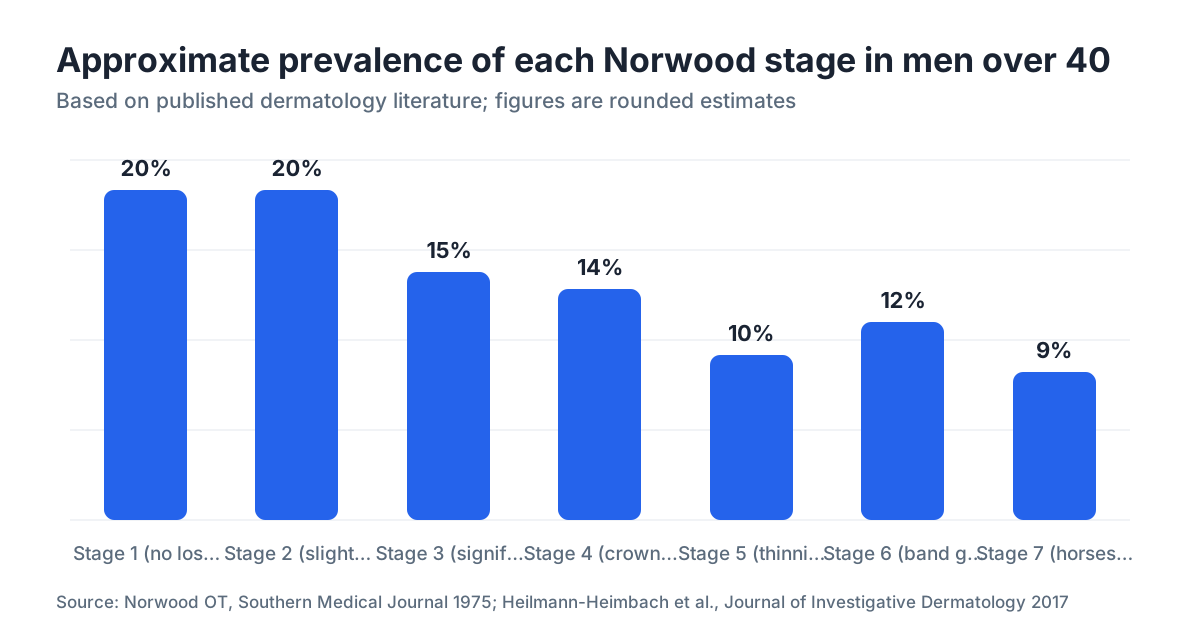
Breaking it down by stage is harder because large representative population studies with precise Norwood staging are scarce. The best available data comes from the Norwood 1975 paper and subsequent dermatology reviews. The general distribution looks roughly like this:
| Norwood Stage | Approximate prevalence in men over 40 |
|---|---|
| Stage 1 (no loss) | ~20% |
| Stage 2 (slight temple recession) | ~20% |
| Stage 3 (deeper recession or early crown) | ~15% |
| Stage 4 (definite crown loss, band intact) | ~14% |
| Stage 5 (thinning band separating areas) | ~10% |
| Stage 6 (band gone, large connected bald area) | ~12% |
| Stage 7 (only horseshoe rim remains) | ~9% |
The percentages above are rounded estimates from published dermatology literature and should be read as approximate. They make one point clear: advanced stages are common, not outliers. [1][2]
Ethnicity matters here. Studies comparing populations have found lower prevalence of advanced Norwood stages in men of East Asian and Chinese descent compared to men of European ancestry, though the gap narrows with age. [3]
What does each Norwood stage actually look like? A clear description of every level
Stage 1 is a baseline. No meaningful recession, no thinning visible to the eye. The hairline sits where it did in adolescence. Most men in their teens and early twenties are here.
Stage 2 is where most men first notice something. There is slight recession at the temples, forming a mild M-shape. The vertex (crown) looks normal. Lots of men at this stage convince themselves they have always looked this way. Sometimes they are right, because a mature hairline, the normal shift that occurs between adolescence and adulthood, is not the same as androgenetic alopecia.
Stage 3 is the first stage Norwood classified as clinically significant hair loss. It has two variants. Stage 3 Vertex shows a bald or thinning spot at the crown with temples still relatively intact. Stage 3 (standard) shows deep temporal recession reaching at least halfway back toward the ears, with the center of the hairline holding. These can occur together or separately, and which pattern a man gets is largely genetic.
Stage 4 is a visible jump. The crown spot has grown, the temples are deeply receded, and there is still a band of hair separating the crown from the front. From above, the bald areas look large but still disconnected.
Stage 5 is a transition. The band separating the frontal and crown bald zones narrows significantly. Hair there is thin, not gone. From certain angles it still looks like the areas are separate, but photos from above often reveal how little is left.
Stage 6 is where that band disappears entirely. The frontal and crown loss zones merge into one large continuous bald area. Only the horseshoe of hair on the sides and back (the safe donor zone) remains dense.
Stage 7 is the most advanced classification. The horseshoe is the only hair left, and even that can be thin. The strip wraps from ear to ear across the back of the head. At Stage 7, the amount of donor hair available for transplantation becomes genuinely limited.
The Norwood scale also includes a Type A variant that progresses differently: instead of starting at the temples and crown separately, the hairline retreats uniformly from front to back with little or no crown involvement until very late. Type A pattern runs in some families. [1]
How fast does male pattern baldness progress through the Norwood stages?
This is the question everyone asks and the one with the least satisfying answer. Rate of progression varies enormously between individuals.
Some men move from Stage 2 to Stage 4 in two to three years in their twenties. Others sit at Stage 3 for a decade. A minority plateau entirely. Nobody can tell you with confidence how fast your specific hairline will go, because that depends on the combination of androgen receptor sensitivity genes, DHT levels, and scalp microenvironment that is unique to you.
What research does tell us is that men who start losing hair earlier, particularly before age 25, tend to reach more advanced stages by midlife. A 2005 review in the Journal of the American Academy of Dermatology noted that onset before age 30 is associated with progression to Stage 5 or beyond in the majority of affected men. [4]
Early treatment changes the trajectory. Finasteride (1 mg/day) has demonstrated in randomized trials that it can halt progression and even regrow hair, particularly in the crown. The 5-year data from the original Merck trial showed that 90% of men on finasteride maintained or improved hair count versus continued loss in the placebo group. [5] That does not mean everyone should take finasteride, but the evidence for slowing progression is solid.
The honest summary: if you are noticing loss and you are under 35, you are in the highest-risk window for rapid progression. Act or decide not to act, but do more than wait indefinitely hoping it stops on its own.
Which Norwood stages respond best to minoxidil and finasteride?
Both drugs work better when there is still something to save. That is not a platitude, it is what the clinical data shows.
Minoxidil (2% and 5% topical, as well as oral formulations) is FDA-approved for androgenetic alopecia. The FDA label specifies it is indicated for men with a degree of hair loss on the top of the scalp, broadly corresponding to Norwood stages 3 Vertex through 5. [6] The mechanism involves widening blood vessels and prolonging the anagen (growth) phase of hair follicles. It does not block DHT, so it treats a symptom rather than the underlying driver. At Stage 6 or 7, the follicles in bald areas are largely fibrosed and minoxidil cannot revive them.
Finasteride blocks 5-alpha reductase type II, reducing scalp DHT by roughly 60-70%. [5] It works best at Stages 2 through 5, particularly in the crown. Frontal hairline response is less reliable. At Stage 6 or 7, finasteride can preserve the remaining donor fringe but is unlikely to grow meaningful hair in the large bald zones.
Using both together is a common clinical approach. A 2015 study in Dermatologic Therapy found the combination produced greater hair count improvements than either drug alone. [7] The finasteride and minoxidil for men articles on this site cover dosing, side effects, and what to realistically expect.
If you want to understand whether DHT-blocking approaches apply to you specifically, checking your estimated Norwood stage is a useful first step. The free AI hair analysis at MyHairline can give you a starting estimate from photos, which you can then bring to a dermatologist for confirmation.
One thing worth stating plainly: no FDA-approved drug cures androgenetic alopecia. Both minoxidil and finasteride require ongoing use to maintain their effect. Stop either one and the hair you preserved will shed within months.
At what Norwood stage should you consider a hair transplant?
Most experienced hair transplant surgeons will not operate on a man below Stage 3, and many prefer to wait until Stage 4 or beyond before doing a primary transplant. The reason is not technical, it is strategic.
If a surgeon transplants hair into a still-receding hairline at age 22, the native hair behind the transplant continues to fall out. You end up with transplanted hair in front and a bald gap forming behind it. You either need another surgery, or the result looks strange.
For candidates at Stages 3 through 5 who want a transplant, surgeons typically recommend being on finasteride for at least a year first to stabilize the native hair before surgery. This is standard guidance from the International Society of Hair Restoration Surgery. [8]
Stage 6 and 7 candidates face a different problem: donor supply. The horseshoe of permanent hair on the back and sides has a finite number of follicular units. A full Stage 7 head may require 4,000 to 6,000+ grafts to achieve reasonable coverage, and not every patient has that many donor grafts available. Some surgeons use body hair as supplemental donor material in these cases, but results are variable.
If you are at Stage 4 or 5 and have realistic expectations, a hair transplant can produce durable, natural-looking results. If you are at Stage 7 and expecting a full head of hair, no surgeon can deliver that regardless of technique or price.
What is the difference between Norwood stages 3 vertex, 4, and 5? They look similar in images
This is one of the most common sources of confusion, especially when looking at comparison images online.
Stage 3 Vertex: the temples may be only mildly receded, but there is a clearly visible bald or thinning circle at the crown. The crown spot tends to be under 2 centimeters in diameter by many clinical descriptions, though Norwood did not specify exact measurements.
Stage 4: the crown loss has grown beyond what Stage 3 shows, the temporal recession is deep, but a definite band of hair still separates the crown from the front of the scalp. That band is dense enough to be obvious in photos from above.
Stage 5: the band is still there but thin. If you look at a photo from directly above, you can see scalp through it. The overall shape from above starts to look like an hourglass with a narrow waist.
In practice, distinguishing 4 from 5 requires a good overhead photo or an in-person assessment. This is why clinicians almost always want to see patients in person rather than relying on a selfie. The distinction matters for treatment planning: Stage 5 patients need more grafts if they choose surgery, and the prognosis for medical therapy covering all bald areas is lower.
When staging yourself at home using images as a reference, err toward the more advanced stage if you are uncertain. It is better to act earlier than to spend a year telling yourself you are only Stage 3 when you are actually Stage 4.
Can the Norwood scale predict where your hair loss will end up?
Partially. Family history is the strongest predictor available. Androgenetic alopecia has a polygenic inheritance pattern, meaning many genes contribute rather than one single gene. The old belief that you should look at your mother's father to predict your baldness is a myth. Research shows both maternal and paternal lineage contribute, and the AR gene (androgen receptor) on the X chromosome is one of the genes involved among several. [3]
What the Norwood scale does is give you a map of the territory. Once you know your current stage, the most likely progression paths are the adjacent higher stages, usually in the direction your loss is already moving. A man with Stage 3 Vertex whose crown is the primary problem is likely heading toward Stage 5 or 6, not Stage 3 standard.
Blood or genetic tests marketed as predicting hair loss severity have not, as of 2025, demonstrated sufficient clinical accuracy to change management decisions. The American Academy of Dermatology does not recommend genetic testing as a routine part of hair loss evaluation. [9] The honest position is that genetics can tell you something about risk, but your own scalp over the past two to three years tells you more.
Photographs are underrated here. Take a standardized photo, same lighting, same angle, every three to six months. Over a year you will see clearly whether you are progressing and how fast. That data is more actionable than any genetic test currently on the market.
How does androgenetic alopecia actually cause the Norwood pattern? The biology in plain terms
DHT is the primary driver. Testosterone converts to dihydrotestosterone via the 5-alpha reductase enzyme, and DHT binds to androgen receptors in scalp follicles. Men with androgenetic alopecia have follicles in certain scalp regions that are genetically sensitive to DHT. When DHT binds to those follicles, it triggers a process called miniaturization: the follicle produces progressively thinner, shorter hairs over successive growth cycles until it eventually produces no hair at all. [5][10]
The spatial pattern of sensitivity (temples and crown vulnerable, sides and back resistant) is why the Norwood classification looks the way it does. The occipital and parietal fringe, the horseshoe, has follicles that are relatively DHT-resistant. This is why that zone survives even at Stage 7, and why transplanted hair from that zone retains its resistance even after being moved to a DHT-sensitive area.
This is also why DHT blockers like finasteride work at all: reducing systemic DHT slows or reverses miniaturization in follicles that still have some function. It cannot resurrect fully dead follicles, which is the main reason advanced-stage patients see limited regrowth from medication.
Understanding this biology also clarifies why treatments like biotin supplements, caffeine shampoos, and most hair loss supplements do not move the needle for androgenetic alopecia. They do not address DHT. They might help with hair shaft quality or scalp health, but they are not treating the mechanism causing Norwood progression.
How do you accurately assess your own Norwood stage at home?
You need three things: good overhead lighting, a second mirror or a phone camera with timer, and some honest eyes.
Take four photos: front-facing, left profile, right profile, and directly from above. The overhead shot is the one most people skip and the one that matters most for staging. Crown loss is nearly invisible in a front-facing mirror because you naturally tilt your head forward.
Compare your overhead photo to the Norwood reference images published in dermatology literature. Look specifically at two things: how far your temporal recession extends (measure mentally from the corner of your eye upward) and whether you can see scalp at the crown.
Then be honest. Most people underestimate their stage by one level because denial is comfortable. If your photos suggest Stage 4, you are probably Stage 4, not an ambitious Stage 3.
For a more structured approach, an AI-based photo analysis can be a useful starting point. MyHairline's free scan at myhairline.ai/scan compares your photos against the Norwood framework, though any digital tool should be followed up with a dermatologist assessment before making treatment decisions.
If you suspect your hair loss might not be androgenetic alopecia at all (for example, sudden diffuse shedding rather than a patterned recession), read up on telogen effluvium and what causes hair loss before assuming the Norwood scale applies to you. Temporary shedding conditions require completely different management.
What treatment options make sense at each Norwood stage?
The right intervention depends on your stage, your age, and how fast you are progressing. Here is a practical summary.
Stages 1 and 2: Most dermatologists recommend watchful waiting unless progression is documented. If you have a family history of rapid advancement and you are under 30, starting finasteride is a reasonable conversation to have with a doctor. The risk of treating aggressively early is almost always lower than the risk of waiting too long.
Stages 2 through 4: This is the primary window for medical therapy. Finasteride alone, minoxidil alone, or the combination all have evidence behind them. The finasteride and minoxidil combination page covers the trial data in detail. At these stages, surgery is an option only after medical therapy has been tried for at least a year and the loss has stabilized.
Stages 4 and 5: Surgery becomes a realistic and common choice here. Medical therapy should continue post-transplant to protect the non-transplanted native hair. A good transplant at Stage 4 or 5 can look very natural.
Stages 6 and 7: Medical therapy can preserve the existing fringe but is unlikely to regrow the large bald zones. Surgery is possible but limited by donor supply. Some men at these stages opt for shaving, hairpieces, or scalp micropigmentation. These are legitimate choices, not failures.
Across all stages, be skeptical of any product or clinic claiming to regrow hair at Stage 6 or 7 without a transplant. No topical, supplement, or laser device has credible evidence for meaningful regrowth at that level. The FTC has acted against companies making unsubstantiated hair loss claims, and the FDA has not approved any non-drug, non-surgical treatment for androgenetic alopecia beyond low-level laser therapy devices cleared for adjunctive use. [6]
If you are managing minoxidil side effects or trying oral minoxidil, the relevant articles on this site go into the specifics. The short version: side effects at standard doses are uncommon but real, and oral minoxidil carries different considerations than the topical form.
Is the Norwood scale used differently for receding hairlines versus crown loss?
Yes, and this distinction matters clinically.
A receding hairline without any crown involvement maps to the standard Norwood progression (Stages 2, 3, 4 without Vertex). Crown-dominant loss without much temporal recession maps to Stage 3 Vertex or the Type A variant depending on the overall pattern. Many men have both simultaneously.
Treatment response differs. Finasteride's regrowth benefit is consistently stronger in the crown than at the frontal hairline. The original Merck trial data showed statistically significant improvements in crown hair count but more modest effects at the frontal scalp. [5] If your primary concern is your hairline, finasteride may stabilize it but regrowth there is less reliable.
Minoxidil also shows better responses in the vertex in clinical images, largely because the FDA studied it specifically in men with vertex thinning. [6]
For surgeons, hairline cases (lower Norwood stages with frontal emphasis) and crown cases (Vertex patterns) require different design strategies and different expectations about how many grafts are needed for a natural result. A receding frontal hairline can often be addressed with 1,500 to 2,500 grafts; crown coverage at an advanced stage may require two to three times that.
Sources
- Norwood OT. Male pattern baldness: classification and incidence. Southern Medical Journal, 1975
- Heilmann-Heimbach S et al. Journal of Investigative Dermatology, 2017 - Meta-analysis of genome-wide association studies
- Lee WS, Oh Y. Journal of Dermatological Science, 2012 - Androgenetic alopecia in Asian populations
- Vary JC. Journal of the American Academy of Dermatology, 2015 - Selected disorders of skin appendages
- Kaufman KD et al. Journal of the American Academy of Dermatology, 1998 - Finasteride 1mg 5-year study
- FDA - Rogaine (minoxidil) 5% topical solution prescribing information and OTC label
- Hu R et al. Dermatologic Therapy, 2015 - Combined finasteride and minoxidil vs monotherapy
- International Society of Hair Restoration Surgery - Patient education guidelines
- American Academy of Dermatology - Hair loss: diagnosis and treatment guidelines
- Sinclair R et al. Journal of Investigative Dermatology Symposium Proceedings, 1999 - Pathogenesis of androgenetic alopecia