
TL;DR: Most women shed 50 to 100 hairs a day, and up to 150 on wash days. The American Academy of Dermatology calls that range normal. Shedding consistently above 150, or noticing a widening part and visible thinning, is a signal to get checked rather than wait it out. The trend matters more than any single count.
What is a normal amount of hair loss per day for women?
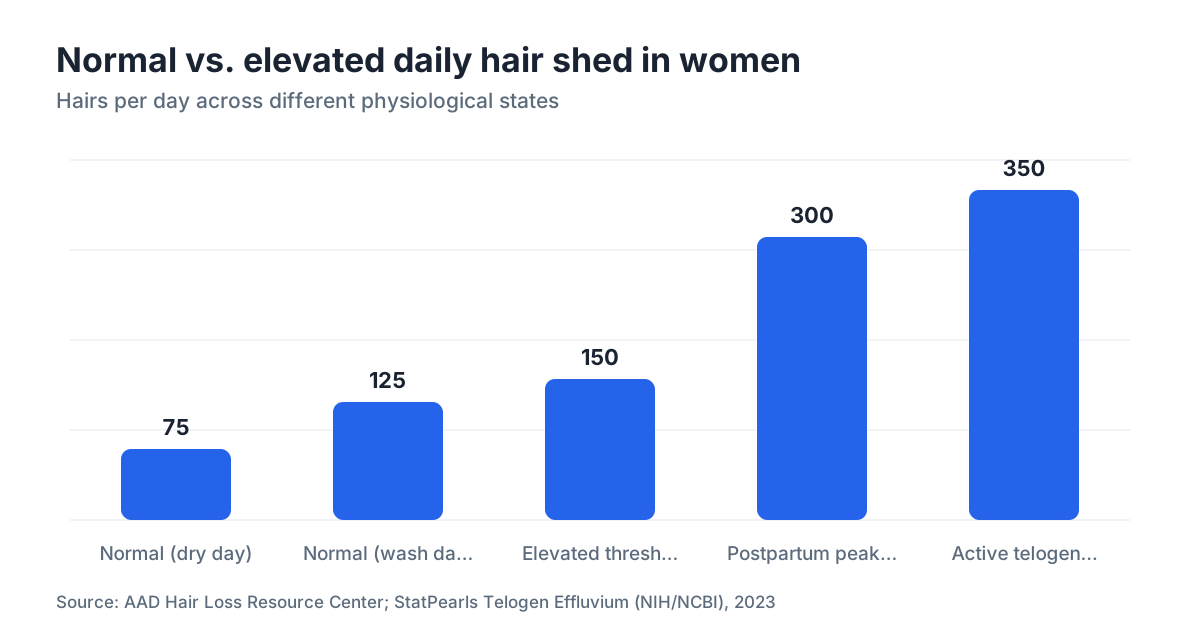
The American Academy of Dermatology puts the normal daily shed at 50 to 100 hairs [1]. Some dermatologists push that ceiling to 150 on days you wash and detangle, because combing dislodges hairs that were already loose. The count alone tells you less than the trend does.
Your scalp holds roughly 80,000 to 120,000 hairs at any moment [2]. About 85 to 90 percent are actively growing (anagen), 1 to 2 percent sit in a brief transition (catagen), and 10 to 15 percent are resting and ready to fall (telogen). When a telogen hair sheds, a new anagen hair is already pushing up underneath it. That is why moderate daily shedding is a sign of a healthy, renewing scalp, not a problem.
Counting your real daily shed is harder than it sounds. The practical method: collect hairs from your brush, shower drain, and pillow over a few consecutive mornings, then average. Land below 100 consistently and you are almost certainly normal. Land above 150 and watch it worsen, and that pattern is worth a dermatologist's time.
Why do women tend to notice shedding more than men?
Hair length is the main reason. A long strand on the shower floor reads as dramatic even when the number is identical to a man's. Women also wash less often, so several days of shed hair exits during one wash and looks like a crisis.
Women's hair takes more mechanical abuse too: heat styling, coloring, tight ponytails, and extensions all increase breakage, which is a different thing from true shedding at the root. Breakage leaves short fragments with a frayed end. True shedding leaves a full-length strand with a small white bulb at the root. The difference matters because the causes and the fixes have nothing in common.
Hormones swing more over a woman's life: the menstrual cycle, pregnancy, the postpartum drop, and menopause all shift the hair cycle [3]. So the "normal" window for women is genuinely wider and more changeable than the flat 50 to 100 figure suggests.
What does the hair growth cycle have to do with daily shedding?
The follicle runs four phases on a loop: anagen (growth, 2 to 7 years), catagen (transition, 2 to 3 weeks), telogen (rest, 2 to 4 months), and exogen (active shedding). Exogen is the moment the resting hair detaches and drops [2].
Each follicle cycles on its own schedule, so you lose a few dozen hairs a day instead of all at once. The count on any given morning just reflects how many follicles happen to be in exogen. Stress and physiological shocks can sync a big cohort of follicles into telogen at the same time. That is exactly what happens in telogen effluvium: a large group enters rest together, then sheds together two to four months later [4].
Seasonal cycling is real. A 2009 study in the British Journal of Dermatology found a peak in the proportion of scalp hairs in telogen during summer, with a matching shed peak in autumn [5]. So the extra hair in your brush every September is not in your head. It is a documented pattern.
Here is why the cycle matters: shedding is not permanent loss unless the follicle itself is damaged or miniaturized. Most shed hairs get replaced.
How do you know if you are losing too much hair?
The pull test is a simple start. Grip about 40 to 60 hairs between thumb and forefinger, hold taut, and pull firmly from root to tip. If six or more come out consistently across different scalp areas, dermatologists call that a positive pull test, a sign of shedding above the normal line [6]. A negative test (fewer than six) is reassuring but not the final word.
Visual cues beat counting. A widening center part, scalp showing through on overhead photos, a smaller ponytail circumference, or thinning at the temples all mean cumulative loss is outrunning regrowth. A daily count cannot tell you whether you are in net loss, because you cannot see regrowth happening below the surface.
Density at the part line is one of the clearest early signals in women. Female androgenetic alopecia tends to spread across the crown rather than build a receding front, so tracking part width in photos over a few months beats counting hairs. The what causes hair loss article walks through the patterns.
Want an objective baseline? Many dermatologists use trichoscopy (a dermoscopy read of follicle density) or a wash test. The wash test asks you to collect every hair shed during a 24-hour no-wash period plus a standardized shampoo, then count. More than 100 hairs collected this way counts as elevated [6].
What causes sudden or increased hair shedding in women?
Telogen effluvium is the most common cause of sudden heavy shedding in women. It is less a disease than a physiological reaction: a major stressor forces a large share of follicles into rest, and two to four months later they shed together. Triggers include high fever, major surgery, crash dieting (protein deficiency especially), childbirth, and severe psychological stress [4].
Postpartum shedding earns its own paragraph because it hits a huge share of new mothers and terrifies them. During pregnancy, high estrogen holds hairs in anagen, so fewer shed. After delivery, estrogen crashes and all those held hairs enter telogen at once. The shed usually peaks around three to four months postpartum and clears on its own by 12 months in most women [3].
Nutrient gaps drive shedding too. Iron deficiency (with or without full anemia) is the most studied, and ferritin below 30 ng/mL has been linked to more shedding in several dermatology studies, though the causal link is still argued [7]. Zinc, vitamin D, and low protein show up in the literature as well. Eat very little or cut out food groups, and your hair is one of the first things your body deprioritizes.
Thyroid trouble, both hypo and hyper, is another common cause worth ruling out with bloodwork before you assume the problem is genetic [3]. Scalp disease, certain medications, and rapid weight loss all belong on the list. The what causes hair loss article covers the full differential.
Is hair loss different during menopause?
Yes, and it is underrated. Estrogen and progesterone support hair growth; they stretch the anagen phase and appear to blunt some of dihydrotestosterone's (DHT) effect on follicles. When ovarian hormone output falls at menopause, that cover thins, and androgenetic alopecia often surfaces or speeds up in women who were genetically primed for it [8].
Female pattern hair loss (FPHL) affects roughly 40 percent of women by age 50, and prevalence keeps climbing with age [8]. Unlike male pattern baldness, FPHL usually diffuses across the crown and top of the scalp and spares the frontal hairline in most, though not all, women. The daily shed count may not spike much. Instead the regrown hairs come back finer and shorter as follicles miniaturize, so density fades slowly.
The distinction that matters: menopausal thinning is not telogen effluvium, though the two can overlap. Effluvium from menopause-related stress tends to pass. FPHL is chronic and progressive without treatment. Telling them apart takes a proper scalp evaluation.
What do dermatologists look at when evaluating female hair loss?
A real workup starts with history: when the shedding started, sudden or gradual, recent stressors, diet changes, medications, and family history on both sides. Then a scalp exam of the pattern, and often a pull test.
Bloodwork usually covers a complete blood count, ferritin, thyroid-stimulating hormone (TSH), and sometimes zinc, vitamin D, sex hormone binding globulin, and free and total testosterone. The American Academy of Dermatology advises ruling out systemic causes before landing on an FPHL diagnosis [6].
Trichoscopy (dermoscopy of the scalp) shows follicle miniaturization, perifollicular inflammation, and other structural clues without cutting. A scalp biopsy comes into play when the picture is murky, especially to separate FPHL from scarring alopecias like lichen planopilaris, which destroy follicles for good.
Want a low-stakes first step before you book? A free AI scan at MyHairline reads your hairline and part from photos, flags patterns worth raising with a clinician, and gives you a baseline to track. It does not replace a dermatologist, but it helps you show up with sharper questions.
Can diet and nutrition affect how much hair you shed?
It can, plainly. Hair is metabolically expensive tissue, and the follicle holds one of the fastest-dividing cell groups in the body. Cut calories or protein and your body pulls resources away from hair fairly fast.
The strongest nutritional link is iron. A 2006 review in the Journal of the American Academy of Dermatology concluded that iron deficiency may be a causative factor in hair loss, and that the optimal ferritin level for hair may sit higher than the standard anemia cutoff [7]. Many labs flag ferritin under 12 ng/mL as deficient, but plenty of dermatologists aim above 70 ng/mL for hair concerns. Nobody has clean data on the ideal target; the 70 ng/mL figure comes from clinical practice, not a randomized trial.
Protein matters too. Hair is about 95 percent keratin, which is protein. Very low-protein diets or extreme restriction (under roughly 1,000 calories a day) are well-documented telogen effluvium triggers [4]. Crash diets almost always bump up shedding two to four months after the restriction starts.
Before you spend money on pills, the hair loss supplements article sorts what has evidence from what is mostly marketing.
When does normal shedding cross into a condition that needs treatment?
The line is functional. Once shedding outpaces regrowth long enough to show up as visible thinning, a thinner ponytail, or a wider part, it has crossed from normal physiology into something worth treating.
Temporary triggers like effluvium from illness or postpartum change often resolve on their own. Standard guidance: if you can name a clear trigger and the shed is already slowing, wait and monitor for about six months. If it is still heavy at six months, or there is no obvious trigger, get evaluated instead of waiting.
Female androgenetic alopecia is progressive and does not self-correct. FDA-approved treatments for FPHL are few but real. Minoxidil 2% topical solution is FDA-approved for women; the 5% foam is labeled for men but used off-label in women, and the AAD notes both concentrations have evidence in women [9]. The minoxidil side effects article covers what to expect. Finasteride is sometimes used off-label in postmenopausal women; it is not FDA-approved for FPHL and carries teratogenicity risk in premenopausal women [10]. Do not go it alone here.
For transplant candidacy, the bar is higher in women than men because female donor zones are less predictable. The hair transplant article has a section on female candidacy.
Does the type of hair or styling routine affect how much you shed?
Styling can inflate what looks like shedding, though most of it is breakage, not follicle-level loss. Heat over about 230°C (450°F) from flat irons and curling tools weakens the keratin shaft until it fractures. Bleaching, perming, and relaxing do the same. Those broken pieces pile up in your brush and drain and pad the perceived count without the follicle ever being involved.
Traction is a separate problem. Chronic tight styles, cornrows, tight ponytails, and months-long weaves can cause traction alopecia, which begins as reversible follicle stress and turns into permanent scarring if the tension continues for years [11]. The frontal and temporal hairlines take the worst of it. Caught early, it reverses. Advanced cases leave bald patches that do not come back.
Curly and coily textures make counting tricky, because the curl pattern traps shed hairs inside the rest of the hair instead of dropping them through the day. Women with coily hair often see a big pile on wash day not because they shed more, but because several days of shed released at once.
What are the actual treatment options for excessive female hair loss?
The options track the cause. For most reactive shedding, treating the trigger comes first: correct iron deficiency, address thyroid disease, drop the traction, let postpartum hormones settle.
For androgenetic alopecia, minoxidil is the most established option. The FDA approved 2% topical minoxidil for women in 1991 [9]. Studies show statistically significant gains in hair count and hair weight at 32 weeks versus placebo. Low-dose oral minoxidil (0.25 to 2.5 mg daily) is an off-label choice more dermatologists now reach for when women cannot tolerate the topical. The oral minoxidil article covers the evidence.
DHT blockers like spironolactone (off-label) and finasteride (off-label in postmenopausal women) target the androgenic side. See the dht blocker article for the options. Finasteride is contraindicated in women of childbearing potential because of documented fetal harm [10].
Platelet-rich plasma (PRP), low-level laser therapy, and topical ketoconazole carry evidence that runs from modest to preliminary in women. None are FDA-approved specifically for FPHL, though some laser devices hold FDA clearance for cosmetic hair enhancement.
A MyHairline AI scan helps you document your pattern over time, which matters when you are tracking whether a treatment is working.
For women with established FPHL and good donor density, a hair transplant is an option, though it moves hair around rather than treating the cause, so medical treatment usually continues afterward.
How can you track your hair shedding accurately at home?
The wash test is the most reliable DIY method. Skip washing for 24 hours. Then shampoo normally and collect every hair from your hands, the drain catch, and a light-colored towel draped over your shoulders while you style. Count all of it. Repeat on at least two separate occasions and average. More than 100 hairs per wash session is elevated by most dermatology references [6].
Photography is underrated. Shoot a consistent photo of your part line (top-down, same lighting) every four to six weeks. Changes invisible day to day jump out when you compare shots three months apart. This is also how you document a treatment response.
Here is a simple density check: pull your hair into a ponytail and measure the circumference at the base. Write it down. Measure again in six months. A drop of more than about 20 percent is clinically significant and worth chasing. Some minoxidil trials used ponytail circumference before trichoscopy became routine.
Do not obsess over the daily count until it feeds anxiety, which is itself a legitimate telogen effluvium trigger. Periodic measurement beats daily counting every time.
Sources
- American Academy of Dermatology, Hair Loss Resource Center
- StatPearls (NCBI/NIH), Physiology of Hair
- American Academy of Dermatology, Women and Hair Loss
- StatPearls (NCBI/NIH), Telogen Effluvium
- British Journal of Dermatology, 2009 (Kunz et al.): Seasonal changes in hair shedding
- American Academy of Dermatology, Diagnosis and Treatment of Hair Loss
- Journal of the American Academy of Dermatology, 2006 (Trost et al.): Iron deficiency and hair loss
- Journal of the American Academy of Dermatology (Blume-Peytavi et al.): Female pattern hair loss prevalence
- FDA, Minoxidil Topical Label (Women's Rogaine 2%)
- FDA, Finasteride Drug Label (Propecia)
- American Academy of Dermatology, Hairstyles That Pull Can Cause Hair Loss