

TL;DR: Statins can trigger hair loss in women, usually as telogen effluvium: hairs shift into a resting phase and shed a few months after you start the drug. Clinical trials put the incidence below 1%, though real-world reports run higher. Switching to a lower-fat-loving statin or treating the shedding directly usually fixes it without stopping a medication your cardiologist wants you on.
Do statins actually cause hair loss in women?
Yes, statins can cause hair loss in women, and the risk is lower than the panic you feel the first time you Google it. Randomized controlled trials put the class-level incidence under 1%, and most large trials don't even list alopecia as a statistically significant adverse event [1]. Spontaneous adverse-event databases, which capture real-world use instead of controlled trial populations, tell a cleaner story.
A 2017 pharmacovigilance analysis in JAMA Dermatology mined the FDA Adverse Event Reporting System (FAERS) and found that several statins had reporting odds ratios for alopecia well above 1.0, meaning hair loss came in more often than background rates would predict [2]. Women filed the majority of those reports. That tracks, because diffuse shedding alarms women faster and gets reported more.
Here's the honest version. Statins do cause hair loss. It's a real drug effect, it's uncommon, and it's almost always reversible. The mechanism explains the why, and the why decides what you do next.
How do statins trigger hair shedding?
Hair follicles are hungry. They cycle through growth (anagen), transition (catagen), and rest (telogen), and they lean hard on cholesterol synthesis for cell membranes and for signaling molecules that time the cycle [3]. Statins block HMG-CoA reductase, the enzyme that makes mevalonate. Mevalonate feeds more than cholesterol. It feeds a whole cascade: coenzyme Q10, dolichols, isoprenoids [9]. Some of those products matter to follicle cycling.
The main pattern is telogen effluvium. The follicle doesn't die. It just clocks out early into the resting phase. Telogen runs about three months before the hair drops, so women usually notice diffuse shedding two to four months after starting a statin, which is exactly when nobody suspects a new prescription.
There's a weaker androgen hypothesis too. Statins lower cholesterol, and cholesterol builds sex steroids. Some research suggests statins nudge androgen precursor levels, but the data is inconsistent and the relevance to scalp hair is unclear [4]. The telogen effluvium story is the one with real support.
Statins also differ in how well they dissolve in fat. Lipophilic statins (simvastatin, atorvastatin, lovastatin) slip through cell membranes and reach follicle cells at higher concentrations than hydrophilic ones (pravastatin, rosuvastatin, fluvastatin) [10]. That's the likely reason the hair loss signal is louder for some statins than others.
Which statins are most linked to hair loss in women?
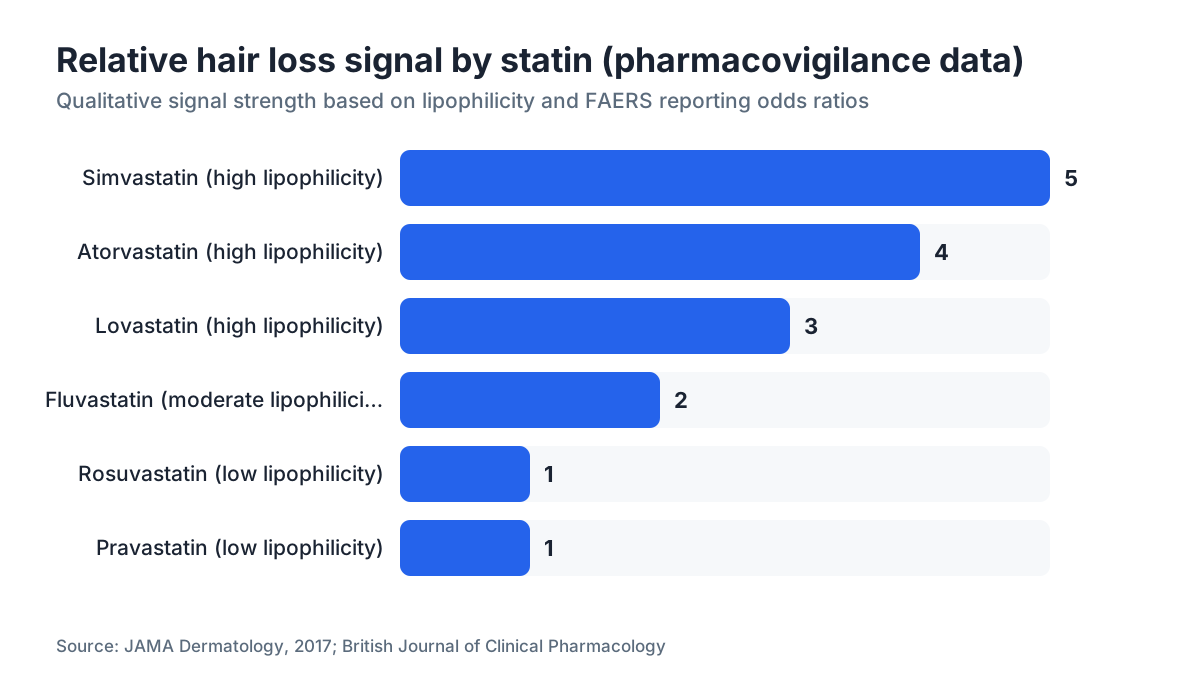
Simvastatin and atorvastatin carry the strongest hair loss signal in the FAERS data and in the scattered case series [2]. Both are highly lipophilic. Lovastatin turns up in case reports too. Hydrophilic statins like pravastatin and rosuvastatin report at much lower rates, though not zero.
The table below maps each major statin by fat solubility and its relative hair loss signal from the published pharmacovigilance literature.
| Statin | Lipophilicity | Relative hair loss signal |
|---|---|---|
| Simvastatin | High | Highest in FAERS data [2] |
| Atorvastatin | High | High |
| Lovastatin | High | Moderate-high |
| Fluvastatin | Moderate | Moderate |
| Rosuvastatin | Low | Low |
| Pravastatin | Low | Low |
This is not a reason to refuse a statin your doctor prescribes. Simvastatin and atorvastatin are first-line for good reasons, and millions of women take them with no change to their hair. But if you're already shedding on a high-lipophilicity agent, the table gives you a place to start the switch conversation.
Dose counts too. Higher doses mean more HMG-CoA reductase inhibition and more interference with follicle metabolism. A 2013 case series reported alopecia resolving on dose reduction alone, no drug change needed [5].
What does statin-related hair loss actually look like?
It's diffuse. Not a receding hairline, not bald patches, not the temples-and-crown pattern of female androgenetic alopecia. Women who lose hair on statins see it as extra shedding on the brush, in the shower drain, on the pillow. Density drops across the whole scalp instead of in one spot.
Timing is the tell. Because this is telogen effluvium, onset lands two to six months after starting the statin or bumping the dose [6]. A woman who walks in with diffuse shedding and a statin she started four months ago has handed her clinician the biggest clue in the room.
Under dermoscopy, a dermatologist usually sees a higher-than-normal share of telogen hairs (club hairs with white roots) on a pull test. A real workup also rules out the usual suspects for diffuse loss in women: thyroid disease, iron deficiency, vitamin D deficiency, and androgenetic alopecia. Those are common enough to ride along with statin use rather than come from it. Find out which one you're actually treating before you touch any medication.
Seeing both diffuse shedding and a widening part or crown thinning? That can mean the statin is stacked on top of underlying androgenetic alopecia, which needs a different set of treatments. What causes hair loss covers that distinction.
How common is statin hair loss compared to other drug causes?
Statins sit nowhere near the top of the drug-induced alopecia list. Chemotherapy agents, certain anticoagulants (warfarin and heparin especially), immunosuppressants, and high-dose vitamin A derivatives all carry higher and better-documented hair loss risk [7].
Inside the cardiovascular drug cabinet, beta-blockers and ACE inhibitors also throw hair loss signals. Women on several of these at once often can't pin down the culprit without a careful medication timeline.
A 2020 review in the Journal of the American Academy of Dermatology sorted drug-induced alopecia by mechanism and evidence quality. It placed statins under "probable" causation for telogen effluvium: consistent case reports and a plausible mechanism, but not the double-blind trial evidence that earns a "definite" rating [7]. That grade reflects the state of the evidence, not doubt that it happens.
So the practical read: if you're shedding and you're on a statin, investigate the statin. Also investigate everything else on your medication list, your thyroid panel, and your ferritin.
Should you stop taking your statin because of hair loss?
Almost certainly not on your own. This is a conversation with the prescriber, not a solo call.
Statins cut cardiovascular events [11]. For women with established heart disease or familial hypercholesterolemia, the absolute risk reduction is large enough that trading it for hair density is the wrong trade. For a woman at lower cardiac risk who got a statin mainly for modestly high LDL, the math shifts, but that's still a clinical judgment and not a Google-and-decide moment.
The smarter first move is usually asking whether a switch to a lower-lipophilicity statin fits your case. Going from simvastatin to rosuvastatin often hits a similar LDL target with a quieter hair loss signal. A dose cut is another lever. Both keep the heart protection while potentially killing the scalp effect.
If the statin is truly necessary and switching doesn't help, treat the hair loss directly and keep the drug. Topical minoxidil has the most evidence for diffuse female hair loss and no known interaction with statins [8]. Low-dose oral minoxidil is an emerging option with growing evidence; oral minoxidil breaks down the dosing and the data for women.
How long does it take for hair to grow back after stopping a statin?
For plain statin-driven telogen effluvium, the timeline after you stop or switch matches telogen effluvium from any other cause. Shedding slows within one to three months. Visible regrowth shows up three to six months after that. Full density can take twelve months or longer, because hair grows about half an inch a month and the new growth has to reach a length you can see [6].
That wait is maddening. Three to six months before you can even judge whether the switch worked feels endless when hair is coming out in your hands. Set that expectation with your doctor up front.
If recovery drags past twelve months or the regrowth doesn't look like simple diffuse fill-in, revisit the diagnosis. Sometimes "drug-induced telogen effluvium" is androgenetic alopecia that the stress of a medication change sped up. A scalp biopsy can separate the two.
If the thinning during the wait is heavy enough to hurt your daily life, female wigs and hair toppers have gotten far better and far more natural. Plenty of women use them as a bridge through regrowth with zero long-term commitment. Not a treatment, but a fair option while the biology catches up.
What treatments actually help while you're still on a statin?
If stopping the statin is off the table, you still have real choices.
Topical minoxidil 2% or 5% is FDA-approved for female androgenetic alopecia and is the most studied treatment for diffuse hair loss in women [8]. It works partly by stretching out anagen, which pushes back against the telogen shift statins cause. Results take four to six months. The 5% foam is popular because it irritates the scalp less than the solution. Minoxidil side effects lists what to watch for.
Low-level laser therapy (LLLT) has modest trial support for diffuse loss. The evidence trails minoxidil by a wide margin, but it has essentially no systemic effect and stacks on top of any drug regimen.
Nutritional gaps often ride alongside drug-induced shedding, because the same stress that triggers the shed can drain iron and certain vitamins. Test ferritin, vitamin D, and zinc and fix any deficiency as a baseline step. Hair loss supplements sorts which ones have evidence and which don't.
Platelet-rich plasma (PRP) sometimes gets offered for diffuse female loss. The evidence base is growing but inconsistent across studies, and it's expensive. Worth a look if other approaches stall, not a first line.
Finasteride blocks DHT, so it isn't the tool for statin-induced telogen effluvium, where DHT isn't the driver. It earns a role only if androgenetic alopecia is stacked on top of the drug effect. Finasteride explains the evidence and the serious cautions for women of childbearing age.
Not sure which type of loss you have? Running a free scan at MyHairline gives you a pattern read to carry into a dermatology visit, so you show up with something concrete instead of a vague complaint about shedding.
Can statins cause permanent hair loss in women?
No good evidence says statins cause permanent hair loss. Every documented case in the literature resolved after stopping or switching, with no reports of scarring alopecia or follicle destruction tied to statin use [5].
The catch: long, untreated telogen effluvium can thin hair enough that it takes a while to look normal again even after the trigger is gone. The follicles are healthy. They just need time. And if underlying androgenetic alopecia is hiding beneath the statin effect, that androgen-driven loss keeps going no matter what you decide about the statin, which can make it look like the statin did permanent damage when something else is running the show.
Loss that still hasn't recovered twelve to eighteen months after you address the drug cause needs a dermatology workup. A biopsy shows whether the follicles are still alive or whether a different diagnosis explains why it won't come back.
What should you ask your doctor if you think statins are thinning your hair?
Bring a timeline. Write down when you started the statin, when the shedding started, and any big stressors in between (illness, surgery, a major diet change, pregnancy). That three-to-four-month lag between trigger and shed is information your doctor actually needs.
Ask directly: Is there a lower-lipophilicity statin that hits the same LDL goal? Is dose reduction an option given my current numbers? Will you order thyroid, ferritin, vitamin D, and a full blood count to rule out other causes?
Then ask for a dermatology referral. General practitioners often aren't fluent in drug-induced alopecia versus androgenetic alopecia versus chronic telogen effluvium. A dermatologist who focuses on hair (a trichologist in some countries) can run a pull test, dermoscopy, and a biopsy if needed, so you get a diagnosis instead of a guess.
Photograph your hair every four weeks. Density change is notoriously hard to judge by feel, and photos give you and your doctor a fixed reference point.
MyHairline's AI scan works as a baseline you update over time, so you can see whether a treatment or a medication switch is actually working instead of relying on memory.
Are women more vulnerable to statin-related hair loss than men?
The pharmacovigilance data points to yes, though the reasons aren't fully clear [2]. Women report statin-related alopecia at higher rates than men across multiple adverse event databases. A few explanations are on the table.
Women notice and report diffuse thinning more readily, so reporting bias plays into it. Female hormone balance interacts with cholesterol metabolism differently than male, and hitting the mevalonate pathway may ripple differently through sex steroid production in women. And women already carry a higher baseline rate of telogen effluvium from other causes (postpartum, thyroid, iron deficiency), so adding a statin to a group that's already primed to shed lifts the apparent rate.
Still, the absolute risk is low for both sexes. Most women on statins never lose meaningful hair. Knowing you sit in a slightly higher-risk group is useful context, not a reason to walk away from cholesterol management.
Sources
- FDA, NLM DailyMed: statin drug product labeling
- JAMA Dermatology 2017: Pharmacovigilance study of statin-associated alopecia using FAERS
- Journal of Investigative Dermatology: Cholesterol and the hair follicle cycle
- European Journal of Endocrinology: Statin effects on sex steroid levels
- Journal of the American Academy of Dermatology: case reports of statin-associated alopecia and dose reduction
- American Academy of Dermatology: Telogen effluvium overview
- Journal of the American Academy of Dermatology 2020: Drug-induced alopecia review
- FDA: Minoxidil topical solution approval for females
- StatPearls, NCBI Bookshelf: HMG-CoA reductase inhibitors mechanism
- British Journal of Clinical Pharmacology: Lipophilicity differences among statins and tissue penetration
- American Heart Association: Statin therapy for cardiovascular risk reduction