

TL;DR: Telogen effluvium (TE) shoves a big share of your hairs into rest at once, so heavy diffuse shedding shows up 2 to 3 months after a trigger. Most acute cases fully resolve within 3 to 6 months of removing the cause. Chronic TE (over 6 months) takes longer but still reverses in most people. The before-and-after difference is real and well documented.
What is telogen effluvium and why does the 'before' look so alarming?
Telogen effluvium is reactive, diffuse hair shedding. Normally about 85 to 90% of your scalp hairs are in the anagen (growth) phase and roughly 10 to 15% sit in telogen (rest), waiting to fall out [1]. A physical or emotional shock can flip a large slice of those anagen hairs into telogen at once. Two to three months later, when the resting hairs get pushed out by new growth underneath, you lose far more than the usual 50 to 100 hairs a day.
The 'before' stage scares people because the shed comes fast and hits everywhere. You see it on the shower drain, the pillowcase, the brush. The scalp doesn't go patchy the way androgenetic alopecia does. It thins evenly across the top, and sometimes the sides and back too. Some people lose enough density in 6 to 8 weeks to see scalp clearly under normal light.
None of that means the follicles are dead. They're not. The follicle stays structurally intact. It just put itself down for an early nap. That single distinction is why the before-and-after story in TE reads so differently from other hair loss conditions.
For a wider look at the biology, see our guide to telogen effluvium.
What triggers telogen effluvium in the first place?
Triggers share one thread: the body reads a big stress and pulls resources away from anything it treats as optional, hair growth included. Common ones [2]:
- Fever or acute illness (COVID-19 included, which has been linked to heavy post-infection TE)
- Major surgery or general anesthesia
- Crash dieting or fast weight loss (under 1,000 kcal/day is a known culprit)
- Childbirth (postpartum TE affects an estimated 40 to 50% of new mothers) [3]
- Iron deficiency, or ferritin below roughly 30 to 40 ng/mL
- Thyroid trouble, both hypo- and hyperthyroidism
- Starting or stopping hormonal contraceptives
- Severe psychological stress
- Protein malnutrition
The trigger usually landed 2 to 3 months before the shedding turns obvious. That lag is one of the cruelest parts of TE. By the time you're pulling handfuls out of the drain, the original insult is often long gone, and you're tearing your life apart looking for a cause that isn't there anymore.
Knowing what causes hair loss in general helps you rule out other conditions riding alongside TE.
How long does the 'before' phase last (and how bad does it get)?
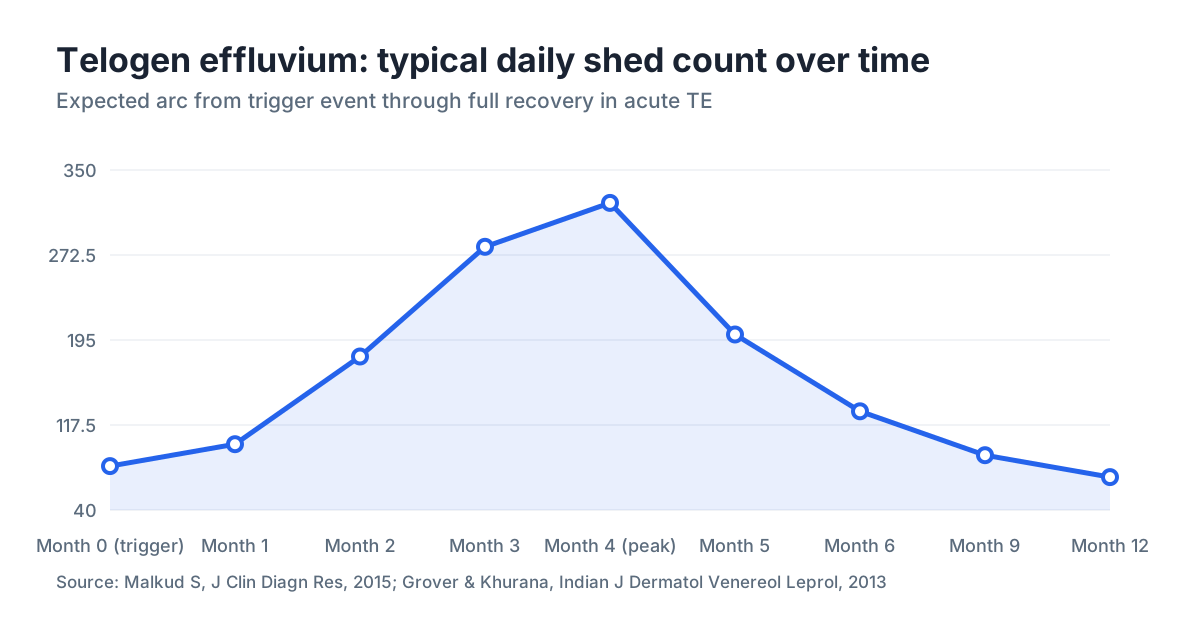
Acute TE means shedding under 6 months. Most acute cases end on their own. Once the trigger clears, follicles cycle back into anagen on their own schedule, and active shedding usually peaks around 3 months post-trigger, then tapers [2].
How much do you lose? Phototrichogram studies show anagen-to-telogen ratios sliding from a normal 9:1 to as bad as 7:3 or even 6:4 in moderate TE [4]. On a scalp with 100,000 follicles, a shift like that dumps 20,000 to 30,000 extra hairs into the resting queue. That's a real volume hit.
Daily counts above 300 shed hairs happen in bad acute episodes. For context, dermatologists flag counts consistently above 100 a day as worth investigating, and the American Academy of Dermatology puts normal shedding at up to 100 hairs daily [1].
Chronic TE means shedding past 6 months. It's less common, leans toward women in their 30s to 60s, and usually has a persistent or cycling trigger (low ferritin, uncontrolled thyroid, chronic stress) that nobody has found or fixed yet. The outlook stays good once the cause surfaces, but full recovery stretches to 12 to 18 months or longer.
What does the 'after' phase actually look like, and when does it start?
The 'after' phase starts with regrowth, not with the shedding stopping. Those two events don't line up. You can still be counting heavy daily shed while short new hairs are already pushing through at the scalp.
The earliest signs of recovery:
- Short, fine hairs (people call them 'baby hairs') coming up across the top of the scalp, most obvious along the hairline and part. They might sit at 1 to 3 cm while the rest of your hair is far longer.
- Daily shed counts dropping back toward the 50 to 100 range.
- Better coverage when the hair is wet or pulled back.
Full recovery in acute TE usually lands 6 to 12 months after the trigger is removed [2]. That window drags when you're living inside it, but it just reflects the math: new anagen hairs grow about 1 to 1.5 cm per month [6]. Getting a 1 cm sprout back to your old length and density takes time, not medication.
A real before-and-after using standardized global photography (the gold-standard research method) usually shows near-complete density restoration at the 12-month mark in acute cases where the trigger fully resolved. A review of telogen effluvium in the Indian Journal of Dermatology, Venereology and Leprology put it plainly: TE is "self-limiting" once the cause is identified and corrected [2].
Want to track your own recovery without guessing in the bathroom mirror? MyHairline's free AI hair scan compares scalp density at different points in time.
What does the before-and-after look like on a real timeline?
Here's the general arc from published dermatology literature. People vary, but this is what acute TE looks like when the trigger gets removed.
| Timepoint | What's happening | What you see |
|---|---|---|
| Trigger event (month 0) | Hairs pushed into telogen | Nothing yet |
| Month 1 to 2 post-trigger | Telogen hairs piling up | Mild rise in shed count |
| Month 2 to 4 post-trigger | Peak telogen cohort exiting | Heavy daily shedding, visible thinning |
| Month 4 to 6 | New anagen begins, shed tapers | Short regrowth hairs visible, less shedding |
| Month 6 to 9 | Regrowth hairs 3 to 7 cm long | Density visibly improving |
| Month 9 to 12 | Approaching pre-TE density | Near-normal look for most |
| Month 12 to 18 | Full density restoration | Complete recovery in acute cases |
For chronic TE (trigger persists past 6 months), every column shifts right. Recovery may not even start until the underlying issue is fixed, and full restoration can run 18 to 24 months from when treatment begins.
How do you tell TE apart from pattern hair loss (androgenetic alopecia)?
This is where people trip up the most, and getting it wrong sends you toward the wrong treatment.
Androgenetic alopecia (AGA) miniaturizes follicles over years, piling thinning at the crown, temples, and mid-scalp in men, or along the part in women. Those follicles shrink and stay shrunk; they don't recover on their own [12]. TE does the opposite: even, diffuse thinning across the whole scalp, no miniaturization, and full follicle recovery once the trigger is gone [4].
A dermatologist can usually tell them apart with trichoscopy or a pull test, sometimes a scalp biopsy. The pull test is simple: grasp 40 to 60 hairs and pull with steady pressure. Losing more than 10% of the bunch (4 to 6 out of 60) points to active shedding consistent with TE. It's not proof by itself, but it adds real information.
Here's the trap. TE and AGA can run together. A crash diet can set off a TE episode in someone who already has quiet AGA. Fix the TE and density comes back to that person's AGA baseline, but the AGA part won't budge without its own treatment (finasteride or minoxidil for men). Mistaking TE recovery for a response to an AGA drug is one of the most common self-management errors out there.
If your shedding hasn't improved 6 months after the presumed trigger cleared, get a proper diagnosis. The receding hairline pattern and biopsy findings will tell you which process is running the show.
Do you need treatment to recover, or does TE resolve on its own?
For acute TE with a clear, corrected trigger, you need no specific hair-loss treatment to recover. The follicles cycle back on their own. What matters is going after the root cause: correct iron deficiency, stabilize the thyroid, eat enough protein, stop the offending drug.
Ferritin below 30 ng/mL is the number most often cited as the point where hair growth suffers [5]. If yours sits down there, iron supplementation can genuinely shorten recovery. Many dermatologists aim for ferritin above 70 ng/mL for best regrowth, though the evidence behind that exact figure is moderate, not settled [10].
Minoxidil gets used off-label during TE recovery. Not because it reverses TE, but because it can shorten anagen re-entry time and make regrowth look faster. If you're considering it, read up on minoxidil side effects first. One catch: starting minoxidil can set off its own shed in the first 4 to 8 weeks as follicles resync, which is the last thing you want to mistake for ongoing TE.
Hair loss supplements sold for TE recovery mostly lack strong clinical backing. Biotin deficiency is genuinely rare in people eating a varied diet, and taking biotin when you're not deficient does nothing for shedding. The AAD says there's no good evidence that biotin supplements help hair loss in people without a deficiency [1]. Spend that money on blood tests instead.
When TE rides along with AGA, you're treating two problems on two tracks, sometimes at the same time. Finasteride and minoxidil handle the AGA; correcting the trigger handles the TE.
What blood tests should you get before and during recovery?
A targeted blood panel finds the trigger and tells you whether your correction is working. Dermatologists commonly order:
- Complete blood count (CBC) to check for anemia
- Serum ferritin (more useful than hemoglobin here; you can be iron-depleted without being anemic)
- Total iron binding capacity (TIBC)
- Thyroid-stimulating hormone (TSH) and free T4
- 25-hydroxyvitamin D
- Zinc
- Complete metabolic panel
- In women: free and total testosterone, DHEA-S if PCOS is suspected
Ferritin is the result to watch hardest. Multiple case series and observational studies tie low ferritin specifically (under 30 ng/mL) to drawn-out TE [5]. Retest ferritin after 3 to 4 months of supplementation to confirm the level is climbing.
Thyroid disease is the other big miss, because its symptoms blur into plain fatigue [8]. A TSH outside the 0.5 to 4.5 mIU/L reference range warrants endocrine follow-up. Shedding tied to thyroid dysfunction won't quit until levels normalize, which can take months of dose tweaking.
Get these done before you spend a dollar on topicals. Knowing whether you have a correctable deficiency changes how you manage the whole next 12 months.
Does postpartum telogen effluvium have the same before-and-after pattern?
Postpartum TE is the most common form of the condition. During pregnancy, high estrogen keeps hairs in anagen longer than usual, so hair gets unusually thick. After delivery, estrogen crashes, and all those extra anagen hairs slide into telogen together. The shed usually starts around 2 to 4 months postpartum and peaks around month 4 to 5 [3].
The before-and-after arc matches acute TE from any trigger, with one twist: you're comparing yourself to an artificially dense pregnant baseline, not your true pre-pregnancy normal. Plenty of new mothers feel like they're losing more than they ever had, when they're really just returning to their real baseline while shedding the bonus hairs pregnancy added.
Most postpartum TE resolves fully by 12 months postpartum with no treatment at all [3]. Breastfeeding can hold hormone levels slightly off and sometimes drag the shed out, but the data on that are mixed. If shedding runs past 12 months postpartum, a workup for iron deficiency (common in new mothers), thyroid dysfunction, and underlying AGA makes sense.
If you're nursing, get medical advice before starting any supplement or topical. Minoxidil isn't recommended during breastfeeding because systemic absorption does happen and infant safety data are absent [7].
Can photographs actually capture telogen effluvium before and after recovery?
Yes, and standardized photography is the research gold standard for measuring TE outcomes. In trials, investigators use the 7-point global photographic assessment scale and compare baseline and follow-up photos shot under identical lighting, distance, and scalp orientation [4].
At home you can get meaningful comparisons by holding three things steady: same lighting (natural daylight from a window, no flash), same position (top-down scalp shot plus a front-facing hairline shot), and same hair state (dry, same styling). Part your hair along the same line every time. Monthly is plenty. Weekly comparisons just breed anxiety without giving change enough time to show.
At the 3-month mark, look for short regrowth hairs, not for the thinning to reverse. The shed can still run high at month 3 while new growth is already underway. By month 6, expect visible density improvement if the trigger got corrected. By month 9 to 12, photos should show near-complete restoration in acute TE.
Daily mirror checks work against you. The changes move too slowly to catch day to day, but fast enough to jump out in a 6-week photo comparison.
What if your hair doesn't grow back fully after telogen effluvium?
If density hasn't clearly come back 12 months after the trigger was corrected, three things are worth checking.
First: is the trigger actually gone? Low ferritin can hang on even after you start iron if absorption is poor or blood loss continues. Thyroid levels need a recheck. Chronic stress, restrictive eating, and a running caloric deficit often persist without the person clocking them.
Second: was TE the only diagnosis? Underlying AGA, alopecia areata, or lupus-related hair loss can all speed up or coexist with TE. A scalp biopsy under dermoscopy separates follicle miniaturization (AGA) from a clean follicle stuck in extended telogen (chronic TE).
Third, and rare: a severe or prolonged TE episode can cause permanent follicle damage, but this is uncommon and usually tied to extreme nutritional deprivation (prolonged starvation, bariatric surgery without supplementation) or a heavily inflammatory trigger [2].
If you've hit 12 months with incomplete recovery and every trigger is corrected, that's the moment to weigh a hair transplant consult, especially if AGA coexists and donor follicles are adequate. Transplanting into an active TE shed is contraindicated; the procedure should wait until the cycle settles. A DHT blocker may be warranted if AGA is confirmed.
To track recovery between dermatologist visits, the free AI hair scan at MyHairline compares density using your own photos.
Sources
- American Academy of Dermatology, Hair Loss Overview
- Grover C, Khurana A. Telogen effluvium. Indian J Dermatol Venereol Leprol. 2013;79(5):591 to 603.
- Phillips TG, Slomiany WP, Allison R. Hair Loss: Common Causes and Treatment. Am Fam Physician. 2017;96(6):371-378.
- Malkud S. Telogen Effluvium: A Review. J Clin Diagn Res. 2015;9(9):WE01-WE03.
- Rushton DH. Nutritional factors and hair loss. Clin Exp Dermatol. 2002;27(5):396-404.
- Malkud S. Telogen Effluvium: A Review. J Clin Diagn Res. 2015;9(9):WE01-WE03.
- FDA, Drugs@FDA Database (Minoxidil Topical Solution Labeling)
- National Institutes of Health, MedlinePlus: Hair Loss
- Guo EL, Katta R. Diet and hair loss: effects of nutrient deficiency and supplement use. Dermatol Pract Concept. 2017;7(1):1-10.
- Almohanna HM et al. The Role of Vitamins and Minerals in Hair Loss. Dermatol Ther (Heidelb). 2019;9(1):51-70.
- Olds H et al. Telogen effluvium associated with COVID-19 infection. Dermatol Ther. 2021;34(2):e14761.
- Rebora A. Pathogenesis of androgenetic alopecia. J Am Acad Dermatol. 2004;50(5):777-779.