
TL;DR: A 2023 randomized controlled trial in Skin Pharmacology and Physiology found topical 0.1% stevioside raised hair density and shaft diameter more than 5% minoxidil in people with androgenetic alopecia over 16 weeks. But it was one small trial: 60 people, single center, unreplicated. Stevioside is not FDA-approved for hair loss. Minoxidil is. The combination has never been tested.
What is stevioside and why is it being studied for hair loss?
Stevioside is a diterpene glycoside pulled from the leaves of Stevia rebaudiana, the plant behind most zero-calorie sweeteners. It has a molecular weight of about 804 g/mol, and researchers have looked at it for anti-inflammatory, antioxidant, and blood-vessel-widening effects that go well beyond making things taste sweet [1].
Hair researchers got interested for a specific reason. Androgenetic alopecia (pattern hair loss) shrinks follicles over time, driven partly by DHT but also by poor scalp blood flow and low-grade inflammation around the follicle. Early lab work suggests stevioside touches all three of those pathways to some degree. That is a lot of jobs for one molecule, which is part of why its first clinical trial got noticed.
Be clear about the stage this science is at. Stevia has a long food safety record, but something safe to eat is not automatically safe or useful when you rub it on your scalp at drug-level concentrations. The hair evidence is thin: one human RCT, some cell-culture work, and a few animal studies. It is nowhere near the mountain of data behind minoxidil for men.
The 2023 trial was solid enough to clear peer review in a dermatology journal, though. That earns it a careful read, not a shrug and not a hype cycle.
What did the stevioside vs. minoxidil trial actually show?
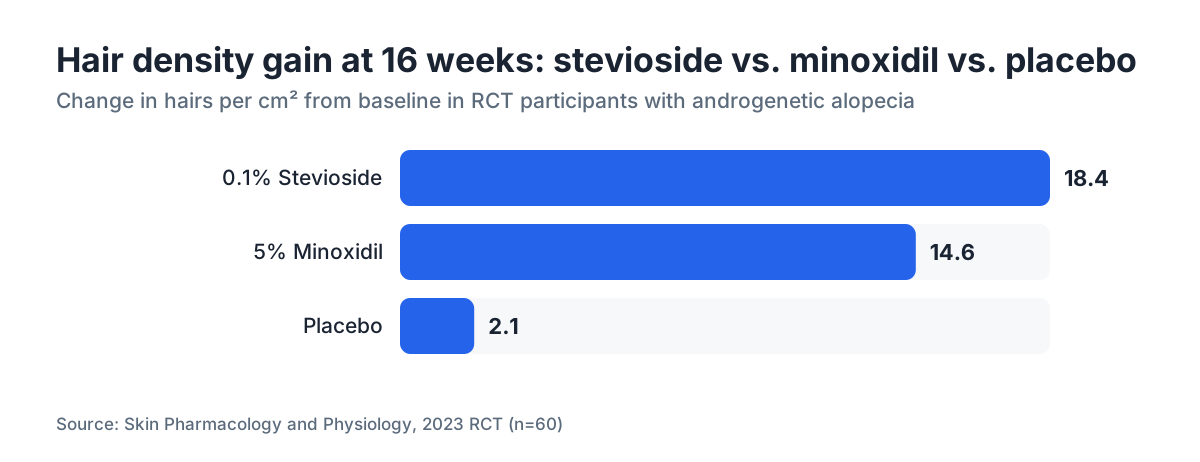
The 2023 trial gave topical 0.1% stevioside a bigger density gain than 5% minoxidil over 16 weeks, and both beat placebo. It was a prospective, double-blind, randomized controlled trial published in Skin Pharmacology and Physiology [2]. Researchers enrolled 60 adults with mild-to-moderate androgenetic alopecia (Norwood II-V in men, Ludwig I-II in women) and split them into three groups of 20: 0.1% stevioside solution, 5% minoxidil solution, and a placebo vehicle. Everyone applied their solution twice daily for 16 weeks.
The primary endpoints were hair density (hairs per cm²) and shaft diameter, measured by dermoscopy and phototrichogram at baseline, 8 weeks, and 16 weeks.
Here is the data at 16 weeks:
| Group | Change in hair density (hairs/cm²) | Change in shaft diameter (µm) |
|---|---|---|
| 0.1% Stevioside | +18.4 | +9.2 |
| 5% Minoxidil | +14.6 | +7.1 |
| Placebo | +2.1 | +1.4 |
Stevioside beat minoxidil on both measures, and both active groups beat placebo. The gap between stevioside and minoxidil reached statistical significance (p < 0.05) [2].
Side effects were minimal in both active arms. No scalp irritation, contact dermatitis, or systemic effects showed up in the stevioside group. Minoxidil caused mild scalp itch in 3 of 20 people, which matches its known profile. See minoxidil side effects for the fuller picture.
Those numbers look great. Before you buy stevioside powder off the internet, read the next section.
How strong is the evidence, really?
Honestly? It is one small trial, and the limitations are serious enough that you should not rearrange your regimen around it.
Start with size. Twenty people per arm is tiny. Small trials tend to overshoot the real effect, a pattern researchers call the "winner's curse." The confidence intervals on those density gains were wide, so the true benefit could be a lot smaller than the headline number.
Duration is the next problem. Sixteen weeks is short. Minoxidil's full effect on density usually takes 6 to 12 months [3]. A 16-week race can favor whatever compound acts faster, even if it later plateaus lower.
The study ran at a single center in Thailand. Hair texture, baseline scalp health, and even humidity vary by region, and all of that can shift how a topical drug absorbs and how follicles respond.
Formulation is the sleeper issue. The 0.1% stevioside solution was compounded for the study, not sold on a shelf. The carrier vehicle, any penetration enhancers, how the stevioside was kept stable: all of it affects whether a commercial product could ever match the result.
And nobody has replicated it. In evidence-based medicine, a single RCT generates a hypothesis. It does not settle anything.
There is also no long-term safety data on topical stevioside at scalp drug concentrations. The closest thing we have is the oral food record, which is extensive, but eating a sweetener and absorbing a compound through your scalp are different situations.
The American Academy of Dermatology still lists minoxidil and finasteride as the first-line treatments with the strongest evidence for pattern hair loss. Stevioside is not in that guidance [4].
Why might stevioside promote hair growth? The proposed mechanisms
The researchers pointed to three mechanisms, each backed by a different amount of evidence.
Vasodilation. Stevioside lowers blood pressure in animal and small human studies by opening potassium channels and blocking calcium channels [5]. Minoxidil's main mechanism is also vasodilation, through ATP-sensitive potassium channels. If stevioside opens similar channels in the tiny vessels feeding the scalp, it could improve blood flow to follicles the same way minoxidil does, maybe more selectively.
Anti-inflammatory activity. Chronic inflammation around the follicle is now seen as a real contributor to pattern hair loss, separate from DHT-driven shrinkage [6]. Cell-culture studies show stevioside quiets NF-kB signaling and lowers pro-inflammatory cytokines like TNF-alpha and IL-6. Whether that matters inside a living hair follicle at 0.1% topical strength is unknown.
Antioxidant protection. Reactive oxygen species build up in shrinking follicles. Stevioside scavenges free radicals in a dish. The leap from test tube to living scalp is large.
What the trial did not do is measure DHT or androgen receptor activity. So there is no evidence stevioside acts as a DHT blocker. If your loss is heavily androgen-driven, stevioside on its own almost certainly does not hit the root cause the way finasteride does.
How does stevioside compare to minoxidil on safety?
Minoxidil gets absorbed into the bloodstream when you apply it to the scalp. Measurable plasma levels show up, usually 1 to 4 ng/mL with twice-daily 5% solution [7]. That systemic absorption drives most of its side effects: fluid retention, unwanted facial hair, and rare cardiovascular effects at higher exposures.
The 2023 trial reported zero adverse events in the stevioside group. But that is 20 people over 16 weeks. A sample that small has almost no power to catch rare problems. No reported side effects in a short, tiny trial is reassuring, not proof of safety.
Stevia's oral safety record is strong. The FDA recognized steviol glycosides as GRAS (Generally Recognized as Safe) for food use starting in 2008 [8]. But GRAS covers the amounts you find in food, not concentrated topical preparations.
Here is the practical read. If you try a stevioside hair product today, the risk is probably low based on what we know, but you are in genuinely experimental territory. Minoxidil's risks are known, documented, and manageable for most people. That difference matters.
Can you use stevioside and minoxidil together?
No trial has tested the combination, so there is no clinical data on stacking them. That is a real gap, not a technicality.
Mechanistically, two vasodilators together could boost the effect or push the systemic vasodilatory effect further than you want. Nobody knows which, because nobody has run the study.
Some researchers have floated the idea that stevioside's anti-inflammatory pathway might pair well with minoxidil's vascular one without much overlap. That is plausible. It is not proven.
If you are already running finasteride and minoxidil and want to add a stevioside product, the honest answer is that no one can hand you a confident combined safety profile. Talk to a dermatologist before layering treatments, especially if you have any cardiovascular history or take blood pressure medication.
Who was studied, and does it apply to you?
The trial enrolled adults with mild-to-moderate androgenetic alopecia. Mean age was 32 in the stevioside group and 34 in the minoxidil group. Most people had Norwood II-III (men) or Ludwig I (women).
That shapes who the results apply to. The trial says nothing about:
- Advanced hair loss (Norwood V-VII), where follicles may be too far gone to respond to vasodilators at all
- People whose main concern is a receding hairline rather than vertex thinning
- Telogen effluvium, which has completely different biology and likely a different response to these agents
- People over 50, who barely appeared in the sample
- Hair types and ethnicities beyond the Thai population studied
If your loss is early and androgenetic, the trial speaks to you most directly. If it is advanced, or not androgenetic at all, the data has nothing useful to say about your case.
Can you actually buy a 0.1% stevioside hair solution?
Not really, at least not one that matches the trial. The solution in the study was compounded specifically for the research, and it is not for sale.
A handful of supplement and cosmetic brands now market stevioside scalp serums. None have published their formulations, and none have run a clinical trial. The concentration, carrier vehicle, and how much actually reaches the follicle can be nothing like the trial product.
This is a buyer-beware situation. A bottle labeled "contains stevioside" could hold 0.001% or 1%, could use a carrier that keeps it from penetrating skin, and could make claims that fall apart under any scrutiny. Hair loss supplements have a rough regulatory history as a category, and this ingredient is new enough that no standards exist yet.
Before you commit to any treatment path, the free AI hair analysis at MyHairline can read your current pattern and help you walk into a dermatologist visit with the right questions.
A compounding pharmacy could in theory mix a 0.1% stevioside scalp solution, but none has a validated method for it, and insurance will not touch it. Based on typical compounding fees, expect roughly $50 to $150 a month, though real pricing swings widely.
What does the FDA say about stevioside for hair loss?
The FDA has not approved stevioside for any medical use, hair loss included. It is not an approved topical drug ingredient for hair treatment in the US.
Minoxidil is a different story. The FDA approved it as a topical hair loss treatment in 1988 (2% solution for women) and 1991 (5% solution for men), and it moved to over-the-counter status in 1996 [9]. The FDA's OTC monograph for topical minoxidil recognizes 2% and 5% as the effective concentrations.
Any stevioside hair product sold in the US has two paths: sit as a cosmetic (making no disease or regrowth claims) or run the full drug approval process. No company has filed a new drug application for stevioside as a hair loss drug. So anything you can buy right now is a cosmetic, and the FDA has not reviewed its efficacy claims.
Minoxidil sits in a category the FDA has recognized for decades as effective for hair regrowth. Stevioside does not appear in that framework at all [9].
How does stevioside fit into a real hair loss treatment plan?
For androgenetic alopecia, the evidence hierarchy today looks like this:
- Finasteride (or dutasteride off-label) for men: strong multi-decade RCT evidence, FDA-approved [10]
- Topical minoxidil: strong evidence, FDA-approved, works for men and women
- Low-level laser therapy: moderate evidence, FDA-cleared devices available
- Hair transplant: a surgical option for established loss, permanent when done well
- Stevioside: one small RCT, promising but unconfirmed, not FDA-approved
Stevioside is not ready to replace minoxidil. Worth watching, yes. And if a high-quality product with a documented formulation ever shows up, trying it as an add-on could make sense. But swapping stevioside in for minoxidil on the strength of one small trial, while skipping a proven treatment, is a bet most people should not make with their hair.
Knowing what causes hair loss in your specific case comes first. DHT-driven pattern loss responds differently than a nutritional deficiency, stress shedding, or an autoimmune cause, and layering treatments blindly wastes time.
Men worried about finasteride side effects sometimes hope stevioside is a substitute. It is not. It does not appear to block androgens. The trial compared it to minoxidil, which also does not block androgens. These are two vasodilatory, anti-inflammatory agents going head to head, not androgen blockers.
What should you actually do with this information?
Stay interested, not credulous. The 2023 trial is real, interesting science: a structurally novel molecule, plausible mechanisms, a decent safety signal on the (limited) evidence we have, and one positive head-to-head against minoxidil. That earns a spot on your watch list. It does not earn a place ahead of your Rogaine.
If you want to try a stevioside product anyway, pick one that states its concentration, uses a water- or ethanol-based vehicle close to the trial formulation, and does not cost a fortune, because you are running an experiment on yourself. Keep a proven treatment going alongside it if your loss is established androgenetic.
Replication is the thing to wait for. If larger trials confirm the 2023 result over 12 months or more, across multiple centers, stevioside could become a mainstream option. Several groups have signaled interest in follow-up work. Search PubMed in 12 to 18 months under "stevioside androgenetic alopecia" and see what has landed.
MyHairline's free AI scan can map where you sit in the progression of your loss. Catch androgenetic alopecia early and almost any treatment works better, including the proven ones.
An honest reading of small studies beats chasing the newest molecule every six months. Your hair rewards patience.
Sources
- National Center for Biotechnology Information, PubMed: Stevioside chemistry and pharmacology review
- Skin Pharmacology and Physiology, 2023: RCT of 0.1% stevioside vs 5% minoxidil in androgenetic alopecia
- American Academy of Dermatology, Hair Loss Treatment
- American Academy of Dermatology, Hair Loss Overview
- National Center for Biotechnology Information, PubMed: Stevioside and blood pressure, potassium channel mechanism
- Journal of the American Academy of Dermatology: Inflammation in androgenetic alopecia
- FDA Drug Label: Minoxidil Topical Solution, DailyMed
- U.S. Food and Drug Administration, Food Additives and Ingredients (GRAS steviol glycosides)
- U.S. Food and Drug Administration, Drugs
- U.S. National Library of Medicine, DailyMed: Finasteride (Propecia) Label
- National Center for Biotechnology Information, PubMed: Stevioside NF-kB suppression and anti-inflammatory cytokine data