TL;DR: No shampoo permanently kills a healthy follicle. But sulfates, formaldehyde-releasing preservatives, overused selenium sulfide, and fragrance can inflame the scalp, damage the barrier, or break hair near the root until shedding jumps. Medical causes like thyroid disease, iron deficiency, and genetics matter far more than your bottle. Still, switching products can lower daily shed counts.
Can shampoo actually cause hair loss in women?
Not the way most people fear, but not zero either. No shampoo can reach a healthy follicle and kill it. What a shampoo can do is disrupt the scalp enough to push more follicles into shedding early, irritate the skin badly enough to mimic inflammatory hair loss, or damage the shaft so hair snaps near the root and looks like shedding when it isn't.
The American Academy of Dermatology draws a line between hair loss at the follicle and breakage at the shaft [1]. Most "shampoo-caused hair loss" women describe is really shaft breakage or an irritant reaction speeding up a normal shed. That distinction changes what you should do about it.
Chronic scalp inflammation is a real path to follicle miniaturization over time, though. A study in the Journal of the American Academy of Dermatology found scalp dermatitis was significantly associated with worse female pattern hair loss severity [2]. So the shampoo is rarely the root cause. It can still pour fuel on a fire that's already burning.
Which shampoo ingredients are most likely to cause hair shedding or scalp irritation?
These are the ingredients with real evidence behind the worry. Dermatological and toxicological findings, not forum rumor.
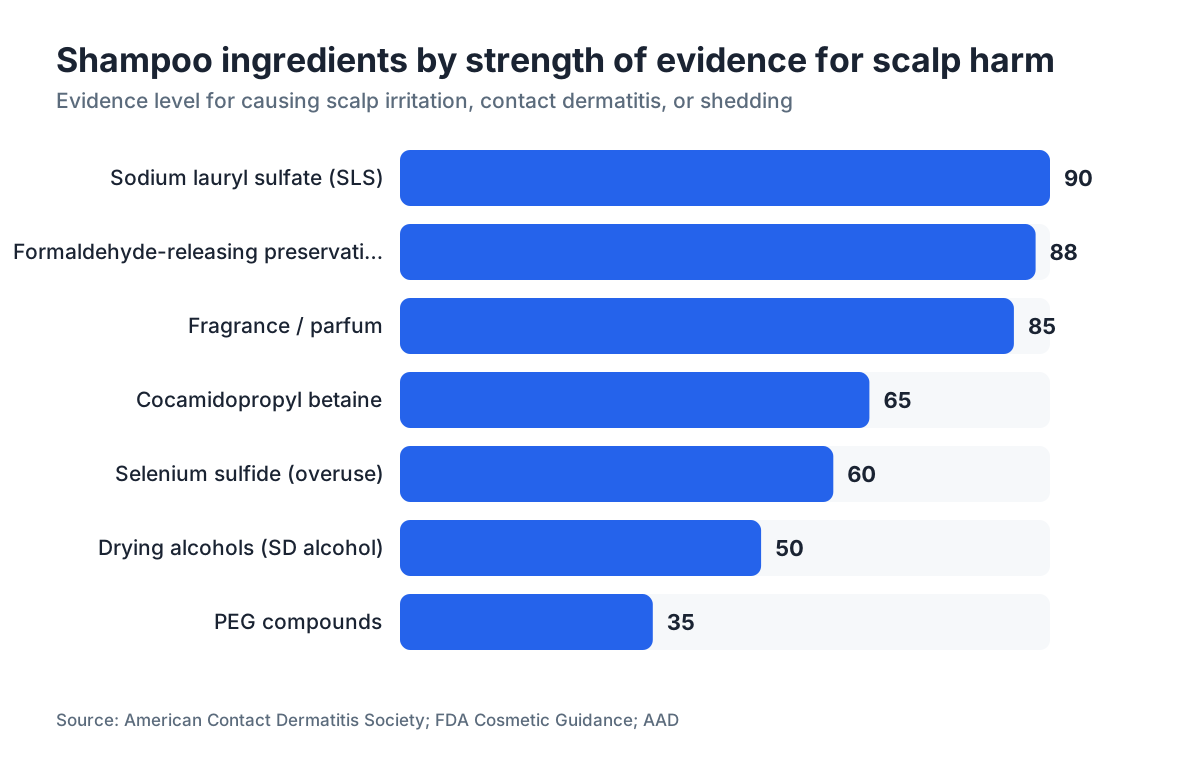
Sodium lauryl sulfate (SLS) and sodium laureth sulfate (SLES) SLS is a strong detergent. It cleans well, and it's also one of the most common contact irritants used in dermatology patch testing [3]. Repeated exposure degrades the scalp's lipid barrier, increases water loss through the skin, and in sensitive people sets off an irritant dermatitis that looks a lot like seborrheic dermatitis. Women who already have a reactive scalp or hormonal thinning often report more shedding after switching to a high-SLS shampoo. SLES is milder but still rough on touchy scalps.
Formaldehyde-releasing preservatives DMDM hydantoin, quaternium-15, imidazolidinyl urea, and diazolidinyl urea all release formaldehyde slowly as they break down. Formaldehyde is a known allergen, and the FDA has flagged these releasers in cosmetics as a cause of allergic contact dermatitis [4]. On the scalp that reaction shows up as itching, inflammation, and a diffuse shed that gets mistaken for genetic loss. These preservatives turn up in a large share of rinse-off hair products.
Selenium sulfide (in medicated dandruff shampoos) Selenium sulfide shampoos like Selsun Blue genuinely work for seborrheic dermatitis. The FDA's monograph for OTC dandruff products warns they shouldn't be used more than twice weekly for maintenance [5]. Daily use, or leaving the product on longer than directed, is linked to scalp irritation and, in some users, more shedding. The therapeutic window here is narrow.
Fragrance (parfum) Fragrance is the single most common cause of allergic contact dermatitis in leave-on and rinse-off cosmetics, according to the American Contact Dermatitis Society [3]. When fragrance triggers an allergy on the scalp, the inflammation can cause a diffuse shed that mimics telogen effluvium. Because "fragrance" on a label covers dozens of individual chemicals, pinning down the exact allergen without patch testing is close to impossible.
Cocamidopropyl betaine Sold everywhere as a "gentle" surfactant, cocamidopropyl betaine was named Allergen of the Year by the American Contact Dermatitis Society in 2004 [6]. It's less irritating than SLS for most people. In those who get sensitized, it can cause real scalp dermatitis.
Polyethylene glycol (PEG) compounds PEGs work as penetration enhancers, helping other chemicals pass through the skin barrier more easily. Useful in pharmaceuticals, less so when paired with irritating co-ingredients in a shampoo. There's no strong standalone evidence PEGs cause hair loss. Their barrier-disrupting effect just amplifies the damage from whatever else is in the formula.
Alcohol (SD alcohol, denatured alcohol, alcohol denat) Drying alcohols strip natural oils from the scalp and shaft. Used now and then, they're fine. In a daily shampoo on an already-dry scalp, they speed up mechanical fragility and breakage.
| Ingredient | Primary risk | Evidence level |
|---|---|---|
| Sodium lauryl sulfate | Scalp barrier damage, irritant dermatitis | Strong (patch-test data) |
| Formaldehyde-releasing preservatives | Allergic contact dermatitis | Strong (FDA flagged) |
| Selenium sulfide (overuse) | Scalp irritation, shedding | Moderate (FDA monograph warnings) |
| Fragrance/parfum | Allergic contact dermatitis | Strong (ACDS data) |
| Cocamidopropyl betaine | Allergic contact dermatitis | Moderate (ACDS Allergen of Year) |
| Drying alcohols | Shaft breakage | Moderate |
Are there specific shampoo brands or product types women should avoid?
Naming brands as "hair loss shampoos" would mislead you. Formulas change and individual reactions vary enormously. Here's what to be careful with by category.
Smoothing and keratin treatment shampoos: Many carry formaldehyde or formaldehyde-releasing compounds at higher concentrations than a standard shampoo. The FDA and OSHA have both flagged certain Brazilian blowout and keratin products for elevated formaldehyde [4]. The at-home shampoos built to maintain those treatments can carry the same chemistry.
Clarifying shampoos used daily: These are built for heavy buildup removal, so they run at maximum surfactant strength. They're designed for weekly or monthly use. Running one through your hair every day is like scrubbing your hands with degreaser over and over. The inflammation that follows is real and documented.
2-in-1 shampoo-conditioners with heavy silicones: The silicone buildup can clog follicular openings over time. Direct evidence that this causes hair loss is thin, but there's enough dermatologist agreement to flag it.
Highly fragranced salon shampoos: Some professional formulas contain fragrance at concentrations that are perfectly legal and still high enough to sensitize you with regular use. Sensitization is a one-way door. Once you develop a fragrance allergy, even a low dose can set off a reaction.
One honest caveat. The women most likely to get shampoo-related shedding already have an active scalp condition or underlying hair loss. If your scalp is healthy and nothing hormonal has shifted, even a mediocre shampoo probably won't cause meaningful shedding. Shampoo choice matters most when your follicles are already under stress.
What illnesses and medical conditions cause hair loss in females that get blamed on shampoo?
Most articles skip this part. It matters more than anything else here. The majority of women who notice extra shedding and blame their shampoo are actually living through a medical hair loss pattern the shampoo has nothing to do with.
The common ones worth knowing:
Telogen effluvium: Diffuse shedding triggered by a physical stressor 2 to 4 months before the shed shows up. Childbirth, crash dieting, major surgery, severe illness, starting or stopping hormonal birth control. Women often spot the shed while washing and blame whatever shampoo they happen to be using. The shampoo is innocent. Our telogen effluvium article covers this pattern.
Female pattern hair loss (androgenetic alopecia): Affects roughly 40% of women by age 50, per the AAD [1]. It comes from a genetic sensitivity to dihydrotestosterone (DHT) at the follicle. No shampoo causes it and none cures it, though certain ingredients can speed its visible progression by adding inflammation on top.
Thyroid disease: Both hypothyroidism and hyperthyroidism list diffuse hair loss as a common symptom. MedlinePlus notes thyroid problems and iron deficiency among the medical causes of diffuse shedding in women [11]. The shed pattern is often identical to telogen effluvium.
Iron deficiency and anemia: Serum ferritin below 30 ng/mL is the threshold dermatologists commonly cite for worsening shedding, though the exact cutoff is debated in the literature. Menstruating women carry the most risk.
Polycystic ovary syndrome (PCOS): High androgens can drive scalp thinning and extra body or facial hair at the same time. PCOS affects roughly 6 to 12% of US women of reproductive age, according to the CDC [8].
Alopecia areata: An autoimmune condition causing patchy or diffuse loss. Nothing to do with shampoo.
Lupus and other autoimmune diseases: Hair loss is a recognized symptom of systemic lupus erythematosus. The disease drives the follicle damage, not any product on the shelf.
Our what causes hair loss overview walks through these mechanisms. If you're shedding noticeably and can't name a recent stressor, a blood panel covering thyroid (TSH, free T4), iron studies (ferritin, TIBC), and androgens is the right first move. Not a shampoo swap.
How much daily hair shedding is actually normal for women?
The number you see everywhere is 50 to 100 hairs a day, and it comes from trichology and dermatology textbooks rather than one clean trial [11]. It's a reasonable average across different wash schedules and the normal hair cycle.
A few things move that count legitimately. Washing less often piles up shed hairs, so wash day looks dramatic. Naturally fine hair sheds in higher numbers but lower total mass. Postpartum women can drop 300 to 400 hairs a day for weeks and still sit inside the range of normal physiological shedding.
A daily shed above 150 hairs that hangs around for more than three months is a fair reason to see a dermatologist. The AAD suggests the pull test as a quick home screen: grasp 40 to 60 hairs between your fingers, pull with gentle traction from root to tip, and if more than 6 come out in one pull, that points to an active shed phase [1].
Why this matters for the shampoo question: calibration. Lose 60 hairs in the shower and that's almost certainly normal, no ingredient swap will touch it. Lose 200 and an irritating shampoo might account for 20 or 30. The other 170 need a medical explanation.
What does a dermatologist actually look for when shampoo-related hair loss is suspected?
Patch testing is the standard for identifying contact allergens. A dermatologist applies a set battery of common allergens to the skin (usually the upper back) under occlusion for 48 hours, then reads results at 48 and 96 hours [3]. The North American Contact Dermatitis Group's standard series includes most shampoo allergens worth checking: fragrance mix, formaldehyde, cocamidopropyl betaine, and more.
Beyond patch testing, trichoscopy (dermoscopy of the scalp) separates inflammatory follicular patterns from androgenetic thinning. They look genuinely different under magnification and point toward different treatments.
Blood work usually covers complete blood count, thyroid function, ferritin, zinc, vitamin D, and, if androgenetic alopecia is on the table, free and total testosterone plus DHEA-S.
Here's the honest timeline. If shampoo contact dermatitis is the cause, switching products and calming the inflammation usually shows visible improvement in shedding within 3 to 6 months, because that's how long a telogen hair takes to grow back to visible length. Don't judge a product switch in three weeks.
What ingredients should women with thinning hair actually look for in a shampoo?
This is where an opinion is fair: the evidence for "hair growth shampoos" as a category is weak. No shampoo ingredient carries the clinical weight of topical minoxidil [1]. A few do have reasonable data for scalp health.
Ketoconazole 1% and 2%: Multiple randomized trials show ketoconazole shampoo lowers scalp DHT and improves hair density in androgenetic alopecia. A 1998 trial in Dermatology compared 2% ketoconazole shampoo to 2% minoxidil and found comparable improvements in hair density and shaft diameter [9]. That's the strongest shampoo case in the literature, and it's available OTC at 1% (Nizoral) in the US. Pairing a ketoconazole shampoo with a DHT blocker treatment hits the same pathway from two angles.
Zinc pyrithione: Works against the Malassezia yeast tied to seborrheic dermatitis, which helps indirectly by lowering scalp inflammation. Head and Shoulders is the familiar example.
Biotin-containing shampoos: Biotin has real evidence for hair loss caused by biotin deficiency, which is rare. As a shampoo ingredient, there's no good evidence it penetrates the follicle from outside. The marketing runs well ahead of the science.
Caffeine: Some in-vitro and small clinical studies suggest topical caffeine may extend the anagen (growth) phase by inhibiting phosphodiesterase. Results are modest and the research is thin, but the ingredient is harmless and cheap.
If you're dealing with real shedding, understanding minoxidil side effects and whether hair loss supplements hold up is more productive than optimizing shampoo. Shampoo is a supporting player at best.
Can sulfate-free shampoos actually help women with hair loss?
Switching to sulfate-free is reasonable harm reduction, not treatment. If your scalp irritation is genuinely driven by SLS sensitivity, dropping SLS lowers baseline inflammation and can meaningfully cut daily shed counts. If your hair loss comes from genetics, thyroid disease, or iron deficiency, sulfate-free won't move the needle.
Sulfate-free shampoos use milder surfactants like sodium cocoyl isethionate, sodium lauroyl methyl isethionate, or coco-glucoside. They're gentler on the barrier and strip less. The tradeoff is less lather, and fine hair can feel coated without a good rinse.
One real benefit: sulfate-free shampoos hold color longer, so women who color their hair (and carry more chemically fragile strands) see less shaft breakage. Less breakage means less apparent shedding, even when the follicle shed rate hasn't changed. That's a measurable improvement in how dense the hair looks.
My honest position: try sulfate-free for 90 days if you have a sensitive or reactive scalp. If shedding and scalp comfort haven't shifted after 90 days, it's unlikely to help further.
What are the red flags that mean hair loss is serious and needs medical attention?
Changing your shampoo is a reasonable first step when you see more hair in the drain. Some patterns mean see a doctor this week, not next quarter.
See a dermatologist promptly if you notice:
- A receding hairline, especially at the temples. That pattern, including receding hairline changes in women, often signals androgenetic alopecia that responds much better to early treatment.
- Patchy loss or smooth bald spots, which can point to alopecia areata.
- Scalp burning, pain, or visible scarring around follicles. Scarring alopecias (lichen planopilaris, frontal fibrosing alopecia) cause permanent follicle loss if untreated.
- Shedding plus fatigue, weight changes, irregular periods, or acne. Any combination points toward a systemic illness (thyroid, PCOS, anemia) rather than a shampoo problem.
- Shedding that starts or sharply worsens after a new medication.
Treatments with real evidence include topical minoxidil (FDA-approved for women at 2% and 5%) [1], finasteride in postmenopausal women in select cases, and hair transplant for women with stable pattern loss and enough donor density. Different conversations than shampoo, but worth knowing they exist.
For a starting point before your appointment, the free AI hair analysis at MyHairline (/scan) helps you identify your loss pattern so you walk in with a clearer picture.
How should women read a shampoo ingredient label to avoid the worst offenders?
US cosmetic labels list ingredients in descending order of concentration, with one exception: anything below 1% can appear in any order at the end [4]. That matters because a fragrance or preservative sitting near the bottom of a long list is still present at a level that can sensitize you with repeated use.
Practical steps:
-
Scan for the formaldehyde releasers by name: DMDM hydantoin, quaternium-15, imidazolidinyl urea, diazolidinyl urea. Any of these in a daily shampoo is worth replacing if you have a reactive scalp.
-
Check where "fragrance" or "parfum" lands. Top half of the list means a meaningful concentration. Fragrance-free and unscented aren't the same: unscented products often hide masking fragrances.
-
Look for sodium lauryl sulfate versus sodium laureth sulfate. SLES (with the "eth") is gentler. If scalp sensitivity is your issue, swap to SLES or move to a non-sulfate primary surfactant.
-
The EWG Skin Deep database (ewg.org) and CosDNA are free tools that cross-reference cosmetic ingredients against safety databases. Neither is perfect. Both are useful for quick screening.
FDA cosmetic ingredient labeling rules are codified at 21 CFR Part 701 [4]. Manufacturers must list every ingredient, and the same rules apply to rinse-off shampoos as to leave-on products.
If you're also managing androgenetic alopecia with medication, checking your shampoo against your topical treatments is worthwhile. Our finasteride and minoxidil overview covers what to watch for when you use both.
What does the research actually say about shampoo-related hair loss in women?
The honest answer: the research base is thinner than the internet consensus suggests. Most of what we know comes from contact dermatitis literature, ingredient safety reviews, and inference from scalp inflammation studies, not large randomized trials comparing specific shampoo formulas to placebo.
The strongest published evidence points concern at:
- Formaldehyde and its releasers: well-documented contact allergens with scalp-specific case series [4]
- SLS: multiple controlled irritancy studies confirm barrier damage, though most are skin studies rather than scalp-specific [3]
- Selenium sulfide: FDA monograph warnings rest on adverse event reports and safety review, not a prospective hair loss trial [5]
A 2019 systematic review in the Journal of Dermatological Treatment found scalp microbiome disruption, which harsh surfactants can cause, correlates with more inflammatory mediators near hair follicles [10]. The mechanism is plausible and the association is there. Clean causation is harder to prove.
Nobody has a large, well-controlled prospective trial randomizing women to SLS versus sulfate-free and following them two years with trichoscopy. The closest data sits in the contact dermatitis literature and in ketoconazole trials that happened to measure hair density along the way.
What that gap means: avoiding ingredients based on known allergen and irritant data is sensible precaution. Anyone selling a "DHT-blocking" or "hair-growth" shampoo as clinically proven should be asked to produce the study.
Sources
- American Academy of Dermatology, Hair Loss Overview
- Journal of the American Academy of Dermatology, scalp dermatitis and female pattern hair loss association
- American Contact Dermatitis Society, Patch Testing Resources
- FDA, Cosmetics (21 CFR Part 701 labeling; keratin treatment formaldehyde guidance)
- FDA, OTC Dandruff Drug Products Monograph (21 CFR Part 358)
- American Contact Dermatitis Society, Allergen of the Year Archive
- CDC, PCOS Feature
- Dermatology (journal), Ketoconazole vs Minoxidil for androgenetic alopecia, 1998
- Journal of Dermatological Treatment, scalp microbiome and hair follicle inflammation review, 2019
- National Institutes of Health, MedlinePlus, Hair Loss