

TL;DR: Clascoterone (brand name Winlevi, active ingredient CB-03-01) is a topical androgen receptor blocker that fights hair loss by competing with DHT at the follicle. Phase 3 trials in androgenetic alopecia showed meaningful hair count gains with minimal systemic absorption. It is not yet FDA-approved for hair loss but is approved for acne, and off-label use is growing.
What is clascoterone and how does it work on hair loss?
Clascoterone is a topical antiandrogen. It binds to androgen receptors inside the hair follicle and blocks dihydrotestosterone (DHT) from attaching there. No DHT signal, no follicle miniaturization.
That mechanism matters a lot. Most people know that DHT is the hormone behind androgenetic alopecia, the most common form of hair loss in both men and women. You can read more about the full chain of events in our guide to what causes hair loss and the specific role DHT plays as a dht blocker target. The difference with clascoterone is that it does not block DHT production anywhere else in the body. It sits on the receptor itself, only where you apply it.
The molecule started life as a derivative of progesterone, which itself has some androgen-receptor-blocking properties. Researchers at Cassiopea, the Swiss pharmaceutical company behind the drug, spent years refining it into a compound stable enough for topical formulation and selective enough to avoid the estrogenic effects that plagued older topical antiandrogens.
After it soaks into the skin, clascoterone converts to its inactive metabolite cortexolone, which has no meaningful androgenic or antiandrogenic activity in the bloodstream [1]. That built-in off switch is the whole safety story.
Is clascoterone FDA-approved for hair loss?
Not yet, as of mid-2025. The FDA approved clascoterone 1% cream (Winlevi) in August 2020, but that approval was specifically for acne vulgaris in patients 12 and older [2]. The androgenetic alopecia indication is a separate regulatory path.
Cassiopea ran two large phase 3 trials (ETRULIA 1 and ETRULIA 2) for the hair loss indication using a higher-concentration topical solution. Those results went to the FDA, and as of early 2025 the company was in active talks with the agency about a possible approval. The situation is still moving. If you are eyeing clascoterone for hair loss right now, any prescription you get is off-label.
Off-label prescribing is legal and common. Dermatologists prescribe finasteride off-label for women, and minoxidil began as a blood pressure drug. It does mean insurance is unlikely to cover it, and the prescribing physician carries more responsibility for justifying the choice.
The current label for Winlevi covers only acne [2]. Dermatologists who write it for hair loss are working from the published trial data, not from an approved use.
What did the clinical trials actually show?
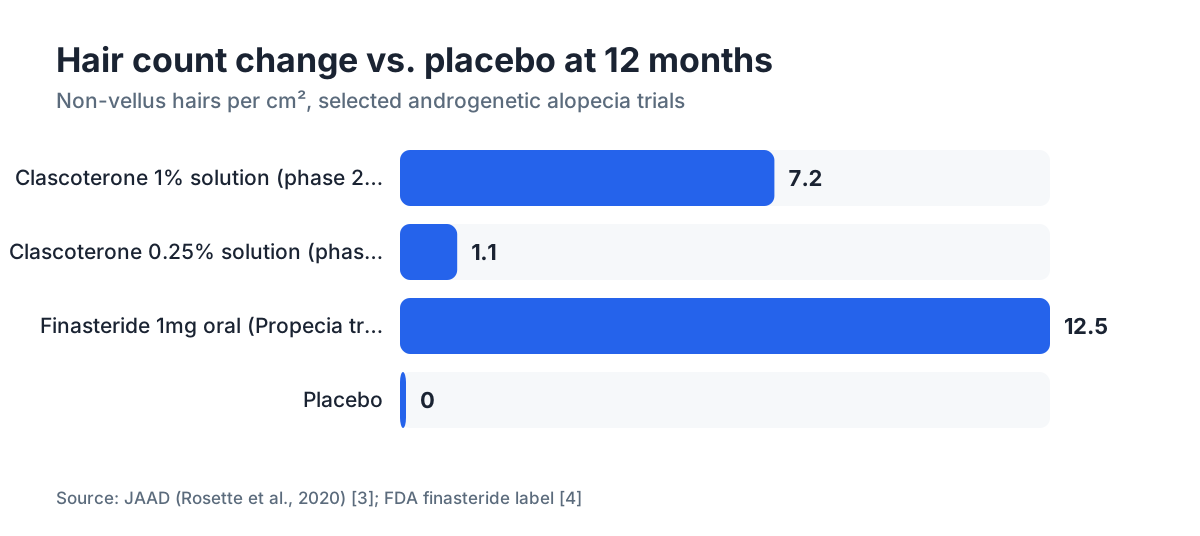
The phase 2 trial published in the Journal of the American Academy of Dermatology in 2020 tested CB-03-01 (clascoterone) topical solution in men with androgenetic alopecia. After 12 months, participants using the 1% concentration had a statistically significant increase in non-vellus hair count compared to placebo, and the 1% group also showed a significant increase in cumulative hair thickness [3].
The phase 2 data were encouraging but the samples were modest, around 91 subjects per arm. The phase 3 ETRULIA trials enrolled larger populations and used a 7.5 mg/mL (roughly 0.75%) solution applied twice daily. Cassiopea's press releases reported that ETRULIA 2 met its primary endpoint of change in non-vellus hair count from baseline, while ETRULIA 1 results ran more mixed depending on the subpopulation. The company presented pooled analyses pointing to positive outcomes, but the full peer-reviewed publication was still pending as of this writing.
Here is how the key measurements stack up across what has been published:
| Study / Arm | Duration | Hair count change vs. placebo | Notes |
|---|---|---|---|
| Phase 2, CB-03-01 1% solution | 12 months | +7.2 hairs/cm² (p<0.05) | Men only, Norwood II-V [3] |
| Phase 2, CB-03-01 0.25% solution | 12 months | Not significant | Lower dose failed |
| Phase 3 ETRULIA 2 (pooled) | 6 months | Met primary endpoint | Full data not yet peer-reviewed |
| Finasteride 1mg (for comparison) | 12 months | +7-18 hairs/cm² (range across trials) | Men only, systemic [4] |
The honest read: the phase 2 effect size is real but modest. It lands in the same general neighborhood as finasteride on the hair-count metric, though no direct head-to-head data exist yet. Finasteride's track record across decades of trials is much larger.
If you want to know where you stand before starting any treatment, tools like the free AI hair analysis at MyHairline can help you document your current density so you have a real baseline to compare against.
How does clascoterone compare to finasteride and minoxidil?
These three drugs work through completely different mechanisms, which is exactly why researchers and clinicians are interested in stacking them rather than picking one.
Finasteride blocks 5-alpha reductase, the enzyme that converts testosterone into DHT. It cuts DHT in the scalp and serum by roughly 65-70% [4]. That works very well for many men, but systemic DHT suppression is also what drives the side effects some men report: lower libido, erectile dysfunction, and mood changes. Women of childbearing age cannot take it safely. Our finasteride guide walks through the full evidence.
Minoxidil is a vasodilator. It stretches out the anagen (growth) phase of the hair cycle and widens blood vessels around follicles. It does not touch androgens at all. Because the mechanisms differ, finasteride and minoxidil together beat either one alone in most trials.
Clascoterone sits in a third lane: local androgen blockade. It does what finasteride does in concept (blocks the DHT signal at the follicle) but without lowering circulating DHT. That profile makes it the most interesting option for two groups. Women who cannot use finasteride because of pregnancy risk. And men who have had, or fear, finasteride's sexual side effects.
The catch is evidence. Finasteride has decades of randomized trial data, FDA approval for androgenetic alopecia, and a known long-term safety record. Clascoterone has promising phase 2 data and pending phase 3 results. Nobody has 10-year follow-up on clascoterone for hair loss yet.
Why would someone choose clascoterone over finasteride?
The clearest case is sexual side effects. Finasteride's systemic DHT reduction reaches tissues throughout the body, including sexual and neurological tissue. The FDA label for finasteride carries a warning about persistent sexual side effects that may continue after stopping the drug [4]. For men already living with those effects on finasteride, or too worried to start it, a topical antiandrogen that leaves systemic DHT alone is genuinely appealing.
Women are the other obvious group. Finasteride is teratogenic and poses a serious risk to a male fetus if a pregnant woman is exposed. Many dermatologists simply will not prescribe it to women of childbearing age. Clascoterone has no meaningful systemic absorption, so it sidesteps that risk. The phase 2 trial was male-only, but several ongoing studies include women with female-pattern hair loss.
There is a practical combination angle too. Some physicians already prescribe clascoterone alongside minoxidil, pairing topical DHT blockade with vasodilation. That combination makes theoretical sense even if the published combination data are thin.
One thing worth saying plainly. If you have a receding hairline and no reason you can't take finasteride, finasteride plus minoxidil is still the best-evidenced first-line approach for men. Clascoterone is not a proven replacement for that combination yet. It is a real option for specific situations.
What are the side effects of clascoterone?
This is where the drug looks genuinely good. In the acne trials, which give us the most controlled safety data we have, clascoterone 1% cream applied twice daily produced a low rate of local irritation and, importantly, showed no meaningful changes in serum testosterone, LH, FSH, or SHBG versus placebo [2]. It is not reaching in and suppressing the hypothalamic-pituitary-gonadal axis.
In the hair loss phase 2 trial, the tolerability picture was similarly clean. Application site reactions (mild dryness, redness) hit a small percentage of participants and stayed mild [3].
Because it flips to its inactive metabolite fast after absorption, the classic worries with traditional antiandrogens, things like feminization in men or menstrual disruption in women, do not seem to apply here based on the available data. The caveat: long-term safety data for the hair loss concentration and formulation are limited. The acne data cover a shorter stretch of time and a younger population.
Watch for scalp irritation, which can happen with any topical solution. And keep an eye out for any sign of systemic androgen changes if you are applying it heavily over a long period. The data so far say this is not a real risk, but the clinical experience is still short next to minoxidil or finasteride.
How do you use clascoterone for hair loss and what does it cost?
For the acne indication, Winlevi cream goes on twice daily. The hair loss trials used a solution applied to the scalp, also twice daily. The exact concentration in the phase 3 ETRULIA trials was 7.5 mg/mL.
A dermatologist prescribing it off-label for hair loss today may write it as the approved Winlevi cream (used off-label on the scalp) or work with a compounding pharmacy to make the solution used in trials. Compounded clascoterone is increasingly available through telehealth platforms that focus on hair loss.
Cost is a real barrier. Winlevi cream through commercial pharmacies without coverage runs roughly $300 to $500 per month, depending on the pharmacy and your location. Compounded topical clascoterone from specialty pharmacies usually comes in lower, around $60 to $150 per month depending on concentration and volume, though pricing swings a lot. These are 2024-2025 market estimates. Ask your specific pharmacy for the current price before you commit.
Insurance almost never covers it for hair loss because that use is off-label. For acne, some plans do cover Winlevi with prior authorization [2].
The application is simple. Part the hair, apply directly to the thinning scalp, let it dry. No different in practice from using a topical minoxidil solution. Some physicians prescribe them together in one routine.
Can women use clascoterone for hair loss?
Yes, in principle, and this may turn out to be one of its most important uses. Female-pattern hair loss is androgen-driven in many cases, but women have very few approved options. Minoxidil is FDA-approved for women [5]. Finasteride is not, and spironolactone (an oral antiandrogen) requires systemic exposure and brings its own side effect profile.
Clascoterone's topical, locally acting mechanism is a natural fit for women who want androgen receptor blockade at the scalp without the risks of systemic antiandrogens. The phase 2 hair trial was male-only, but Cassiopea has said its phase 3 program and ongoing research include women. Several academic dermatology centers have reported early clinical experience in women using compounded clascoterone.
The absence of estrogenic activity matters here too. Some older topical antiandrogens (like topical spironolactone or cyproterone) raised concerns about systemic effects in women. Clascoterone's quick inactivation after skin absorption clears most of that worry.
For women dealing with thinning that does not respond well to minoxidil alone, or who want to avoid the systemic load of oral spironolactone, compounded topical clascoterone is a reasonable conversation to have with a dermatologist. It is not a guaranteed fix, and the female-specific data are still thin, but the mechanism makes biological sense.
How long does clascoterone take to show results?
Hair follicle biology sets the floor. The anagen (active growth) phase cycles every few months, and you need at least one full cycle to see meaningful change in hair count or thickness. Most honest assessments say don't judge any hair loss treatment before six months.
In the phase 2 clascoterone trial, statistically significant differences from placebo showed up by month 12 [3]. The phase 3 trials used a six-month primary endpoint, which is standard in the field but arguably on the short side for reading full effect.
Be realistic. Expect six to twelve months of consistent twice-daily use before you can tell whether the drug is working for you. Taking standardized photos at the same spot every three months is the only honest way to track it. Hair loss moves slowly enough that memory lies.
One more thing. If you stop clascoterone, any benefit likely reverses. The drug blocks DHT at the receptor only while you use it. Stop, and DHT resumes its signal. Same maintenance reality as finasteride or minoxidil.
Can clascoterone be combined with minoxidil or other treatments?
Pairing topical clascoterone with minoxidil for men is logically sound and already happening in clinics. Minoxidil works on blood flow and the hair growth cycle. Clascoterone works on androgen receptor signaling. They do not compete or interfere with each other at the mechanism level.
Some compounding pharmacies already make combination formulas with both ingredients in one solution to simplify the twice-daily routine. Published trial data on the combination for hair loss is limited, so the case rests mainly on mechanistic reasoning plus early clinical observation.
Clascoterone plus finasteride is a messier picture. If you are already on finasteride (which suppresses DHT production), adding a DHT receptor blocker is probably redundant unless finasteride is not fully suppressing your DHT. Some physicians do combine them, but there is no formal evidence behind it.
Clascoterone after a hair transplant is another area of interest. Transplanted follicles stay androgen-sensitive over time, and protecting native follicles in nearby areas matters. A topical antiandrogen with minimal systemic effects could slot neatly into a post-transplant maintenance plan, though formal trial data do not exist yet.
If you are dealing with diffuse shedding rather than patterned loss (think telogen effluvium), clascoterone is unlikely to help. That condition is triggered by systemic stress, not DHT signaling.
How do I get a prescription for clascoterone for hair loss?
You need a licensed physician, usually a dermatologist or a telehealth provider who focuses on hair loss. Because the hair loss indication is off-label, not every general practitioner will know about it or feel comfortable prescribing it. A dermatologist with experience in androgenetic alopecia is your best starting point.
Bring the published trial data to the appointment if you can (the 2020 JAAD paper is the most accessible source [3]). Be ready for the physician to suggest starting with finasteride and/or minoxidil first, since those carry stronger evidence and FDA approval for hair loss. That is not bad advice.
Telehealth hair loss platforms have adopted clascoterone faster than traditional clinics, largely because they are built to handle compounded prescriptions. If you go the compounding route, confirm the pharmacy is PCAB-accredited or operates under FDA compounding rules (503A or 503B status), which matters for quality.
Want a baseline before your appointment to show the physician where your thinning is most concentrated? The free AI hair scan at MyHairline can give you a starting photo analysis to bring to the conversation.
One caution. Do not buy anything labeled "clascoterone" from an international online pharmacy without a prescription. Quality control outside the US compounding framework is unverifiable.
Sources
- Cassiopea S.p.A., Winlevi prescribing information (FDA label)
- FDA, Drugs@FDA database entry for Winlevi (clascoterone) NDA 213433
- Rosette JM et al., Journal of the American Academy of Dermatology, 2020, Phase 2 RCT of CB-03-01 topical solution in androgenetic alopecia
- FDA, Drugs@FDA database entry for Propecia (finasteride 1mg)
- FDA, Drugs@FDA database entry for minoxidil 2% topical solution
- American Academy of Dermatology Association, Hair Loss: Diagnosis and Treatment
- Cassiopea S.p.A., ETRULIA Phase 3 Trial Press Release 2024
- Sinclair R, Patel M, Dawber TR et al., Journal of Investigative Dermatology Symposium Proceedings, Androgen signaling and hair follicle miniaturization
- National Institutes of Health, MedlinePlus, Androgenetic alopecia
- FDA, Compounding (503A and 503B outsourcing facilities overview)