
TL;DR: Clascoterone (Winlevi) is a topical androgen blocker that fights hair loss at the DHT receptor inside the follicle. Minoxidil is a vasodilator that extends the growth phase of hair. Both beat placebo in trials, but minoxidil has 40 years of evidence behind it. Clascoterone is newer, carries no sexual side effects, and can be layered with minoxidil for a second mechanism.
What are clascoterone and minoxidil, and how do they work?
Minoxidil started life as an oral blood pressure drug in the 1970s. Researchers noticed patients grew hair as a side effect, and topical versions followed. The FDA approved 2% topical minoxidil for men in 1988 and 5% in 1991. It works by opening ATP-sensitive potassium channels in vascular smooth muscle, which widens blood vessels around the follicle, prolongs the anagen (growth) phase, and may push follicles from a resting into a growing state [1]. It does not lower DHT anywhere in your body.
Clascoterone is a completely different animal. It is a topical androgen receptor antagonist, meaning it competes with dihydrotestosterone (DHT) for the receptor site inside the hair follicle itself. When DHT cannot bind, it cannot signal the follicle to miniaturize. The FDA approved clascoterone 1% cream (brand name Winlevi) in August 2020, first for acne, and it is used off-label for androgenetic alopecia [2]. It acts locally. Blood levels after scalp application are low enough that systemic anti-androgen effects are minimal, which is the main reason it does not produce the sexual side effects associated with finasteride.
Think of the two drugs as attacking hair loss from opposite directions. Minoxidil tries to keep the follicle alive and growing by improving its environment. Clascoterone tries to stop the hormonal signal that is shrinking it in the first place. Neither is a cure. Both need ongoing use to hold results. To understand more about how DHT drives the whole process, see our overview of dht blocker options.
What does the clinical evidence say about how well each one works?
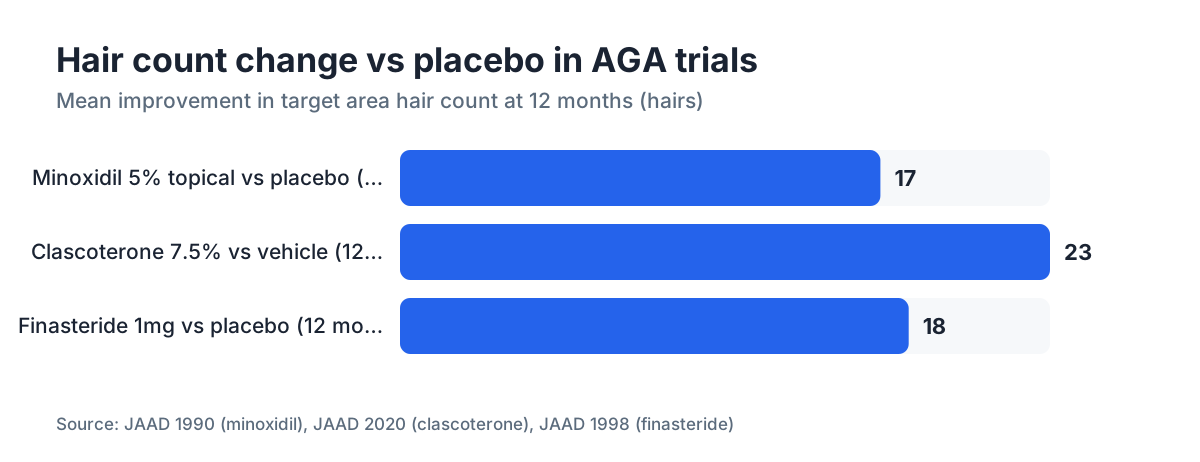
Minoxidil's track record is long and consistent. A 1990 placebo-controlled trial published in the Journal of the American Academy of Dermatology found that 5% topical minoxidil produced a mean hair count increase of roughly 17 hairs per cm² after 48 weeks versus about 7 hairs per cm² with placebo [3]. Later studies and a 2018 Cochrane systematic review confirmed that 5% minoxidil outperforms 2% minoxidil in men, with responder rates in the range of 60-70% for any measurable benefit, though the fraction of men who see dramatic regrowth is lower [4].
Clascoterone's evidence base is smaller. That is the honest reality right now. The two big Phase 3 trials submitted to the FDA for the acne indication enrolled roughly 1,440 patients. For androgenetic alopecia specifically, a Phase 2 randomized controlled trial published in the Journal of the American Academy of Dermatology in 2020 tested clascoterone 7.5% solution (a higher concentration than the approved cream) in men with AGA. After 12 months, clascoterone-treated patients showed statistically significant improvement in target area hair count compared to vehicle, with a mean difference of roughly 23.1 hairs in the target area [5]. That is a meaningful number, but the trial was relatively small and used a concentration not yet commercially available.
Head-to-head trials comparing clascoterone to minoxidil in a randomized design essentially do not exist yet. That gap matters. You cannot confidently say one outperforms the other based on separate trials with different patient populations and outcome measures. What you can say: both beat placebo, minoxidil has far more long-term data, and clascoterone's mechanism is genuinely different enough to make combination use scientifically sensible.
For women, the picture shifts. Minoxidil 2% is FDA-approved for female pattern hair loss [1]. Clascoterone, as an anti-androgen, is logically attractive for women too, particularly because finasteride is not approved for women and carries pregnancy risks. Early data look promising, but no large female-specific RCTs for clascoterone AGA treatment have been published as of mid-2026.
How do the side effect profiles compare?
Minoxidil's most common side effects are scalp irritation, dryness, and flaking. The propylene glycol in older topical formulas is the usual culprit; foam formulations cut that problem for many users. A real concern is initial shedding: in the first 2-8 weeks, minoxidil can push resting hairs into a shed phase before new growth follows. This is normal, not failure, but it alarms people. More serious cardiovascular effects (fluid retention, rapid heartbeat) are tied to oral minoxidil, not topical use at standard doses, though low-level absorption does occur [1]. For a thorough breakdown of what to expect, the minoxidil side effects article covers each one.
Clascoterone's most reported side effects in trials were local: erythema (redness), dryness, and application site scaling. In the acne trials, about 5% of participants had local skin reactions severe enough to note, but systemic anti-androgen effects (gynecomastia, sexual dysfunction) were not observed at rates above placebo [2]. That local-only profile is the drug's biggest selling point over systemic anti-androgens like finasteride.
There is one honest caveat. Because clascoterone is still newer and post-market surveillance is shorter, rare long-term effects may not yet be well characterized. Minoxidil has been used by millions of people for decades. The safety database is simply much larger.
Clascoterone vs minoxidil: a side-by-side comparison
The table below sums up what we actually know, without overstating the clascoterone evidence.
| Feature | Minoxidil (topical) | Clascoterone (topical) |
|---|---|---|
| FDA approval for AGA | Yes (men 1988, women 1996) [1] | No (off-label; approved for acne 2020) [2] |
| Mechanism | Vasodilator, prolongs anagen | Androgen receptor antagonist |
| Typical concentration | 2%-5% solution or foam | 1% cream (off-label AGA use) |
| Evidence quality for AGA | High (multiple large RCTs, 40 yrs) | Moderate (Phase 2 RCT, 2020) |
| Sexual side effects | Not reported at topical doses | Not reported |
| Initial shedding | Common in weeks 1-8 | Not prominently reported |
| Works in women | Yes (2% approved) | Theoretically yes; limited female data |
| Available OTC | Yes | No (prescription only) |
| Monthly cost (rough range) | $10-$30 generic | $80-$150 branded or compounded |
| Can combine with each other | Yes | Yes |
Cost is a real differentiator. Generic minoxidil is cheap and sold everywhere. Clascoterone at the Winlevi brand price runs much higher, and compounded versions vary. If money is tight, minoxidil is the obvious starting point.
Can you use clascoterone and minoxidil together?
Yes, and the combination makes mechanistic sense. Because they work through completely different pathways, there is no pharmacological reason to expect them to cancel each other out. One targets blood flow and hair cycle timing; the other blocks the hormonal miniaturization signal. Using both is roughly analogous to the logic behind combining finasteride and minoxidil, which has good evidence behind it.
A small pilot study published in 2021 in Dermatology and Therapy looked at clascoterone combined with minoxidil 5% in men with AGA and found the combination outperformed either agent alone on hair count metrics over 6 months, though the study size was too small to draw firm conclusions [6]. Larger trials are ongoing.
If you go this route, apply them at separate times to avoid formulation interactions (cream plus solution can pill or reduce absorption) and let each dry fully before applying the other. Most dermatologists suggest minoxidil in the morning and clascoterone at night, though no protocol has been formally standardized.
How does clascoterone compare to finasteride?
This is the comparison that matters most to men worried about sexual side effects. Finasteride works systemically: it inhibits the 5-alpha reductase enzyme that converts testosterone to DHT, lowering serum DHT by roughly 60-70% [7]. That systemic DHT reduction is why it works so well for scalp hair but also why it can affect libido, erection quality, and, in rare cases, cause post-finasteride syndrome.
Clascoterone blocks the androgen receptor locally at the follicle without suppressing systemic DHT. In theory, it gives you the follicle-level anti-androgen effect without the body-wide hormonal change. In practice, the evidence for finasteride in men is considerably stronger than for clascoterone in men. A five-year placebo-controlled trial showed finasteride 1mg maintained or increased hair count in about 90% of men versus 25% in the placebo group [7].
So the trade-off is real: finasteride has stronger efficacy data, clascoterone has a cleaner systemic side effect profile. For men who have tried finasteride and stopped due to side effects, clascoterone is a genuinely interesting alternative to discuss with a dermatologist. For men who are worried about side effects but have not tried finasteride, it is worth reading the finasteride full breakdown first before assuming you cannot tolerate it. Many men do fine.
For women, clascoterone is arguably more directly comparable to spironolactone (another oral anti-androgen used off-label for female AGA) than to minoxidil, since the mechanism is hormonal. The topical, local nature of clascoterone makes it attractive for women who want anti-androgen activity without the systemic blood pressure effects of spironolactone.
Who is each drug best suited for?
Minoxidil is the right first step for almost everyone starting to address hair loss, regardless of gender or Norwood stage. It is cheap, proven over decades, sold without a prescription, and the risk profile is well understood. If you are at a receding hairline stage and just beginning to take action, topical minoxidil is what most dermatologists recommend first.
Clascoterone makes the most sense in specific situations:
Men who cannot tolerate finasteride or are unwilling to try a systemic anti-androgen but want DHT-level intervention at the follicle. Women with androgenetic alopecia who want an anti-androgen option without systemic exposure. People already on minoxidil who have plateaued and want to add a different mechanism rather than push the dose higher. Patients with a clearly androgen-driven pattern where blocking DHT at the receptor seems directly logical.
Clascoterone is probably not the best starting drug if cost is a constraint, if you want the strongest-evidence option, or if you have not yet tried the basics. Hair loss medicine has a rough hierarchy of evidence: minoxidil and finasteride have the most data, clascoterone is promising but newer. Start with what has the deepest evidence base unless you have a specific reason not to.
If you want an objective, algorithm-driven starting point, the free AI hair scan at MyHairline (myhairline.ai/scan) can help you characterize your pattern before a dermatologist visit, so you walk in with a clearer picture of what you are dealing with.
How long does each treatment take to show results?
Minoxidil takes time. Most dermatologists tell patients to commit to at least 6 months before judging effectiveness, and a full year is a better measure. The first 6-8 weeks often bring shedding rather than growth, which is discouraging but expected. Real density improvement typically shows up at 4-6 months, with continued gains through 12 months. After that, you are mostly maintaining rather than improving.
Clascoterone timelines are less precisely mapped given the smaller body of trials, but the Phase 2 AGA trial ran 12 months and showed progressive improvement throughout, suggesting a similar or slightly slower timeline than minoxidil [5]. Anti-androgens generally act by preventing further miniaturization first; visible regrowth of already-miniaturized follicles is a slower process.
Neither drug produces results in weeks. Anyone promising fast hair regrowth from any topical is overselling. Patience is genuinely required, and before-and-after photos taken under consistent lighting at baseline and 6 and 12 months are the most honest way to track progress.
What happens if you stop taking either one?
Both drugs need continuous use. Stop minoxidil, and any hair maintained or regrown typically sheds within 3-4 months as follicles return to their pre-treatment cycle. This is not the drug damaging your hair; it is the underlying androgenetic alopecia reasserting itself. The same logic applies to clascoterone: remove the androgen receptor blockade and DHT can signal miniaturization again.
This is a non-trivial commitment. You are signing up for ongoing use, ongoing cost, and ongoing application. People sometimes underestimate this before starting. It is worth thinking through the long-term plan: how will you feel about applying this every day in five years? What is the cost burden over a decade? These are real questions, not reasons to avoid treatment, but reasons to go in clear-eyed.
For people who want a more permanent solution, a hair transplant moves follicles from DHT-resistant zones to thinning areas. Transplanted follicles generally keep their DHT resistance, so they do not need anti-androgen treatment to survive. Many people use both: a transplant for permanent density and minoxidil or clascoterone to preserve remaining native hair.
Is clascoterone available over the counter, and what does it cost?
No. Clascoterone requires a prescription. Winlevi (the branded 1% cream approved for acne) is what most prescribers write when using it for hair loss off-label. As of 2025-2026, the retail cost of Winlevi runs approximately $300-$400 per tube before insurance or discount cards, though GoodRx-type coupons can bring it lower at some pharmacies. Compounding pharmacies offer higher-concentration formulations (sometimes 5% or 7.5%, closer to what the AGA trials tested) for roughly $80-$150 per month, though compounded versions are not FDA-approved and quality control varies.
Minoxidil, by contrast, costs as little as $10-$20 per month for generic topical formulas at chain pharmacies. Even the better foam formulas run $25-$40 per month. The cost gap is large and should be part of your decision-making, especially since neither drug has a defined stopping point.
Insurance coverage for clascoterone for hair loss is unlikely given the off-label status. For acne it is sometimes covered; for AGA, expect to pay out of pocket. For more on the minoxidil for men options and pricing, that article covers both topical and oral forms in detail.
Should you consider oral minoxidil instead of topical?
Oral minoxidil has drawn serious attention from dermatologists over the past several years. At low doses (0.625 mg to 2.5 mg per day for women, 2.5 mg to 5 mg for men), it can be more convenient than daily topical application and may produce stronger effects in some patients. A 2021 review in the Journal of the American Academy of Dermatology found that low-dose oral minoxidil was effective and well-tolerated in AGA, with hypertrichosis (unwanted body hair growth) being the most common side effect [8].
Compared to clascoterone, oral minoxidil is still a vasodilator with no anti-androgen effect. If your hair loss is driven heavily by DHT sensitivity, adding an anti-androgen (topical clascoterone or finasteride) alongside any form of minoxidil addresses a different mechanism. The oral minoxidil article goes deeper on dosing and who it suits best.
The theoretical ideal stack for a man who wants broad coverage without finasteride's systemic anti-androgen effects: low-dose oral minoxidil plus topical clascoterone. No large RCT has tested this exact combination yet, so that is an honest qualifier, but the mechanistic rationale is sound and some dermatologists are prescribing this combination now.
Sources
- FDA, Minoxidil Drug Label (Rogaine 5% Topical Solution)
- FDA, Winlevi (clascoterone) Approval and Label, August 2020
- Olsen EA et al., Journal of the American Academy of Dermatology, 1990
- Cochrane Database of Systematic Reviews, Minoxidil for Androgenetic Alopecia, 2018
- Rosette C et al., Journal of the American Academy of Dermatology, 2020, Clascoterone Phase 2 AGA Trial
- Fertig RM et al., Dermatology and Therapy, 2021, Clascoterone plus minoxidil pilot study
- Kaufman KD et al., Journal of the American Academy of Dermatology, 1998 to 5-year finasteride placebo-controlled trial
- Randolph M and Tosti A, Journal of the American Academy of Dermatology, 2021, Low-dose oral minoxidil review
- FDA, Drug Approvals and Databases
- American Academy of Dermatology, Hair Loss: Who Gets and Causes
- National Institutes of Health, MedlinePlus, Minoxidil Topical