
TL;DR: Coconut oil is a decent hair conditioner with real evidence for reducing protein loss during washing, but no clinical trial has shown it reverses a receding hairline or stimulates new follicle growth. Androgenetic alopecia, the most common cause of receding hairlines, requires proven treatments like minoxidil or finasteride. Coconut oil won't hurt, but treating it as a primary therapy means losing ground.
What does coconut oil actually do to hair and scalp?
Coconut oil is about 50% lauric acid, a medium-chain fatty acid with a molecular weight low enough to penetrate the hair shaft rather than just coat the surface [1]. That's genuinely unusual. Most other oils, including mineral oil and sunflower oil, sit on the outside of the strand. Lauric acid gets inside.
A 2003 study published in the Journal of Cosmetic Science compared coconut oil, mineral oil, and sunflower oil as pre- and post-wash treatments [1]. Coconut oil was the only one that measurably reduced protein loss from both damaged and undamaged hair. The effect held up across repeat testing, and it means something for people who bleach, color, or heat-style often.
What it doesn't do is communicate with your follicles. The hair shaft is dead tissue. Reducing protein loss from the shaft protects the strands you already have from breaking, but it has no known mechanism for telling a miniaturized follicle to produce a thicker, longer hair again.
On the scalp itself, coconut oil has mild antimicrobial properties, mostly attributed again to lauric acid [2]. Some small studies suggest it can reduce colonization by Malassezia, the yeast associated with dandruff and seborrheic dermatitis. A scalp irritated from chronic dermatitis can shed diffusely, so clearing that up matters. But that's a different problem from androgenetic alopecia, which is what drives most receding hairlines.
Can coconut oil actually regrow a receding hairline?
No published randomized controlled trial has shown coconut oil regrowing hair in people with androgenetic alopecia (the genetic, DHT-driven hair loss behind most receding hairlines). That's not a technicality. It means we have no reliable human evidence it works for this purpose.
Receding hairlines are almost always driven by dihydrotestosterone binding to androgen receptors in genetically susceptible follicles, causing them to miniaturize over years [3]. Coconut oil has no known anti-androgenic effect and no established mechanism for reversing follicle miniaturization. Applying it to the hairline is like moisturizing a tire with a slow puncture. The tire looks better briefly, but the air keeps leaking.
The viral claims you see online typically conflate two things: coconut oil making existing hair look thicker (true, because it fills gaps in the cuticle and reduces breakage) with coconut oil regrowing lost hair (no evidence). Those are completely different outcomes.
If you want to understand the biology driving your hairline back, receding hairline is worth reading before you decide what to spend money on. And if you're wondering what's actually behind your shedding, what causes hair loss covers the mechanisms researchers have verified.
What does the research on coconut oil and hair loss actually include?
Here's the honest picture: the evidence base for hair regrowth is thin, and most of what exists is in vitro or animal work. Here's what's on the record.
The 2003 Rele and Mohile study in the Journal of Cosmetic Science is the most cited, and its finding is about protein loss reduction, not regrowth [1]. It's a good study. It answers a different question.
A 2021 review in the International Journal of Molecular Sciences looked at natural compounds and hair disorders [4]. It noted that some coconut-derived compounds have anti-inflammatory properties relevant to scalp health, but the authors said plainly that clinical trials for hair regrowth are lacking.
There's one frequently cited small Indian study suggesting coconut oil may reduce hair fall tied to scalp inflammation. It was not randomized, had no control group, and used subjective self-report. That's nowhere near enough to draw conclusions from.
Some researchers have looked at whether lauric acid inhibits 5-alpha reductase, the enzyme that converts testosterone to DHT. There's in vitro data suggesting weak inhibition [5]. In vitro means in a cell dish, not in a human scalp. Plenty of substances inhibit enzymes in a dish and do nothing measurable when applied topically to intact skin. The leap from "lauric acid shows weak 5-AR inhibition in a cell assay" to "coconut oil treats androgenetic alopecia" is not supported.
Nobody has good data on the topical DHT-inhibition question in humans. The closest thing we have is the well-established clinical evidence for DHT blocker medications, which work through mechanisms validated in large trials.
How does coconut oil compare to treatments with proven evidence?
The comparison is where things get stark.
| Treatment | Evidence level | Typical regrowth in trials | Mechanism proven |
|---|---|---|---|
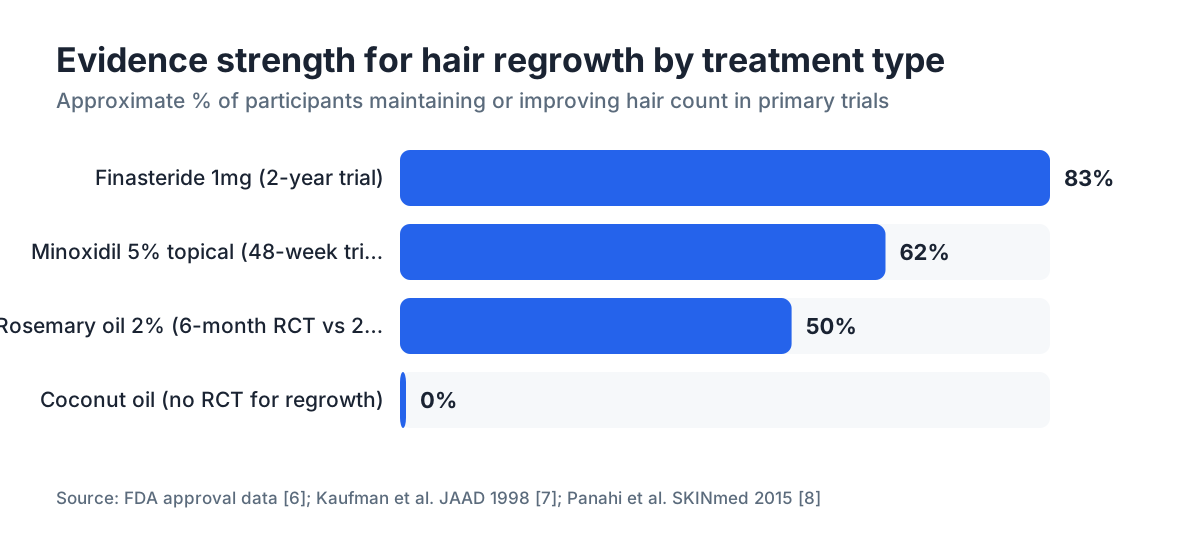
| Minoxidil 5% topical | Multiple RCTs | ~15-25% increase in terminal hair count at 48 weeks [6] | Prolongs anagen, possible vasodilation |
| Finasteride 1mg oral | Multiple RCTs | ~83% stopped progression, ~66% showed some regrowth at 2 years [7] | 5-AR inhibition reduces scalp DHT by ~70% |
| Rosemary oil 2% | One RCT (n=100) | Comparable to minoxidil 2% at 6 months [8] | Possible anti-inflammatory, circulation |
| Coconut oil (topical) | No RCTs for regrowth | No measured regrowth data | None established for follicles |
Rosemary oil earns a separate note because it actually has a head-to-head trial. A 2015 randomized controlled trial published in SKINmed compared rosemary oil to 2% minoxidil in 100 patients over six months [8]. Both groups had similar hair count increases by week 24. That's one study, it used 2% minoxidil (not the stronger 5%), and it needs replication. But it's actual evidence of follicular response. Rosemary oil for receding hairline is a reasonable thing to investigate if you want a natural option with some trial data behind it.
Coconut oil has nothing equivalent. That doesn't mean you should avoid it. It means you shouldn't rely on it as your primary strategy when you have a receding hairline.
Are there any real benefits of coconut oil for your hair and scalp?
Yes, a few, though none of them are about regrowing lost ground.
Breakage protection is real. If you have any hair left at your hairline and it's fragile from styling or chemical processing, using coconut oil as a pre-wash treatment can reduce the protein loss that leads to breakage [1]. That keeps the hair you have from thinning through mechanical damage.
Scalp moisture can help in specific cases. If you have a dry, flaky scalp, coconut oil can reduce that. The antimicrobial effect on Malassezia may reduce mild dandruff [2]. A calmer scalp is a better environment, though "better environment" is not the same as "regrows follicles."
It's safe and cheap. A jar of unrefined coconut oil costs $8 to $15. There are no known serious adverse effects from topical use. Some people find it comedogenic (pore-clogging) on facial skin, and the scalp has a high follicle density, so if you're acne-prone on your scalp, watch for it. For most people, the risk profile is negligible.
As a complement to proven treatments, it's fine. If you're using minoxidil for men and want to add coconut oil as a scalp conditioner on the side, that's a reasonable choice. Just use them at different times. Applying coconut oil right before minoxidil may reduce minoxidil's absorption, which is the opposite of what you want.
How should you use coconut oil on your hair if you choose to try it?
If you decide to use it, here's an approach grounded in what the evidence supports.
Pre-wash treatment works better than leave-in for most hair types. Apply a small amount (roughly a teaspoon for medium-length hair) to dry or slightly damp hair, focusing on the mid-lengths and ends rather than dumping it on the scalp. Leave it for 30 to 60 minutes, then shampoo out. This is the closest application method to what the 2003 Rele and Mohile study tested [1].
If you want to apply it to the scalp, use very small amounts. A little goes a long way. Massaging it in for 4 to 5 minutes isn't a bad habit, because scalp massage itself has some supporting evidence for modest hair growth improvement, separate from any oil effect [10].
Avoid it on the same application as minoxidil, as mentioned above. If you're using topical minoxidil twice daily, a coconut oil treatment once a week is fine, just not in the same session.
Organic, unrefined ("virgin") coconut oil is the form used in most research. The refining process strips some of the lauric acid content, so refined versions may be less effective for hair shaft penetration.
Frequency: once a week is plenty. Daily application to the scalp tends to cause buildup that makes hair look greasy and can force more aggressive shampooing, which adds its own mechanical stress.
What about coconut oil mixed with other oils for hair loss?
There are a lot of recipes online combining coconut oil with peppermint oil, castor oil, rosemary oil, or onion juice. The evidence for each varies enormously.
Rosemary oil is the strongest natural candidate here. The 2015 SKINmed trial [8] gave it real credibility that the other "natural" options mostly lack. Mixing it into coconut oil as a carrier is a common and reasonable approach. A typical dilution is 2 to 3 drops of rosemary essential oil per teaspoon of carrier oil. Essential oils at higher concentrations can irritate the scalp, so don't assume more is better.
Castor oil gets a lot of attention but has essentially no controlled trial data for hair regrowth. Its main known property is that it's a very thick, occlusive oil that coats the hair shaft. Some people find it helps with moisture retention. It has no known follicular mechanism.
Peppermint oil has one mouse study showing it outperformed minoxidil for hair growth in rodents. Mouse hair growth works very differently from human androgenetic alopecia. One mouse study is not a basis for a treatment decision.
The honest position: combining coconut oil with rosemary oil is probably the most evidence-adjacent of the DIY approaches. The rest are largely speculative.
When is coconut oil a bad idea for hair loss?
There are a few situations where relying on coconut oil specifically costs you.
If you have early androgenetic alopecia (Norwood II-III, a hairline that's starting to move back), the window where treatments have the best effect is right now. Waiting months to see if coconut oil works is waiting months during which your follicles keep miniaturizing. The evidence for finasteride preventing further progression is strong [7]. Delaying that to try an unproven remedy is a real cost, even if the oil itself is harmless.
If your hair loss came on suddenly and diffusely rather than as a gradual recession, you might be dealing with telogen effluvium rather than androgenetic alopecia. Coconut oil does nothing for that mechanism either, and the underlying trigger (nutrition, stress, illness, hormonal shift) needs to be addressed directly.
If you've been applying coconut oil for six months and convincing yourself things look better, get a real assessment. A photo comparison under the same lighting is more honest than your impression. Tracking matters. If you want an objective baseline before you decide on anything, the free AI hair analysis at MyHairline gives you a starting point so you're doing more than guessing in the mirror.
Coconut oil is not a bad product. It's a bad primary strategy for hair regrowth.
What treatments actually work for a receding hairline?
Here's what has real evidence, stated plainly.
Minoxidil is the most accessible first step. The 5% topical solution or foam is FDA-approved for androgenetic alopecia [6]. It doesn't work for everyone, but the trial data is solid. It requires daily use indefinitely. Stop, and you lose what you gained within months. The minoxidil side effects profile is generally mild but worth understanding before you start. Some people find oral minoxidil more convenient and equally effective, though it's used off-label.
Finasteride is more powerful for androgenetic alopecia specifically. It targets the hormonal mechanism directly. The five-year data from the original Merck trial showed 90% of men maintained or improved hair count compared to 75% of placebo patients who worsened [7]. Sexual side effects affect a minority of users (around 2 to 4% in trials) and usually resolve on stopping. Read finasteride before you decide, and have that conversation with a doctor.
Using both together compounds the benefit. Finasteride and minoxidil in combination show better outcomes than either alone in several trials.
For people who've already lost significant ground and want permanent restoration, hair transplant is an option, though it's expensive ($4,000 to $15,000 depending on graft count and method) and works best when underlying loss is stabilized first.
None of these are coconut oil.
Is there any risk to using coconut oil on your hair or scalp?
For most people, topical coconut oil is safe. The American Academy of Dermatology doesn't list it as a high-risk product, and serious adverse reactions are rare [9].
The main risks are minor. Coconut oil is comedogenic for some people, meaning it can clog pores. On the scalp this can occasionally trigger folliculitis (inflamed hair follicles) in people already prone to scalp acne. If small, tender bumps develop on your scalp after starting coconut oil, stop using it there.
Allergy is uncommon but possible. If you're allergic to coconut or tree nuts, check with your doctor before applying any coconut-derived product topically.
The bigger practical risk is product buildup. Coconut oil doesn't wash out easily with a gentle shampoo. If you use a lot of it often, you may need a clarifying shampoo every week or two to prevent residue from accumulating. Heavy buildup makes the scalp feel greasy and can make topical medications less effective if they're applied over it.
So it's a low-risk addition. The risk is not in the oil itself. The risk is in replacing effective treatments with it.
What's the honest bottom line on coconut oil for a receding hairline?
Coconut oil is a good hair conditioner with legitimate science behind its ability to reduce protein loss and shaft breakage [1]. It may help with mild dandruff. It costs almost nothing and has a favorable safety profile. Use it if you like how your hair feels with it.
It is not a treatment for androgenetic alopecia. No trial has shown it reverses follicle miniaturization, stimulates new growth, or stops a receding hairline from continuing to recede. The mechanism driving hairline recession (DHT, androgen receptor sensitivity) is not touched by coconut oil.
If you're early in the process and your hairline is just starting to move, that's actually good news: the earlier you start a proven treatment, the more you preserve. Spending six months on coconut oil instead is six months of unnecessary loss.
As a complement to minoxidil or finasteride? Fine, on separate applications. As a substitute? No.
The best thing you can do right now is get a clear picture of where you stand. MyHairline's free AI scan (/scan) maps your hairline and gives you a Norwood stage estimate so you can make a real decision rather than hoping a pantry staple will do the work of a pharmacy.
Sources
- Journal of Cosmetic Science, Rele and Mohile 2003
- Journal of Medicinal Food, Ogbolu et al. 2007
- American Academy of Dermatology, Hair Loss Overview
- International Journal of Molecular Sciences, Gavazzoni Dias 2021
- Journal of Natural Products, Liao and Hiipakka 1995
- FDA, Drug Approvals and Databases: Minoxidil
- Journal of the American Academy of Dermatology, Kaufman et al. 1998
- SKINmed Journal, Panahi et al. 2015
- American Academy of Dermatology, Skin Care Recommendations
- Dermatology and Therapy, Koyama et al. 2019
- National Institutes of Health, MedlinePlus: Androgenetic Alopecia