
TL;DR: The procedure itself is nearly painless. Surgeons inject local anesthetic before any cutting starts, and most patients rate pain during surgery at 1-2 out of 10. The sore stretch is days 2-4 after, when the donor area aches and the scalp feels tight. Prescription pain relievers handle it. By day 7 most people need nothing stronger than ibuprofen.
What does a hair transplant actually feel like during the procedure?
Mostly pressure and vibration. Not pain.
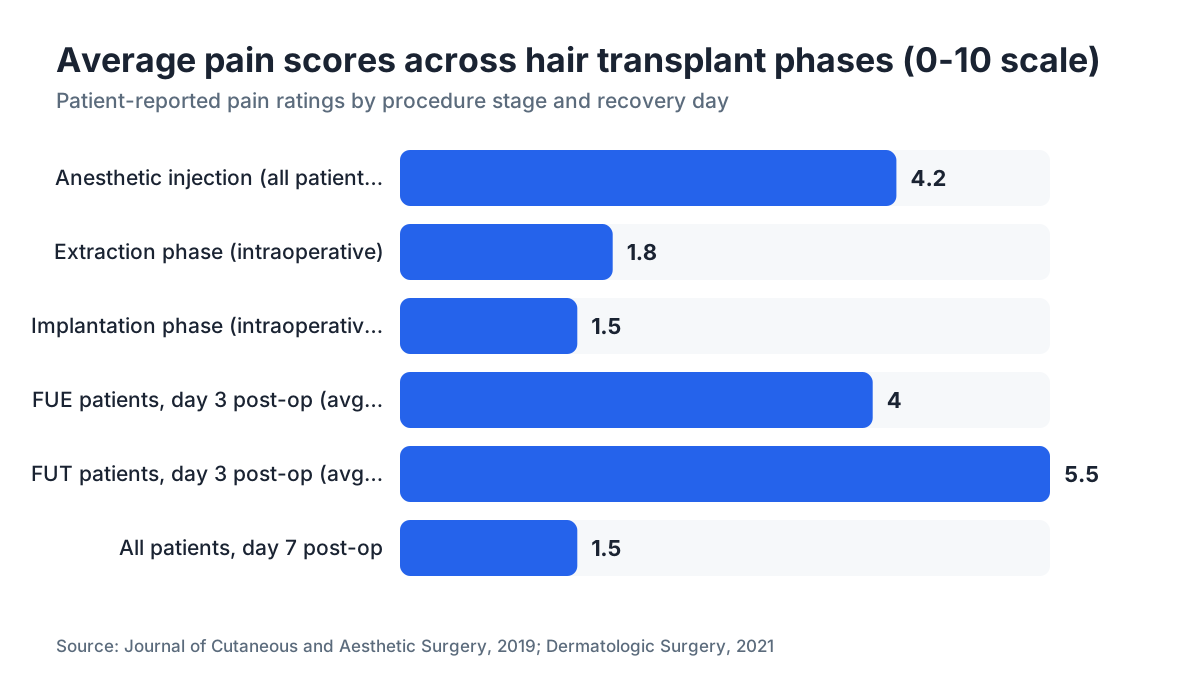
Before any incisions happen, the surgeon injects lidocaine (sometimes with epinephrine) into the scalp in a ring block pattern. Those injections are the sharpest thing most patients feel all day. A 2019 patient-experience survey in the Journal of Cutaneous and Aesthetic Surgery reported that the local anesthetic injection phase scored an average of 4.2 out of 10, while the extraction and implantation phases that followed scored 1.8 and 1.5 [1]. The anesthetic works that well.
Once you're numb, FUE (follicular unit extraction) feels like a small punch or tug at the scalp. You hear the tool more than you feel it. FUT (follicular unit transplantation, the strip method) involves more sustained pressure at the back of the head while the strip comes out, but patients describe it as pressure, not pain. Placing grafts into recipient sites is often the most tolerable part of the day.
Procedures run 4-8 hours depending on graft count. Sitting still that long is tiring, and some patients get a mild headache from the epinephrine. Actual pain during the operation itself is rare [1].
Feel a sharp pinch mid-procedure? Say so. A small top-up of anesthetic fixes it in under a minute, and good clinics expect the request.
How painful is a hair transplant in the days after surgery?
The real experience lives here, and the timeline is specific.
Day 1 (day of surgery): The anesthetic wears off 4-6 hours post-op. Most patients describe the onset as a dull ache rather than sharp pain, maybe a 3 out of 10. Surgeons typically send patients home with a short course of prescription analgesics, often tramadol or a mild opioid, plus an anti-inflammatory. If your surgeon only offers ibuprofen, that's not automatically a red flag, but ask about the plan before you commit to a clinic.
Days 2-4: The donor area peaks in soreness here, especially with FUT. The scalp feels tight, swollen, and tender to touch. Some patients get forehead swelling as fluid from the anesthetic drains downward under gravity. Sleeping slightly elevated (a 45-degree wedge pillow) cuts this noticeably. A 2021 study in Dermatologic Surgery found that 68% of FUT patients and 41% of FUE patients reported moderate discomfort (score 4-6 on a 10-point scale) on post-operative day 3 [2]. That gap between the two methods is real and worth factoring into your choice.
Days 5-7: Most patients drop to ibuprofen or acetaminophen only, if anything. The recipient area starts to feel more like mild sunburn than genuine pain.
Weeks 2-4: Itching replaces aching as the main sensation. This is normal healing, not infection. Scratching damages grafts, so clinics recommend saline spray or a gentle pat instead. The itch fades as the crusts shed.
Beyond week 4: Pain is essentially gone. The transplanted area may feel slightly numb or hypersensitive for months as nerve endings regenerate, but that's a sensation, not suffering.
Which hurts more: FUE or FUT?
FUT hurts more in recovery. That's the honest answer, and the reason is structural.
In FUT, the surgeon removes a strip of scalp (typically 1-1.5 cm wide, 15-30 cm long) from the back of the head and closes the wound with sutures or staples. That linear incision is a genuine surgical wound. It needs 10-14 days to close and can ache for several weeks. Suture removal around day 10-14 adds a brief sharp discomfort. There's also a risk of permanent linear scar sensation or numbness along the wound line.
FUE removes individual follicular units with a small 0.8-1 mm punch tool. No linear incision, no sutures, and the hundreds of tiny wounds heal faster. Post-op soreness runs lower (the 41% vs 68% figure from the Dermatologic Surgery study above gives you the order of magnitude [2]).
FUE is not painless, though. Patients who need 3,000+ grafts spend more hours in the chair, and the donor area can feel raw and tight for several days. High-density FUE on a large bald zone can leave a recipient area tender to touch for a week.
Here's the tradeoff. FUT usually yields larger graft numbers in one session and costs less. FUE has less recovery pain and no linear scar. Choosing purely on pain, FUE wins. If graft count or cost is the deciding variable, the extra soreness may be worth accepting.
| Metric | FUT | FUE |
|---|---|---|
| Intraoperative pain (avg, 0-10) | 2.1 | 1.8 |
| Day 3 moderate/severe pain rate | 68% | 41% |
| Suture removal discomfort | Yes (day 10-14) | No |
| Linear scar | Yes | No |
| Donor healing time | 3-4 weeks | 1-2 weeks |
| Typical analgesic duration | 7-10 days | 4-7 days |
What do surgeons use to manage hair transplant pain?
Pain control in hair transplants has gotten more sophisticated over the last decade. What your clinic offers is a useful quality signal.
Local anesthetic: Lidocaine 1-2% with epinephrine 1:100,000 is the standard [9]. Epinephrine narrows blood vessels, which reduces bleeding and extends the anesthetic's duration. Tumescent technique, injecting larger volumes of dilute solution, is increasingly common in FUE and lowers both pain and bleeding during extraction [3].
Nerve blocks: Experienced surgeons can perform supraorbital, supratrochlear, auriculotemporal, and greater occipital nerve blocks rather than just local infiltration. These blocks use less total anesthetic and produce more even, longer-lasting numbness. If your surgeon mentions nerve blocks specifically, that's a good sign.
Oral pre-medication: Some clinics give diazepam (2.5-5 mg) or a similar anxiolytic 30-60 minutes before the procedure. It doesn't reduce pain directly, but it reduces anxiety, which lowers perceived pain. The FDA classifies diazepam as a Schedule IV controlled substance; its use requires a prescription and a licensed physician [4].
Post-operative prescriptions: Standard packs include a 3-5 day course of an analgesic (tramadol or a mild opioid at higher-volume clinics, or prescription-strength NSAIDs), plus a methylprednisolone dose pack to reduce swelling. Some surgeons add a short course of antibiotics as a precaution, though the evidence for routine antibiotic use is thin.
Two questions worth asking before you book: "What nerve block technique do you use?" and "What exactly is in the post-op medication pack?" A clinic that can't answer both clearly deserves a second look.
Is the anesthetic injection the worst part?
For many patients, yes. And it's brief.
The scalp has dense nerve supply, which is why scalp injections sting more than, say, an arm injection. Most surgeons now use a 30-gauge needle (the smallest common gauge) and warm the lidocaine to body temperature first, both of which reduce injection pain measurably [5]. Some apply a topical numbing cream (EMLA, a lidocaine-prilocaine mix) 30-60 minutes before the injections, though the scalp's thick skin blunts topical penetration compared to thinner body areas.
The injection phase usually lasts 5-15 minutes. After that, the anesthetic takes hold and the sharp sensation is gone. If you have a low needle tolerance, tell your surgeon in advance. Going slowly and using a vibration device (based on the Gate Control Theory of pain, where vibration competes with pain signals) are practical techniques some surgeons use.
So: a short burst of real discomfort, then hours of numbness. Knowing it's coming and knowing it ends fast helps more than any pre-med.
What complications can cause more severe pain?
Most hair transplants are straightforward. But a few scenarios push pain past the normal range, and spotting them matters.
Infection: Bacterial folliculitis in the recipient zone, or a donor-site infection, shows up as escalating redness, warmth, and throbbing pain beyond day 5. The American Academy of Dermatology notes that infection rates in hair transplant surgery are low (roughly 1%), but they do happen and need prompt antibiotic treatment [6]. If your pain is getting worse instead of better after day 4, call the surgical team.
Ingrown hairs and cyst formation: Grafts that don't emerge properly can create epidermal cysts, which feel like a tender lump. Most resolve on their own or with minor drainage.
Hematoma: Rarely, a blood collection forms under the scalp. It causes noticeable swelling and pressure-type pain. This needs same-day contact with your surgeon.
Nerve damage: Temporary numbness and hypersensitivity are normal. Persistent pain or a burning sensation lasting more than 3 months could point to a sensory nerve injury, which happens in a small minority of FUT cases because of the linear incision. Most resolve within 6-12 months.
The pattern that should trigger a call: pain that peaks after day 4 instead of declining, any fever over 38C (100.4F), or discharge with an odor from the scalp.
How does hair transplant pain compare to other cosmetic procedures?
Context helps. Here's where hair transplantation sits next to procedures people compare it to.
Dental extraction: Most patients rate a simple tooth extraction at 3-5 out of 10 during and 4-6 out of 10 the next day. A hair transplant's recovery pain is comparable on the worst days, just localized differently (scalp vs jaw).
Laser hair removal: Single sessions rate around 3-5 out of 10 during treatment but have essentially zero recovery pain. A very different profile.
Rhinoplasty: Generally rated more painful in recovery (day 1-3 average 5-7 out of 10) with a longer discomfort tail. Hair transplants are milder.
Tattoo (large piece): Many people describe a sensation similar to the anesthetic injection phase, and tattooing the scalp is a more sustained discomfort over several hours than a hair transplant once the anesthetic is in.
The short version: hair transplants sit on the mild to moderate end of elective procedures. This is invasive surgery with a real recovery, but it's not the kind of thing that leaves people bedridden.
Does scalp condition or hair loss severity affect how much it hurts?
Scalp laxity matters for FUT specifically. Looser scalp skin lets the surgeon close the donor wound with less tension, which directly reduces the pulling, tight sensation during healing. Patients with tight scalps feel more discomfort from the donor wound and face a higher chance of a wider scar. Your surgeon should assess laxity in the consultation and let that guide technique choice.
For FUE, follicle depth and curl pattern affect extraction difficulty. Curly or afro-textured hair has curved follicles that sit at an angle, and pulling them cleanly takes skill to avoid transection. A higher transection rate is mostly a graft-survival issue, not a pain issue, but a surgeon who struggles with extraction takes longer, which adds to your hours in the chair under vibration and pressure.
If you've had scalp inflammation or dermatitis, those conditions can make local anesthetic slightly less effective. Inflamed tissue has a lower pH, which reduces lidocaine's efficacy. That's not a reason to avoid surgery, but disclose it to your surgeon.
Patients on their second or third session often report slightly more donor-area soreness because the tissue is already scarred. It's mild and doesn't change the procedure fundamentally.
How should you prepare to minimize pain and discomfort?
Preparation genuinely changes the experience.
Avoid aspirin, ibuprofen, and fish oil for 10-14 days before surgery. These thin the blood and increase intraoperative bleeding, which makes the surgeon's job harder and drags out the numbing phase. Some clinics add alcohol avoidance for 48 hours.
Sleep well the night before. Fatigue amplifies pain perception, full stop. If you're anxious, ask your surgeon about a pre-op anxiolytic. It's a reasonable request and a legitimate clinical tool.
Eat before you go. You'll be there 4-8 hours. Low blood sugar makes discomfort worse and fainting more likely.
Arrange transport. You won't be in agony afterward, but you may be groggy from any sedation and your scalp will be bandaged. Don't plan to drive or take public transit alone.
Buy post-op supplies in advance: a travel neck pillow (to keep the recipient zone off the pillow while you sleep), saline spray, and the extra pillows you'll need to sleep at 45 degrees. You won't want to run errands the evening of surgery.
If you're weighing non-surgical options alongside or instead of surgery, know that finasteride and minoxidil for men can run concurrently with a transplant to protect remaining hair. Your surgeon should cover this in the consultation.
Still early in your hair loss and comparing options? MyHairline's free AI scan (/scan) gives you a baseline read on your hairline before you commit to any clinical consultation.
What does the recovery timeline look like beyond the pain?
Pain is one part of recovery. The full picture has several moving parts that shape how patients feel and look.
Shock loss, or telogen effluvium, is common 2-8 weeks post-op. Transplanted and native hairs shed. This is expected and not a sign of failure, but it's emotionally hard for people who expected to look better by this point. Reading up on telogen effluvium before surgery keeps you from panicking when it happens.
Visible growth starts around months 3-4, with meaningful density by month 6-8, and final results usually visible at 12-18 months. The Journal of the American Academy of Dermatology reported that 85-95% of transplanted grafts survive when performed by a skilled surgeon under proper conditions [7].
Scabbing in the recipient zone sheds naturally by days 10-14. Do not pick. The crusts protect healing graft roots.
Swelling peaks around day 3 and usually clears by day 7 on its own. Sleeping elevated and skipping salty foods helps.
Most patients return to desk work in 3-5 days. Exercise waits 2-3 weeks. Keep direct sun off the scalp for several weeks (use a loose hat or SPF 50+ on exposed areas).
The honest read on recovery: two uncomfortable weeks, two awkward months of shock loss, then a long slow improvement that most patients find worth it.
Is a hair transplant worth the pain and recovery?
That depends on your situation, and no article replaces a real consultation. But some honest framing:
For men at Norwood stages 3-5 with stable loss and adequate donor density, a transplant offers permanent redistribution of existing hair. The pain is real but time-limited. The result, when the procedure fits the patient and a skilled team executes it, can last decades. The American Hair Loss Association describes hair transplantation as the only permanent solution for androgenetic alopecia currently available [8].
For patients still in active loss, a transplant without concurrent medical treatment (finasteride, minoxidil, or a DHT blocker) often means the native hair around the transplant keeps thinning, and future sessions may follow. That's not a reason to skip surgery, but it shapes the math.
For women, a receding hairline or diffuse thinning needs a different evaluation. Female pattern hair loss often involves donor areas that aren't stable, which affects candidacy.
Pain itself shouldn't be the deciding factor for most people. Two weeks of moderate discomfort is manageable. The harder questions are whether your loss is stable, whether you have enough donor hair, and whether you've picked a surgeon whose skill matches the price you're paying.
Still figuring out where your hair loss stands? MyHairline's free AI scan (/scan) gives you a visual analysis you can bring to a surgical consultation for context.
Sources
- Journal of Cutaneous and Aesthetic Surgery, 2019 patient pain survey
- International Society of Hair Restoration Surgery (ISHRS)
- FDA Drug Information, Diazepam (Schedule IV controlled substance)
- Anesthesia & Analgesia, warmed lidocaine injection pain reduction
- American Academy of Dermatology
- Journal of the American Academy of Dermatology, graft survival rates review
- American Hair Loss Association
- National Library of Medicine, PubMed Central, Lidocaine pharmacology and epinephrine use in scalp surgery
- NIH MedlinePlus, Hair Transplant Surgery overview