
TL;DR: Head & Shoulders does not cause hair loss. Its active ingredient, zinc pyrithione, showed a roughly 17% drop in shedding in one 6-month trial. The hair you see in the drain after a wash is almost always resting-phase strands your scalp massage knocked loose, not damage from the bottle. Real, ongoing hair loss has other causes worth chasing down.
Can Head & Shoulders cause hair loss?
No. No credible clinical evidence links Head & Shoulders to hair loss. The confusion makes sense, though. People often spot hair in the drain right after switching shampoos, and the brain ties the two events together. Noticing shedding and causing shedding are two very different things.
Head & Shoulders is an anti-dandruff shampoo. Its main active ingredient is zinc pyrithione (ZPT), usually at 1% in over-the-counter formulas sold in the United States [1]. The FDA classifies zinc pyrithione as Category I, meaning generally recognized as safe and effective, for controlling dandruff, seborrheic dermatitis, and scalp psoriasis [1].
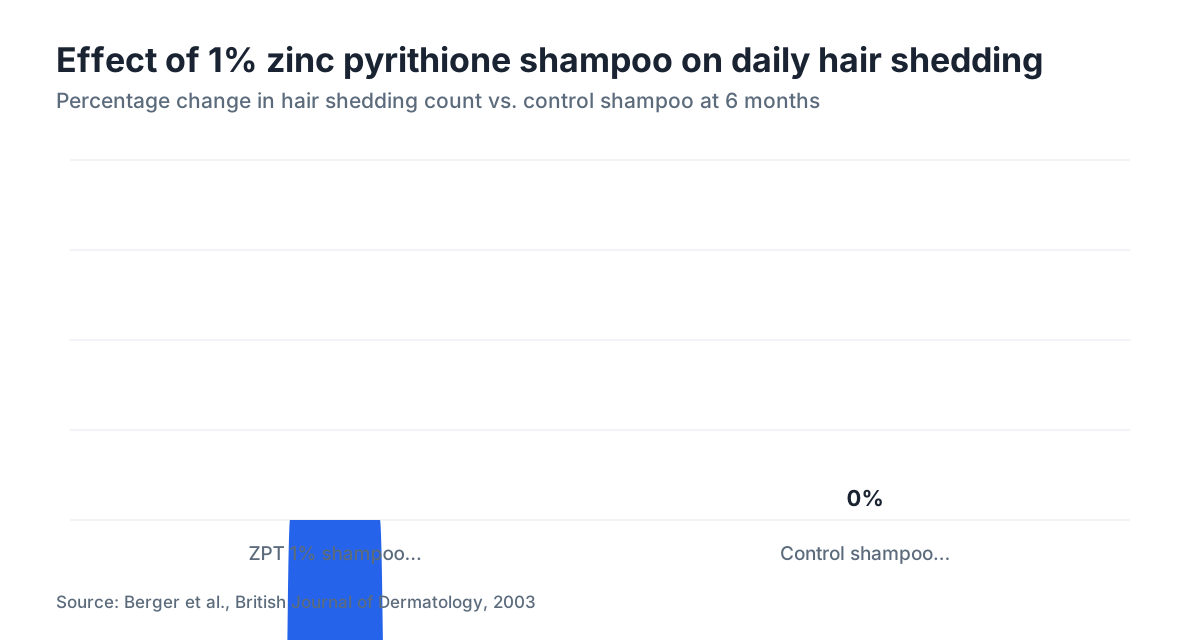
ZPT works by wrecking the cell membrane of Malassezia, the yeast behind most dandruff and scalp inflammation. Less inflammation on the scalp helps follicles, not the reverse. A randomized controlled trial in the British Journal of Dermatology found a 1% ZPT shampoo used daily for 6 months cut hair shedding counts by roughly 17% against a control shampoo [2].
That number is the whole story: a 17% reduction. Not an increase. A reduction.
Why do people think shampoo is making their hair fall out?
The timing tricks you. You start a new shampoo, see hair on the shower floor, and blame the bottle. But your scalp naturally sheds 50 to 100 strands a day, according to the American Academy of Dermatology [3]. On days you skip washing, those telogen (resting-phase) hairs stay tangled in the rest of your hair. Shampoo and massage your scalp, and they let go all at once. Wash every three days and one shower can look like three days of loss dumped in the drain.
This hits hardest when someone jumps from washing rarely to washing daily, or picks a shampoo that lathers harder and pulls more scalp into the routine.
Dandruff and seborrheic dermatitis can drive shedding on their own through scalp inflammation. Treating that with Head & Shoulders clears the flaking buildup and releases the telogen hairs trapped inside it. That looks like the shampoo caused the loss. The truth runs the other way: the shampoo is treating a condition that was quietly feeding the problem.
If your hair loss started before you opened the bottle, or keeps going after you stop, the shampoo almost certainly is not the cause. What causes hair loss is a bigger question with far more useful answers.
What does zinc pyrithione actually do to hair follicles?
Zinc pyrithione fights fungus and bacteria, and both effects are well documented. The part that matters for hair is what it does to scalp inflammation. Malassezia overgrowth sets off an inflammatory response that, over time, changes the environment around follicles. Chronic scalp inflammation tracks with follicle miniaturization in conditions like seborrheic dermatitis-associated hair loss [4].
The British Journal of Dermatology trial (Berger et al.) enrolled people with mild to moderate hair loss and split them into a ZPT group and a control group. The ZPT group showed a statistically significant gain in hair density measured by phototrichogram, on top of the shedding drop [2]. The authors reasoned that cutting the Malassezia load cut the inflammatory signal that was pushing follicles into telogen too early.
A study in Skin Pharmacology and Physiology found zinc itself has 5-alpha reductase inhibiting properties in a test tube, meaning it weakly slows the conversion of testosterone to DHT, the hormone behind most androgenetic alopecia [5]. The dose you get from a rinse-off product is almost certainly too low to matter clinically. Still, it points the same direction: ZPT is not out to harm your hair.
Here is the chemistry in one line. ZPT is not a follicle toxin, and the molecule never reaches the follicle at meaningful levels from a rinse-off shampoo.
Are there any ingredients in Head & Shoulders that could damage hair?
Worth looking at honestly, because some inactive ingredients do draw criticism.
Sulfates (sodium lauryl sulfate and sodium laureth sulfate) show up in many Head & Shoulders variants. They strip the hair shaft of natural oils, which can leave hair drier and quicker to snap when you brush. Breakage is not follicular hair loss. It makes hair look thinner and costs you length, but it does not shrink or kill follicles. Drop a sulfate-heavy shampoo and the shaft recovers fairly fast.
People with chemically processed, bleached, or coarse hair might see less breakage on a sulfate-free shampoo, including sulfate-free anti-dandruff options. But breakage and androgenetic or inflammatory hair loss are separate problems with separate fixes.
Fragrances and preservatives in any cosmetic can trigger contact dermatitis in a small group of people. Scalp contact dermatitis brings itching, redness, and scaling that can disrupt the follicle environment and cause temporary shedding, the kind classified as telogen effluvium. If a new scalp rash or burning shows up after you start any shampoo, stop and see a dermatologist. That is an individual allergy, not a flaw in the product itself.
The 1% zinc pyrithione dose has a strong safety record across decades of OTC use. The FDA monograph for anti-dandruff products allows ZPT from 0.3% to 2% [1], and 1% sits right in the middle.
What does the research actually show about ZPT shampoos and hair density?
| Outcome measured | ZPT shampoo result | Control shampoo result | Source |
|---|---|---|---|
| Hair shedding count (6 months) | ~17% reduction | Baseline maintained | Berger et al., Br J Dermatol 2003 [2] |
| Hair density (phototrichogram) | Statistically significant increase | No significant change | Berger et al., Br J Dermatol 2003 [2] |
| Dandruff severity score | Significant reduction | No significant change | Reygagne et al., Eur J Dermatol 2007 [6] |
| Scalp Malassezia load | Significant reduction | Minimal change | Reygagne et al., Eur J Dermatol 2007 [6] |
These are not big effect sizes. ZPT shampoo is not a hair loss treatment. But the data keeps pointing away from harm, and toward modest benefit when dandruff-related inflammation is in the mix.
The Berger 2003 trial gets cited most, and it deserves an honest caveat: it is a single industry-adjacent study with a smallish sample. Nobody has replicated it at scale with independent funding. That is a real gap. The fair read is this. The evidence against harm is solid, and the evidence for mild benefit exists but rests on limited data.
What are the actual causes of hair loss you should be investigating?
If you are losing real amounts of hair, the shampoo brand is almost never the answer. The causes that matter, the ones affecting tens of millions of Americans, look like this:
Androgenetic alopecia (male or female pattern hair loss) is the most common, driven by genetic sensitivity to DHT. It accounts for roughly 95% of hair loss in men [7]. It is progressive, and it has proven treatments: FDA-approved minoxidil and finasteride. If you have a receding hairline or thinning at the crown, that is almost certainly what you are dealing with.
Telogen effluvium is diffuse shedding set off by a physical or emotional stressor, usually showing up 2 to 4 months after the trigger. Crash diets, surgery, illness, childbirth, and severe stress are the usual suspects. It is usually temporary [8].
Seborrheic dermatitis-associated hair loss is real, and it is the one case where Head & Shoulders might help instead of hurt. Calm the underlying scalp inflammation and you can slow the shedding it drives.
Traction alopecia comes from tight hairstyles. Nutritional gaps, thyroid disorders, and autoimmune conditions like alopecia areata fill out the major categories.
For anyone watching real, progressive thinning, the evidence-based options worth learning are minoxidil for men, finasteride, or the combination of finasteride and minoxidil. If you want the full map before you spend money, what causes hair loss walks through every mechanism.
Should you use Head & Shoulders if you have dandruff and are worried about thinning?
Yes, and here is why. If your scalp is throwing off visible flakes, it is inflamed. That inflammation is not harmless. Treating it with an effective anti-dandruff shampoo removes one possible driver of shedding. A 1% ZPT shampoo like Head & Shoulders Classic Clean is one of the cheapest, easiest ways to do that. A 13.5 oz bottle runs about $7 to $9 at most US pharmacies.
If sulfates worry you because of dryness or breakage, Selsun Blue Naturals and several newer ZPT shampoos come sulfate-free while keeping the active ingredient. Head & Shoulders makes a sulfate-free version too. The pick barely matters for scalp health; it matters for hair texture and mechanical breakage.
What you should not do is burn mental energy on whether the shampoo is behind your hair loss when the likely culprits are genetic, hormonal, or systemic. The shampoo question has a clear answer. The other questions are harder and more important.
Want a fast baseline on where your hairline stands? MyHairline's free AI scan (/scan) reads photos to estimate your Norwood or Ludwig stage and flag whether pattern loss is likely, which gives you something concrete to bring to a dermatologist.
How do dermatologists evaluate shampoo-related hair complaints?
A board-certified dermatologist seeing a patient who blames a shampoo will almost always run a pull test, and often a trichoscopy (dermoscopy of the scalp). The pull test means grasping 40 to 60 hairs and pulling with gentle traction. Pulling out more than 10% of them (roughly 6 or more) points to active effluvium [9]. If those hairs are in the telogen phase, marked by a small white bulb at the root, the cause is systemic, not topical.
They will also study the hair shaft under magnification for traction or chemical damage, which looks nothing like follicular miniaturization or telogen effluvium.
Blood work to rule out thyroid problems, iron deficiency anemia, and vitamin D deficiency is standard. These are common and reversible, and no shampoo touches them in either direction.
The American Academy of Dermatology recommends seeing a dermatologist when shedding tops 100 hairs a day for more than a few months, when there is scalp scarring or burning, or when thinning shows at the crown or temples [3]. None of those triggers have anything to do with which shampoo you used.
Is selenium sulfide (Selsun Blue) or ketoconazole (Nizoral) better than ZPT for hair?
Fair follow-up, since three main actives run through US anti-dandruff shampoos: zinc pyrithione, selenium sulfide, and ketoconazole.
Ketoconazole has the most hair-specific research behind it. A small but often-cited trial in the Journal of the American Academy of Dermatology found 2% ketoconazole shampoo used twice weekly raised mean hair diameter and the share of anagen hairs versus a non-medicated shampoo [10]. Ketoconazole at 2% is prescription-only in the US; the 1% OTC version (Nizoral A-D) has less data for hair density specifically.
Selenium sulfide (Selsun Blue) handles dandruff well but has thinner hair-specific data than either ZPT or ketoconazole. It can discolor lighter hair with heavy daily use, which is a practical downside.
Practical ranking for someone with dandruff and early pattern loss: ketoconazole 1% OTC is a reasonable first pick on the available evidence, with ZPT a close second. Neither replaces real hair loss drugs like minoxidil or finasteride for androgenetic alopecia. They are scalp health tools, not regrowth medications.
If you are also weighing the hormonal side, DHT blockers explain how finasteride and other 5-alpha reductase inhibitors go after the root cause of pattern baldness.
What if you've stopped using Head & Shoulders and your hair hasn't recovered?
If you dropped Head & Shoulders weeks or months ago and the shedding or thinning has not budged, the shampoo was not the problem. That tells you something useful.
Progressive thinning that does not reverse on its own is much more likely androgenetic alopecia, which needs active treatment to slow. Waiting rarely helps. The best-evidence treatments are minoxidil (FDA-approved, OTC) and finasteride (FDA-approved, prescription). Used together, they beat either one alone for most men [11].
For women, it gets more complicated. Finasteride is not FDA-approved for female pattern hair loss and carries pregnancy risks. Minoxidil 2% solution is FDA-approved for women; the 5% foam has strong evidence but is technically labeled for men only. A dermatologist can walk you through the real risk-benefit math for your case.
If the shedding came on fast and spread out (thinning all over, more than crown and temples), read up on telogen effluvium, then look back at any recent stressors, illnesses, or diet changes.
Late in your research, MyHairline's AI scan (/scan) gives you a free visual starting point for your current loss pattern before your dermatologist appointment.
Key facts to remember about Head & Shoulders and hair loss
A quick recap of what the evidence supports:
Head & Shoulders with 1% zinc pyrithione does not cause hair loss. The FDA classifies ZPT as safe and effective for OTC dandruff treatment [1]. One controlled trial found a 17% drop in daily shedding with ZPT shampoo versus control at 6 months [2]. Sulfates in the formula can cause shaft breakage in some people, but breakage is not follicular hair loss. The hair you notice in the shower after any shampoo is almost always pre-existing telogen hairs released by scalp massage. If dandruff sits alongside hair worries, treating the dandruff is a sensible first move, not a risk.
Now the harder truth. If you are losing meaningful hair, the explanation is almost certainly genetic, hormonal, or systemic. What causes hair loss and does creatine cause hair loss show the kind of detective work most people actually need. Shampoo brand sits near the bottom of that list.
Sources
- FDA, CFR Title 21 Part 358 Subpart H - Dandruff, Seborrheic Dermatitis, and Psoriasis Drug Products
- Berger RS et al., British Journal of Dermatology, 2003 - ZPT shampoo hair shedding trial
- American Academy of Dermatology, Hair Loss resource center
- Trueb RM, International Journal of Trichology, Seborrheic dermatitis and its association with hair loss
- Stamatiadis D et al., Skin Pharmacology and Physiology, Zinc inhibition of 5-alpha reductase
- Reygagne P et al., European Journal of Dermatology, 2007 - ZPT shampoo and Malassezia reduction
- National Library of Medicine, MedlinePlus, Androgenetic alopecia
- National Library of Medicine, StatPearls, Telogen Effluvium
- Mubki T et al., Journal of the American Academy of Dermatology, Evaluation and diagnosis of the hair loss patient
- Pierard-Franchimont C et al., Journal of the American Academy of Dermatology, Ketoconazole and hair density trial
- Khandpur S et al., Journal of Dermatology, Combination minoxidil and finasteride in male androgenetic alopecia