

TL;DR: Hair transplants in the US usually cost $4,000 to $15,000, with most patients paying $6,000 to $10,000. The bill depends on technique (FUE costs more than FUT), how many grafts you need, and your surgeon's location and reputation. Insurance never covers pattern baldness. Turkey and other medical-tourism spots run $1,500 to $3,500, with real trade-offs.
What does a hair transplant cost in the US?
Most American patients pay $6,000 to $10,000 for a single hair transplant session. The full range runs from about $4,000 on the low end (a small session, a less competitive market, the FUT technique) to $15,000 or more for a large FUE procedure at a high-profile clinic in a major city.
You almost never see a flat price published, and there's a reason. Clinics charge per graft, not per procedure. The going rate in the US is roughly $3 to $8 per graft [1], and the number of grafts a patient needs ranges from a few hundred for a small hairline refinement to 3,000 or more for extensive coverage at Norwood stages 5 or 6. Do that math and the total climbs fast.
A few costs get lost in the initial quote. The surgical consultation sometimes carries a fee of $100 to $250, though many clinics waive it against the procedure cost. Post-op medications (antibiotics, anti-inflammatories, minoxidil) add $50 to $200. If you're flying somewhere for surgery, add travel, a hotel, and at least a few days off work. And a real share of patients need a second session to build density or keep up with ongoing loss, which roughly doubles the bill.
Budget for the full realistic number before you book anything.
FUE vs FUT: which technique costs more and why?
FUE (Follicular Unit Extraction) reliably costs more than FUT (Follicular Unit Transplantation, or strip surgery). Those are the two dominant techniques, and the price gap is about labor and time.
With FUT, a surgeon removes a strip of scalp from the donor area, dissects it into individual grafts under a microscope, then transplants them. The process is faster and needs less specialized equipment, so per-graft costs run lower, often $3 to $5 per graft in the US.
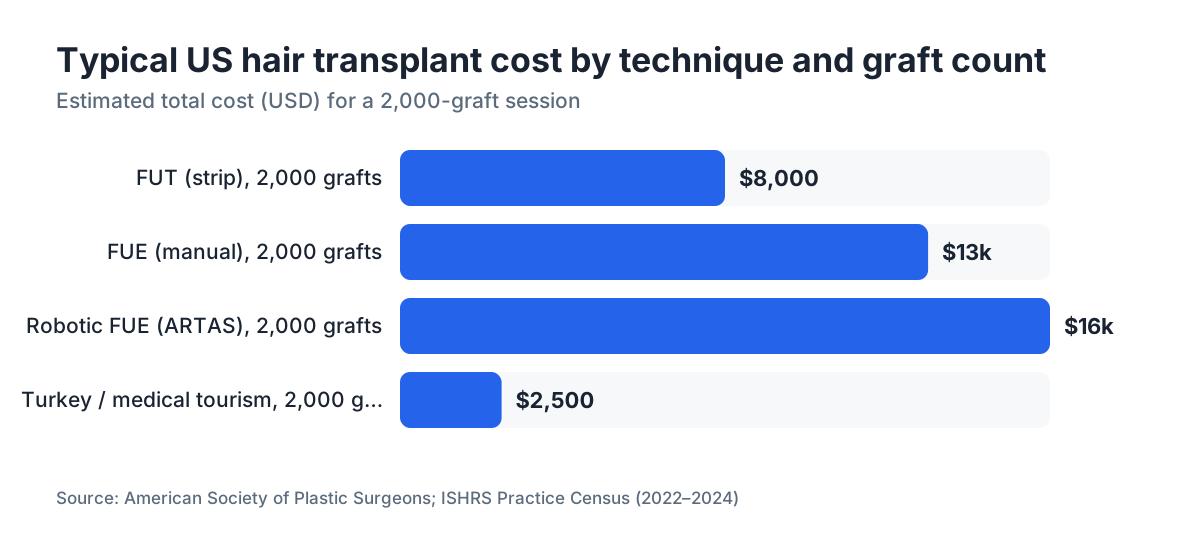
FUE skips the strip. Each follicular unit gets extracted one by one with a small punch tool, which takes far more time and needs either a skilled surgeon or a robotic assist system. Per-graft pricing for FUE typically runs $5 to $8, sometimes higher at premium practices [1]. A 2,000-graft FUT session might cost $7,000. The same graft count via FUE could run $11,000 to $14,000 at the same clinic.
| Technique | Avg US cost per graft | Typical total (2,000 grafts) | Scar type | Downtime |
|---|---|---|---|---|
| FUT (strip) | $3 to $5 | $6,000 to $10,000 | Linear scar | 10 to 14 days |
| FUE (punch) | $5 to $8 | $10,000 to $16,000 | Scattered dot scars | 7 to 10 days |
| Robotic FUE (ARTAS) | $6 to $10 | $12,000 to $20,000 | Scattered dot scars | 7 to 10 days |
Price isn't the whole decision. FUT leaves a linear scar that shows with very short haircuts. FUE scars are tiny but scattered across the donor zone. If you keep your hair long, FUT is the rational money choice. If you wear a short fade, FUE earns its premium. Your surgeon's honest read on your donor density matters more than either technique's marketing.
How many grafts do you need, and what does that mean for cost?
Graft count is the single biggest driver of your total bill. A graft holds one to four hair follicles, and the number you need depends on the size of the area being covered and the density you want.
A rough guide: Norwood stage 2 or 3 hairlines usually need 1,000 to 2,000 grafts. Stage 4 or 5 coverage runs 2,000 to 3,500 grafts. Stage 6 or 7 can require 4,000 or more, which often can't be done in a single session because the donor zone has a finite supply [2].
Your donor density matters as much as the recipient area. Someone with thick, coarse hair from a dense donor zone gets good coverage with fewer grafts than someone with fine hair. A surgeon who does a proper in-person exam, not a photo consultation, can give you an honest graft estimate. Be skeptical of anyone quoting a very low graft count for obvious extensive loss. Under-grafting looks worse than not grafting at all.
For a picture of what progression looks like before you decide on surgery, the receding hairline guide walks through the Norwood stages in detail.
What other factors push the price up or down?
Geography does real work here. A FUE session in New York, Los Angeles, or Miami costs meaningfully more than the same procedure in Dallas, Phoenix, or a mid-sized Midwestern city, even from surgeons with comparable training and results. Hair transplant cost in Austin, Texas, for example, tends to run 10 to 20% below major coastal markets while still giving you access to board-certified plastic surgeons and dermatologists.
Surgeon credentials matter and show up in the price. A board-certified plastic surgeon or dermatologist who has done thousands of hair transplants charges more than a general physician who added a weekend hair restoration course to their practice. That premium is usually worth paying. The International Society of Hair Restoration Surgery (ISHRS) is one place to find credentialed surgeons [3].
Clinic overhead factors in too. A standalone hair restoration clinic with a dedicated surgical suite, specialized nursing staff, and high-end equipment charges more than a general dermatology practice that does the occasional transplant. Neither is automatically better. You just want to know what you're paying for.
Then there's the consultation itself. Some clinics quote a low per-graft price but recommend far more grafts than you need. Others quote high per-graft rates but stay conservative and honest about counts. Get at least two in-person consultations with itemized quotes before you commit.
How much does a hair transplant cost outside the US?
Medical tourism for hair transplants is common, and the price gap is big enough to take seriously. Turkey, the most popular destination, charges roughly $1,500 to $3,500 all-in for procedures that would cost $8,000 to $12,000 in the US [4]. Thailand, India, and Poland pull patients for the same reasons.
The trade-offs are real. The best Turkish clinics have very experienced surgeons and good outcomes. But the market also holds a lot of clinics where the work is done mostly by unlicensed technicians, with the physician present only briefly. Patient safety reporting in those settings is thin, and if something goes wrong, legal recourse from the US is basically nonexistent.
Travel costs eat into the savings. Round-trip flights from the US to Istanbul run $600 to $1,200, and you'll need a week-plus stay, plus the cost of any follow-up complications you handle back home. Revision surgery, if you need it, is harder to coordinate with a clinic overseas.
If you go this route, confirm the operating surgeon is licensed as a physician in that country, review verifiable before-and-after photos from that specific surgeon (not stock imagery), and read reviews on platforms that verify patients. The ISHRS publishes guidance on vetting international clinics [3].
Here's the honest summary. Overseas can be a legitimate option for budget-constrained patients who do the research. It isn't inherently a bad idea. But there are more ways for it to go wrong than a domestic procedure, and the downside is a bad scar on your scalp, not a bad hotel room.
Does insurance cover hair transplant surgery?
No. Health insurance in the US does not cover hair transplants for androgenetic alopecia (pattern baldness), because transplants are classified as cosmetic [5]. This holds for all major insurers, Medicare, and Medicaid.
One exception is worth knowing. Hair loss caused by a documented medical condition, burns, or trauma may qualify for some coverage in some cases, but that falls under reconstruction surgery, not elective restoration, and it requires specific documentation and prior authorization. Assume you're paying out of pocket.
Some clinics offer payment plans, often through third-party medical financing companies like CareCredit or Alphaeon Credit. These can make a $10,000 procedure feel manageable at $200 to $300 a month, but read the terms. Many use deferred-interest structures that get expensive if you don't clear the balance inside the promo period. A standard personal loan from a credit union or bank may carry a lower effective rate.
HSA and FSA funds generally can't be used for cosmetic hair transplants either, for the same reason insurance won't cover them. Confirm with your plan administrator, but don't count on it.
Is a hair transplant worth the cost, or should you try medications first?
Here's the honest question most guides dodge. A hair transplant is a permanent surgical procedure, but it doesn't stop ongoing hair loss. It redistributes the follicles you already have. If you don't treat the underlying cause, the transplanted area can look great while you keep losing native hair around it, which eventually leaves an unnatural island of density.
For most people with androgenetic alopecia, the evidence-backed starting point is medication, not surgery. Finasteride (a 5-alpha reductase inhibitor) lowers DHT and slowed or halted male pattern hair loss in roughly 83 to 90% of men who took it consistently in clinical trials [6]. Minoxidil, topical or oral, pushes follicle activity and can add visible density. Neither is a cure, both need ongoing use, but they cost $10 to $50 a month and carry manageable side-effect profiles for most users.
The practical answer. If you're in your 20s or early 30s and your loss is still actively moving, surgery before stabilizing medically is risky. You may end up needing multiple transplants as the loss continues. If your loss has stabilized, you have realistic donor supply, and medications either didn't work or aren't something you'll commit to, a transplant becomes a much more rational option.
More on finasteride and on the combination of finasteride and minoxidil if you want to understand the medication side before committing to surgery. For what actually drives hair loss in the first place, what causes hair loss covers the evidence clearly.
If you want a clearer read on where your hair loss stands before booking consultations, MyHairline's free AI hair scan gives you a Norwood stage estimate and a baseline in a few minutes.
What are the risks and hidden costs after a hair transplant?
The upfront price isn't the total cost. Recovery brings real expenses and real risks.
In the first two weeks, most patients get some swelling, crusting, and shock loss, where existing native hair sheds from the trauma of surgery. This is normal and usually temporary, but it can look alarming. Most surgeons prescribe a short course of antibiotics and anti-inflammatories. Plan to take at least a week off work, maybe two if your job involves physical activity or a lot of face time.
Complications are uncommon but real. Infection happens in roughly 1% of cases [12]. Folliculitis (inflammation of the follicles) is more common and usually clears with topical or oral antibiotics. Scarring beyond the norm is rare with experienced surgeons but possible. The FDA has not approved any device or drug for hair transplantation as a treatment indication, though surgeons use FDA-cleared tools [7].
Density isn't fully visible for 12 to 18 months. Transplanted hairs shed in the first few weeks and regrow slowly. Plenty of patients feel underwhelmed at the 3 to 6 month mark and need reassurance. Final results genuinely take a year or more to judge.
Then there's the second session. A real share of patients (estimates vary; no good population-level data exists) go for a second transplant, either because initial density fell short or because their underlying loss kept moving. That's another $6,000 to $12,000.
Most surgeons also recommend continuing medical therapy post-transplant to protect native hair. That means ongoing cost for minoxidil for men or finasteride, or a DHT blocker protocol.
How do you evaluate surgeons and avoid bad actors?
The hair transplant industry has a real number of clinics that produce poor outcomes, and some of them advertise the hardest. A few practical filters.
Verify credentials. Look for board certification in plastic surgery (ABPS) or dermatology (ABD) through the American Board of Medical Specialties [8]. ISHRS membership is a positive signal but not a guarantee. Confirm the surgeon, not a technician, performs the extraction and placement.
Ask to see a portfolio of patients at the 12 to 18 month mark with hair type and Norwood stage similar to yours. A clinic that won't provide this is a red flag. Results at 6 months are too early and often get used to mislead.
Get the consultation in writing with a specific graft estimate and cost breakdown: per-graft price, total grafts planned, and the surgeon's name attached. Avoid any clinic that quotes a package price without specifying graft count.
Be wary of very low prices at home. A US surgeon quoting $2 per graft for FUE is either miscounting grafts or cutting corners on staffing, facilities, or both.
Patient forums like the Hair Restoration Network have been around for decades and collect real patient experiences, good outcomes and bad, tied to specific clinics. It's one of the better non-commercial sources for surgeon reputation research.
What's the cost comparison between a transplant and long-term medical treatment?
One frame gets skipped a lot: a hair transplant is expensive upfront, but so is decades of medication.
Generic finasteride costs roughly $10 to $30 a month [9]. Over 20 years that's $2,400 to $7,200. Topical minoxidil runs $10 to $30 a month, adding another $2,400 to $7,200 over the same stretch. Someone on both from age 30 to 50 could spend $5,000 to $14,000 in medication alone, with results that vary by person and stop if they quit.
A single transplant at $8,000 with no ongoing treatment is cost-competitive over a 20-year horizon, though most surgeons still recommend medical therapy post-transplant to protect native hair, which narrows the comparison.
Neither path is clearly cheaper for everyone. The math turns on how long you stay on medications, how much loss you have, and whether you need a second transplant. What's clear is that the "transplant is always way more expensive" assumption doesn't survive a full lifetime of hair management costs.
For people whose hair loss comes from temporary causes rather than genetics, the calculation changes entirely. Telogen effluvium is one common cause of shedding that often resolves without any permanent intervention.
What's a realistic timeline from consultation to final results?
Worth mapping out clearly, because patients routinely underestimate how long this takes.
Consultation to surgery: 2 to 8 weeks depending on clinic scheduling and how fast you decide. Some high-demand surgeons book 3 to 6 months out.
Surgery day: FUT procedures typically take 4 to 8 hours. FUE sessions can run 6 to 12 hours depending on graft count.
Days 1 to 14: The grafts are in place but fragile. Most clinics give strict rules on sleeping position, washing, and staying out of sun and heavy exertion. Swelling peaks around days 3 to 5.
Weeks 2 to 8: Shock loss. Many transplanted and native hairs shed. This is expected and not a failure, but it's genuinely discouraging to look at.
Months 3 to 6: Early regrowth begins. Thin, fine hairs appear. Density isn't visible yet.
Months 9 to 12: Meaningful density shows. Most patients start to feel it was worth it around here.
Months 12 to 18: Final result. This is when a surgeon can honestly judge whether a second session is warranted.
Total time from decision to real outcome: 14 to 20 months. Anyone who tells you results show up in 3 to 4 months is overpromising.
Sources
- American Society of Plastic Surgeons, Procedural Statistics
- International Society of Hair Restoration Surgery, Practice Census
- International Society of Hair Restoration Surgery, Patient Resources
- ISHRS, 2022 Practice Census Results
- CMS.gov, Medicare Coverage General Information
- Kaufman KD et al., Finasteride in the treatment of men with androgenetic alopecia, Journal of the American Academy of Dermatology, 1998
- U.S. Food and Drug Administration, 510(k) Premarket Notifications
- American Board of Medical Specialties, Certification Verification
- GoodRx, Finasteride Pricing Data
- American Academy of Dermatology, Hair Loss: Diagnosis and Treatment
- National Institutes of Health, MedlinePlus
- National Institutes of Health, MedlinePlus