

TL;DR: In the United States, most hair transplants cost $4,000 to $15,000, with a typical mid-sized case landing around $6,000 to $8,000. Price depends on technique, graft count, and the surgeon. Insurance almost never pays. Clinics abroad charge $1,500 to $4,000 but carry real risk. There's no flat price, because you're buying a surgeon's time by the graft.
What is a hair transplant, and why does the cost vary so much?
A hair transplant moves hair follicles from a donor area, usually the back and sides of the scalp where follicles resist DHT, into thinning or bald zones [1]. Two techniques dominate: FUT (follicular unit transplantation, also called strip surgery) and FUE (follicular unit extraction). Which one you pick is one of the biggest reasons two people pay wildly different amounts.
FUT takes a strip of scalp, dissects individual follicular units from it under a microscope, and closes the wound with sutures. It leaves a thin linear scar and tends to produce more grafts per session. FUE harvests follicles one at a time with a small punch, leaving tiny round scars instead of a line. FUE eats more of the surgeon's time, so it usually costs 20 to 30% more per graft than FUT [2].
The quote you get is rarely a flat fee. It's a per-graft rate times the number of grafts you need. And the number of grafts you need depends on how much you've lost and how dense you want to look. A man at Norwood Stage 3 might need 1,500 to 2,500 grafts. Someone at Stage 6 might need 4,000 to 6,000 grafts across multiple sessions [3]. Same per-graft price, and two patients still walk out $6,000 apart.
Surgeon experience, clinic location, and regional rates pile on more variation. A board-certified plastic or dermatologic surgeon in Manhattan or Beverly Hills charges more than a physician at a Midwest regional clinic for the same graft count and technique. That gap isn't always a quality difference. It's almost always a real pricing difference.
How much does a hair transplant cost in the US?
The American Society of Plastic Surgeons reported an average surgeon fee of about $4,291 for hair transplantation in 2020, but that figure hides the real bill because it leaves out anesthesia, facility fees, and post-op care [4]. Add everything up and most US patients pay $6,000 to $12,000 for a mid-sized FUE procedure. Complex cases push past $15,000.
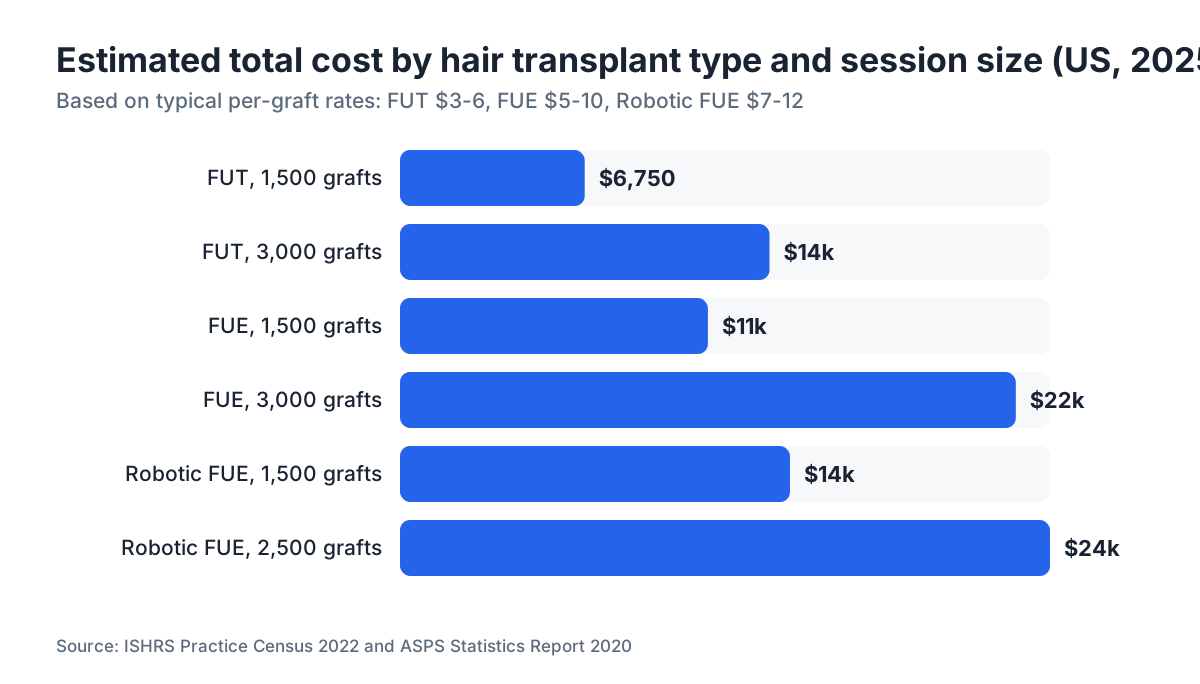
Here's how per-graft pricing usually breaks down by technique in the US:
| Technique | Typical per-graft cost (US) | Typical session size | Estimated total range |
|---|---|---|---|
| FUT (strip) | $3 to $6 per graft | 1,500 to 4,000 grafts | $5,000 to $15,000 |
| FUE (manual or motorized) | $5 to $10 per graft | 1,000 to 3,500 grafts | $6,000 to $20,000 |
| Robotic FUE (ARTAS) | $7 to $12 per graft | 1,000 to 2,500 grafts | $8,000 to $20,000+ |
These ranges come from published clinic pricing, peer-reviewed cost analyses, and ASPS data [2][4]. Your quote will sit somewhere inside this range, and occasionally outside it.
Per-graft pricing sounds clean. It isn't always. Some clinics quote a low per-graft rate, then add facility fees, PRP (platelet-rich plasma) upsells, or a separate design fee. Others bundle it all. Get a written, itemized quote before you sign anything.
What specific things drive your final hair transplant bill?
Graft count is the biggest lever, full stop. Every extra graft adds surgeon time, tech time, and consumables. If your donor density is low, the surgeon may not be able to harvest as many grafts as you want, which can mean a second session and a second bill.
Technique matters too. Robotic FUE systems like ARTAS carry a premium because the clinic is paying off a machine that runs over $200,000 [2]. That doesn't buy you better results by default. It buys the clinic more overhead, and they pass it to you.
Surgeon credentials move the price. Fellowship-trained hair restoration surgeons, especially members of the International Society of Hair Restoration Surgery (ISHRS), tend to charge more [5]. Whether the premium is worth it comes down to the specific surgeon, not the letters after their name.
Geography matters more than people expect. Clinics in New York City, Los Angeles, and Miami charge 30 to 50% more than comparable clinics in Atlanta, Phoenix, or Columbus, mostly because their own overhead is higher.
Anesthesia is a smaller factor. Most transplants use local anesthesia with oral sedation, which is cheap. Ask for IV sedation or general anesthesia and you add an anesthesiologist fee of $500 to $1,500.
Post-op products and follow-up visits often show up as separate line items. PRP injections get upsold at $500 to $1,500 per session. They're optional. The evidence that PRP improves transplant outcomes is mixed and not solid enough to call it standard care [6].
How much do hair transplants cost abroad, and is it safe?
Medical tourism for hair transplants is real and growing fast. Turkey leads by a wide margin, with many Istanbul clinics advertising FUE packages at $1,500 to $3,500 all-in, hotel and airport transfers included. Clinics in India, Thailand, and Mexico usually run $2,000 to $5,000 [2].
The savings are genuine, and some of these surgeons are genuinely skilled. The risk structure is what changes. If something goes wrong, your legal recourse in a foreign country is thin. Follow-up care is hard once you're home. And some high-volume tourism clinics let unlicensed technicians do most of the actual extraction and implantation while a physician signs off without touching the punch tool [5].
The ISHRS has published warnings about "hair mills," its term for clinics processing hundreds of grafts a day with minimal physician oversight [5]. The society reports that patients have come home with infections, scarring, and poor graft survival that needed corrective surgery, which costs as much or more than doing it right the first time.
Still, some patients travel, get good outcomes, and save $5,000 to $8,000. If you go, verify that the operating surgeon holds credentials recognized in their country, that the facility is accredited, that the surgeon personally performs the critical steps, and that you have a real plan for post-op care at home. Ask one blunt question: who is holding the punch tool during my extraction?
Does insurance cover hair transplant surgery?
Almost never. Every major US insurer classifies hair transplants as cosmetic, which means they're excluded from standard health coverage outright [7].
There's one narrow door. If hair loss is the direct result of a covered medical event or condition, some insurers will pay for reconstruction. Alopecia from burns, chemotherapy, or certain autoimmune diseases can qualify, but it takes documentation and prior authorization, and approval is far from a sure thing.
Medicare and Medicaid do not cover hair transplants for androgenetic alopecia (pattern baldness) under any current coverage determination [7].
Most clinics offer financing through third-party lenders like CareCredit or Alphaeon, and some run in-house payment plans. Interest rates swing hard between products. CareCredit's deferred-interest promotions look great until you miss the promotional window, at which point retroactive interest hits the full balance. Read the terms before you sign.
What's the difference in cost between FUT and FUE?
FUE usually costs 20 to 40% more than FUT per graft, and the gap widens at high-end clinics where the lead surgeon does FUE by hand [2]. It comes down to time. Harvesting follicles one by one with a punch is slower than cutting a strip and dissecting grafts from it in parallel.
FUT leaves a linear scar across the back of the head. Keep your hair long enough and it disappears. Want a grade 1 or 2 clipper cut? FUE's scattered dots hide better under short hair. That cosmetic tradeoff is the main reason patients pay up for FUE.
Results are close. Survival rates for properly handled grafts run about 90 to 95% for both techniques when an experienced surgeon does the work [3]. FUT often pulls more total grafts from a session because strip dissection under magnification has lower transection rates (accidentally slicing through the follicle) than punch extraction, especially when punch size isn't matched precisely to follicle angle and depth.
Need a very large graft count and don't care about a linear scar? FUT often gives more coverage for less money. Early Norwood stage, fewer grafts, and want freedom to buzz your hair short? FUE is the common pick despite the higher price.
How many grafts do you need, and what does that tell you about cost?
The Norwood-Hamilton scale sorts male pattern baldness into stages 1 through 7, higher stages meaning more loss [3]. Graft requirements climb roughly with the stage:
| Norwood Stage | Approximate grafts needed | Estimated US cost (FUE) |
|---|---|---|
| Stage 2 to 3 | 800 to 1,500 | $4,000 to $10,000 |
| Stage 3 to 4 | 1,500 to 2,500 | $8,000 to $15,000 |
| Stage 4 to 5 | 2,500 to 3,500 | $12,000 to $20,000 |
| Stage 6 to 7 | 3,500 to 6,000+ | $18,000 to $30,000+ (multiple sessions) |
These are approximations. Donor density, hair caliber, and your coverage goals all shift the number. Thick, coarse hair covers the same area with fewer grafts than fine hair does.
This is why an in-person consultation beats price shopping online. A quote for "2,000 grafts at $5 per graft" means nothing if a surgeon looks at your scalp and says you actually need 3,500 grafts and your donor supply is tight.
Reading your own loss pattern early changes the math too. If you're still shedding fast, a transplant now can look great for five years and then strand you as the surrounding native hair keeps falling out. Most surgeons want you to stabilize with finasteride or minoxidil before surgery, or at least talk through the trajectory. You can read up on finasteride and minoxidil as stabilization options, and see what a receding hairline looks like at different stages before your consult.
Are there hidden or ongoing costs after a hair transplant?
Yes. Several.
The first weeks bring prescription meds: an antibiotic course (usually 5 to 7 days), anti-inflammatories, and sometimes finasteride if you weren't already taking it. Figure $50 to $150 total. Small, but real, and some clinics skip mentioning it upfront.
Many clinics push post-op shampoos, growth serums, and specialty sprays. Most aren't medically necessary. A gentle sulfate-free shampoo does the job, and the FDA has cleared only minoxidil and finasteride as hair loss treatments with clinical evidence behind them [8].
Add PRP sessions, which some clinics recommend at one, three, and six months post-transplant, and that's another $500 to $1,500 each. The evidence isn't strong enough that you should feel obligated to buy them.
A second session is the biggest possible add-on. Many patients at higher Norwood stages or chasing full density will need one. A straight-shooting surgeon tells you this before your first procedure, not after.
Then there's ongoing medical therapy. If you weren't on minoxidil or finasteride before surgery, starting after is often recommended to protect the hair you didn't transplant. Generic finasteride costs $10 to $30 per month. Minoxidil solution or foam runs $15 to $30 per month. Neither is a big number on its own. Over five or ten years they add up, and they're a real part of managing hair loss for the long haul. Before committing to surgery, figure out what causes hair loss in your case and whether medication alone might carry you.
Is a hair transplant worth the money?
It depends on your situation, your expectations, and your donor supply. This isn't a neutral question, so I won't pretend it is.
For the right candidate, a transplant delivers permanent results no drug can match. Transplanted follicles keep their DHT resistance and stay for life in most cases. FUE studies show graft survival of 90 to 95% at 12 months in experienced hands [3]. If you have enough donor supply, stable loss, realistic expectations (transplants create the look of density, not the density of an untouched head), and the money to absorb the cost, the long-term value is real.
For a guy in his early 20s who's still shedding fast, spending $8,000 to $12,000 now often means spending another $8,000 to $12,000 in five years to fill in what fell out since. The smarter money move in most of those cases is to try finasteride and minoxidil first, stabilize the loss, wait a few years, then decide whether surgery still makes sense.
For anyone hoping to buy back the hairline of their teens, the math usually breaks. Donor supply is finite. You can't move what isn't there.
If you want to know where you actually stand before spending a dollar, the free AI hair scan at MyHairline gives you a Norwood stage estimate and a clearer read on your current pattern. Useful context before you sit across from a surgeon who is also trying to sell you a procedure.
The best transplant is the one you don't regret in five years because your native hair kept thinning while you waited. Stabilizing first is usually the smarter financial move.
How do you find a trustworthy surgeon without overpaying?
Start with credentials. The ISHRS (International Society of Hair Restoration Surgery) and the American Board of Hair Restoration Surgery keep directories of verified members and diplomates [5]. Board certification in dermatology or plastic surgery counts too, though hair restoration isn't its own board specialty in the US. What matters most is that the surgeon does hair work regularly, not as a side gig.
Ask to see before-and-after photos from patients whose loss pattern and hair type look like yours. Ask how many procedures the surgeon personally does per month. Then ask the sharp question: will the surgeon or the technicians perform the extraction and implantation? At many clinics, techs do most of the work. That's not automatically bad. You should still know.
Get two or three in-person consultations. Most reputable clinics do them free. Quotes that come back wildly apart usually mean the clinics are proposing different graft counts or different quality tiers.
Be skeptical of very low domestic prices. A US FUE procedure priced under $4,000 for a meaningful graft count should make you ask what's getting cut. Staffing, overhead, and consumables cost money, and clinics running high daily volume with mostly technician-performed work are a real slice of the market.
The American Academy of Dermatology publishes guidance on finding dermatologic surgeons, which includes hair restoration specialists [9]. That's a sane place to start a candidate list before you pick up the phone.
What non-surgical alternatives cost compared to a transplant?
Before you commit to surgery, run the numbers on what else is available. The comparison changes minds.
Generic finasteride runs $10 to $30 per month, roughly $120 to $360 per year [8]. The FDA approved it for androgenetic alopecia in men in 1997. It stops further loss and produces measurable regrowth in a large share of users. It's the cheapest effective long-term intervention for men who tolerate it. Over ten years you'd spend $1,200 to $3,600, against $6,000 to $15,000 for surgery.
Topical minoxidil (OTC) costs $15 to $30 per month [8]. It works differently from finasteride, extending the anagen (growth) phase instead of blocking DHT, and the evidence supports it for men and women. You can read how topical minoxidil works and what to expect.
Oral minoxidil, prescribed off-label, usually costs $10 to $40 per month as a generic. Low doses (0.625 to 2.5 mg in women, 2.5 to 5 mg in men) have growing evidence behind them. More at oral minoxidil.
Finasteride plus minoxidil together costs $25 to $60 per month and has additive evidence over either drug alone.
Hair systems (wigs, toppers, hairpieces) cost $200 to $3,000 upfront plus ongoing upkeep. They aren't surgical, they work the day you put one on, and they're fully reversible. For someone who isn't ready for surgery, they're an underrated option.
The honest comparison: a person in their 20s or 30s who responds well to finasteride and minoxidil can spend $30 to $60 per month, preserve donor supply, delay or skip surgery, and pay a fraction of the surgical price over a decade. Surgery and medication aren't rivals. Surgery without medical therapy to protect the surrounding hair is a common, expensive mistake.
Sources
- American Academy of Dermatology, Hair Loss: Diagnosis and Treatment
- International Society of Hair Restoration Surgery, Practice Census Survey 2022
- Dermatologic Surgery, Rassman et al., Follicular Unit Extraction: Minimally Invasive Surgery for Hair Transplantation
- American Society of Plastic Surgeons, 2020 Plastic Surgery Statistics Report
- International Society of Hair Restoration Surgery, Patient Resources and Hair Mill Warning
- Journal of the American Academy of Dermatology, Platelet-Rich Plasma for Hair Loss: A Systematic Review
- CMS Medicare Coverage Database, Cosmetic Surgery Exclusions
- FDA, Approved Drug Products for Hair Loss: Finasteride and Minoxidil
- American Academy of Dermatology, Find a Dermatologist
- JAMA Dermatology, Hair Transplant Outcomes and Patient Satisfaction Meta-analysis 2019