
TL;DR: Follicular unit extraction (FUE) is a hair transplant method where a surgeon punches out individual follicular units from a donor area, usually the back of the scalp, and implants them where you're thinning. There's no linear scar, downtime is about a week, and natural-looking results take 12 to 18 months. Costs typically run $4,000 to $15,000 depending on graft count and clinic location.
What exactly is FUE and how does it differ from FUT?
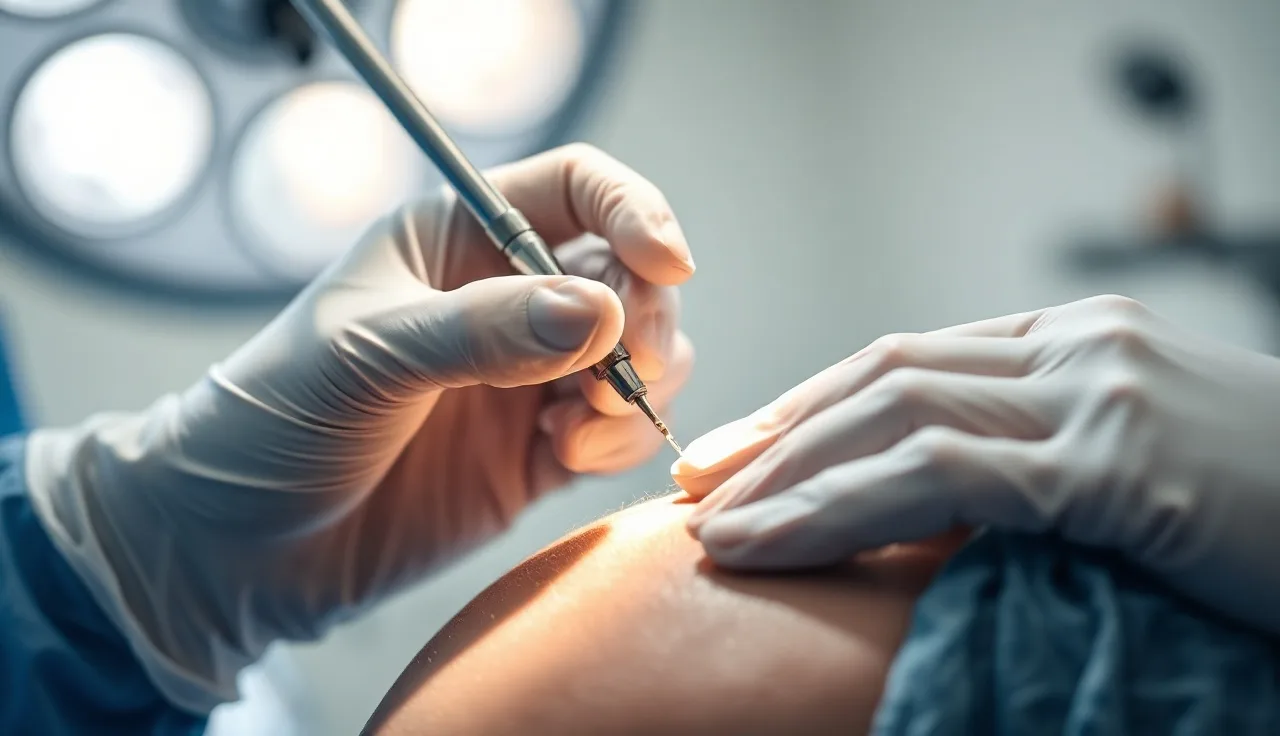
FUE, follicular unit extraction, removes grafts one at a time using a small circular punch, typically 0.6 to 1.0 mm in diameter. Each punch extracts a single follicular unit, which is a natural grouping of one to four hairs as they actually grow from the scalp. The surgeon or a robotic system then implants those units into tiny recipient sites made in the thinning area.
The main alternative is FUT, follicular unit transplantation (also called the strip method). With FUT, the surgeon cuts a strip of scalp from the donor area, dissects it into individual grafts under a microscope, and closes the donor site with sutures. That leaves a linear scar, sometimes visible if you shave your head short. FUE leaves only tiny round dot scars, typically under 1 mm each, that are nearly invisible even with a very short haircut [1].
The trade-off is time and cost. FUE is slower to harvest, so large sessions (3,000 or more grafts) can take 8 to 10 hours, and clinics charge more per graft. FUT remains the better option for patients needing maximum grafts in a single session from limited donor supply, because the strip method can often yield slightly more usable hair per session.
Neither method is universally better. The right choice depends on your Norwood stage, donor density, lifestyle (do you want to buzz your head?), and budget. A surgeon who only does one method has an obvious financial reason to recommend it, so getting opinions from surgeons who offer both is worth your time. To understand what hair transplant surgery involves more broadly, that overview covers both methods side by side.
How does the FUE procedure actually work, step by step?
Consultations happen first, ideally in person so the surgeon can assess donor density with a dermoscope, count approximate available grafts, and map your hairline. Good surgeons photograph you, document your current Norwood stage, and discuss how your hair loss may progress, because transplanting into areas that will keep thinning without medical support is a common mistake.
On procedure day, the donor area (usually the back and sides of the scalp) is shaved to about 1 mm. Local anesthesia is injected, which is the most uncomfortable part for most patients. Surgeons sometimes use a nerve block or oral sedation; ask specifically what's available.
Extraction follows. The punch scores around each follicular unit, and the surgeon or a technician extracts the graft with forceps. This is repeated hundreds or thousands of times. Extracted grafts are stored in a chilled holding solution, typically saline or a specialized solution like HypoThermosol, to keep them viable. Graft survival during storage matters a lot. Research published in the journal Dermatologic Surgery found that grafts stored in HypoThermosol maintained higher viability over several hours than saline alone [2].
Recipient site creation comes next. The surgeon makes tiny incisions, controlling angle, direction, and depth to mimic natural hair growth patterns. This step determines how natural the result looks, and it's where surgeon skill matters most. Placing grafts that point the wrong direction produces an unnatural, "doll hair" appearance.
Graft implantation finishes the procedure. Technicians place each graft into a recipient site using forceps or an implanter pen. A session of 2,000 grafts can take a full day.
You leave with a bandaged donor area and small scabs at each recipient site. Most clinics give you a post-op kit with saline spray and instructions for washing.
What does FUE hair transplant recovery actually look like?
The first three days are the roughest. Scalp soreness, tightness, and swelling are normal. Swelling can migrate toward the forehead and eyes around day two or three, which looks alarming but resolves on its own. Sleeping with your head elevated helps minimize it.
Scabs form over each recipient site and the donor dots. Most clinics instruct patients to gently wash starting day two or three, using a diluted shampoo poured over the scalp rather than rubbed in. Picking at scabs is the most common self-inflicted complication; it can dislodge grafts or cause scarring.
By day 7 to 10, most people are presentable enough to return to desk work. Redness in the recipient area can persist for two to six weeks depending on skin type. Direct sun exposure should be avoided for at least a month, as UV damage to healing grafts and recipient sites is a real risk.
Strenuous exercise (anything that elevates blood pressure significantly) is typically restricted for two to three weeks to reduce bleeding and swelling risk.
Then comes the hardest part psychologically: shock loss. Between weeks two and eight, the transplanted hairs shed. This is normal. The follicles enter a resting phase after the trauma of transplantation. Most patients see little to no hair in the transplanted area for three to five months. Visible regrowth usually starts around month four or five. Full, mature results take 12 to 18 months. Patients who panic and judge the procedure at month three are almost always wrong.
How much does FUE cost, and what drives the price variation?
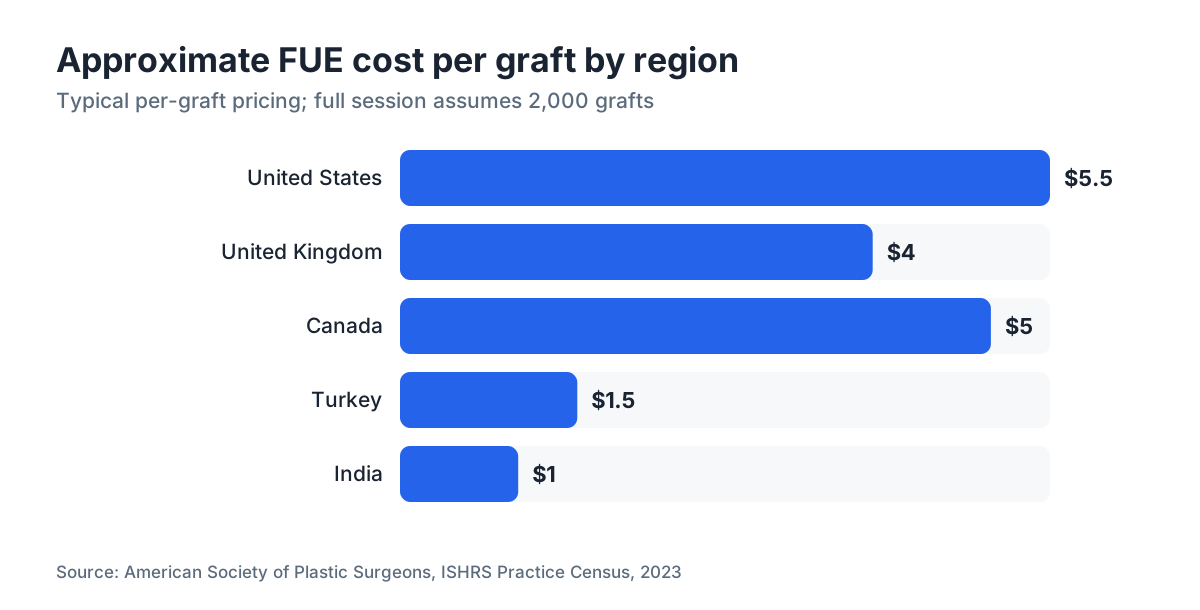
In the United States, FUE typically costs between $4,000 and $15,000 for a full session [3]. Most clinics price by the graft: $3 to $8 per graft is the common range in the U.S. A 2,000-graft session at $5 per graft runs $10,000. Large sessions of 3,000 to 4,000 grafts can push costs to $15,000 or more at premium clinics.
What drives the variation? Surgeon experience and reputation are the biggest factors. A board-certified dermatologist or plastic surgeon with 10 years of dedicated hair restoration work charges more than a general practitioner who added FUE as a revenue stream. Clinic location matters too: New York and Los Angeles run higher than Nashville or Phoenix. Technology also affects price. Clinics using the ARTAS robotic system sometimes charge a premium, though clinical outcomes data comparing ARTAS to skilled manual FUE show mixed results with no clear winner on graft survival [4].
| Country / Region | Approx. cost per graft | Typical full session (2,000 grafts) |
|---|---|---|
| United States | $3, $8 | $6,000, $16,000 |
| United Kingdom | £2, £5 | £4,000, £10,000 |
| Turkey (Istanbul) | $0.90, $2 | $1,800, $4,000 |
| India | $0.50, $1.50 | $1,000, $3,000 |
| Canada | CAD $4, $8 | CAD $8,000, $16,000 |
Medical tourism for FUE is genuinely popular, particularly to Turkey, where clinics are accredited and some surgeons are highly experienced. The risks are real though: if you have complications, getting follow-up care 5,000 miles from home is difficult. The complication isn't always the clinic's fault, but managing it remotely is hard regardless.
Hair transplant surgery is almost never covered by insurance because it's classified as cosmetic. FSA and HSA funds may apply at some clinics, but check with your plan administrator. Some clinics offer financing through third-party lenders like CareCredit.
What is the FUE graft survival rate, and how is success measured?
Graft survival is the percentage of transplanted follicular units that produce permanent, growing hair. Survival rates of 90 to 95 percent are commonly cited by reputable clinics, but this figure depends heavily on surgeon skill, graft handling time, and the holding solution used [2].
The American Hair Loss Association notes that poorly executed FUE, especially with inexperienced punch operators, can result in transection rates (accidentally cutting through the follicle during extraction) of 10 to 20 percent, which means those grafts die before they're even implanted [5]. An experienced surgeon using the correct punch size for your hair characteristics typically achieves transection rates below 5 percent.
How do you measure success yourself? Count the hairs in photographs at 12 and 18 months. Good clinics take standardized photos under consistent lighting before the procedure and at follow-up visits, making comparison objective. Clinics that resist standardized photography are a red flag.
Density is another metric. Hair density is measured in follicular units per square centimeter. Average scalp density is roughly 65 to 85 follicular units per cm2 [11]. Transplanting at 30 to 45 units per cm2 in recipient areas, combined with your existing hair, can create the appearance of full coverage if designed correctly [1].
One study published in Dermatologic Surgery found that overall aesthetic satisfaction rates after FUE were above 80 percent in patients with realistic expectations who were managed by experienced surgeons [2]. That qualifier about expectations matters a lot. Patients who expected their 22-year-old hairline restored reported lower satisfaction regardless of objective graft survival.
Who is a good candidate for FUE, and who shouldn't get it?
Good candidates have stable hair loss, meaning your loss has slowed or stabilized, ideally confirmed over 12 to 24 months of documentation. They have adequate donor density at the back and sides of the scalp. They have realistic expectations about coverage and density. And they're willing to use medications like finasteride or minoxidil to protect non-transplanted hair from ongoing loss.
Norwood stages 3 through 6 are the most common candidates. Stage 7, the most advanced pattern, often lacks sufficient donor hair to cover the loss area meaningfully, though crown work is sometimes possible.
People who generally should not get FUE right now: anyone whose loss is still progressing rapidly, anyone under 25 (loss patterns aren't established yet, and a hairline designed for a 23-year-old may look strange at 45), anyone with diffuse unpatterned alopecia (where the donor area itself is thinning), and anyone with active scalp conditions like psoriasis or alopecia areata.
Women can be good FUE candidates, particularly those with female pattern hair loss showing a specific area of thinning with stable donor hair. But female pattern loss is often diffuse, meaning donor areas are also affected, so candidate evaluation is more complex [10]. A detailed dermatological assessment is necessary before any woman books a transplant.
If you're not sure of your loss pattern or stage, tools like the free AI scan at MyHairline can give you a starting point before you pay for a surgical consultation.
Does FUE work without also taking finasteride or minoxidil?
Yes, FUE can produce results without medications. But the transplanted hair is not the whole story.
Transplanted follicles are taken from the DHT-resistant donor zone, so they keep growing permanently regardless of medication use. That's the good news. The bad news is that your existing non-transplanted hair continues to be subject to miniaturization from DHT if you have androgenetic alopecia. Over years, you can end up with good coverage in the transplanted area while the area around it thins further, creating an unnatural look.
This is why most experienced hair restoration surgeons strongly recommend using finasteride (or another DHT blocker) to slow the ongoing loss. Finasteride reduces DHT levels in the scalp by roughly 60 to 70 percent and has clinical evidence for slowing male pattern baldness and even stimulating some regrowth [6]. Minoxidil for men is often added to support existing hair and improve recipient area blood flow.
The combination of finasteride and minoxidil alongside a transplant gives you the best shot at long-term results that look natural as you age. Refusing all medication and banking on the transplant alone is a reasonable personal choice, but go in with eyes open about what your hairline might look like at 50 if loss continues around a stable transplanted zone.
What are the real risks and potential complications of FUE?
FUE is a surgical procedure. It's low-risk compared to general surgery, but the risks are real and some are underplayed in clinic marketing.
Infection is uncommon but possible. Clinics should provide post-op antibiotics. Folliculitis, inflammation of hair follicles in the donor or recipient area, can occur in the weeks after surgery and usually responds to topical or oral antibiotics.
Poor scarring in the donor area. While FUE scars are small dots, some patients develop hyperpigmentation or slightly raised scars depending on skin type. People with darker skin tones or a history of keloid formation should discuss this risk explicitly with their surgeon before booking.
Necrosis of grafts or scalp tissue. Rare, but it happens when blood supply is disrupted, often by over-dense packing of grafts or underlying vascular issues. An experienced surgeon avoids over-packing recipient sites.
Unnatural hairline design. This is arguably the most common complaint in long-term follow-up. A hairline placed too low, too straight, or without proper temporal recession looks artificial, especially as a patient ages and surrounding hair continues to thin. The hairline design conversation before surgery is one of the most important parts of the process.
Shock loss of native hair, where existing hair in and around the transplanted area sheds temporarily, can occur. It usually resolves in three to six months but is distressing. This is different from the expected shedding of transplanted hairs.
Unrealistic expectations leading to dissatisfaction. A 2019 literature review in the Journal of the American Academy of Dermatology noted that patient dissatisfaction after hair restoration surgery often traces back to inadequate preoperative counseling rather than technical failure [7].
And then there are the complications specific to underqualified providers: high transection rates that destroy grafts before they're planted, poor angle control leading to pluggy results, and donor area over-harvesting that leaves the back of the scalp looking depleted.
What is robotic FUE (ARTAS) and is it actually better?
The ARTAS system, cleared by the FDA for harvesting hair grafts, uses image-guided robotics to score and extract follicular units [8]. The theoretical advantages are consistency (no surgeon fatigue over an 8-hour session) and precise scoring angles.
In practice, the evidence for superior outcomes over skilled manual FUE is limited. A review published in Hair Transplant Forum International found no statistically significant difference in graft survival between ARTAS and experienced manual FUE when performed under comparable conditions [4]. ARTAS works best on straight, dark hair against light skin because its image recognition struggles more with curly, fine, or light-colored hair.
Clinics that use ARTAS often charge a premium for it. That premium might not translate into better hair. What does translate into better results is the surgeon's experience with recipient site design and graft handling, regardless of how the extraction was done.
AI-assisted systems are being developed to improve on ARTAS's limitations, particularly for curly and light hair, but none have published solid clinical outcome data yet.
Bottom line: don't choose a clinic primarily because it has a robot. Choose it because the surgeon doing your recipient sites and designing your hairline is demonstrably experienced.
How do I choose a qualified FUE surgeon and avoid bad clinics?
Board certification is the floor, not the ceiling. Look for surgeons certified by the American Board of Dermatology or the American Board of Plastic Surgery, with specific fellowship or dedicated practice in hair restoration. The International Society of Hair Restoration Surgery (ISHRS) maintains a member directory and has published guidelines warning patients about the global growth of unqualified providers performing hair transplants [9].
Ask to see before-and-after photos taken under standardized lighting at 12 to 18 months post-op, not at 6 months when shock loss is still resolving. Ask the surgeon personally who will be performing your extraction and recipient site creation. In many high-volume clinics, technicians do most of the work; the surgeon appears briefly. Know what you're actually buying.
Red flags: unusually low per-graft pricing that undercuts local market rates by 50 percent or more, guarantees of specific graft counts before your scalp is examined in person, and before-and-after galleries with inconsistent lighting, different hair lengths, or styling changes that could explain the apparent difference.
Ask about the clinic's policy if results are unsatisfactory. Reputable clinics have a clear protocol for follow-up photography, review visits at 6 and 12 months, and in some cases complementary touchup sessions if graft survival was low.
If you're still in the early stages of understanding your hair loss before booking consultations, reading about what causes hair loss and your own receding hairline pattern can sharpen the questions you ask surgeons.
How many grafts will I need, and what's realistic to expect?
Graft needs depend on the area being covered and your target density. As a rough guide:
| Area | Approximate grafts needed |
|---|---|
| Hairline only (mild recession) | 500 to 1,500 |
| Hairline + frontal third | 1,500 to 2,500 |
| Hairline + mid-scalp | 2,500 to 3,500 |
| Crown only | 1,000 to 2,000 |
| Full top of scalp (Norwood 5-6) | 3,000 to 4,500+ |
These are estimates. Your actual donor supply limits everything. Average total donor capacity for FUE on an average male scalp is roughly 6,000 to 8,000 grafts lifetime, though this varies widely [1]. Over-harvesting in a single session depletes reserves for future procedures.
Density expectations matter too. A transplanted density of 30 to 45 grafts per cm2 looks natural when combined with existing hair, but thinner existing hair means the illusion requires more grafts to achieve. Surgeons who promise "full density" matching your 18-year-old scalp are setting you up for disappointment or proposing multiple large sessions.
Plan for at least one possible future session as loss progresses. Young patients especially should budget emotionally and financially for this. If you understand that FUE is a long-term management strategy rather than a one-time cure, your expectations stay calibrated.
What happens to existing hair loss after a transplant, and should I be worried?
The transplant addresses thinning in the areas treated. It does nothing to stop future loss in untreated areas. This is the central issue most patients underestimate at booking.
Androgenetic alopecia is a progressive, genetic condition. The miniaturization process driven by DHT continues unless slowed by medication [10]. A 30-year-old who gets a hairline transplant but doesn't use finasteride may find at 40 that his transplanted hairline looks odd because the mid-scalp behind it has thinned further.
This is why the best hair restoration physicians treat the transplant as one tool in a broader plan, typically combined with finasteride to reduce DHT, sometimes topical or oral minoxidil to preserve existing hair, and occasional follow-up procedures over years. Conditions like telogen effluvium can also cause temporary shedding after surgery, compounding the shock loss period.
For younger patients experiencing rapid loss, some surgeons prefer to delay transplantation, stabilize the loss with medication for 12 to 24 months, then reassess. This isn't the advice that generates immediate revenue for clinics, but it's often the most honest approach.
If you're researching whether non-surgical options have given you everything they can before surgery, reviewing the evidence on hair loss supplements and combination medical therapy is a reasonable step before committing to a procedure.
Tools like the MyHairline AI scan at myhairline.ai/scan can help you track your loss pattern over time, which is useful context for any surgeon consultation.
Sources
- International Society of Hair Restoration Surgery (ISHRS), Practice Census Data and FUE Technical Guidelines
- American Society of Plastic Surgeons, Hair Transplant Procedure Statistics and Cost Data
- Hair Transplant Forum International (ISHRS peer publication), ARTAS versus manual FUE comparison reviews
- American Hair Loss Association, Hair Transplant Information
- FDA Drug Label, Finasteride 1mg (Propecia), NDA 020788
- Journal of the American Academy of Dermatology, 'Patient satisfaction after hair restoration surgery' (2019 literature review)
- FDA 510(k) Clearance Database, ARTAS Robotic Hair Restoration System
- ISHRS, 'Fight the FIGHT' patient safety campaign and Member Directory for Qualified Surgeons
- American Academy of Dermatology, Androgenetic Alopecia Clinical Information
- National Library of Medicine / StatPearls, 'Hair Transplantation'