
TL;DR: Topical minoxidil is an FDA-approved over-the-counter treatment that slows hair loss and regrows hair in roughly 60% of people who use it consistently. It works best on the crown and takes 4-6 months to show visible results. It doesn't cure hair loss: stop using it and whatever you gained fades within a few months.
What is topical minoxidil and how does it work?
Topical minoxidil is a solution or foam you apply directly to your scalp. It started as an oral drug for high blood pressure in the late 1970s, and doctors noticed one stubborn side effect: patients grew hair in places they didn't want it. That accident led to the 2% topical version approved by the FDA for women in 1991, followed by the 5% version approved for men in 1997 [1].
The honest answer on mechanism is that we still don't fully understand it. The working theory is that minoxidil, or more precisely its active metabolite minoxidil sulfate, acts as a potassium channel opener that widens blood vessels and increases blood flow and oxygen delivery to hair follicles [2]. Miniaturized follicles, the kind that produce thin, short, barely visible hairs in androgenetic alopecia, appear to recover some of their size and extend their active growth phase (anagen). The result is that more follicles stay in anagen longer, producing thicker, longer hairs.
What it cannot do is revive follicles that have already died and been replaced by scar tissue. This is why early treatment matters, and why a doctor looking at your scalp can sometimes tell you minoxidil is unlikely to help.
The drug itself is the same whether you're using the 2% liquid, 5% solution, or 5% foam. The formulation affects absorption, dryness, and how easy it is to apply without flattening your hair. The foam version was designed to reduce propylene glycol, which causes scalp irritation in some people.
Does topical minoxidil actually work, and what does the research show?
Yes, for many people, and the evidence is reasonably solid by hair loss standards. FDA approval rested on randomized controlled trials, more than observational data.
In the 1990 Olsen et al. trial published in the Journal of the American Academy of Dermatology, 5% minoxidil solution produced significantly more hair regrowth than 2% solution and placebo, with subjects using 5% showing a 45% greater increase in nonvascular hair weight compared to placebo at 48 weeks [3]. Later foam trials showed similar efficacy with better tolerability.
A 2019 systematic review and meta-analysis covering 59 studies found that topical minoxidil was associated with statistically significant increases in total hair count and hair weight compared to placebo in androgenetic alopecia [4]. The AAD (American Academy of Dermatology) lists minoxidil as the only FDA-approved topical treatment for hair loss in both men and women.
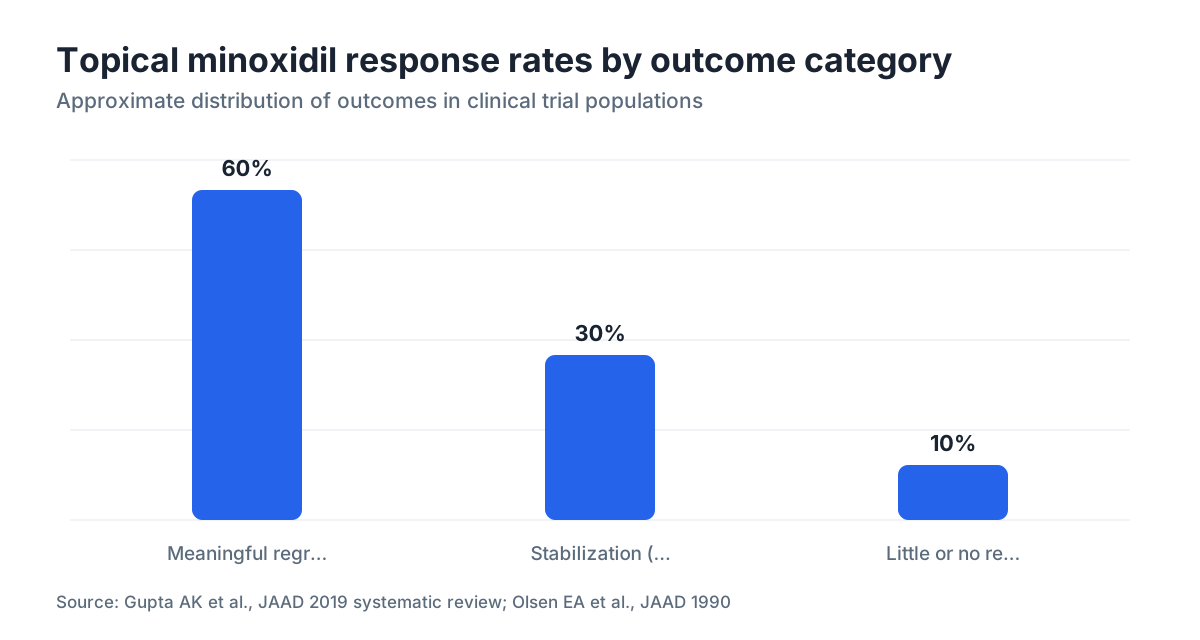
The numbers deserve honest framing. Across trials, roughly 60% of users see meaningful regrowth. About 30 to 40% hold steady but don't regrow much. A small slice sees little or nothing. The non-responders often have low levels of sulfotransferase, the enzyme that converts minoxidil into minoxidil sulfate in the scalp. Genetic tests for this enzyme exist, but they aren't standard care yet.
Where you're treating matters as much as whether you treat. The crown responds best in most studies. The frontal hairline and temples fight back harder. If you're dealing with a receding hairline specifically, read our guide to receding hairline, because minoxidil alone often isn't enough there.
See also our deeper look at does minoxidil work for a full breakdown of the trial data by hair loss pattern.
What are the differences between 2% and 5% minoxidil, and which should you use?
The 2% concentration was the original approval for women; the 5% came later and was first approved only for men. The FDA has since acknowledged that women can use 5% too, and many dermatologists recommend it. The labeling still reflects the older approval history more than current clinical thinking.
In head-to-head comparisons, 5% beats 2% on regrowth. The Olsen 1990 trial showed it clearly. If tolerability isn't a concern, 5% is the stronger choice for most adults.
The formulations differ in practice:
| Formulation | Minoxidil % | Propylene glycol | Application | Best for |
|---|---|---|---|---|
| Solution (liquid) | 2% or 5% | Yes | Dropper, twice daily | Diffuse thinning, easy to apply to parted hair |
| Foam | 5% | No | Fingers, once or twice daily | People with scalp sensitivity or fine hair that droops |
| Low-dose topical (compounded) | 0.5%-1% | Varies | Once daily | Off-label sensitivity or combination use |
Propylene glycol is worth knowing about. It helps absorption but causes redness and flaking in roughly 5 to 7% of users [2]. If you've tried the solution and had scalp irritation, switching to foam often fixes it.
Once-daily versus twice-daily: the FDA approval is based on twice-daily application, but some dermatologists have patients use 5% foam once daily with acceptable results. The evidence base for once-daily is thinner than for twice-daily, so if you want to follow the label, apply twice.
How do you apply topical minoxidil correctly?
Application sounds simple but is genuinely easy to get wrong, and doing it wrong cuts into your results.
For the solution, part your hair and apply 1 mL (the full dropper) directly to the dry scalp in the thinning area. Don't apply to wet hair. Wet hair dilutes the concentration and makes it harder for the solution to reach the scalp. Rub it in gently with your fingertips, wash your hands thoroughly, and wait at least 4 hours before washing your hair or going to bed. For the foam, dispense about half a capful, work it into your fingertips (it melts fast), then press it onto the scalp.
Timing matters for a few practical reasons. If you apply at night and go to bed too soon, you transfer the product to your pillow and away from your scalp. If you apply in the morning and wash your hair 20 minutes later, absorption is incomplete. Most dermatologists suggest a minimum 4-hour contact time between application and rinsing.
You don't need to shampoo before every application, but a clean scalp absorbs more effectively than one covered in buildup or other products. If you use styling products, apply minoxidil first on a bare scalp, let it dry fully (10 to 15 minutes), then style.
One thing many people miss: consistency beats perfect technique. Regularly missing doses, not the occasional miss, is what stalls results. Skipping one or two applications a week probably won't tank your progress. Treating it as optional several times a week will.
When will you see results from topical minoxidil?
Most people want to know one thing: how long do I have to wait? Give it 6 to 12 months before you judge it, and expect the timeline below.
In the first 2 to 8 weeks, many users notice increased shedding. This is the minoxidil shed, and it's real, not a myth. Minoxidil forces dormant or telogen-phase hairs to drop out so new anagen hairs can cycle in. It's temporary, but genuinely alarming if nobody warned you. Our article on hair loss telogen explains the growth cycle in detail.
At 4 to 6 months, early regrowth becomes visible to someone looking closely. The hairs are often fine and vellus-like at first. By 12 months, users who are going to respond have generally shown the clearest sign of it. The AAD says it may take up to 12 months of use before you can tell whether the treatment is working for you [5].
Peak results typically land around 12 to 18 months of consistent use. After that, the goal shifts from regrowth to maintenance.
A realistic expectation for a good responder: modest but noticeable density gain, mostly on the crown, with your ongoing loss slowed. The realistic expectation overall: it's more likely to slow and partly reverse thinning than to hand back the hair you had at 20.
What are the side effects of topical minoxidil?
Topical minoxidil has a good safety profile compared to systemic treatments, but it isn't side-effect-free.
The most common issues are local: scalp dryness, flaking, itching, and redness. These usually trace back to propylene glycol in the solution formulation. Switching to foam clears it up for most people.
Unwanted facial hair growth is a real concern, especially for women. The mechanism is contact transfer: product on your hands touches your face, or you rest your head on a pillow shortly after applying. Keeping application precise and letting it dry before it touches pillowcases cuts this way down.
Systemic absorption from topical minoxidil is low but not zero. In rare cases, people get dizziness, a fast heartbeat, swelling in the hands or feet, or chest pain. Those can signal systemic hypotension or cardiovascular effects. They're uncommon with topical use at standard doses, but stop the drug and see a doctor right away if they show up. People with pre-existing cardiovascular disease should talk to a cardiologist before starting [1].
We have a full breakdown at minoxidil side effects if you want the complete picture before starting.
One more thing worth saying plainly: if you stop minoxidil, you'll likely lose the hair you gained within 3 to 6 months. This isn't a permanent treatment. It's maintenance. That's a real cost-benefit calculation to make before you start.
How does topical minoxidil compare to oral minoxidil?
This is a genuinely useful question, because low-dose oral minoxidil has grown in clinical popularity over the last several years, helped along by a 2018 study from Sinclair showing regrowth in women with androgenetic alopecia at doses of 0.25 to 1 mg daily [8].
Oral minoxidil at low doses (0.5 to 5 mg, depending on sex and tolerance) sidesteps the sulfotransferase problem. Everyone absorbs it systemically, so the non-responder rate tied to scalp enzyme levels is lower. Some dermatologists now consider it more reliably effective than topical.
The tradeoffs are real. Oral minoxidil carries higher risk of systemic side effects: fluid retention, faster heart rate, and hypertrichosis (body and facial hair growth) are all more common orally than topically. Blood pressure monitoring is advised. It's also still off-label for hair loss in most countries, including the United States, so insurance rarely touches it.
Topical stays the easier first step for most people: OTC availability, lower systemic exposure, no prescription needed in most countries. If topical isn't working after 12 months of honest use, oral is a reasonable next conversation with a dermatologist.
See our full comparison at oral minoxidil.
Should you combine topical minoxidil with finasteride?
Combining minoxidil with finasteride is the most evidence-backed approach for men with androgenetic alopecia who want maximum medical treatment. The two drugs work through different pathways: finasteride reduces DHT (the hormone that miniaturizes follicles), while minoxidil directly stimulates follicle activity and blood flow. They add up rather than overlap.
A 2015 randomized controlled trial by Hu et al. published in Dermatologic Therapy found that combination therapy produced significantly greater improvement in hair density than either drug alone over 12 months [6].
For women, finasteride is generally not first-line because of teratogenicity risk (it can cause birth defects in male fetuses), though it's used off-label in post-menopausal women. Women typically use minoxidil alone or combined with other anti-androgens like spironolactone.
If you're a man dealing with significant hair loss and you're willing to take a daily oral pill, the combination is worth discussing with a dermatologist. It's more to manage, more to pay for, and finasteride has its own side effect profile. Our guide to finasteride and minoxidil walks through the evidence and what to expect.
For the broader medical and surgical landscape, check our overview of what causes hair loss and how treatments map to different causes.
How much does topical minoxidil cost, and is the generic the same as Rogaine?
The original brand-name topical minoxidil is Rogaine, sold by Johnson & Johnson. The patent expired long ago, and generic minoxidil has been widely available since the mid-2000s. The active ingredient is identical. Generics typically cost 50 to 70% less than Rogaine.
Typical retail prices in the US in 2024:
| Product | Monthly cost (approx.) |
|---|---|
| Generic 5% solution (3-month supply) | $10-$20/month |
| Generic 5% foam (2-month supply) | $15-$25/month |
| Rogaine 5% foam (2-month supply) | $30-$50/month |
| Compounded topical minoxidil | $30-$60/month |
Insurance generally does not cover minoxidil for hair loss. It's considered cosmetic. FSA and HSA funds can sometimes be used; check with your plan.
Compounded formulations (often from online platforms) mix minoxidil with other ingredients like tretinoin or finasteride, sometimes at lower per-ingredient costs. These aren't FDA-approved as combination products, and quality control varies by pharmacy. If you go this route, stick to compounding pharmacies that are PCAB-accredited.
Here's the bottom line on cost: if budget is a concern, generic 5% solution is essentially as effective as Rogaine at a fraction of the price. There's no clinical evidence that Rogaine outperforms generic minoxidil.
Who is a good candidate for topical minoxidil, and who isn't?
Topical minoxidil works best for androgenetic alopecia (male and female pattern hair loss). The AAD recommends it as a first-line treatment for this condition in both sexes [5].
Good candidates:
- Adults with early to moderate androgenetic alopecia, particularly at the crown
- People who still have miniaturized follicles (not fully scarred over)
- Those committed to long-term, consistent daily use
- Women with diffuse thinning across the top of the scalp
Poor candidates or people who need more nuance:
- Those with complete follicle loss (no peach fuzz or vellus hairs in the bald area), because there's nothing for minoxidil to work with
- People with untreated scalp conditions like seborrheic dermatitis or psoriasis, which interfere with absorption and tolerance
- People with cardiovascular disease who haven't talked to a cardiologist
- Pregnant women or women trying to conceive (the 5% label advises against use during pregnancy, though topical exposure is lower than oral)
If you're unsure whether your hair loss pattern is the kind minoxidil can help, get a scalp assessment before you commit months of use. MyHairline's free AI scan (/scan) can analyze your hairline and tell you which Norwood or Ludwig stage you're likely at, which helps frame whether topical treatment alone is a reasonable starting point.
Minoxidil is also not a replacement for hair transplant surgery in advanced cases. If you've already lost a large amount, transplants become the realistic path to visible density. Read about that at hair transplant and hair transplant expenses to understand what that path involves.
What happens if you stop using topical minoxidil?
Understand this before you start: minoxidil is not a cure. It works only while you use it.
Within 3 to 6 months of stopping, most users slide back to the hair loss trajectory they were on before treatment. The hairs that grew or thickened during treatment miniaturize and shed again. You don't keep the gains for free.
That creates a real commitment question. If you're in your 30s and start today, you're signing up for a treatment that could run for decades and costs money every month. Some people decide that's worth it. Others decide they'd rather weigh their options, including hair transplants, which permanently move follicles that aren't sensitive to DHT. Both are legitimate choices.
One practical note: if you plan to stop minoxidil because you're heading toward a hair transplant, talk the timing through with your surgeon. Some surgeons recommend staying on minoxidil to protect existing native hair even after a transplant.
Also check out minoxidil for men for a closer look at how this commitment question plays out for male pattern baldness across the Norwood scale.
Are there things you can combine with topical minoxidil to improve results?
A few add-ons have real evidence behind them. Others are popular and mostly noise.
Finasteride (for men) is the strongest addition, discussed above. The evidence for combination therapy is clear.
Microneedling (dermarolling) is genuinely interesting. A 2013 randomized trial by Dhurat et al. in the International Journal of Trichology found that men using a 1.5mm dermaroller with minoxidil saw significantly greater hair count increases at 12 weeks than those using minoxidil alone [7]. The proposed mechanism is that microneedling opens micro-channels that improve minoxidil penetration and also triggers wound-healing growth factors. It's a real finding from a real trial, though the sample was small.
Ketoconazole shampoo (1-2%) has some supporting data as an add-on, with a modest effect on hair counts in small trials. The anti-androgenic and anti-inflammatory properties may help, and it's low risk. It's an adjunct, not a replacement for minoxidil.
Nutrient deficiencies, particularly iron, ferritin, zinc, and vitamin D, can make hair loss worse and blunt any treatment response. Fixing a real deficiency helps. Taking supplements you don't need probably doesn't. Our overview at hair loss supplements covers what the evidence actually supports.
Lasers (low-level laser therapy, or LLLT) have FDA clearance for promoting hair growth and some supporting trials, but the evidence quality is lower than for minoxidil and the devices cost a lot. Probably not the first thing to spend money on.
What doesn't help: castor oil, rosemary oil as a monotherapy (one small trial exists; the effect size was tiny), and most supplement stacks marketed for hair. They're not harmful. They're not going to substitute for real treatment either.
Sources
- FDA, Rogaine (minoxidil) prescribing information and labeling history
- StatPearls (NCBI Bookshelf), Minoxidil
- Olsen EA et al., Journal of the American Academy of Dermatology, 1990
- Gupta AK et al., Journal of the American Academy of Dermatology, 2019 systematic review
- American Academy of Dermatology, Hair loss: diagnosis and treatment
- Hu R et al., Dermatologic Therapy, 2015
- Dhurat R et al., International Journal of Trichology, 2013
- Sinclair RD, International Journal of Dermatology, 2018 (low-dose oral minoxidil in women)