
TL;DR: A hair transplant in the US costs $4,000 to $15,000 or more. The price tracks your graft count, the technique (FUT or FUE), the surgeon's experience, and the clinic's city. Most patients need 1,500 to 3,500 grafts. Insurance won't touch it. Cheaper is rarely better here: the surgeon's skill predicts your result more than any other single factor.
What does a hair transplant cost in the US?
The honest range runs $4,000 on the low end to $15,000 or beyond for large sessions with experienced surgeons in expensive cities. Most men paying for a mid-range FUE procedure at a reputable US clinic land somewhere between $6,000 and $10,000. [1]
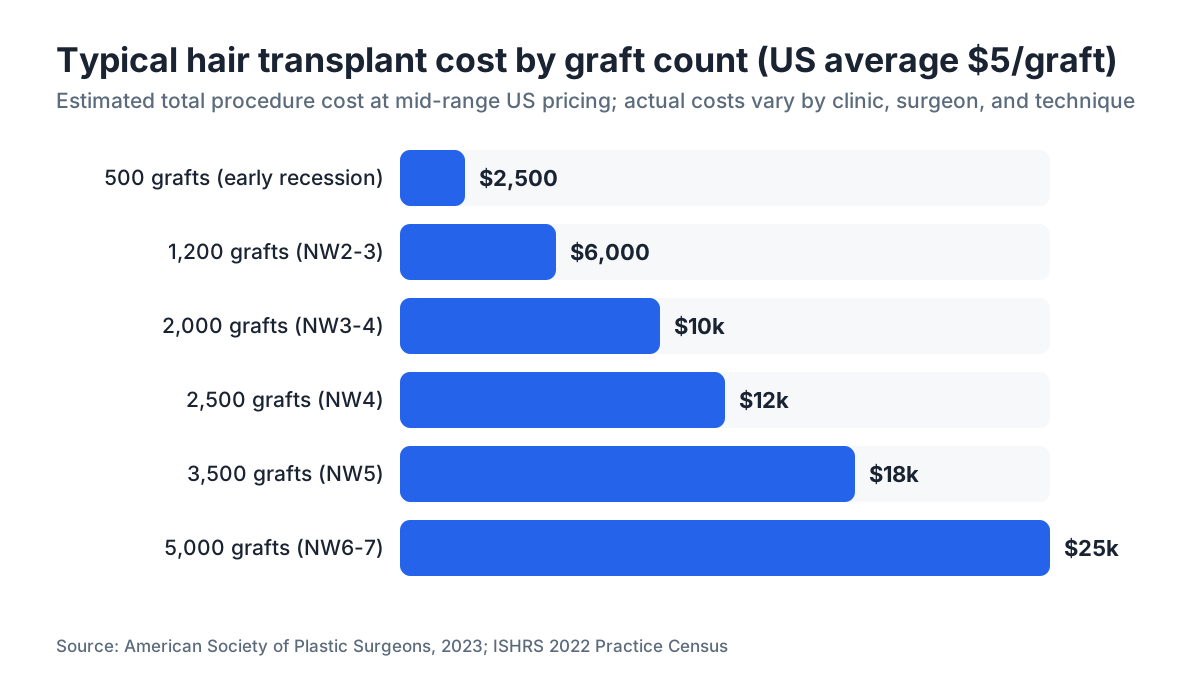
The number that actually matters is cost per graft. In the US that figure typically runs $3 to $10 per graft, with most established practices pricing between $4 and $7. [1] A session of 2,000 grafts at $5 per graft is $10,000. Simple math. Most clinic websites bury it anyway.
Prices swing hard by region. New York, Los Angeles, and Miami sit at the top of the range. Midwest and southern clinics often charge 20 to 30 percent less for comparable quality, though geography tells you nothing on its own about whether a given surgeon is any good.
Some clinics quote a flat fee rather than a per-graft rate. That can work in your favor on a large session, but ask what happens if the surgeon harvests fewer grafts than planned. Get the pricing structure in writing before you put down a deposit.
How does the technique (FUT vs FUE) affect the price?
FUE (Follicular Unit Extraction) costs more than FUT (Follicular Unit Transplantation) at almost every clinic that offers both. The gap is usually 20 to 40 percent. [1]
FUT means removing a strip of scalp from the donor area, dissecting it into individual grafts under microscopes, and closing the wound with sutures. It's faster for the surgical team, which is why it's cheaper. You get a linear scar at the back of your head, which matters if you ever want to wear your hair very short.
FUE extracts grafts one by one using a small punch tool (typically 0.8 to 1.0 mm). No linear scar, longer procedure time, higher per-graft cost because the surgeon and tech team spend more hours on each case. On a 2,500-graft session, the time difference can run several hours, and that labor cost lands on your bill.
Robotic FUE systems like ARTAS charge a premium on top of standard FUE rates, sometimes $1,000 to $3,000 more per session. The published evidence that robotic extraction beats skilled manual FUE is thin. I wouldn't pay extra for the robot unless you've confirmed the specific surgeon gets better results with it.
FUT still makes clinical sense for patients who need a very large number of grafts, because the strip method yields more usable grafts per session from the same donor area. If your surgeon recommends FUT, that's no red flag. Ask them to walk you through the reasoning.
What does cost per graft actually tell you?
Cost per graft is the most useful single number for comparing clinics, and it still hides a lot. Two clinics can both charge $6 per graft and hand you wildly different results, because graft quality and survival rate depend almost entirely on how the team handles the follicles between extraction and implantation.
Graft survival is the whole game. A follicle that dies in the dish before implantation is a graft you paid for and got nothing from. Technicians who keep grafts hydrated, at the right temperature, and out of the light for as little time as possible produce better survival. There's no universal published benchmark, but the dermatology literature suggests poor handling can cut survival by 20 to 30 percent compared to optimal protocols. [2]
Some clinics advertise unusually low per-graft prices by counting follicular units differently, or by counting grafts a more conservative practice would discard. Ask any clinic how they define and count a graft before you compare quotes.
The surgeon-to-patient ratio matters too. If the lead surgeon makes the incisions and supervises extraction but a large team of junior technicians places the grafts without much oversight, your result can suffer. Ask directly: who places the grafts, and how many procedures are running at once that day?
How many grafts do most people need, and what does that mean for total cost?
Graft count depends on how far your hair loss has gone, the density you want, and the quality and density of your donor area. Here's a rough guide based on Norwood scale staging: [3]
| Norwood Stage | Typical Graft Range | Estimated US Cost (at $5/graft) |
|---|---|---|
| NW2 (early recession) | 500 - 1,200 | $2,500 - $6,000 |
| NW3 (deeper recession) | 1,200 - 1,800 | $6,000 - $9,000 |
| NW4 (crown thinning added) | 1,800 - 2,500 | $9,000 - $12,500 |
| NW5 (significant loss) | 2,500 - 3,500 | $12,500 - $17,500 |
| NW6-7 (extensive loss) | 3,500 - 5,000+ | $17,500 - $25,000+ |
These are approximations. Your real need depends on your donor density and how conservatively your surgeon designs the hairline. A surgeon who's honest about what your donor area can safely supply is a good sign. One who quotes you a graft count far beyond what your donor area can realistically yield is not.
Many patients with NW5 or higher loss need more than one session, spaced 12 to 18 months apart so the first session grows in fully before anyone judges what's left to do. Budget accordingly. [4]
Not sure where you fall on the Norwood scale? A receding hairline guide helps you map your loss pattern before the consultation.
Does surgeon experience and reputation change the price that much?
Yes. A lot.
A board-certified dermatologist or plastic surgeon who does hair restoration and nothing else, with 10 or more years of focused experience, charges more than a general practitioner who bolted transplants onto a cosmetic menu. That premium is usually earned.
The American Board of Hair Restoration Surgery (ABHRS) offers a certification specifically for hair restoration physicians. Surgeons who hold it have passed written and oral examinations and met minimum case volume requirements. [5] It's not a guarantee of a great outcome, but it's a real bar. Check it.
Highly experienced surgeons at top practices in major cities sometimes charge $10 to $12 per graft. A junior surgeon at a high-volume chain might charge $3 to $4. The difference over a 10-year horizon can be enormous, and a bad transplant is expensive to correct or impossible to fully reverse.
Corrective work (fixing a poor hairline design, extracting misplaced grafts, hiding visible scarring) costs as much as the original surgery, often more. Saving $3,000 upfront on the cheaper surgeon is a bad trade if you spend $8,000 three years later trying to undo the result.
How do overseas hair transplant prices compare?
Turkey is the most common destination for hair transplant tourism, with all-in prices that regularly run $1,500 to $3,500, hotel and some post-op care included. [6] That's a real price difference. It also carries real tradeoffs.
The Turkish market is huge and uneven. Some Istanbul clinics have skilled surgeons producing results that compete with the best US work. Others run factory-style operations where the surgeon is rarely in the room and unlicensed technicians do most of the procedure. Patient harm reports, including uneven results, scalp infections, and donor area overharvesting, are documented in the medical literature. [7]
The UK's Care Quality Commission and similar bodies elsewhere have published warnings about the specific risks of traveling abroad for surgery, pointing to limited recourse if something goes wrong and complications that surface after you've flown home. [8]
Other popular destinations include the UK (typically $4,000 to $8,000), India ($1,000 to $3,000), and Thailand ($2,000 to $5,000). The quality range at each one is wide.
If you're seriously weighing overseas treatment, do this much at minimum: verify the lead surgeon's credentials yourself, request video of that surgeon actually performing procedures (not the clinic's polished reel), and confirm there's a plan for follow-up care if you develop complications back home. Flying abroad for elective surgery to save money is reasonable. Doing it without researching the specific surgeon is not.
For the medical side of what you're signing up for, the hair transplant overview explains the procedure in full.
Does insurance cover hair transplant costs?
Almost never. US health insurers classify hair transplants as cosmetic and exclude them from coverage in the overwhelming majority of plans. There are narrow exceptions: some insurers cover hair restoration for patients who lost hair to burns, chemotherapy, or certain medical conditions, and a few alopecia areata cases have won on appeal. For androgenetic alopecia (typical male or female pattern loss), assume you're paying out of pocket. [9]
HSA (Health Savings Account) and FSA (Flexible Spending Account) funds can't cover cosmetic procedures under IRS rules. The IRS defines eligible medical expenses as those for "diagnosis, cure, mitigation, treatment, or prevention of disease," and a standard hair transplant doesn't clear that line. [10]
Financing is everywhere in this space. Many clinics partner with medical lenders like CareCredit or Prosper Healthcare Lending. Rates range from 0% promotional periods (typically 12 to 24 months if you pay in full before the window closes) to 20%+ APR after that. Read the terms. A $9,000 procedure financed at 26% APR over 48 months costs far more than the sticker price, and the clinic won't volunteer that math.
What hidden fees should you watch for in a hair transplant quote?
Get an itemized quote before you sign anything. Fees that sometimes show up separately:
Anesthesia or sedation. Most hair transplants use local anesthesia, usually included. If IV sedation or general anesthesia is on the table, that can add $500 to $1,500 or more.
Pre-operative lab work. Some clinics require blood panels before surgery. Costs vary depending on what's ordered and whether your primary care physician can run them through your health insurance instead.
Post-operative medications. You may be prescribed minoxidil, a short course of finasteride, antibiotics, or anti-inflammatory drugs. Ask what you'll need and what it costs. Some are covered by insurance; others aren't.
PRP (Platelet-Rich Plasma) add-ons. Clinics push PRP injections at the time of surgery, claiming better graft survival. The evidence for that claim is mixed and not settled. [11] PRP sessions typically cost $500 to $1,500 extra. I'd treat it as optional until the data firms up.
Follow-up visits. Confirm whether your quoted price includes post-op appointments. If complications come up, are there extra charges?
Touch-up sessions. Some clinics offer a free or discounted touch-up within 12 months if density lands below target. Get it in writing if it's offered out loud.
Is a cheaper hair transplant ever worth it?
Sometimes. Not often.
There are genuinely skilled surgeons who charge less because they're building a reputation, working in a lower cost-of-living area, or simply pricing below what their skill could command. They exist. Finding them takes work: study before-and-after photos with patient consent and case histories, read verified patient reviews on platforms like RealSelf that run some verification, and sit through consultations with more than one surgeon.
What's almost never worth it: the aggressively cheap, high-volume clinics running multiple simultaneous procedures and competing mostly on price. This is a procedure where the surgeon's time, attention, and technical skill turn directly into your result. Volume models that protect margin by cutting time per patient tend to produce worse outcomes.
If you want to trim cost by trying non-surgical options first, understand the evidence for finasteride and minoxidil for men. Both cost a fraction of surgery and can slow or stop loss before a transplant becomes necessary. Some patients who start medical treatment early enough don't need a transplant for years, if ever.
You can also run a free AI-powered hair analysis at MyHairline (/scan) to map your current loss pattern before deciding whether surgery belongs in the conversation yet.
How should you evaluate a hair transplant clinic before paying?
A few things I'd actually check before handing over a deposit.
Surgeon credentials. Is the lead surgeon certified by the ABHRS, or a board-certified dermatologist or plastic surgeon with documented hair restoration specialization? [5] Look them up independently, more than on the clinic's own site.
Before and after photos. Any reputable clinic keeps a deep photo library. Look for cases like your pattern, shot at consistent lighting and angles. Be wary of a clinic showing only its greatest hits.
Consultation quality. A good surgeon spends real time on your donor density, on realistic expectations, and on the hairline design rationale. A consultation that feels like a sales pitch is a bad sign.
Graft handling protocols. Ask how long grafts stay out of the body on average and what storage solution the clinic uses. ATP-containing and hypothermic solutions (like HypoThermosol, or Ringer's lactate with supplements) are tied to better graft survival in the literature. [2]
Transparency about risks. The published complication rate is low with experienced surgeons, but risks include infection, numbness or sensation changes, shock loss (temporary shedding of existing hair), and poor growth. [4] A surgeon who mentions no downsides is not reassuring.
If you're managing active loss with medication, understand how your current regimen fits surgical planning. The finasteride and minoxidil combination is often used to stabilize loss before and after surgery.
How long does it take to see results after paying for a transplant?
The transplanted grafts drop into a resting phase (telogen) almost right after surgery and shed within 2 to 6 weeks. That's normal and expected. New growth starts around 3 to 4 months. [4]
Visible density usually shows up between months 6 and 9. Final results, the point where you can honestly judge whether the procedure hit your goals, generally aren't there until 12 to 18 months post-surgery. [4]
This timeline shapes your finances. If you're unhappy with density at month 8, resist the urge to book a second session right away. Plenty of patients who looked sparse at 8 months were happy at 14, once the slower grafts caught up.
Shock loss, where existing native hair in and around the transplanted zone sheds temporarily from surgical trauma, can rattle you. It's usually temporary, but how much sheds and how fully it returns varies. Surgeons operating on areas with a lot of existing native hair carry a higher risk of triggering it, which is one more reason conservative planning matters.
If shock loss or diffuse thinning is part of your picture, the telogen effluvium article explains the shedding cycle in detail and helps make sense of what happens post-op.
What are the total lifetime costs of hair restoration to factor in?
A hair transplant isn't a one-time cost if your underlying loss is still moving. Androgenetic alopecia (the hormonal, genetic type) keeps going after surgery. Transplanted grafts resist DHT and are generally permanent, but your native surrounding hair keeps thinning. [4] Patients who don't stabilize ongoing loss with medication often end up needing a second or third procedure down the line.
A realistic lifetime hair restoration budget for a man with moderate to extensive loss might look like this.
Initial procedure: $7,000 to $12,000. Finasteride (generic, if tolerated): roughly $200 to $600 per year. Minoxidil: $100 to $300 per year for topical. A second procedure in 5 to 10 years: $5,000 to $10,000 if loss has advanced. PRP maintenance (optional, evidence limited): $500 to $1,500 per session, several sessions a year.
Over 20 years, a full maintenance program can easily total $30,000 to $50,000. That's not a reason to skip it. It is a reason to go in clear-eyed instead of treating the first transplant as the end of the story.
Knowing what's driving your loss in the first place, whether it's DHT-driven androgenetic alopecia, a nutritional deficiency, or something systemic, changes the math. The what causes hair loss article is a good place to start before you commit to a plan.
MyHairline's free AI scan (/scan) helps you track whether your loss pattern is moving between consultations, which matters a lot for timing surgery.
Sources
- American Society of Plastic Surgeons, 2023 Plastic Surgery Statistics Report
- International Society of Hair Restoration Surgery, ISHRS
- Norwood KT, Male Pattern Baldness: Classification and Incidence, Southern Medical Journal, 1975
- American Academy of Dermatology, Hair Loss: Diagnosis and Treatment
- American Board of Hair Restoration Surgery, ABHRS Certification
- International Society of Hair Restoration Surgery, 2022 Practice Census Survey
- BMJ Case Reports, Complications of hair transplant tourism, 2019
- UK Care Quality Commission, Risks of cosmetic procedures abroad
- US Department of Labor, Employee Benefits Security Administration, FAQs on health coverage
- IRS Publication 502, Medical and Dental Expenses
- Dermatologic Surgery, PRP for hair loss: systematic review, 2019
- FDA, Approved treatments for androgenetic alopecia