

TL;DR: Worrying about hair loss is common and normal. But when the worry turns obsessive, eats hours of your day, or drives repeated mirror-checking and social avoidance, it may be body dysmorphic disorder (BDD). BDD affects roughly 2% of people and responds well to CBT and, in some cases, medication. This article explains the difference, what the evidence says, and what to do.
Why does hair loss cause so much anxiety?
Hair is tied to identity, energy, and attractiveness in nearly every culture anthropologists have documented. Losing it, especially fast or young, can feel like losing part of yourself. That reaction is not weakness. It is a normal human response to a visible, involuntary change.
The anxiety is partly biological too. Hair loss in androgenetic alopecia is driven by dihydrotestosterone (DHT) acting on genetically sensitive follicles, but the psychological fallout runs through the same threat-detection pathways that respond to any perceived loss of social status [1]. Research in the Journal of the American Academy of Dermatology found that hair loss patients report significantly lower self-esteem and higher rates of anxiety and depression than matched controls [2].
So no, you are not being vain. The distress is real, and it deserves real attention.
What is the difference between normal hair loss worry and body dysmorphic disorder?
Normal hair loss anxiety looks like this: you notice your hairline or density has changed, you feel upset, you research options, and you eventually make a decision or accept the situation. The worry ebbs and flows. It does not take over your life.
Body dysmorphic disorder (BDD) is different in degree and in kind. The DSM-5 defines BDD as a preoccupation with one or more perceived defects in physical appearance that are not observable or appear slight to others, paired with repetitive behaviors (mirror-checking, grooming, skin picking, reassurance-seeking) or mental acts in response, causing significant distress or functional impairment [3].
For hair specifically, BDD can look like spending two or more hours a day examining your hairline in different lighting, photographing it obsessively, asking partners or friends over and over whether it looks thinner, or skipping social events because you fear others will notice. Here is the clinical line: in ordinary hair loss anxiety, the concern roughly matches the actual loss. In BDD, the distress is out of proportion, and reassurance buys only minutes of relief before the obsession returns.
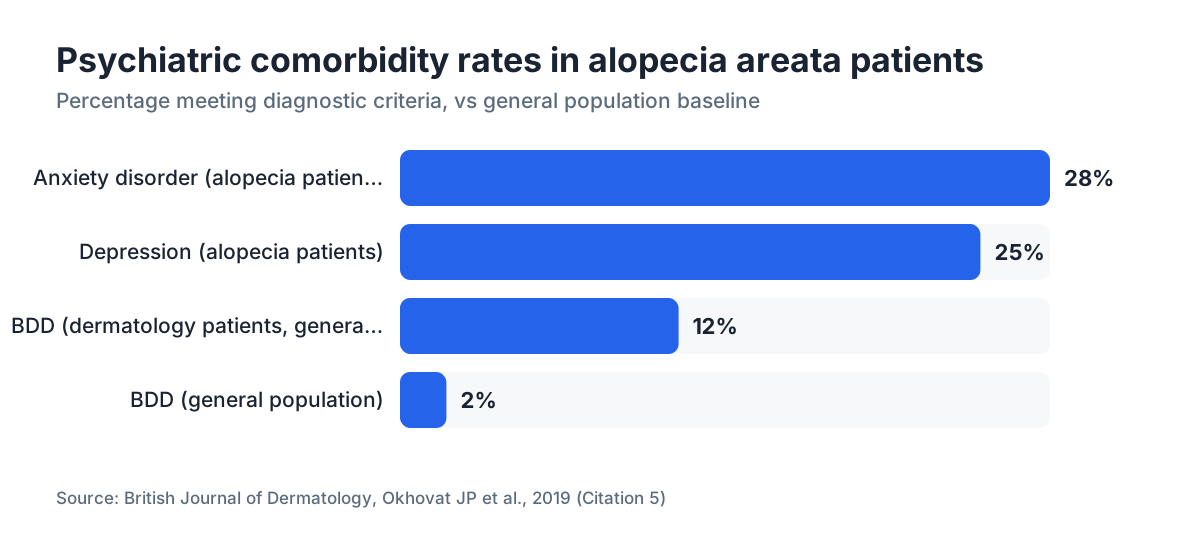
BDD affects an estimated 1.7 to 2.9% of the general population, with some surveys placing the rate far higher in dermatology and cosmetic surgery practices (up to 9 to 15%) [4]. It is not rare, and it is genuinely treatable.
How do I know if what I'm experiencing is BDD or just normal worry?
A reasonable self-check starts with time and function. Ask yourself: how many hours a day do I spend thinking about, examining, or camouflaging my hair? If the answer is more than one hour on most days, that is a clinical signal worth taking seriously [3].
Second, ask about reassurance. Does hearing "you look fine" from someone you trust make you feel better for the rest of the day, or does the relief last only a few minutes before the doubt creeps back? Short-lived reassurance is a hallmark of BDD, not of typical anxiety.
Third, ask about avoidance. Have you cancelled plans, skipped job interviews, dodged photographs, or reshaped your daily routine to hide your hair? Functional avoidance that goes beyond picking a particular hairstyle is a yellow flag.
The BDD Foundation offers a validated screening tool called the BDD Questionnaire (BDDQ), which is publicly available and takes about five minutes [4]. It is not a diagnosis, but it gives you a number to bring to a clinician.
If you score in the probable BDD range, the next step is a mental health clinician with experience in OCD-spectrum disorders. Dermatologists can confirm whether actual hair loss exists, but they are not trained to treat BDD itself.
What does the research say about hair loss and mental health outcomes?
The evidence here is better than most people realize.
A 2019 cross-sectional study in the British Journal of Dermatology surveyed 1,000 adults with alopecia areata and found that 28% met criteria for an anxiety disorder and 25% for depression [5]. Androgenetic alopecia (common male and female pattern loss) shows similar associations, though the effect sizes run somewhat smaller, likely because the onset is gradual rather than sudden.
Telogen effluvium, the diffuse shedding triggered by stress, illness, or major life events, adds a cruel feedback loop: emotional stress causes shedding, the shedding causes more stress, and that can prolong the shedding [6]. Understanding the loop is itself useful, because telogen effluvium is almost always reversible once the trigger resolves.
For BDD specifically, a major meta-analysis in Clinical Psychology Review found that cognitive behavioral therapy (CBT) produced large effect sizes (Cohen's d around 1.4 to 2.0) in reducing BDD symptom severity, making it the best-supported psychological treatment available [7]. That is a bigger effect than most psychiatric medications produce on their own.
The read from the literature: hair loss distress sits on a spectrum, most people with mild to moderate worry benefit from good information and practical action, and those at the severe end respond to CBT and, when appropriate, serotonin reuptake inhibitors (SRIs).
What are effective coping strategies for hair loss anxiety?
Start with information. A lot of hair loss anxiety runs on uncertainty: is this normal shedding or real loss? Is it getting worse? Knowing what you are actually dealing with shrinks the unknown. A dermatologist can run a pull test, a dermoscopy exam, or blood work to find the cause. What causes hair loss is a good primer on the main categories before you see a doctor.
Second, take one evidence-based action if the loss is real and you want to treat it. Minoxidil and finasteride have the strongest clinical evidence for androgenetic alopecia [1]. Doing something cuts the helpless feeling that feeds anxiety. If you decide not to treat, that is a valid choice too, and making it on purpose helps.
Third, set a single daily mirror limit. This sounds trivial. It is clinically meaningful. Excessive mirror-checking keeps preoccupation running and makes it worse. Exposure and response prevention (ERP), the core technique in CBT for BDD, asks you to gradually cut checking behaviors. Picking one fixed time a day to check, and refusing to check outside that window, is a version of ERP you can start on your own.
Fourth, test your beliefs against reality. BDD runs on predictions ("everyone will notice," "I will be rejected"). Write the prediction down, go do the thing you are avoiding, and record what actually happened. Most predictions are wrong. The gap between prediction and outcome is how exposure therapy works.
Fifth, be careful with forums and social media. Hair loss communities online carry useful information, but they can normalize hours of daily focus on hairlines, feed comparative anxiety, and spread unproven treatments. Treat them like any other exposure: useful in small doses, harmful in excess.
When should I see a doctor or therapist, and which kind?
See a dermatologist first if you have not confirmed what is actually happening to your hair. Anxiety about imagined loss and anxiety about real, progressive loss call for different responses. A dermatologist gives you a ground-truth picture of your scalp and follicle health.
See a mental health clinician if your daily preoccupation runs past one hour, your function is impaired (work, relationships, social life), reassurance does not help, or you are avoiding life because of how your hair looks. The right specialist is a psychologist, psychiatrist, or licensed therapist trained in CBT for OCD-spectrum disorders. Ask directly: "Do you have experience treating body dysmorphic disorder?" If they hesitate or say they treat "low self-esteem," keep looking.
The International OCD Foundation maintains a therapist directory searchable by specialty, including BDD [7]. The IOCDF is a good place to start.
A psychiatrist becomes relevant when BDD symptoms are severe enough to warrant medication. SRIs, particularly fluoxetine and clomipramine, have recognized efficacy for OCD-spectrum conditions and are used off-label for BDD at doses generally higher than those used for depression (typically 60 to 80 mg/day of fluoxetine) [8]. Medication alone is rarely as effective as CBT alone, and the combination usually beats either one.
Do not expect a hair transplant or a hair loss drug to fix BDD. Multiple studies document that cosmetic procedures in BDD patients often fail to provide lasting relief, and some patients report worse symptoms after surgery because the focus shifts to a new perceived flaw [4]. If you score high on the BDDQ, sort out the mental health piece before spending money on procedures.
Does treating hair loss actually reduce anxiety?
For people with genuine hair loss and proportionate anxiety: yes, treating the underlying loss often cuts distress meaningfully. A 2019 randomized controlled trial in JAMA Dermatology found that patients receiving effective treatment for alopecia areata reported significant improvements in quality of life and anxiety scores compared with placebo [5].
For androgenetic alopecia, the data are less controlled, but self-reported satisfaction studies consistently show that men and women who gain density from minoxidil for men or finasteride report improved confidence and less hair-related worry. That is worth knowing. Taking evidence-based action matters both medically and psychologically.
For BDD, the answer is different. Treating the hair will not treat the disorder. A person with BDD who gets a hair transplant typically either fixates on imperfections in the graft placement or shifts focus to a different perceived flaw entirely. The research on this is consistent enough that the International Society of Hair Restoration Surgery recommends psychological screening before surgery for patients showing signs of a body image disorder [9].
If you are unsure which camp you are in, try this test: when you have had a good few days, does your hair anxiety mostly disappear? If yes, your distress is probably tied to the actual hair situation, and treatment may help. If your anxiety stays roughly constant no matter what is happening around you, BDD is more likely.
How does CBT actually work for hair loss BDD?
Cognitive behavioral therapy for BDD has two main parts: cognitive restructuring and exposure with response prevention.
Cognitive restructuring targets the thoughts themselves. In BDD, those thoughts tend to overestimate how noticeable a feature is, how badly others will react, and how catastrophic that reaction would be. A therapist helps you weigh the evidence for and against these beliefs. Not to talk you into fake positivity, but to find the more accurate middle ground.
Exposure with response prevention (ERP) is the harder part, and it is the part that actually moves the needle. You build a list of avoided situations, ranked from least to most anxiety-provoking. Then you start doing the least scary ones on purpose, without the usual safety behaviors (checking your hair, wearing a hat, adjusting the lighting, asking for reassurance). You sit with the discomfort until it drops on its own, which it does, every time, if you stay in the situation long enough without the escape hatch. Over weeks of practice, the brain stops treating your hairline as a threat signal.
A standard course of CBT for BDD runs 12 to 22 sessions [7]. Many therapists now offer telehealth, which removes the barrier of appearance anxiety about leaving home.
One caveat matters: CBT for BDD needs a trained practitioner. Generic talk therapy, supportive counseling, or insight-oriented therapy alone does not carry the same evidence base. The specific techniques do the work.
Are there things that make hair loss anxiety worse?
A handful of common patterns reliably keep hair-related anxiety running or make it worse. Recognizing them helps.
Reassurance-seeking. Asking a partner or friend "does my hair look okay?" buys a moment of relief but reinforces the idea that your hair needs constant monitoring. It also slowly wears out the people you lean on.
Comparisons. Measuring your hairline against old photos or against other men's hairlines keeps your brain locked on deficit. The comparison is never reassuring for long.
Overgrooming rituals. Spending 30 minutes arranging hair to cover thinning areas is understandable, but it tells your brain the situation is genuinely dangerous and needs managing. It grows anxiety over time instead of shrinking it.
Self-diagnosis spirals. Reading about receding hairlines or Norwood stages at 2 a.m. is genuinely useful for about 20 minutes. After that, the returns collapse and the anxiety compounds. Set a research time limit.
Chasing treatments with no real evidence. Buying six different hair loss supplements or trying every DIY remedy keeps the focus glued to the problem without the payoff of an evidence-based plan. Anxiety thrives in that gap between effort and result.
If you recognize more than two of these in your own behavior, that is useful data. It means your current coping strategies are feeding the problem, not fixing it, and a different approach is worth trying.
What if my hair loss is real and severe, but I'm also struggling mentally?
Both things can be true at once. You can have genuine, significant hair loss and also a psychological response that is out of proportion or that needs clinical support. These are not mutually exclusive.
The practical answer is to run both tracks at the same time. Work with a dermatologist on the medical side. If you have androgenetic alopecia, finasteride and minoxidil together have the strongest combined evidence and can slow or partially reverse loss in many patients. A hair transplant consultation is reasonable for stable loss if you are a good candidate with realistic expectations. None of that clashes with also working with a therapist on the psychological side.
Starting psychological support before and during a medical or surgical treatment often improves outcomes. You go in with clearer expectations, you handle the waiting period (minoxidil takes 3 to 6 months to show results) more calmly, and you are less likely to catastrophize the normal variation in results.
Myhairline.ai's free AI scan can help you understand what stage of hair loss you are likely dealing with before you spend on treatments, which cuts the uncertainty that fuels anxiety. That said, an AI tool is a starting point. A dermatologist confirms it.
One thing worth saying plainly: acceptance is a valid outcome. Not everyone chooses to treat hair loss, and for some people, working through the grief of losing hair and arriving at genuine acceptance is a more sustainable path than years of treatment maintenance. Therapists with experience in chronic illness adjustment can help with this specifically.
What is the connection between hair loss anxiety and perfectionism or OCD?
BDD sits within the OCD-spectrum disorders in the DSM-5, and for good reason. The mechanism is similar: an intrusive thought triggers anxiety, the person performs a ritual (checking, reassurance-seeking, grooming) to knock the anxiety down for a moment, which reinforces the idea that the threat is real and the ritual is necessary, which makes the next intrusive thought stronger [3].
People with pre-existing OCD, perfectionism, or high harm avoidance face a higher risk for BDD. The same cognitive style that generates "did I lock the door?" can generate "is my hairline noticeably worse than last week?" with the same persistence.
This connection matters for treatment. If you already have OCD or have been told you have OCD tendencies, mention it to any clinician treating your hair-related anxiety. The treatments overlap heavily (ERP is the core of both), but knowing the history helps calibrate the approach.
Perfectionism is worth examining too. Some of the most intense hair loss distress shows up in people whose identity leans heavily on their physical appearance, because of their profession, their upbringing, or a personality style that sets very high standards for self-presentation. Unpacking that is legitimate therapeutic work, separate from the hair itself.
How long does it take to feel better, and what does recovery look like?
For ordinary hair loss anxiety tied to real loss, relief often comes within weeks of getting a clear diagnosis and a plan. Uncertainty is the main driver, and information resolves uncertainty.
For BDD, recovery moves slower. Most clinical trials of CBT for BDD run 12 to 22 weeks, with meaningful symptom reduction by around week 8 in responders [7]. Response does not mean symptom-free; it means the preoccupation no longer dominates daily life and functional impairment drops substantially. Many people keep having some hair-related thoughts but find they no longer feel forced to act on them.
Relapse is common with BDD, especially during high-stress periods or life transitions. That is normal and not a sign that treatment failed. Therapists usually build a maintenance plan into the end of a course, which gives you the skills to handle future flares.
For medication responders, SRIs typically take 6 to 12 weeks to show meaningful BDD symptom reduction, longer than their antidepressant effect, and often at higher doses [8]. Patience matters here.
The most honest summary: most people who get appropriate help feel meaningfully better within three to six months. "Better" here means spending less than 30 minutes a day on hair-related thoughts, resuming avoided activities, and no longer needing constant reassurance. That is a realistic goal.
Sources
- American Academy of Dermatology, Hair Loss Overview
- Journal of the American Academy of Dermatology, Hunt N et al., psychological impact of alopecia
- American Psychiatric Association, DSM-5 Diagnostic Criteria for Body Dysmorphic Disorder
- BDD Foundation, BDD Questionnaire and prevalence data
- British Journal of Dermatology, Okhovat JP et al., alopecia areata comorbidity, 2019
- American Academy of Dermatology, Telogen Effluvium
- International OCD Foundation, BDD treatment resources and therapist directory
- U.S. Food and Drug Administration, Prozac (fluoxetine) prescribing information
- International Society of Hair Restoration Surgery, patient selection guidelines
- National Institute of Mental Health, Obsessive-Compulsive and related disorders
- JAMA Dermatology, alopecia areata treatment and quality of life, 2019